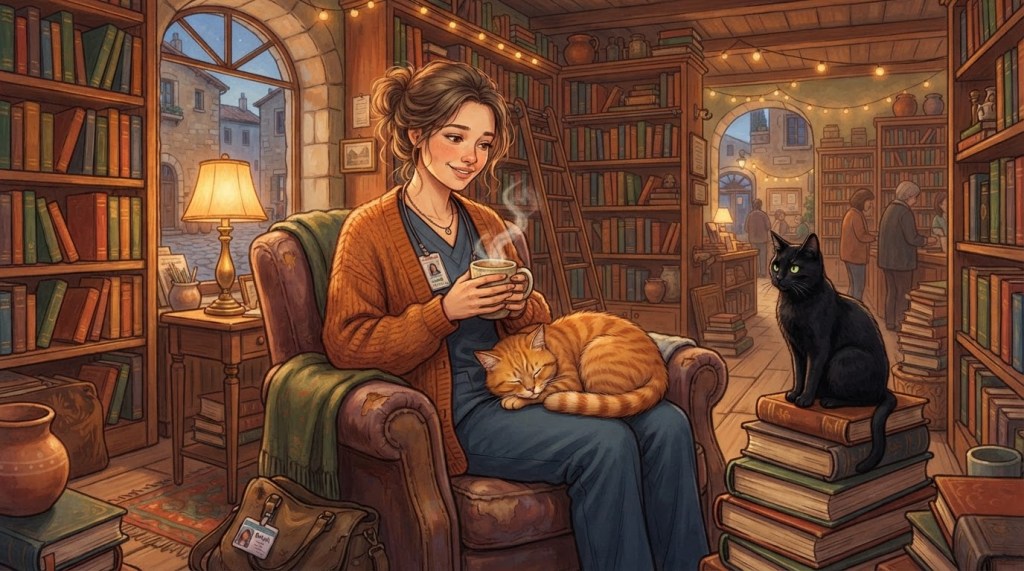
Calm for Carers · Story 11. For everyone who spends their days holding other people together.
On the last Monday of November, the light over Speranza went early. By four in the afternoon the lamps along Via dell’Orologio were already glowing, and the old clock in the square, which had not told the right time since before anyone could remember, struck a confident five. Nobody minded. In Speranza, time was more of a suggestion than a rule.
Federica Sanna had been standing outside the bookshop for nearly twenty minutes.
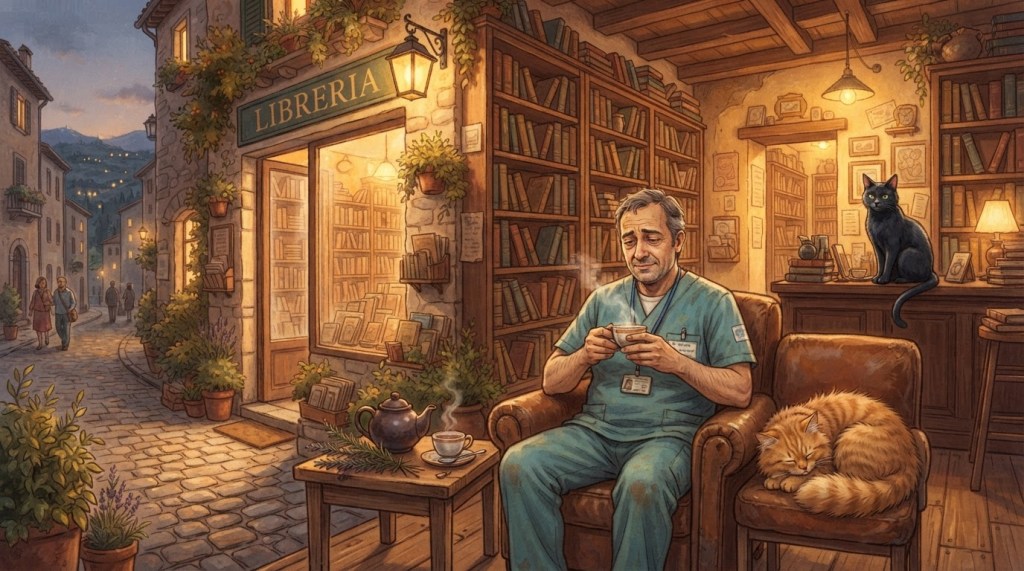
She was not window shopping, although the window was lovely: a heap of paperbacks, a string of tiny lights, a hand-painted sign that said La Pagina che Fa le Fusa, and, curled in the middle of the display like a loaf of warm bread, an enormous ginger cat who appeared to be sleeping with great seriousness. Federica had walked past that window four times since September without going in. Today she had walked past it twice already, turned around at the fountain, and come back a third time.
In her handbag, folded very small, was a letter from the hospital. It said she was expected back on the surgical ward on Monday the seventh of December, on a phased schedule agreed with occupational health. It was a kind letter. It used the phrase “we look forward to welcoming you back”. She had read it so many times that the creases had gone soft as cloth.
Six months earlier she had stopped. Not dramatically. There had been no scene in the corridor, no slammed door. She had simply stood in the medication room one grey morning, holding a tray she had prepared a thousand times, and found that she could not remember what came next. Her hands had known. Her head had gone quiet and far away, like a radio between stations. Tonino Pietranera, the charge nurse who had trained her, had taken the tray from her gently, sat her down on a plastic chair, and said, “Federica. Go home. I mean it.” Her doctor had said the rest.
Now it was nearly December, and she was supposed to be better, and she did not feel better. She felt like someone about to walk back into a house after a fire, unsure whether the walls would hold.
A small black cat appeared on the pavement beside her. She had not heard him approach. He was sleek as a drop of ink, with eyes the green of new leaves, and he looked at her with the calm of someone who has found exactly what he was looking for. He sat down on her shoe.
“Oh,” said Federica. “Hello.”
The cat stood, walked three steps to the bookshop door, and looked back over his shoulder. The door opened from the inside, a bell jingled, and a woman with silver-streaked hair and a cardigan the colour of autumn leaves leaned out.
“I see Toe has found you,” said Moira Hopes. “He does that. He finds lost keys, lost spectacles, and, now and then, lost people. Come in, you’re letting the cold stay outside, which is the wrong way round.”
The Shop at the Bottom of the Street
Inside, the bookshop smelled of paper, wood polish and something green and sharp that Federica could not name. A stove ticked in the corner. Every available surface held books, and every book seemed to have been placed with affection rather than system. Two armchairs sat close to the stove with a low table between them, and on the nearest chair the ginger cat from the window had somehow already relocated, as if he had been there all along.
“That is Ashwaganda,” said Moira. “Fifteen pounds of opinion. He will not mind if you sit on his chair, but he will make you aware that he is minding.”
Federica laughed, and was surprised by the sound. It came out rusty, like a gate that had not been opened in a long while.
She sat in the second chair. Toe leapt up onto the arm and settled there, tail wrapped round his paws, watching her with those green eyes. Ashwaganda opened one amber eye, assessed her, and began to purr, a deep, rolling, engine-room sound that seemed to come up through the floorboards.
“I am not here to buy anything,” Federica said, and then felt foolish. “I mean, I would like to. I just did not know I was coming in until I was in.”
“Then you are exactly the right sort of customer,” said Moira, and went to the shelf behind the counter, where a row of glass jars held dried leaves and flowers. She took down two, measured something into a pot with a small wooden spoon, and set a kettle on the stove. “I think you need a cup of tea more than a book. The book can come second.”
“What kind of tea?”
“Peppermint and a little dried orange peel. It is a bright, clean sort of tea. Not magic, mind you. I am a bookseller, not a clinician, and I would never tell you a leaf can mend what a person needs real help to mend. But it is warm, it smells like a morning, and it gives your hands something to hold while your mouth decides what it wants to say.”
The kettle began to sing. Federica looked at her hands. They were folded tightly in her lap, the knuckles pale.
“I go back on Monday,” she said.
Moira did not say “How wonderful.” She did not say “You must be so relieved.” She poured the water over the leaves, and the smell of mint rose in a cool green cloud, and she said simply, “Ah. Monday. And how does Monday feel?”
What Federica Had Not Told Anyone
It took the whole first cup. Moira let it take that long. She sat with her own tea, and she let the stove tick and the cats breathe, and she asked nothing else.
What came out, in the end, was this. Federica had been a nurse for eleven years. She had loved it, truly, for most of them. She had loved the strange intimacy of it, the three-in-the-morning conversations with frightened people, the small victories of a first walk after surgery, the private jokes that only a ward can produce. But over the last two years the ward had changed. Two colleagues had left and not been replaced. The shifts had become longer and the breaks had become theoretical. She had started to arrive early to catch up, and leave late to finish, and take her phone home in case someone called. She had stopped reading. She had stopped seeing her sister Marisa on Sundays. Somewhere in there she had stopped feeling much about the patients at all, and that, more than the tiredness, had frightened her. She had once cried over a stranger’s fall. Now she looked at a man in pain and felt a kind of grey nothing, and then felt ashamed of the grey nothing.
“And now,” she said, “everyone is being so kind. Tonino sends me a message every Friday, just a photo of the ward plant. Marisa says I must not rush. My doctor says I am recovering well. And I keep thinking, what if I go back and it happens again? What if I am the kind of person who breaks? What if everyone is watching me to see whether I will?”
Ashwaganda’s purr deepened a little, as if he had been listening.
Moira refilled the cups. “May I tell you one or two things I have read? I want to be careful with it. I am only a person who reads a great deal, and I would not want you to take a bookseller’s word over your own doctor’s. But some of it comforted me when someone I love went through something like this, and it might be useful.”
“Please.”
The Word for What Happened
“In 2019,” said Moira, “the World Health Organization updated how it describes burn-out in its International Classification of Diseases. It calls it an occupational phenomenon. It is not filed as a medical condition in itself, and I would not want to overstate that, because a person who is suffering may well need a doctor, and many do. But the description is worth knowing. It says burn-out is a syndrome that comes from chronic workplace stress that has not been successfully managed. And it names three parts: feelings of energy depletion or exhaustion; more mental distance from one’s job, or feelings of negativity or cynicism about it; and a reduced sense of being effective at work.”
Federica sat very still. “The grey nothing,” she said slowly. “That is the second one. The distance.”
“It may be,” said Moira. “Only you and your doctor can say what it was in your case. But notice the words. Chronic stress at work, not successfully managed. It does not say weak person. It does not say bad nurse. It describes what happens to people when a situation goes on too long without enough support, and the part of you that went quiet was not a character flaw. It may have been a kind of circuit breaker.”
Federica pressed her lips together. Her eyes were bright. Toe, without any fuss, stepped from the chair arm into her lap and lay down, a warm black weight, and began a quiet, uneven purr.
“There is a second thing,” said Moira. “Two researchers, Christina Maslach and Michael Leiter, spent many years studying burnout, and in a paper from around the year 2000 they described six areas of working life where a mismatch between a person and their job tends to appear: workload, control, reward, community, fairness, and values. Too much to do and too little say in how. Too little recognition. Too little connection with colleagues. Unfair treatment. Or a gap between what you believe in and what the job actually asks of you.”
“That is my ward,” whispered Federica. “That is all six.”
“I won’t say it is all six, because I have never seen your ward, and the research is a framework rather than a diagnosis. But here is why I find it hopeful. It puts a great deal of the question in the workplace, not only inside the person. It suggests that coming back well is not just about you becoming tougher. It is also about what you come back to, and which of those six areas you can ask to have adjusted. That is a different conversation from ‘what is wrong with me’.”
Federica was quiet for a long time. The stove ticked. Ashwaganda rolled over with a groan and presented his belly to nobody in particular.
“I have spent six months asking myself what is wrong with me,” she said at last. “Not once did I ask what I was being asked to carry.”
The Cat Who Finds Things
Moira got up and went to the shelf by the window. She ran a finger along the spines, hesitated, and then looked down. Toe had left Federica’s lap and was sitting beneath the lowest shelf, one paw resting on the edge of a slim book wedged between two larger ones.
“Of course,” said Moira, and drew it out. It was a small, worn volume with a faded blue cover. “I did not even know I had this one. He does this.”
She opened it at random, read a few lines to herself, and smiled. She did not read them aloud. “It is a book about a lighthouse keeper,” she said, “and it is not about burnout in any way. But the keeper’s whole job is to keep one small light burning so that others can find their way. And somewhere in the middle, he realises that a lighthouse that burns itself out is no use to any ship. He learns to trim the wick, to rest in the daytime, to let someone else take the watch on stormy nights. It is rather lovely. Take it, if you like. As a loan.”
Federica took the book. It was lighter than she expected, and the cover was soft as an old glove.
“I am not sure I can do it,” she said. “Monday.”
“You do not have to do Monday,” said Moira. “You only have to do the first hour of Monday. And perhaps, before that, a few small things in the days between now and then. May I give you a short list? I wrote it down once, after talking with a nurse, a teacher and a carer who had each come back from a long break. It is not clever. It is only kind.”
A Short List for Coming Back
- Ask what the phased return actually looks like, in writing if you can. Hours, tasks, who your point of contact is. Occupational health or your manager can usually explain it, and uncertainty is its own kind of weight.
- Choose one trusted colleague and tell them plainly what helps. “If I go quiet, please ask me to step outside for five minutes” is a perfectly good sentence.
- Make a small ritual for the start and the end of every shift: the same cup of tea, the same short walk, the same song on the way home. Rituals tell the body where work stops.
- Protect one thing outside work that is not negotiable, even if it is only an hour on Sunday with your sister.
- Notice your early signs, the first whisper rather than the shout: sleep going wrong, dread on the walk in, the grey distance returning. Decide in advance who you will tell, and tell them early.
- Keep your follow-up appointments with your doctor or therapist, even when you feel fine. Especially then.
“And if it gets hard again,” Moira added, “that is not a failure. It is information. Take it to your doctor, to occupational health, to someone who can change something. A bookseller can pour you a very good cup of tea, but she cannot rearrange a rota.”
Federica laughed again, and this time the sound was less rusty.
A Visitor in a Flat Cap
The bell above the door jingled, and a stooped old gentleman in a flat cap came in, stamping the cold from his shoes. It was Signor Ferri, who had lived in Speranza all his eighty-three years and who bought exactly one book a month, always a mystery, always on the last Monday.
“Moira. Signora.” He nodded to Federica. “Ashwaganda is on the good chair. As usual.”
“You are a nurse,” he said to Federica, after a moment, squinting at her. “I can always tell. It is the way you sit, as if you might need to stand up at any moment.”
Federica blinked. She looked down at herself. It was true: she was sitting on the very edge of the armchair, back straight, feet flat, ready to leap.
“I was in hospital three years ago,” said Signor Ferri, selecting a paperback with a black cover. “A hip. There was a nurse who came in at night, very tired, I could tell. She tucked my blanket and said, ‘Sleep well, Signor Ferri,’ and meant it. I have never forgotten it. She will never know.” He tapped the book against his palm. “I think the ones who care the most are the ones who need to sit back in the chair once in a while. That is all. Goodnight.”
He paid, tipped his cap to the cats, and went out into the lamplit street.
Federica sat for a moment without speaking. Then, slowly, she let her back touch the chair. She felt the cushion take her weight. Ashwaganda, apparently satisfied by this, began to purr at a volume that made the teacups hum.
“I think,” she said, “that I have not leaned back in about two years.”
“Then that is your homework for the week,” said Moira. “Lean back. Do it once a day. Do not earn it first.”
The First Hour of Monday
They talked a while longer. Moira did not push, and she did not fix. She asked a few questions that began with “what” and “who” rather than “why”: What would make the first morning feel one degree safer? Who on the ward made you feel least watched? What did you used to love, before the grey came, and might any of it still be there?
It turned out that Federica had loved the early quiet of the ward, the half hour before handover when the lights were low and the building seemed to be breathing. It turned out that Tonino Pietranera, in the phased plan, was going to be on the same rota for her first two weeks. It turned out that she had already, without realising, half-decided to ask him for something: that for those two weeks, he would not give her more than two tasks at a time.
“That is a fine, specific, reasonable thing to ask,” said Moira. “Say it out loud once in this shop, so it knows what it sounds like.”
Federica took a breath. “Tonino, for my first two weeks, could you please not give me more than two things at once?”
Nothing dreadful happened. The stove ticked. Toe, who had returned to the arm of her chair, blinked slowly, the way cats do when they approve of something.
“There,” said Moira. “The sky is still up.”
When Federica finally stood to go, it was fully dark outside, and the clock in the square was striking a very confident nine, which was probably a quarter past six. She held the blue book against her chest. She had bought, after all, a second small book as well, a notebook with a green cover, because Moira had suggested she might jot down one thing each evening that had gone a little better than feared.
“I will come back,” she said at the door, “and tell you how Monday went.”
“Do,” said Moira. “Or don’t, if you are busy living. Either is right. But take some tea with you.”
She pressed a small paper bag into Federica’s hands, filled with dried peppermint and a few curls of orange peel, tied with string. Toe followed them to the threshold, sat in the warm light of the doorway, and watched Federica walk up Via dell’Orologio until she turned the corner by the fountain.
She did not walk past the shop again. She walked home, and put the kettle on, and sat in her own armchair, and, for the first time in a very long while, leaned all the way back.
On Monday morning, in the low early quiet before handover, she stood in the corridor of the surgical ward and found, tucked into her pocket, a single curl of dried orange peel. She smelled it. Then she went in.
Moira’s Reflection
I have thought a good deal about the word “return”. It sounds so simple, as if one merely goes back to a place. But nobody returns to the same place, because nobody is the same person who left. The ward has changed, the rota has changed, and you have changed too, and perhaps the kindest thing we can do for someone coming back from burnout is to stop asking them to be who they were and let them be who they are now, a little wiser about their limits.
I am a bookseller, not a clinician, and everything here is a gentle companion to proper care, never a replacement for it. If you are exhausted, numb, dreading work or finding it hard to function, please speak to your doctor, your occupational health service or someone at your workplace who can help adjust the load. You deserve support that does more than tea can.
So here is my question for you, and I would love to read your answers in the comments: if you have come back to work after a hard stretch, or if you are about to, what is the one small thing that made the first week feel safer? A colleague, a ritual, a sentence you learned to say aloud? Someone reading this tonight might be standing outside their own bookshop window, and your answer might be the cat who opens the door.
A Cup for This Story
Peppermint and Orange Peel Tea. Place 1 teaspoon of dried peppermint leaves and 1 small strip of dried orange peel in a cup. Pour over about 250 ml of freshly boiled water, cover, and let it steep for 5 minutes. Strain, hold the cup in both hands, and lean back in your chair before the first sip. A little honey is lovely if you like it.
Herbal teas are not medicine. If you are pregnant, taking medication or living with a health condition (peppermint, for instance, does not suit everyone, including some people with reflux), please check with your doctor or pharmacist first.






Leave a Reply