Calm for Carers · Story 10. For everyone who spends their days holding other people together.
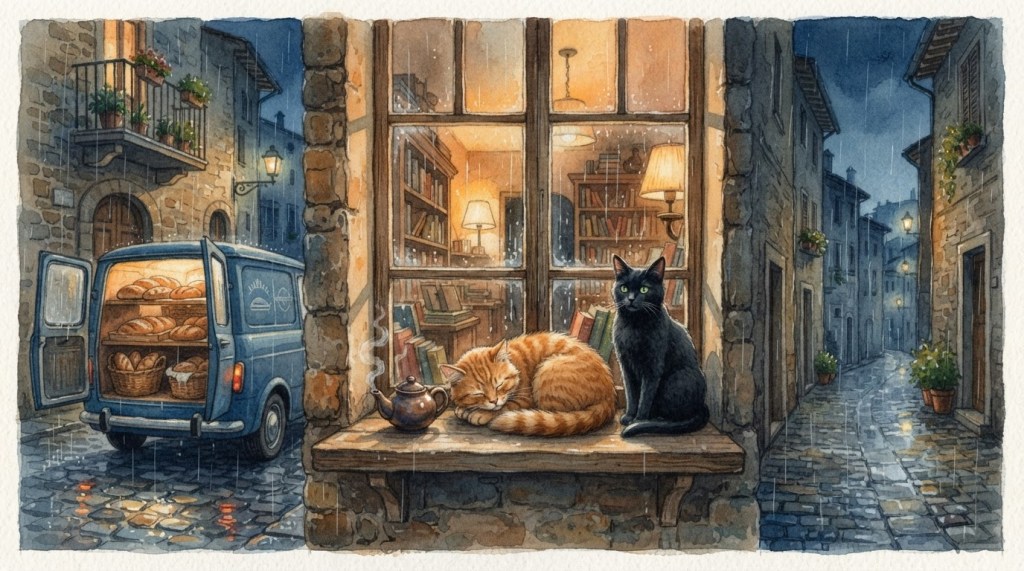
It had been raining on Speranza since the church clock struck four, the soft, persistent rain that makes the cobbles of Via dell’Orologio shine like the backs of fish. By seven the lamps were lit, the baker’s shutters were down, and the only window still glowing on the whole street belonged to La Pagina che Fa le Fusa.
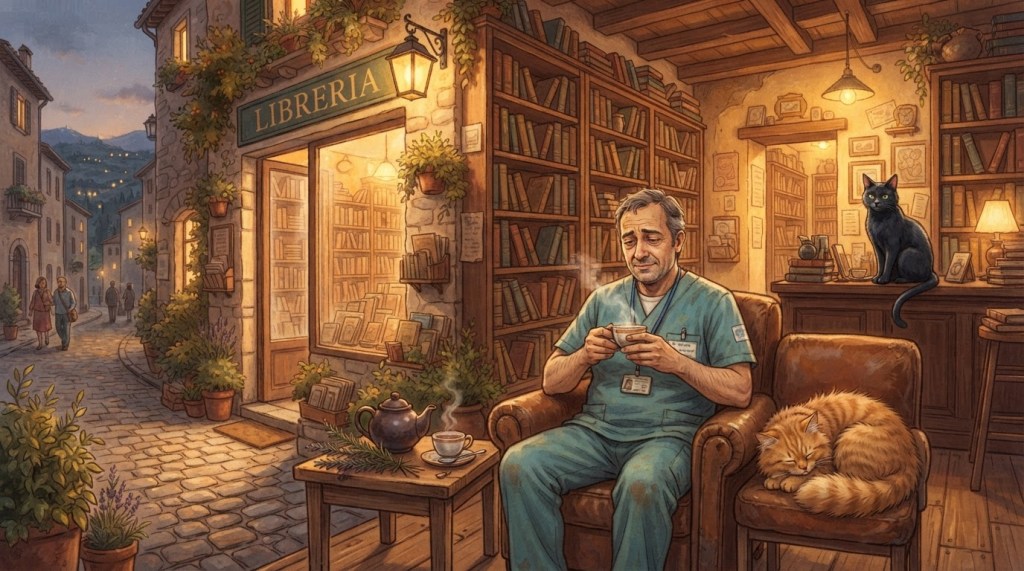
Inside, Moira Hopes was doing what she did best at the end of a wet day: nothing in particular, slowly. She had a kettle murmuring on the little stove behind the counter, a stack of second-hand cookbooks to price, and a cardigan the colour of porridge that she had been meaning to mend since September. Ashwaganda, the fifteen-pound ginger tabby, lay across the armchair by the radiator like a draped rug, his purr running at the low, steady hum of a refrigerator in a quiet kitchen. Toe, the sleek black cat with the green eyes, sat on the end of the counter with his paws tucked beneath him. He was a cat who found things: lost pencils, stray buttons, once a wedding ring that had slipped between two floorboards. He was watching the door the way he always did before somebody important arrived.
The bell above the door gave its small, apologetic tinkle.
The man who came in was big, broad through the shoulders, with the kind of forearms that have pushed a great many heavy things down a great many long corridors. He wore a faded teal work jacket under a raincoat, and he stopped on the doormat and stood very still, dripping, as if he were not sure he was allowed to take up room.
“I’m sorry,” he said. “I only wanted to get out of the rain.”
“That is exactly what a bookshop is for,” said Moira. “Hang your coat on the hook by the stove. There’s a towel on the radiator, and the chair with the cat on it is taken, but the other one is yours.”
He took off the raincoat as carefully as if it were somebody else’s. Toe slid off the counter, crossed the floor without a sound, and sat down squarely in front of the man’s left boot. Then, with great ceremony, he began to wash a paw.
“He likes you,” said Moira. “He is very selective.”
“Nobody likes me,” said the man, and then looked startled, as if the sentence had got out without permission. He gave a short, embarrassed laugh. “That came out wrong. I’m Tonino. Tonino Pietranera. I’m a porter at the hospital in the valley. Twenty-two years this March.”
“Moira,” she said. “Bookseller. Tea-maker. Sit, Tonino.”
The Man Who Pushes the Beds
He sat. The chair received him with a creak of sympathy. Moira did not ask what was wrong; she had learned long ago that people who arrive in a bookshop on a wet evening will say it in their own time, usually to the cat first. She put the kettle on to boil properly and took down three jars from the shelf above the stove: dried thyme, orange blossom, and a jar of dried apple rings that she dried herself every autumn.
“Do you know what I do all day?” Tonino said to the cat, since the cat was nearest. “I take people places. Down to the X-ray. Up to the ward. To the operating theatre, and back from the operating theatre. Bloods to the laboratory. Oxygen cylinders to the third floor. A man who has just been told something terrible, from the consultant’s office to the lift, because somebody has to walk him there and he can’t see through his own eyes.” He rubbed the back of his neck. “And I’m good at it. I’ve had twenty-two years of practice at being good at it.”
“But?” said Moira gently, from the stove.
“But yesterday a doctor walked past me in the corridor, and he said ‘excuse me’ to the bed. To the bed, Moira. I was pushing it, and he looked at the bed, and he said excuse me to the bed, and he went around it as if the thing moved itself.” Tonino laughed again, but it was not a happy sound. “It’s a small thing. I know it’s a small thing. A hundred small things. Nobody is unkind. Nobody is rude, even. It’s only that I’m not there. I’m furniture. I’m a person-shaped part of the corridor. And last night I came home and my wife asked how work was, and I said ‘fine,’ because what else is there to say about a job nobody can see?”
Ashwaganda opened one amber eye, regarded the speaker, and closed it again. His purr deepened by perhaps half a tone. Moira had always believed this was deliberate.
“That is a heavy thing to carry,” she said. “Much heavier than a bed.”
Tonino looked up. It seemed that no one had said that to him before, or not in a very long time. He swallowed and looked back down at the cat, who was now leaning his whole black weight against his boot.
Thyme, Orange Blossom and an Apple Ring
Moira warmed the pot, which was her one non-negotiable rule, and measured in a generous pinch of thyme, a smaller pinch of orange blossom, and two apple rings torn into pieces. She poured the water over them and set the little sand timer on the table where Tonino could see it.
“Thyme is a humble herb,” she said. “It grows between stones, at the edge of paths, in the places nobody plants anything on purpose. People have been drinking it in Mediterranean kitchens for a very long time, mostly because it tastes of sun and warm hillsides and feels good in a sore throat. The orange blossom is only there to be kind. And the apple is there because I have a great many of them and nobody in this village eats them. I should say, so that you know what you’re getting, that I’m a bookseller and not a clinician. This tea will not mend anything. It will give your hands something warm to hold for ten minutes, and sometimes that is the whole job.”
The sand ran. Rain tapped at the window. When the last grain fell she poured, and the shop filled with the smell of a hillside in June. Tonino took the cup in both hands, the way a man does who is used to carrying things that are fragile and heavy, and he breathed in for a long while before he drank.
“That’s good,” he said, surprised. “That tastes like my grandmother’s kitchen. She had thyme growing in a cracked pot on the windowsill.”
“There you are, then,” said Moira. “Something small and unnoticed, doing quiet good. I did not plan the metaphor, I promise. Toe is the one who finds the connections around here.”
What the Cleaners Knew
For a while they simply sat. Moira priced her cookbooks. Tonino drank his tea and scratched the black cat behind the ears, and when the cup was half empty he said, quietly, “Is it stupid to want to be thanked?”
“It is one of the least stupid things I know,” said Moira, setting down her pencil. “May I tell you about something I read? I’ll tell you what I remember and I’ll try not to dress it up, because I only know what I have read, not what I have studied.”
“Please.”
“There are two researchers, Amy Wrzesniewski and Jane Dutton, who wrote a paper in the early two-thousands about how people shape their own work. They called it job crafting. As I understand it, they spoke with a number of hospital cleaning staff, and what struck them was that two people could hold the very same job on paper and experience it completely differently. Some of the cleaners described their work as dull and mechanical, a list of tasks. But others described it as part of the healing of patients: chatting for a moment with someone who had no visitors, noticing who was frightened, helping a lost relative find the right ward. Those cleaners had quietly redrawn the edges of their jobs in their own heads, and in small ways in their days too, and they saw their work as important and skilled.”
Tonino was listening with the whole of his big, patient face.
“I want to be careful here,” Moira went on. “It was a small study, and it does not say that you must choose to feel important and then you will, as if the whole thing were a trick of attitude. It certainly does not say that a person being overlooked should simply think more cheerfully about it. Being treated as invisible is a real thing that people do to each other, and it is not your job to fix it alone. What I take from it is quieter. It says that the meaning of work is not only handed down from above. Part of it is made on the ground, by the person doing it, in the small decisions about who they notice and what they count as theirs.”
“I do that,” Tonino said slowly. “I mean, I didn’t know it had a name. When I take somebody down to theatre, I talk to them. I don’t talk about the operation. I ask where they’re from, or I tell them the football result. There’s an old man, Signor Ferri, who comes in every spring for his heart, and I always bring him down by the long way, past the fish tank, because he likes the fish. I thought that was just me being soft.”
“Tonino,” said Moira, “that is you being very good at your job. I would say it is the part of the job that no one has written on any form.”
He was silent. Then, in a rougher voice: “He holds my sleeve, you know. Going down. He always holds my sleeve.”
Ashwaganda, perhaps judging that the conversation had reached the point where a large warm weight was required, heaved himself out of the armchair and walked across the shop with the slow dignity of a ship entering harbour. He climbed onto Tonino’s knee. It took some time. There was a great deal of cat. When he had finished arranging himself, the man’s two huge hands, which had not known what to do all evening, came to rest on the orange fur.
A Little Thanks Goes a Long Way
“There is a second thing,” Moira said, when the purr had settled. “It’s about being thanked, which is what you asked. Two researchers, Adam Grant and Francesca Gino, published a set of studies in 2010 with the lovely title A Little Thanks Goes a Long Way. In one of them, as I remember it, university fundraisers who were phoning alumni got a visit from their director, who told them sincerely that she was grateful for their work. In the following week those who had been thanked made noticeably more calls than those who had not, and I believe it was something like half again as many, though please do not quote me to the digit. In other experiments, people who were thanked seemed to feel more valued and more socially worthwhile, and that feeling seemed to make them more willing to help others afterwards.”
“So thanks matters,” Tonino said, “to the one who gets it.”
“It matters as a kind of fuel, I think. Not a luxury. Mind you, these were short studies with particular groups of people, and I would never tell you that a single thank-you is a cure for twenty-two years of corridors. But it tells you that wanting to be thanked is not vanity. It is closer to wanting water. The human mind seems to check, quite automatically, whether what it does is seen and counts for something. When the answer is no, day after day, it is perfectly ordinary to feel worn thin. You are not weak. You are simply a person.”
He wiped his eye with the heel of his hand, not very subtly. Toe, on the floor, found this deeply interesting and pressed his head against the man’s ankle.
“I think,” said Tonino, “I’ve been waiting for somebody to say that for about ten years.”
“Then I am very glad you came in out of the rain. And I will say one more honest thing, because I would be a poor bookseller otherwise. If this feeling of being invisible has settled in for good, if you are sleeping badly, or dreading every shift, or feeling flat and numb for weeks, that is worth telling your doctor and, if there is one, your occupational health service or a workplace support team. Not because there is something wrong with you. Because you deserve proper care, not only cat care.”
“I could talk to Federica,” Tonino said, half to himself. “Federica Sanna, the ward sister on the third floor. She’s one of the ones who does look at you. She said good morning to me by name the first day she came and she’s never stopped.”
“Then perhaps it is time to tell her what you told the cat,” said Moira.
A Few Small Things for the Unseen
Moira went to the counter and came back with a scrap of paper and the stub of a pencil. “I will write you a short list. It is not medicine, and it is certainly not the answer to everything. It is only a handful of things that people who work in the unseen parts of care sometimes find help.”
- Name one thing you did today that helped someone, however small, and say it out loud or write it down before you go to bed.
- Thank somebody else first. A thank-you given tends to make the next one easier to receive, and it changes how the corridor feels.
- Tell one trusted colleague, in plain words, that you would like to be noticed. It is a very ordinary request, and most people are relieved to be asked.
- Keep one small ritual that belongs only to you, such as a cup of something warm between shifts or the long way home past the river.
- If the feeling lingers for weeks or begins to colour everything, speak to your doctor or your workplace support service. You do not have to wait until it is a crisis.
Tonino read the list twice, folded it into quarters, and tucked it into the breast pocket of his teal jacket, the pocket over his heart, where the badge said Portantino in worn letters that nobody ever read.
What Toe Found
It was nearly nine when he stood to go. The rain had thinned to a mist. Ashwaganda, evicted, did not seem to mind; he simply poured himself back onto the armchair and resumed his refrigerator hum. Tonino shrugged into his raincoat and hesitated at the door with his hand on the latch.
“What do I owe you for the tea?”
“Nothing at all,” said Moira. “But if you ever want to repay it, thank somebody on Monday. Out loud. With their name.”
He nodded slowly, like a man memorising a route. Then Toe, who had gone quiet beneath the table, trotted over and dropped something at his feet: a small, flat, brass button, tarnished with age, which he must have found somewhere in the shop over the course of the evening.
Tonino bent and picked it up. It had a tiny anchor stamped on it.
“He’s saying take it,” Moira said. “He does that. He finds things that other people have overlooked, and then he gives them to the people who need to be reminded that overlooked things are worth finding.”
Tonino closed his big hand around the button. He did not say anything. He did not have to. He bowed to the cat, which was an absurd and wonderful thing to see, and he went out into the shining street.
Moira watched him walk up Via dell’Orologio, a broad figure with a slightly straighter back than the one that had come in. The church clock struck nine. Ashwaganda purred. On the counter Toe washed his paws, a black cat who had done a good evening’s work and expected nothing in return, which, she reflected, was precisely the point.
She did not know what Monday would look like in the corridors of the hospital in the valley. But she suspected that somewhere on the third floor, a ward sister named Federica was about to be thanked by name, and that she would pass it on, as thanks usually does when given half a chance.
Moira’s Reflection
I am only a bookseller, so I will say this as a bookseller. Care does not live only at the bedside. It lives in the porter who takes the long way past the fish tank, in the cleaner who notices who is frightened, in the kitchen assistant who puts an extra spoonful of something warm on a tray, and in the family member who is the quietest, least visible person in the whole story of an illness. The research I mentioned is small and careful, and I would not stretch it further than it goes. But it points to something I have seen with my own eyes in this shop: people need to be seen, and a little thanks, given sincerely and by name, seems to travel much further than the person giving it expects.
So here is my question for you, and I would love to read your answers in the comments. Who in your working life, or your caring life, does the quiet, unseen work that holds everything together, and what is one small way you could thank them this week? And if you are the unseen one, what would being noticed actually look like for you?
A Cup for This Story
Thyme, Orange Blossom and Apple Tea. Warm the pot first. Add a generous pinch of dried thyme (about one teaspoon), half a teaspoon of dried orange blossom, and two dried apple rings torn into small pieces. Pour over freshly boiled water, cover, and let it steep for about five minutes, or as long as a sand timer takes to run. Strain, hold the cup in both hands, and add a little honey if you like. Drink it slowly, preferably with a cat nearby.
Herbal teas are not medicine. If you are pregnant, taking medication or living with a health condition, please check with your doctor or pharmacist before trying a new herbal tea.







Leave a Reply