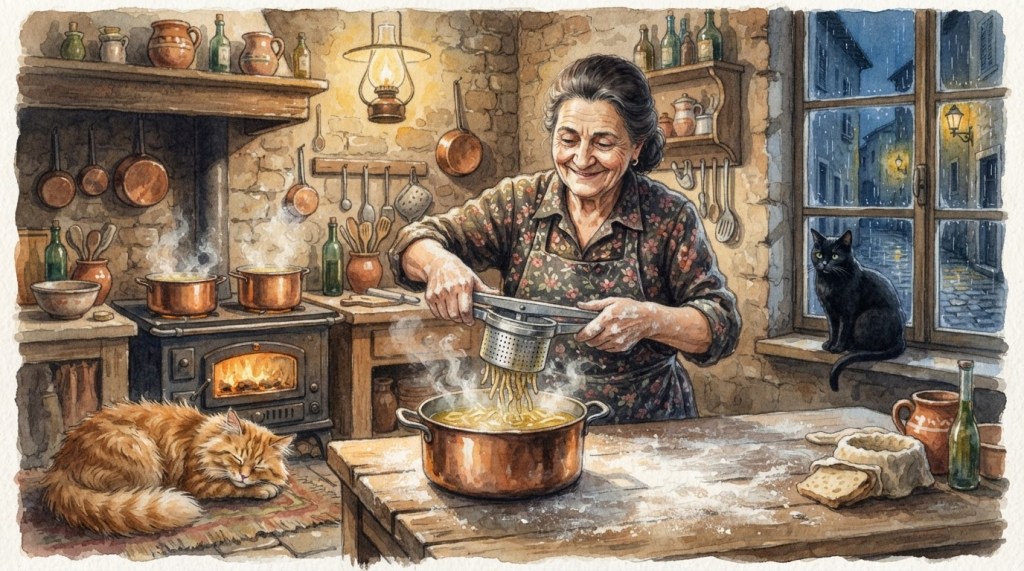
From The Inn’s Menu. “Every village has someone whose hands are always busy feeding everybody else. In Speranza, her name is Ofelia, and she rolls the pasta for the inn next to my bookshop. Tonight I’ll tell you about the evening somebody finally cooked for her.” — Moira
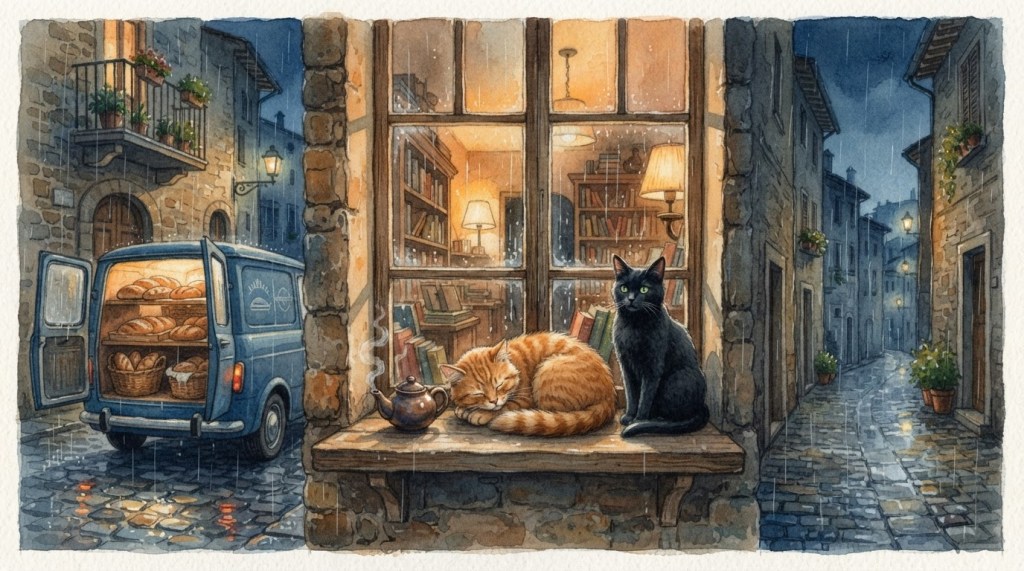
By five o’clock the rain had turned Via dell’Orologio into a long, shining ribbon, and the windows of the inn’s kitchen had fogged from the inside. Behind them, at the scrubbed wooden table, Ofelia was rolling the evening’s sfoglia: a sheet of egg pasta so thin and wide it hung over the edge of the table like a yellow tablecloth.
Ofelia had been the inn’s sfoglina for longer than anyone could remember. She did not use a machine. She used a rolling pin as long as her arm and a pair of hands that had been dusted with flour since she was nine years old. She talked very little while she worked, and when she did talk, it was usually to the dough.
Moira had come through the connecting door from the bookshop with a pot of tea, as she did most evenings, and the cats had followed her, as they did most evenings. Ashwaganda, the large ginger tabby, had arranged himself on the warm tiles by the stove like a loaf left to rise. Toe, sleek and black, took the windowsill, his green eyes following the rolling pin back and forth, back and forth, as though he were refereeing a very slow game of tennis.
“You look tired, Ofelia,” said Moira.
“The dough is never tired,” said Ofelia, which was not an answer, and both of them knew it.
Two Women and an Umbrella
The back door banged open at half past five and let in a gust of cold air, a broken umbrella and Claudia.
Claudia had the hair salon on the piazza, the one with the striped awning and the chairs that spun if you were small enough. Every woman in Speranza sat in one of those chairs at least once a month, and every piece of news in Speranza passed through the salon, usually before it had finished happening. Claudia had very good scissors, very good eyes and a voice that could carry across the square without being raised.
Behind her, folding a sensible umbrella that had survived the walk, came Giada, who taught yoga in the long room above the stationery shop. Giada moved the way water finds its level, without hurry, and her evening classes were where half the village went to stretch out the knots the day had tied in them.
“We’ve come for Ofelia,” Claudia announced.
Ofelia did not look up from the dough. “The tortellini are for Saturday.”
“Not for the tortellini,” said Giada gently. “For you.”
The Question Nobody Asks
It turned out, as Claudia explained while hanging her coat on the hook and her opinions on everything else, that the idea had been born under a hairdryer that very afternoon.
“Three different women, three different appointments, and all three said the same thing. Ofelia made the pasta for my daughter’s wedding. Ofelia made the broth when my mother was ill. Ofelia sent tagliatelle when my husband was in hospital.” Claudia held up three fingers, then folded them. “And then I asked: and who cooks for Ofelia? And the salon went quiet. Do you know how hard it is to make my salon go quiet?”
“Very,” said Moira.
Ofelia put down the rolling pin. For a moment she looked as though somebody had asked her a question in a language she had once known and forgotten.
“I eat,” she said. “I eat standing up. Here. The ends of the dough.”
“Exactly,” said Claudia, as if a case had been proved in court.
On the windowsill, Toe gave one long, slow blink, which in Toe’s language was a unanimous verdict.
Passatelli for the Sfoglina
The plan, it emerged, was passatelli in brodo: the plainest, kindest supper in the whole of the region, made of nothing more than breadcrumbs, cheese, eggs and a good broth. Claudia’s grandmother had made it every Sunday. Giada had brought the broth from home in a jar wrapped in a tea towel, still warm. Moira had the eggs. The inn had the Parmigiano. And the passatelli iron, the round metal press with its little holes that hung by the stove, had been Ofelia’s own mother’s.
“You sit,” said Claudia, pulling out a chair. “Tonight you are a customer.”
Ofelia sat, very stiffly, the way people sit in a dentist’s waiting room. Her hands did not know what to do. They hovered over the table, looking for dough. Ashwaganda, noticing, got up from the tiles, crossed the kitchen and climbed with great dignity onto her lap, where he turned around twice and lay down like a warm, purring sandbag. Ofelia’s hands found his fur and stayed there.
Claudia mixed, talking the whole time: breadcrumbs, a snowfall of grated cheese, a little nutmeg, the zest of half a lemon, then the eggs, until it all came together into a soft, fragrant dough. Giada set the broth on the stove and stood beside it with her hands resting on the counter.
“While we wait for it to simmer,” she said, “everybody breathe out. Slowly. Longer than you breathe in. That’s all. That’s the whole lesson.”
“That’s it?” said Claudia. “People pay you for that?”
“People pay me to remember it,” said Giada. “It’s the remembering that’s hard.”
So they breathed, the four of them, in the warm kitchen with the rain on the windows, and for a moment the only sounds were the soft roll of the broth beginning to move and the deep, engine-like purr of a ginger cat who had always known how to do this without being taught.
The Iron and the Broth
When the broth was simmering, Claudia filled the iron and pressed, and the passatelli came through in thick, rough little ropes and dropped into the pot. Ofelia leaned forward in spite of herself.
“Not so hard,” she said. “Let them fall. They come up when they are ready.”
“Customers don’t give instructions,” said Claudia.
“This customer does,” said Ofelia, and for the first time that evening, she laughed.
The passatelli rose to the surface one by one, as she had said they would. Moira ladled them into a deep white bowl with plenty of broth, Claudia grated more cheese over the top, and Giada set the bowl in front of Ofelia with a spoon and a folded napkin, the way you set a table for someone important.
Ofelia looked at it for a long time.
“My mother’s iron,” she said quietly. “I haven’t eaten these sitting down since she died.”
Nobody said anything. Toe came down from the windowsill, walked along the bench and sat beside her bowl like a small black guard of honour. Ofelia ate slowly, every spoonful, with Ashwaganda still asleep on her lap and the steam rising into the lamplight.
When she had finished, she wiped her eyes with the back of a floury hand and said, to nobody in particular, “Too much nutmeg.”
“There was exactly the right amount of nutmeg,” said Claudia.
“There was exactly the right amount of nutmeg,” Ofelia agreed. “Thank you.”
Outside, the rain went on. Inside, three women washed up while the fourth sat with a cat on her lap and, for once, did nothing at all. Moira watched them from the doorway and thought that some recipes are really instructions for how to look after each other, written down in the form of soup.
From The Inn’s Menu: Ofelia’s Passatelli in Brodo
Passatelli are a traditional dish from Emilia-Romagna and the Marche: short, rustic strands made from breadcrumbs, Parmigiano Reggiano and eggs, pressed through a special iron and cooked in broth. They are humble, quick and deeply comforting. Serves 4.
Ingredients
- 100 g fine dry breadcrumbs (plain, unseasoned)
- 100 g Parmigiano Reggiano, finely grated, plus extra to serve
- 3 medium eggs
- A generous grating of nutmeg
- Finely grated zest of ½ unwaxed lemon
- A pinch of salt
- 1.5 litres good chicken or beef broth (or a vegetable broth)
Method
- In a bowl, mix the breadcrumbs, grated Parmigiano, nutmeg, lemon zest and salt.
- Add the eggs and knead with your hands until you have a soft, compact dough that holds together. If it feels too wet, add a spoonful of breadcrumbs; if too dry, a little beaten egg. Wrap it and let it rest for 20 to 30 minutes.
- Bring the broth to a gentle simmer in a wide pot.
- Press the dough through a passatelli iron, or a potato ricer with large holes, letting the strands fall straight into the simmering broth. Cut them with a knife to about 4 cm long as they come out.
- Cook for 1 to 2 minutes, until they float to the surface. Don’t let the broth boil hard, or they may break.
- Ladle into warm bowls with plenty of broth and finish with more grated Parmigiano.
Moira’s notes: the dough is better slightly firm than slightly soft. If you have no iron or ricer, you can roll small pieces into short ropes with your hands; they will be less traditional but just as good. This dish contains gluten, eggs and dairy.
A Cup for This Story: Giada’s End-of-the-Day Cup
A soft, caffeine-free cup for after supper, when the washing up is done and it’s finally your turn to sit down.
- 1 teaspoon dried lemon balm (melissa)
- A curl of dried or fresh orange peel (only the orange part)
- 250 ml just-boiled water
- A little honey, if you like
Cover and steep for 5 minutes, then strain. While it steeps, try Giada’s one-line lesson: breathe out a little longer than you breathe in. Then drink it slowly, sitting down.
Herbal infusions are a comforting ritual, not medicine. If you are pregnant, breastfeeding, taking medication or living with a medical condition, please check with your doctor or pharmacist first.
From Moira’s shelf, if you’d like to make this at home: a passatelli iron · a potato ricer · dried lemon balm. (Amazon links: we may earn a small commission, at no extra cost to you.)
Moira’s Reflection
Most of us know an Ofelia. Sometimes we are one: the person who feeds everyone, remembers everyone’s birthday, carries the soup across the village in the rain, and eats the ends of the dough standing up. If that’s you, tonight is permission to sit down and let somebody else hold the ladle. And if you know an Ofelia, perhaps this week is the week to ask the question that made Claudia’s salon go quiet: who cooks for the ones who cook?
Tell us in the comments about the Ofelia in your life. Moira, the cats and three new friends from the piazza would love to hear.
Not sure which story to read next? Tell us how you’re feeling tonight and Moira will pick one for you. And if you’d like more evenings at the bookshop, the Tales of Speranza are waiting on the shelf.
Stories and ideas by Birba Anpu.





Leave a Reply