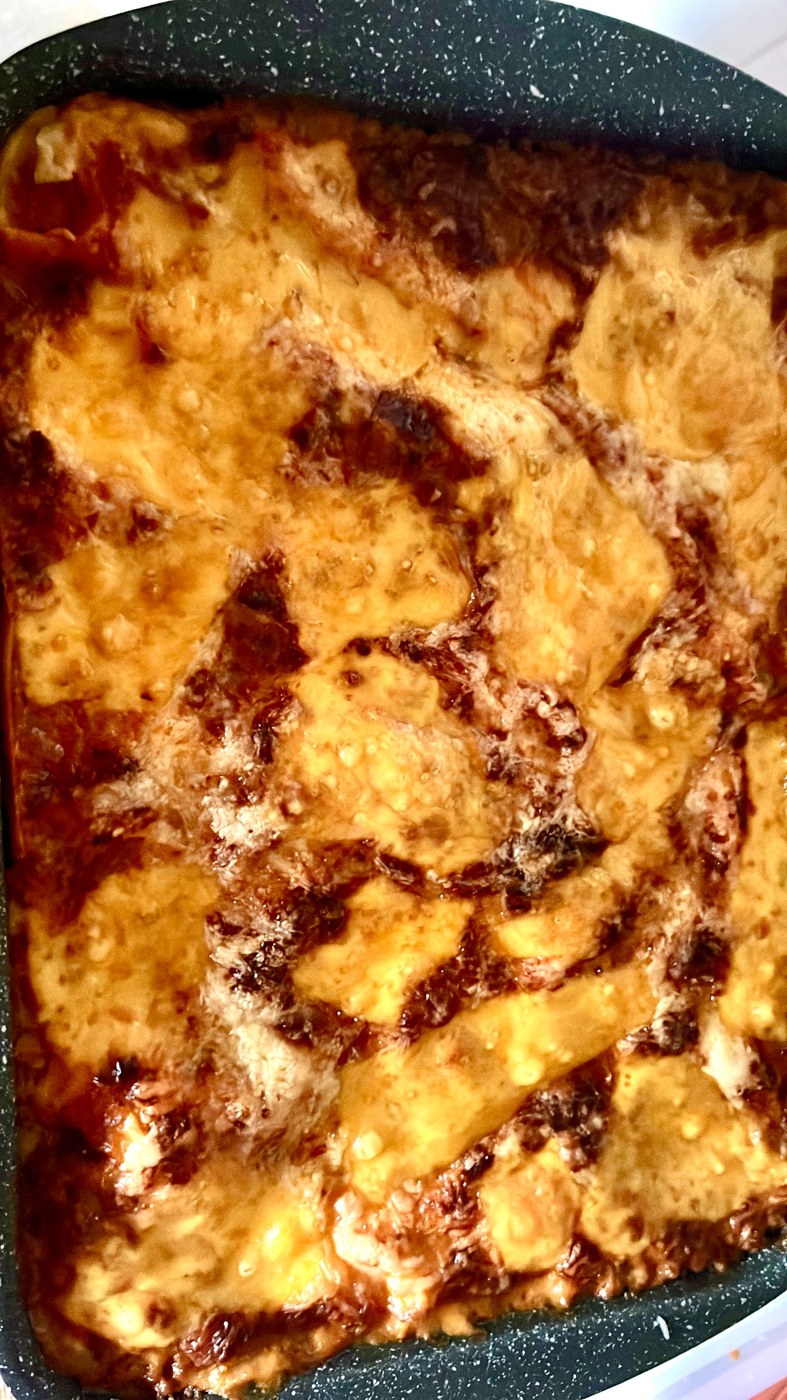
From The Inn’s Menu. On Sundays the inn next to Moira’s bookshop smells of ragù from mid-morning, and by one o’clock Ashwaganda is sitting by the kitchen door, pretending he just happened to be passing. This is the lasagne they serve: a real recipe from a real kitchen, photographed straight out of the oven.
In Bologna, the classic lasagne alla bolognese is made with green spinach pasta, a slow ragù, béchamel and only Parmigiano Reggiano on top. The cook at the inn respects the tradition, but breaks one rule on purpose: she finds Parmigiano too strong and too salty for a dish that is already rich, so every layer gets slices of cheddar and a mix of grated Emmental and mozzarella. The crust comes out golden, soft and mild, and nobody has ever sent a plate back.
Ingredients (serves 6–8)
For the pasta
- 400 g “00” flour
- 3 medium eggs, at room temperature
- 250 g fresh spinach, cooked, squeezed very dry and chopped very finely. Green pasta is the tradition, but at the inn they will tell you that plain egg pasta works just as well: nothing bad happens.
For the ragù
- 400 g coarsely minced beef
- 150 g unsmoked pancetta, finely chopped
- 60 g each of carrot, celery and onion, chopped by hand
- 300 g tomato passata and 1 heaped tablespoon double tomato paste
- 100 ml dry white wine
- 200 ml whole milk
- Hot meat stock as needed, 30 g butter (optional), salt and black pepper
For the béchamel and the cheese
- 1 litre whole milk, 70 g butter, 70 g “00” flour
- Nutmeg and salt
- Grated Emmental and mozzarella, mixed: two big handfuls for each layer
- Sliced cheddar: 5 slices for each layer (about 35 slices for 7 layers)
- 30 g butter in small pieces
Method
- The ragù (start early, or the day before). Melt the pancetta slowly in a heavy pan for about 5 minutes. Add the butter and the chopped vegetables and let them soften gently for 10–15 minutes. Turn up the heat, add the beef and break it up until it sizzles and changes colour. Add the wine and let it evaporate, then the tomato paste and passata. Cover, leaving a gap, and simmer on the lowest heat for about 3 hours, adding a little hot stock when needed. Stir in the milk for the last 20 minutes and season.
- The pasta. Make a well with the flour, add the eggs (and the spinach for green pasta) and knead for 10–12 minutes until smooth. Wrap and rest for 30 minutes. Roll it out to about 0.8–1 mm and cut into rectangles.
- Blanch the sheets. Cook two or three at a time in salted boiling water for 30–40 seconds, cool them in cold water and lay them on clean cotton tea towels.
- The béchamel. Melt the butter, whisk in the flour for 2 minutes, then pour in the warm milk a little at a time, whisking. Simmer for 5–8 minutes until it coats the spoon but is still fluid. Season with salt and nutmeg.
- Assemble seven layers. Butter a 20 x 30 cm dish and spread a spoonful of béchamel and ragù on the bottom. Then build each layer the same way: a sheet of pasta, ragù, béchamel, two big handfuls of grated Emmental and mozzarella, and 5 slices of cheddar. Change the direction of the sheets each time. Seven layers is the inn’s habit, but you can do more or fewer. Finish with ragù, béchamel, cheese and small pieces of butter.
- Bake and rest. Bake at 180°C (static oven) for 35–40 minutes, until the top is golden and bubbling. Let it rest for 15 minutes before cutting, so the layers settle.
The Inn’s Tip for Rolling the Pasta
Rolling by hand is not about strength. Use a long, plain wooden rolling pin on an unvarnished wooden board, and very little flour: too much, and the pin slides instead of stretching the dough. Turn the sheet a little after every few strokes so it stays round and even, and press with the heel of your hand, never with your fingertips. When you can see the shadow of your hand through the sheet, it is ready for lasagne.
P.S. If you like to read while something slow bubbles on the stove, the evenings Moira loves most are gathered in Tales of Speranza.






Leave a Reply