Why do we remember some days forever and forget the ordinary ones in between?
The Shoebox at the Door
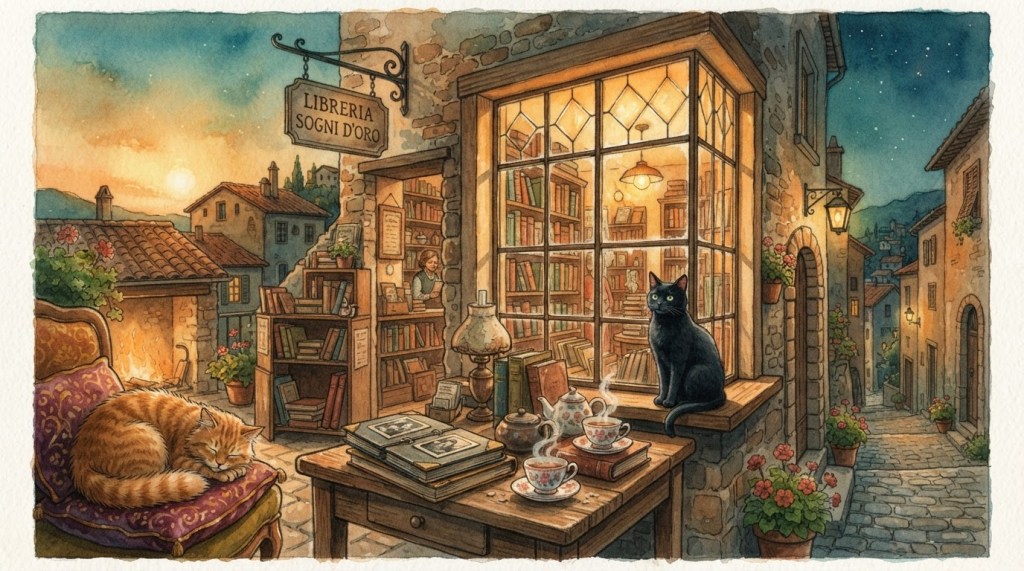
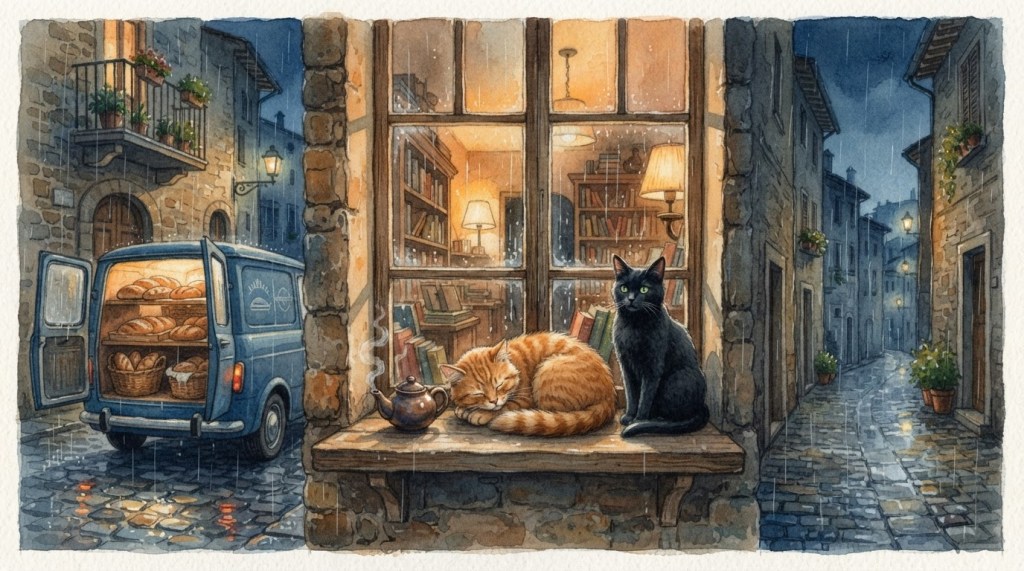
It was a quarter past six on the last Friday of November, and Via dell’Orologio had that held-breath blue look it gets when the street lamps come on before the shops have closed. In La Pagina che Fa le Fusa, Moira Hopes was winding the little brass clock above the till when the bell over the door gave its small, apologetic chime.
The woman who came in was in her late sixties. She wore a good green coat buttoned one button wrong, and she held a battered shoebox against her chest as if someone might try to take it from her.
“Am I too late?” she asked. “The sign says six.”
“The sign says six, and the kettle says whenever you like,” said Moira. “Come in out of the cold.”
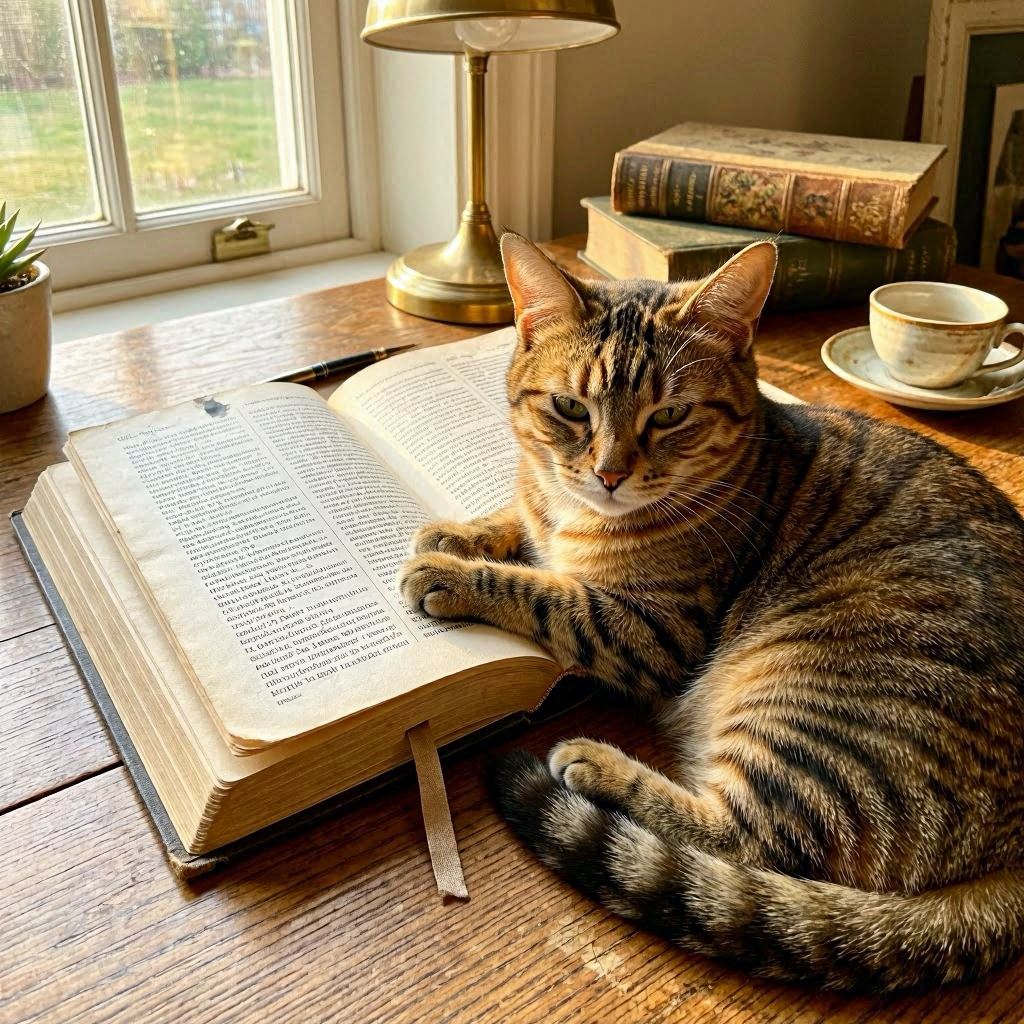
On the armchair beside the stove, Ashwaganda, fifteen pounds of ginger tabby with a purr you could feel in the floorboards, opened one amber eye. He assessed the visitor, closed the eye again, and began to hum at his usual twenty-five hertz, which in cat is a written invitation. Up on the top shelf of the poetry section sat Toe, sleek and black as a piece of the night that had wandered indoors early, his green eyes following every step the woman took.
“I’m Marisa,” the woman said. “From the house with the blue shutters, up past the fountain. I’ve walked past your window for twenty years and never come in. Tonight my feet simply turned the handle, and I don’t entirely know why.”
“Sometimes the feet know first,” said Moira. “Sit down, Marisa. What’s in the box?”
Marisa lowered herself into the chair opposite the stove and rested the box on her knees. She lifted the lid a finger’s width, then let it fall again.
“Photographs. Franco’s and mine. My sister Anna is clearing out her attic and she brought them over on Sunday, all tied up with kitchen string. Franco has been gone four years now, and I thought I would be glad to see them.” She stopped. “I am glad. That isn’t the trouble.”
“Then what is the trouble?”
Marisa laughed, a short laugh with no room in it. “The trouble is that I can tell you the colour of the tablecloth on the night Franco asked me to marry him. Pale yellow, with a burn mark shaped like Sicily. I can tell you the smell of diesel on the boat that August, and the song on the radio, and that he was wearing one blue sock and one grey sock because he had dressed in the dark. That was forty-five years ago. And yesterday I stood in my own kitchen and could not remember whether I’d had lunch.”
She looked at her hands. “Last Tuesday, I cannot tell you one thing about it. Not one. It’s simply gone, like a coin down a drain. My mother began like this, you see. First the small things, then the larger ones. So I keep asking myself why I can keep a whole summer in perfect detail and lose a Tuesday. And I keep asking whether this is how it starts.”
Moira came around the counter and sat on the footstool near her, close enough to be kind and far enough not to crowd.
“Let me say two things first,” she said. “I’m a bookseller, not a doctor. If forgetting truly worries you, a visit to your own doctor is a kind thing to do for yourself, and I’d say so whatever I tell you tonight. Nobody should carry a fear like that around alone in a coat with the buttons wrong.”
Marisa looked down, found the stray button, and smiled in spite of herself.
“The second thing,” Moira went on, “is that the question you asked, why some days stay and some days go, has a real answer, and I think it’s gentler than the one you’re afraid of. Let me make us some tea, and then I’ll tell you what I know.”
Rosemary and Lemon Balm
The kettle had been simmering on the little stove all afternoon, the way it does in Speranza when the weather turns. Moira took down two jars from the shelf behind the till and held them up so Marisa could see: dark, needled rosemary from the rock garden behind the inn, and soft green lemon balm dried in July.
“Rosemary, for remembrance,” she said, crumbling a small sprig into the pot. “Ophelia says it in Hamlet. People have been tying it to memory for centuries. It’s an old, lovely idea, and I’d be lying if I told you the science was as tidy as the poetry.”
“There’s science?”
“A little. A few small studies in Britain, from about two decades ago, suggested that the aroma of rosemary might nudge people’s scores on some memory tasks. Later studies have been mixed. So I’ll call it a pleasant tradition and a lovely smell, not a treatment. Lemon balm goes in because it’s gentle and it tastes like a summer afternoon, and a calm mind is at least a better place to start remembering from.” She added a few leaves, a thin slice of apple and a small spoonful of honey, and poured the water over them.
The scent rose at once: resin and lemon and something green and sweet. Marisa closed her eyes and breathed in.
“My grandmother had a rosemary bush by the back door,” she said, without opening her eyes. “She used to rub a sprig between her fingers and hold it under my nose when I was sulking. I haven’t thought about that in fifty years.”
“There,” said Moira softly. “Hold on to that one. We’ll come back to it.”
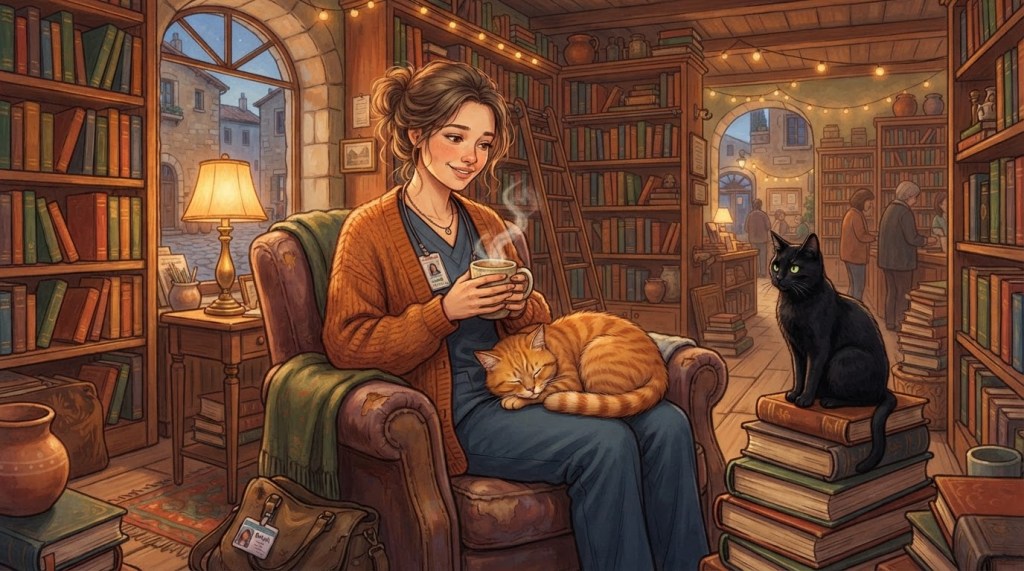
Ashwaganda chose that moment to stand, stretch from the tip of his nose to the tip of his tail, drop from the armchair with a thump, and cross the floor to Marisa. He did not ask. He stepped onto her lap, turned around twice on the shoebox, and settled with the heavy certainty of a loaf of bread. The purr began, low and enormous, and Marisa’s shoulders, which had been up around her ears since she walked in, came slowly down.
Why the Summer Stayed
Moira handed her a cup, took her own, and sat back down on the footstool.
“Here is the first thing, and it’s the one that matters most for you. Your memory is not a filing cabinet that gives every day the same drawer. It is far more selective than that. Deep in the brain there’s a seahorse-shaped structure called the hippocampus, which helps lay down new episodes of your life. Right beside it sits a small almond-shaped region called the amygdala, which reacts to anything that matters emotionally.”
“The amygdala is the one that makes me jump when a door slams.”
“That’s part of its job, yes, but it also does something quieter. When something moves you, whether it’s joy or fear or a proposal on a boat, your body releases stress hormones such as adrenaline, and the amygdala signals the hippocampus to hold that moment tighter. The neuroscientist James McGaugh spent decades at the University of California, Irvine, showing how this works. Emotionally charged moments are, on the whole, stored more strongly than neutral ones.”
Marisa was holding the cup in both hands, very still. “So Franco’s proposal was written in ink.”
“In ink, with a flourish. And last Tuesday was written in the lightest pencil, or perhaps not written at all, because nothing about it asked to be kept. You made coffee, you walked to the market, you came home. Nothing flagged it. That isn’t a defect in your memory, Marisa. It’s closer to the way a very sensible librarian works. If she shelved every receipt and every bus ticket with the same care as the great letters, nobody could ever find the letters.”
“And the tablecloth with the burn mark? The odd socks?”
“Attention narrows when we’re moved. You looked hard at small things that night because you were nervous and happy and every detail seemed to be shouting. Those details rode into memory on the back of the feeling. It’s very common to remember the burn mark on the tablecloth better than the speech.” Moira smiled. “I’d wager you cannot recall a single word Franco said.”
Marisa opened her mouth, closed it, and began to laugh properly, the first real laugh of the evening. “He said something about the wind. I have no idea what.”
“Well, there you are,” said Moira.
Ashwaganda’s purr rose a notch, as if to approve of the laughter.
Forgive me, I always seem to do my best talking with a cat on someone else’s lap and a cup going cold in my hand. While you wait for the tea to cool, here is a small confession: the evenings in this shop that I treasure most have been gathered into a little book, Tales of Speranza. Now, back to Marisa and her shoebox.
The Ticket Under the Stove
“May I see them?” Moira asked. “Only if you’d like to.”
Marisa hesitated, then lifted the lid properly. Ashwaganda, offended at being disturbed, shifted his weight, and the whole shoebox slid sideways. Photographs fanned out across Marisa’s knees and the rug: a young man on a small blue boat, squinting and laughing; two girls in matching cardigans, one of them clearly Anna; a wedding on the steps of a church with the bride’s veil caught in the wind.
Something else slid out with them: a small rectangle of faded paper, lighter than the photographs, which skated across the floorboards and vanished beneath the iron radiator by the stove.
“Oh, leave it, it’s only scrap,” Marisa began, but Toe was already moving. He poured himself down from the top shelf, crossed the room without a sound, lay flat on the floorboards and slid one paw into the gap under the radiator, his green eyes half closed in concentration. Moira had long ago stopped being surprised by this. If something in the shop was lost, Toe was the one who found it.
He drew out the paper, nudged it with his nose until it lay at Marisa’s feet, and sat beside it with the air of a cat who has done the day’s work.
Marisa picked it up. It was a cinema ticket, soft as cloth, the ink gone the colour of weak tea. She turned it toward the lamp and read it aloud, slowly: “Cinema Aurora. Fourteenth of August, 1978. Second showing.”
For a long moment she said nothing at all.
“We went to the cinema,” she said at last. “That night. After the boat. I had completely forgotten. All these years I have told the story as if the whole day was the boat and the sea and then the tablecloth. But before the tablecloth there was a film, and we sat in the back row because Franco had a cold and didn’t want to spoil it for anyone, and he sneezed so loudly during the quiet part that the whole cinema turned around. I had it all wrong. Or rather, I had it all there, and I couldn’t reach it.”
“That,” said Moira gently, “is the second thing.”
Rebuilt Every Time
“A memory that seems lost is very often a memory that’s still stored but has nothing to pull it out,” Moira said. “Psychologists call these retrieval cues. The Canadian psychologist Endel Tulving built much of his career on the idea that remembering depends on the match between what’s stored and what’s in front of you at the time. A smell, a song, a ticket under a radiator. Last Tuesday may not be gone for good. It may simply have had no hook. Your grandmother’s rosemary came back tonight because the steam gave it one.”
“But I’d have sworn I remembered that night perfectly,” said Marisa, turning the ticket over. “And I’d left out the whole cinema.”
“Which brings me to the part that surprises people most, and which I find rather moving. Remembering is not like playing back a recording. Researchers have found that each time you call up a memory, it becomes briefly flexible and is then stored again, a process called reconsolidation. The psychologist Elizabeth Loftus has shown for decades how readily the details of a memory can shift, blur or pick up something borrowed from later. So when you tell the story of the proposal for the hundredth time, you aren’t opening a sealed box. You are rebuilding the scene from its parts, and the rebuilding can leave out a cinema or add a feeling you had much later.”
Marisa frowned. “That sounds as though my memories can’t be trusted.”
“I’d say it differently. The gist of what matters is usually sturdy: you loved him, he made you laugh, there was a boat. The small details can drift, and how vivid a memory feels is not a perfect guide to how accurate it is. Both of those are true for nearly everyone, and neither one is a sign that something is wrong. They are simply what a living memory is like. It is more like a story you keep retelling than a photograph you keep in a drawer.”
She nodded toward the photographs. “And there’s one more thing hiding in your box. Have you noticed that most of these are from when you were young?”
Marisa looked. “The boat, the wedding, Anna and me in the cardigans. All before thirty. Nothing at all from the last ten years, except a few of Franco in the garden.”
“Researchers who study autobiographical memory describe something they call the reminiscence bump. When older adults are asked to recall events from across their whole lives, they tend to produce a disproportionate number from roughly the ages of ten to thirty. Nobody is certain why. Leading ideas are that those years are full of firsts, such as first love, first job and first home, and that they are when we are busy deciding who we are, so the memories feel important to keep. Whatever the reason, it is common, and it means the summer of 1978 stands tall in your mind partly because it was built in the season when memory is richest. It doesn’t mean the last ten years are failing you.”
Toe, satisfied that the matter of the ticket was settled, hopped onto the arm of Marisa’s chair, sniffed the faded paper with great seriousness, and then touched his nose very lightly to her wrist. Ashwaganda’s purr deepened, a sound more felt than heard, like a distant train that is not coming for anyone.
What to Do With a Tuesday
Marisa drank the last of her tea, set the cup carefully on the little table, and was quiet for a while. Outside, a light rain had started up, the kind that doesn’t fall so much as float.
“So the ordinary days,” she said finally. “They go because they don’t mean anything to the librarian.”
“They go because nothing marked them, and some of that forgetting is a mercy. A German psychologist, Hermann Ebbinghaus, measured it back in the 1880s, by memorising lists of nonsense syllables and testing himself, and found that most of what we take in fades quickly unless we do something with it. A mind that kept every Tuesday would be as crowded as a station at Christmas. But there is a second reason ordinary days vanish, and it’s one you can do something about.”
“Go on.”
“Days that are all alike tend to blur into one in memory, because there is nothing to tell them apart. Many people notice that time seems to speed up as life becomes more routine, and a plausible explanation, though not a settled one, is that novel days leave more distinct markers behind. So the remedy is very small. Do one slightly new thing each week. Take the long way to the market. Taste an unfamiliar cheese. Let a stranger sit down beside you. And at the end of the evening, write three short lines in a notebook: something you saw, something you heard, something that made you smile. It takes two minutes. You are giving the future a hook to catch.”
“Three lines,” said Marisa. “That I can do.”
“And if you find you’re forgetting things that matter, the names of people you love, the way home, whether you’ve taken your medicine, then it is time to talk to your doctor, soon and without embarrassment. Forgetting where you put your glasses is one thing. But you asked me tonight why the Tuesday is gone while the summer remains, and that one, I’m happy to say, is the ordinary workings of a healthy human memory.”
Marisa gathered the photographs one by one, laying them back in the box with a care that was almost a blessing. She kept the cinema ticket in her hand. At the door she paused, with Ashwaganda watching from the armchair and Toe back on his shelf among the poets.
“I’ll be passing next Tuesday,” she said. “If you’re open.”
“We’re always open to a Tuesday,” said Moira. “That’s rather our speciality.”
“Then I’ll have one to remember.” She smiled, buttoned her coat correctly this time, and stepped out into the soft, floating rain. Through the window Moira watched her walk up Via dell’Orologio toward the fountain, the shoebox under one arm and a small, faded ticket held carefully in the other hand, as though it were a lit candle.
Moira’s Reflection
We tend to treat forgetting as a kind of theft, and sometimes it is. But much of the time it is the quiet price of a mind that has to choose, every day, what is worth carrying. The days that stay with us stay because we felt something in them, and that is its own small mercy: our memories are a map of what we loved, not of what we did.
And the ordinary days are not worthless just because they slip away. They are the soil the great days grow in. If we want to keep a few more of them, we can do it the simplest way there is, by noticing one thing, writing three lines, and letting a cat sit on our lap while we do.
Which day do you remember most clearly from your own life, and what small detail has stayed with you from it? Tell us in the comments. Moira, Ashwaganda and Toe would love to hear.
A Cup for This Story
Rosemary and Lemon Balm Remembering Tea
- 1 small sprig of fresh rosemary (or half a teaspoon dried), lightly crumbled
- 1 heaped teaspoon dried lemon balm (or a few fresh leaves)
- 1 thin slice of apple
- 1 small spoonful of honey, to taste
- 250 ml of just-boiled water; steep for 5 to 7 minutes, covered, then strain
Herbal teas are a comforting ritual, not medicine, and they are not a treatment for memory problems. If you are worried about your memory, please talk to your doctor.
P.S. If tonight’s question about the days we keep and the days we lose stayed with you, there are ten more slow evenings like this one in Tales of Speranza.
Listen in Speranza
🎧 Moira’s bookshop also has a voice. Tales from Speranza is our free podcast of slow evening stories, read aloud for the end of the day. Listen on Spotify.
📅 New stories, verses and recipes every day of the week: see A Week in Speranza.
Press Play and Stay a While
Before you go, here is the song of the shop. Let it play while the tea cools, and stay as long as you like.





Leave a Reply