Calm for Carers · Story 3. For everyone who spends their days holding other people together.
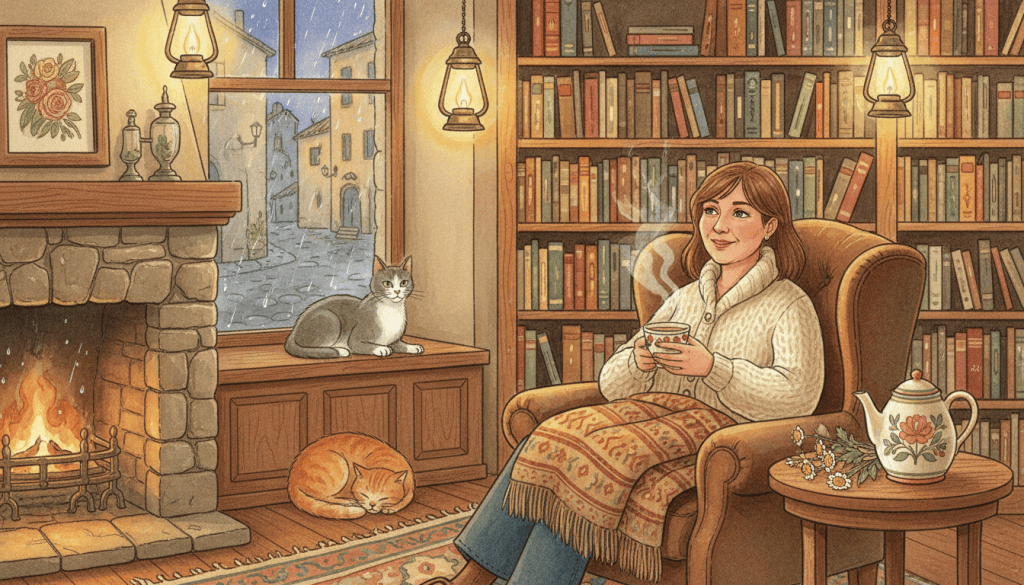
It had been raining in Speranza since the middle of the afternoon, the soft, persistent kind of rain that makes the cobbles of Via dell’Orologio shine like the backs of fish. By seven o’clock the bakery had closed, the pharmacist had pulled down his shutter, and the only lit window left on the whole street was the amber one belonging to La Pagina che Fa le Fusa.
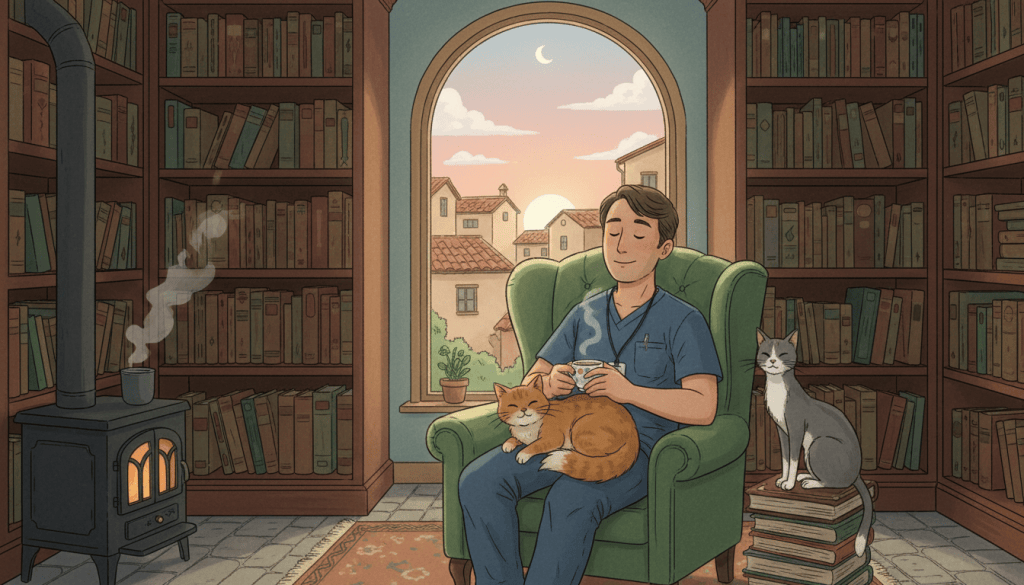
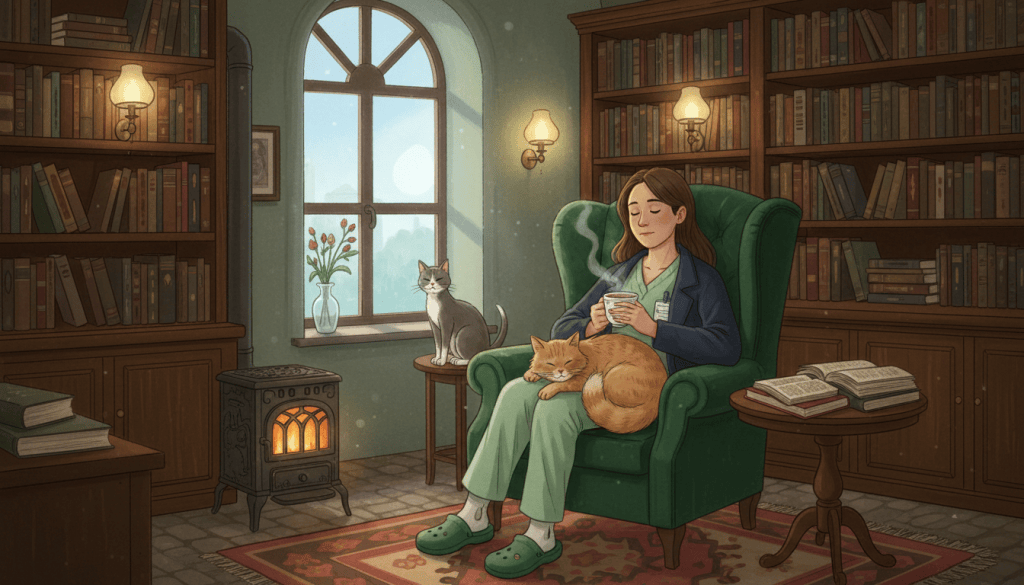
Inside, Moira Hopes was doing what she liked best at the end of a wet day: nothing in particular. She had shelved the new arrivals, dusted the poetry section with the old feather duster, and set a small copper kettle on the little stove behind the counter. Ashwaganda, the fifteen-pound ginger tabby, lay across the warm rug like a draped orange cushion, his deep purr rumbling through the floorboards. Toe, the slender grey cat with immaculate white paws and green eyes, sat on the windowsill and watched the rain run down the glass as though it were a film made especially for her.
The doorbell gave its small silver ring.
A woman stood on the mat, dripping. She was perhaps fifty, with grey coming in at her temples and a good wool coat buttoned wrongly, so that one side hung lower than the other. In one hand she held a closed umbrella that had clearly not been opened at all. In the other she held a phone, face down, the way you hold something that might bite.
“I’m so sorry,” she said. “I only came in because the light was on. I don’t need anything. I just needed to stand somewhere that wasn’t my car.”
“That is the best reason anyone has ever given for entering a bookshop,” said Moira, and she meant it. “Come in. Leave the umbrella by the door. I’m Moira.”
“Elena,” said the woman, and her voice cracked on the second syllable, as if it had not been used for anything but instructions all day.
The Woman Who Sat in Her Car
Moira did not ask questions. She had learned, over many years of selling books to people who were really looking for something else, that questions asked too early make a person close like a clam. Instead she pulled the green velvet armchair a little closer to the stove, nodded at it, and went back to her kettle as though Elena’s sitting down were the most ordinary thing in the world.
Elena sat. She put the phone on her knee, still face down. Toe left the windowsill, crossed the room with that precise, dainty walk of hers, and leapt onto the arm of the chair, where she sat very upright and looked at the stranger with her green eyes. Then, after due consideration, she placed one white paw on Elena’s sleeve.
“She doesn’t usually do that,” Moira said, which was a small lie, but a kind one.
Elena laughed, a short, surprised breath, and then, without warning, she was crying. It was not dramatic crying. It was the quiet, leaky kind, the kind that comes when a dam has been holding for so long that it no longer remembers how to hold anything else.
Moira said nothing. She took down a tin from the shelf above the stove, a battered blue one with a faded picture of a lemon tree on the lid, and began to measure dried leaves into a small earthenware pot. The scent that rose from the tin was green and bright and a little like a garden after rain.
“Lemon balm,” she said, simply, to fill the silence with something gentle. “The old herbalists called it a cheerful plant. I put it together with a little chamomile and a curl of dried orange peel. It isn’t medicine, and I’m not a doctor, only a bookseller. But it tastes like being looked after, and some evenings that is quite enough.”
She poured the hot water. The steam curled up in the lamplight. Ashwaganda, who had not moved at all, purred a little louder, as if he had been informed that an important guest had arrived and wished to contribute.
Nine Hundred and Twelve Small Things
It took Elena most of a cup to begin. Moira let her take her time.
“My mother is eighty-six,” Elena said at last. “Gilda. She lives in the flat above mine. Or rather, she lived in her own house until the fall last March, and now she lives in the flat above mine, because it was the only thing that made sense. I’m a primary school teacher. I have thirty-one eight-year-olds on weekdays and one eighty-six-year-old on every other hour that exists.”
She turned the cup in her hands. “I do the pills. I mean, I set them out in the little box, the way the doctor’s surgery showed me. I do the appointments, the transport to the appointments, the forms for the appointments. I do the shopping and the cooking and the washing, and the phone calls with my brother, who lives in Milan and says things like ‘just let me know what you need,’ and then I don’t know what to say, because what I need is for him to know.”
“That’s a very particular kind of tired,” Moira murmured.
“Tonight I got home at six and she was waiting at the top of the stairs. She’d been waiting since four, she said. She wanted to know why I was late, and had I eaten, and why was my hair like that, and could I look at the television because the picture had gone strange. And I found myself standing in the stairwell and I thought, in this absolutely clear voice, I do not want to go up there. And then I thought: what kind of daughter thinks that? So I went back down and I sat in my car for forty minutes, and then I drove here, and I don’t even know why.”
The phone buzzed once against her knee. She flinched, and did not turn it over.
“I counted them once,” Elena went on, quietly. “On a Sunday, when I couldn’t sleep. All the small things I do for her in a normal week. The pills, the cream for her legs, the post, the bins, the hearing aid batteries, the way I have to say things twice, then three times. I got to nine hundred and twelve and I stopped, because I realised I was counting for her, to prove something to someone. As though there were a judge. As though someone were going to read the list and say, yes, Elena, you may now be tired.”
Moira sat down on the little stool across from her. Ashwaganda, sensing a shift in the evening’s weather, got up with enormous effort, padded over, and lowered his whole warm weight across Elena’s feet. It was like being given a hot water bottle that also had opinions.
“Nobody is going to read the list,” Moira said, “and you don’t need a verdict. You are allowed to be tired. You are allowed to have thought the thought on the stairs. A great many loving people have stood exactly where you stood.”
Elena looked up. “Really?”
“Really. The thought isn’t the problem. The problem is what you did with it afterwards. You turned it into a charge against yourself. And I’ve noticed that carers are the only people on earth who hold trials like that every single night, and always find themselves guilty.”
What a Bookseller Knows (and What She Doesn’t)
Moira refilled the cups. She went to the shelf of psychology paperbacks near the back, the one with the wobbly bottom board, and then, thinking better of it, came back without a book.
“I should say plainly,” she began, “that I’m not a clinician. I sell books and I make tea. But I read a good deal, and I like to know whether the things I tell people are actually true. Years ago a customer left me a paper that I’ve never forgotten. It was about people who look after family members who are ill. It was a small study, done in a hospital in Tianjin, in China. Two hundred and eight family members who were caring for people with cancer.”
“What did it find?” Elena asked.
“Two things, and I’ll tell you honestly how far to trust them. The first is the one you’d expect: the heavier the sense of burden, the more depressive symptoms people reported. The second is the interesting part. The researchers measured something called self-compassion, which is really just how kindly you talk to yourself when things go badly. And among the carers who scored higher on it, the link between burden and low mood appeared weaker. As though self-kindness acted a bit like a cushion.”
“A cushion,” Elena repeated.
“But here’s the honest part. It was a single snapshot, taken at one moment, in one hospital, with people who agreed to take part. The authors themselves say that this kind of design can’t prove that burden causes low mood, or that self-compassion protects anyone, and they ask for studies that follow people over time. So I’m not telling you that being kind to yourself is a cure. I’m telling you that it is a promising thing that careful people think deserves more looking at. And it happens to cost nothing.”
Elena breathed out slowly. “It sounds almost too simple.”
“It is simple. It isn’t always easy. For a woman who has counted nine hundred and twelve small things and still feels she hasn’t earned a rest, it may be one of the hardest things there is.”
Toe, apparently satisfied that the research had been presented fairly, curled up in the angle of Elena’s elbow and closed her green eyes.
The Trouble With “Just Take a Break”
“Everyone tells me to take a break,” Elena said. There was a thread of weary irony in it now, which Moira took as a good sign, because irony is what comes back first when a person begins to feel safe. “The nurse at the surgery said it. My brother said it. A leaflet said it, with a picture of a woman on a beach. Where exactly am I supposed to put my mother while I go to the beach?”
Moira smiled. “I was going to tell you about another piece of reading, and it’s a humbling one. There’s a well-known review, done by a group called Cochrane, which gathers up all the good trials on a question and weighs them. This one asked whether respite care, those short breaks that give carers time away, actually helps people who look after relatives with dementia. They found four studies, with around seven hundred and fifty people in all.”
“And?”
“And the authors concluded that the evidence was of very low quality, and that it did not show benefits or harms. That’s the phrase they used, as I remember it: the current evidence does not demonstrate any benefits or adverse effects. And they said that better-designed trials were needed.”
Elena frowned. “So breaks don’t work?”
“No, and this is the part I want you to hear carefully, because it’s easy to get wrong. It does not say rest is useless. It says that the studies done so far were too few and too weak to tell us. That is a very different sentence. It also tells us something kinder: that nobody has yet worked out a perfect recipe for a carer’s rest. Rest may have to be shaped to the person. For one woman it’s a week in a care home for her mother. For another it’s forty minutes with a book. For you it may begin with sitting in a bookshop with a grey cat on your arm.”
Elena looked down at Toe, who was now, impressively, asleep.
“I think what I’ve been missing,” she said slowly, “is permission. I’ve been waiting for a rest so large and so official that nobody could argue with it. And in the meantime I haven’t rested at all.”
“Small rests count,” said Moira. “I can’t prove it with a trial. But I’ve watched a great many people in this chair, and I’ve never once seen a small, kind pause make anyone worse.”
The Other Side of the Stairs
The rain had softened to a whisper on the glass. In the lamplight the books stood in their rows like patient neighbours. Elena finally turned her phone over and looked at it. There were two messages: one from her mother, Where are you, did you eat, and one from her brother, How is Mamma tonight?
“You may answer them or not,” said Moira. “But let me ask you something that has nothing to do with research. When your mother was your age, who looked after her mother?”
Elena was quiet for a long moment. “My grandmother,” she said. “Nonna Assunta. Mamma looked after her for eleven years. In the same flat, actually. I used to sit on the end of the bed and do my homework while Mamma fed her soup with a little spoon.” Her eyes went distant. “She never complained. Or if she did, I never heard it. I thought that was what strength looked like.”
“And now?”
“Now I wonder whether she complained to someone, somewhere. Whether there was a stool in some shop where she could sit.” Elena’s voice wobbled again, but differently this time, with something warmer under it. “And I wonder whether she’d be horrified that I sat in my car instead of going up the stairs. Or whether she’d understand.”
“I’d guess she’d understand better than anyone,” said Moira. “Often the people we are caring for have been carers themselves, you know. Underneath the confusion and the demands and the difficult mornings, they remember being tired too.”
Elena set down her cup. For the first time since she had come in, her shoulders were not somewhere near her ears.
“I think I’d like to go home now,” she said. “And I think I’d like to go up the stairs. Not because I should. Because I want to see her.”
Five Small Rests for a Long Season of Caring
Before Elena stood, Moira took a pencil and a scrap of paper from the counter, the kind she used to jot down a customer’s wished-for titles, and wrote out a short list. “Not instructions,” she said, handing it over. “Just things that other carers have told me have helped. Take what’s useful, leave the rest.”
- Say the kind sentence out loud. When the guilty thought arrives, try answering it the way you would answer a friend: “Of course you’re tired. You’re doing a hard thing.”
- Make one ten-minute pause a day non-negotiable. A cup of tea, a window, a walk round the block. It doesn’t need to look like self-care. It only needs to belong to you.
- Turn “let me know what you need” into a task. Give the helpful brother or the neighbour one specific, small job: Thursday’s phone call, the pharmacy run, the Sunday lunch.
- Ask about the support that already exists. Your family doctor, the local social services or a carers’ association can tell you what respite, day-centre or home-help options are available where you live.
- Tell someone when it is too much. If the exhaustion, low mood or dread persists for weeks, speak to your doctor or to the support service at your workplace. That is not failure. It is exactly what those services are for.
Elena read it twice. Then she folded the scrap very carefully and slid it into the pocket of her wrongly buttoned coat.
“I’ll have to come back and tell you how it goes,” she said.
“The door is always open,” said Moira. “And the cats keep a record of everybody, so you needn’t worry about being forgotten.”
Toe woke, stretched one white paw as if signing a document, and hopped down. Ashwaganda heaved himself off Elena’s feet with a sigh of deep and noble sacrifice. At the door, Elena stopped, rebuttoned her coat the right way, and opened the umbrella at last, though it had almost stopped raining.
Moira watched her cross the shining street. At the corner, beneath the old clock, the woman paused, took out her phone, and typed a reply. Then she walked on, a little taller than she had come, towards the flat above her own and the old woman waiting at the top of the stairs.
Back in the shop, Moira banked the stove, turned down the lamp, and bent to pick up the empty cups. Ashwaganda was already asleep on the rug. Toe sat on the windowsill again, watching the last of the rain, her green eyes soft.
“Well,” said Moira quietly, to nobody in particular, “that’s another one sent home.”
Ashwaganda purred in his sleep, and the clock outside, which had not told the right time since 1974, struck nine, nearly.
Moira’s Reflection
The thing I notice most about people who care for an ageing parent is how rarely they allow themselves to be tired in public. They are tired in the car, tired in the stairwell, tired in the supermarket queue with a list in one hand, but they are almost never tired in front of anyone who might offer them a chair.
I am a bookseller, not a clinician, and I can only offer you what I have read and what I have seen from behind my counter. The research I mentioned tonight is modest. One small study suggests that kindness toward yourself may soften the weight of caring. One careful review tells us honestly that we do not yet know enough about how best to rest. Neither one is a magic key. Both are, I think, a reason to stop auditing yourself so harshly.
If the heaviness lasts, if the dread or the low mood does not lift, please talk to your doctor or to the support service where you work. Asking for help is part of caring well, not the end of it.
So here is my question for you: what is one tiny, ordinary thing that makes you feel looked after, even for five minutes, and when did you last let yourself have it? Tell us in the comments. Someone reading tonight may need to borrow your answer.
A Cup for This Story
Moira’s Lemon Balm Evening Tea. Place one heaped teaspoon of dried lemon balm, half a teaspoon of dried chamomile flowers and a small curl of dried orange peel in a pot. Pour over a cup and a half of freshly boiled water, cover, and let it steep for five to seven minutes. Strain into your favourite cup, add a little honey if you like, and drink it slowly by a window, with a cat if one is available.
Herbal teas are not medicine. If you are pregnant, taking medication or living with a health condition, please check with your doctor or pharmacist before trying a new herbal tea.
Sources behind the story: Xu, Zhang and Wang (2020), “Caregiver Burden and Depression Among Chinese Family Caregivers: The Role of Self-Compassion,” Mindfulness; and Maayan, Soares-Weiser and Lee (2014), “Respite care for people with dementia and their carers,” Cochrane Database of Systematic Reviews. The characters and the village of Speranza are fictional.




Leave a Reply