Calm for Carers · Story 2. For everyone who spends their days holding other people together.
The Man Who Could Not Sleep in Daylight
There is a particular kind of light in Speranza at a quarter to eight on a November morning. It is thin and pale gold, and it comes in sideways over the terracotta roofs and lies along Via dell’Orologio like a sheet of paper that someone has forgotten to write on. Moira Hopes loved it more than any other light of the day, and she always met it the same way: with the shutters half open, the stove lit, and a pot of something warm waiting on the counter.
That morning she was carrying a crate of returned paperbacks towards the back room when she noticed that Toe had stopped halfway down the stairs from the poetry loft. The slender grey cat sat very still, one immaculate white paw lifted, his green eyes fixed on the front door. Toe did not do this for the postman or for the baker. He did it only for people who needed something and had not yet decided to admit it.
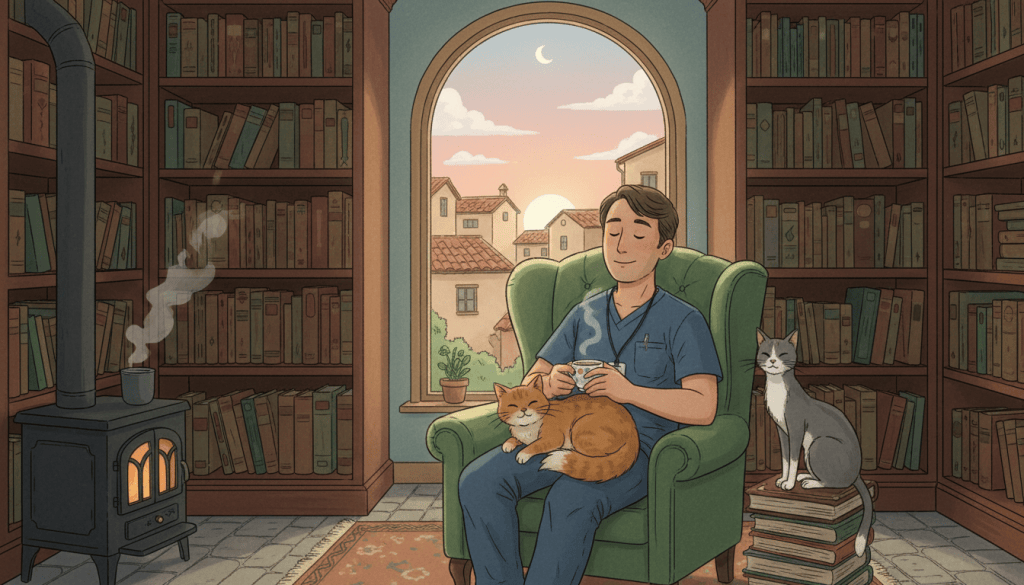
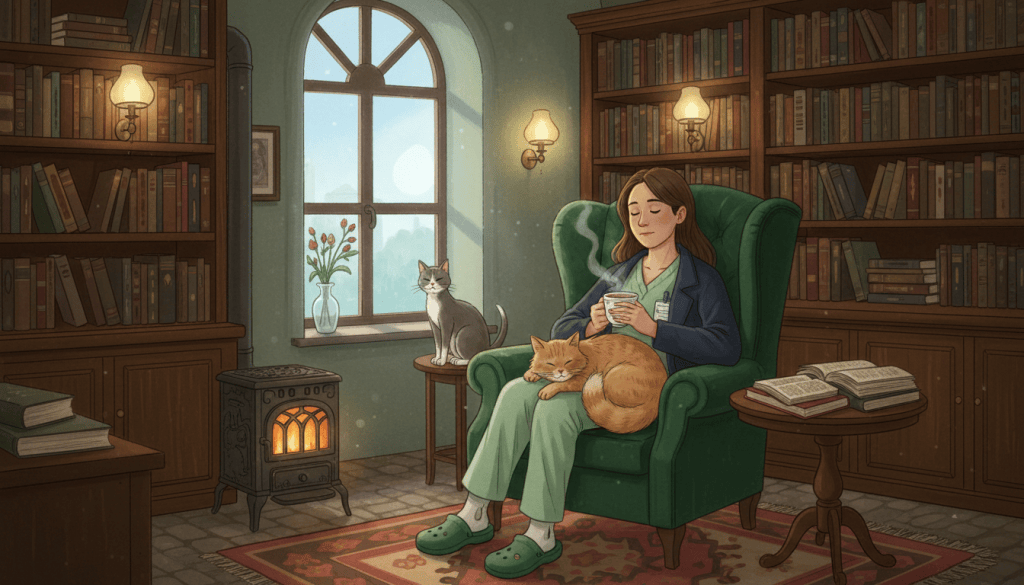
Through the glass, Moira saw a man standing on the pavement. He was somewhere in his late thirties, tall and a little stooped, in a dark blue tunic under an open waxed jacket, with a lanyard still hanging round his neck and a small hospital badge turning slowly on its cord. He had been walking, she thought, because his shoes were wet to the ankle. Now he had stopped in front of the window with his hands in his pockets, and he was looking, with great concentration, at a display of cookery books, as if he had never seen a cookery book before and was determined to understand the genre.
Ashwaganda, the fifteen-pound ginger tabby, was lying on the windowsill directly behind the cookery books. He opened one amber eye, looked at the man, and began, very faintly, to purr. Moira could not hear it through the glass, but she could see the whole great orange body begin to tremble, the way a kettle does just before it sings.
The man looked at the cat. The cat looked at the man. Then the man laughed, a short, startled, rusty laugh, as if the sound had not been used for a while, and he came to the door.
“I’m sorry,” he said, when Moira opened it. “I know you’re not open. I just wanted to look at the cat.”
“He has that effect,” said Moira. “The kettle is on. Come in and look at him properly. He is much more impressive from close up.”
A Quiet Ward and a Loud Bedroom
His name was Davide. He was a nurse at the hospice up the valley road, and he had worked nights there for three years. He told her this standing just inside the door, in the careful, flat voice people use when they have said a sentence many times in their head. Then Ashwaganda leapt down from the sill with a thump that shook the cookery books, wound twice around his ankles, and sat on his foot, and Davide gave up standing and let himself be steered towards the green armchair beside the stove.
“Twelve hours,” he said, folding into the chair. “Seven to seven, and then the handover, so really seven-forty. Eleven patients last night. Two of them were not expected to see the morning.” He paused. “They did. Both of them. That’s a good night, in our work. A good night is one where nobody is frightened.”
Toe came down the last of the stairs without a sound, crossed the floorboards and sat at Davide’s feet, looking up with his serious face. Ashwaganda, having claimed one foot, was now negotiating for the lap, and was granted it, with the grunt of a man being handed a sack of flour.
“So what brings you in off the road?” asked Moira gently. She did not ask it as a question that needed an answer. She asked it the way you leave a door ajar.
Davide looked at the cat for a while. “I live ten minutes from here, in the new flats behind the pharmacy. I have blackout curtains. I have earplugs. I have a very good mattress, because I spent a ridiculous amount of money on a very good mattress. And every morning I come home, and I get into bed, and I lie there.” He turned his hand over on the cat’s back. “I lie there for hours, listening to the whole world carry on. The dustbin lorry. The school bell. Someone drilling. Somebody’s radio. And I am so tired that my eyes ache, and I cannot go under. And then at about two in the afternoon I fall into a kind of grey half-sleep, and the alarm goes off at five, and I get up feeling worse than if I’d never lain down. And at seven I go back to work.”
“For how long?”
“Most of three years. It got worse this autumn.” He smiled, not very convincingly. “This morning I got as far as the front door of the flats. I could see my own bedroom window from the street. And I just couldn’t make myself go up there. So I walked. I don’t know where I thought I was going. And then I saw a cat in a window.”
“That is the correct reason to walk into a bookshop,” said Moira. “I have heard worse.”
The Tea of the Long Afternoon
She went behind the counter and took down three jars from the shelf that holds more jars than a chemist’s. The first held dried chamomile flowers, small and pale, like tiny fried eggs left out in the sun. The second held linden blossom, which the Italians call tiglio, the soft yellow-green flowers that every grandmother in the country keeps in a tin for evenings and for nerves. The third held a few fennel seeds, which she crushed lightly under the back of a spoon so that the whole shop filled with the smell of liquorice and warm bread.
“I should say first,” said Moira, pouring the water, “that I am a bookseller. I am not a doctor, or a nurse, or a sleep specialist, and a cup of tea is not going to repair three years of night shifts. What it can do is give your hands something warm to hold and your body a small signal that the working part of the day is finished. That is all. But I have found that small signals matter more than we like to admit.”
Davide took the cup in both hands. The steam rose between them, smelling of meadow and liquorice, and Ashwaganda, apparently approving of the arrangement, began to purr in earnest, that deep, rolling, floorboard-shaking purr which seems to come from somewhere underneath the shop rather than from the cat. For a long minute, nobody said anything. The stove ticked. Somewhere upstairs a shelf settled with a small wooden sigh.
“It’s strange,” Davide said at last. “People think the hard part of my job is the dying. And it is hard. But I have made my peace with that, mostly. The people I look after, in the last days, they are often so gentle with us. They hold your hand and tell you that you look tired.” He shook his head. “The thing that I can’t make peace with is the sleep. I used to be the kind of person who could fall asleep standing up. Now I am afraid of my own bed.”
“Afraid?”
“By about eleven in the morning, I’m dreading it. I start doing sums. If I fall asleep now, I get six hours. If I fall asleep at noon, five. If it’s two, three. And of course the sums keep me awake.” He laughed again, more softly. “I count what I haven’t slept. Like a miser.”
Toe, the grey cat, rose from the floor and climbed onto the arm of the chair, laid one white paw on Davide’s wrist and sat there, perfectly straight, like a small grey sentry.
What the Researchers Say, and What They Don’t
“I’m going to tell you a few things I have read,” said Moira, sitting on the footstool, “and I want you to hold them lightly, because I am a woman who reads a great deal and understands very little, and because your body is yours and your doctor knows it better than I do. But I have heard what you’ve described from other people, more than once. Nurses, doctors, ambulance drivers, the man who runs the night pharmacy in the valley.”
“People who work at night are asking their bodies to do something the body was not designed to do,” she said. “We have an internal clock, a rhythm that runs roughly on a twenty-four-hour cycle, and it likes light in the morning and dark in the evening. It is a very old clock. It does not read your rota. So when you come home at eight in the morning, with the whole sun pouring through the world, your body is receiving a thousand signals saying that it is time to be awake. It isn’t weakness that is keeping you up. It is the sun.”
Davide was listening very carefully, in the way tired people do, with the whole face.
“There are also reviews of the research on night-shift nurses in particular,” Moira went on, “which find that sleep problems are common in that group. That is what the literature says, as far as a bookseller can read it, and it is not an accident, and it is not a character flaw. It is a very ordinary hazard of a very necessary job.”
“That is oddly a relief,” said Davide. “I’ve been treating it as a personal failure. As if I was bad at sleeping.”
“You are not bad at sleeping. You are a person doing something difficult at the wrong time of day, for other people’s sake.” She paused. “I want to tell you about two pieces of research, and I will be honest about how far they go. They are about naps, and I know they may not solve your particular problem, but they changed the way I think about the whole question.”
“The first was done at Stanford, in an emergency department. A group of staff, nurses and doctors, forty-nine of them in all, worked a long overnight shift. Half were simply asked to carry on as normal. The other half were given a planned forty-minute nap at three in the morning. At the end of the shift, they were all tested, with a simulated drive, a memory test and a computer exercise in which they practised putting in a drip. The people who had napped showed fewer lapses in attention, and felt less tired and more alert, and in the driving simulation they were safer. About half of the nappers fell asleep in less than ten minutes.”
“A nap,” said Davide. “At work.”
“A planned one, agreed with the team. I should say these were simulations, not real patients, and I only know the study from the university’s own account of it, so I will not pretend to know more than that. But the idea was this: that a short, deliberate rest during the night, rather than a heroic refusal to rest, might help people to function, and to get home safely.”
“The second was an older study, by researchers at NASA, among long-haul flight crews. Some of the crew were given a planned forty-minute rest opportunity during the quiet cruise part of the flight. They fell asleep, on average, in about five minutes, and slept for about twenty-six minutes in all. Afterwards, they showed better alertness and performance than the crew who hadn’t rested, including at the demanding moments of descent and landing. And it did not seem to interfere with their sleep afterwards.”
Davide stared into his tea. “Nobody on my ward has ever napped,” he said. “It would be like confessing something. We stay awake because staying awake is the job. We drink coffee and we say we’re fine.”
“I know,” said Moira. “And I am not telling you that you should lie down on the sluice room floor. I am telling you that people who study this for a living have thought carefully about tired people doing important work, and the conclusion they came to was not ‘try harder.’ It was ‘rest on purpose.’”
Baldo and the Warm Bread
The bell above the door gave its soft, lingering note, and Baldo the baker put his head in, flour pale in the creases of his knuckles and a paper bag under his arm. He looked at the stranger in the navy tunic, at the cat in his lap, at the teapot and the two cups, and understood everything in the way people do in small villages.
“First batch,” he said, setting the bag on the counter. “Too good to sell to people who are awake.” And he was gone again before anyone could thank him, because Baldo believes that bread should be given quickly and talked about slowly.
Moira tore the loaf in half. The crust crackled and the steam climbed into the lamplight. Davide ate a piece standing up, then sat down, then ate another, and then looked at his own hand as if it had done something without asking him.
“I haven’t eaten properly in two days,” he said. “I mean a meal. Sitting down. I eat standing up in the kitchen at work, or in the car.”
“Then this is the first rule of the bookshop,” said Moira. “Nobody gets advice on an empty stomach.”
He laughed properly then, a real laugh, and the sound startled Toe so much that the grey cat’s ears went flat for a moment and then came slowly upright again. Ashwaganda, who had been asleep for several minutes with his chin on the tunic pocket, did not move at all. He had slept through three hours of a thunderstorm in August, and he had never been known to wake for a laugh.
The Wrong End of the Day
“There’s something else,” said Davide, more quietly. He was looking at the stove. “I’ve never said this to anyone. When I lie there in the mornings, I don’t only listen to the lorry. I think about the night. Every face. Every name. Whether I should have turned Signora Fontana an hour earlier, whether I spoke too quickly to her son. It all runs round and round, and the quiet in my flat makes it louder.”
“That is the part that I think a cup of tea can help with a little, and a bookshop can help with a little,” said Moira, “and a doctor or a counsellor can help with a great deal more, if it goes on. But I will tell you what I have noticed in the people who sit in that chair. Carers do their remembering at exactly the moment they are supposed to be resting. They carry the whole night home inside them, and then they try to lie down with it.”
“So what do I do with it?”
“I don’t know that there is a single answer. But in this shop, I would suggest giving it somewhere else to go before you go to bed. Not into your head, but out of it.” She got up and took a small notebook from the shelf behind the counter, a plain one with a green cloth cover, the kind she sells for a few euros. “Some people write it down, in the last few minutes before sleep. Not as a diary. As a handover. The way you hand over the ward at seven in the morning. ‘Here is what happened. Here is what is unfinished. I am handing it to the day staff, and I am going to bed.’”
Davide looked at the notebook for a long moment. “I do a handover every morning,” he said. “Twice a day, I give the ward to somebody else. I just never thought of doing it for myself.”
“You are very good at handing over,” said Moira. “I think you are better at it than any of us. I think you simply need to be on the receiving end of your own care.”
A Few Small Signals
When the bread was nearly gone and the second pot of tea had been poured, Moira tore a page from the back of the green notebook and wrote a short list in her careful bookseller’s hand, with Toe supervising from the arm of the chair. “I am a bookseller and not a clinician,” she said, “so these are not instructions. They are things that people who have sat in that chair have told me helped them feel a little less at war with the day.”
- Make the bedroom a small night. Dark curtains, a cool room, and whatever helps with noise: a fan, soft earplugs, a sign on the door for the family or the neighbours.
- Give your body a signal that the shift is over. A warm drink, a shower, a few minutes of quiet. The same ones, in the same order, every morning, so that the ritual does the thinking for you.
- Hand over the night before you lie down. A few lines in a notebook, or a sentence said aloud to someone you trust. Close the ward behind you.
- If your workplace allows it, ask about a short planned rest during the night. It is worth asking your manager or occupational health team, because a policy on rest breaks belongs to the workplace, not to the individual nurse.
- Eat something sitting down, even if it is only bread and cheese. Bodies that are fed can be a little kinder to the people inside them.
- Notice when it becomes weeks and months. If you can’t sleep, if you feel low, or if you are afraid of going to bed, please talk to your doctor or your occupational health service. That is not weakness. That is maintenance.
Davide read the list slowly, twice, with the careful, double reading of a man checking a drug chart. “Ask about a planned rest,” he said. “I’ve been on that ward three years. I never thought I could ask.”
“Carers are always the last people to ask for anything,” said Moira. “It is one of the strangest facts about caring. You will do a double shift for someone else, and you will not ask for ten minutes for yourself.”
The Chair That Asks for Nothing
It was a little after nine when Davide stood up. The sun had climbed above the roofs and was lying in broad gold bars across the floorboards now, picking out the dust in the air and turning Ashwaganda into a small orange lantern on the windowsill, where he had returned without anyone noticing, to resume his supervision of the street.
“I don’t feel like I could sleep,” Davide said, with a smile. “But I feel like I might be allowed to try.”
“That’s a good place to start,” said Moira.
At the door he stopped and turned, one hand on the frame. “The chair,” he said. “Can I come back for it? On the mornings when I can’t face the stairs?”
“The chair belongs to anyone who needs it,” said Moira. “The kettle belongs to me, and it is always on. And Toe has made his decision, I’m afraid, so you are stuck with us.”
Toe, on the arm of the chair, lifted one white paw and licked it with great dignity, in a manner suggesting that this was entirely correct.
A Fortnight Later
Two weeks passed, and the first frost came to Speranza, and the swallows’ old nests under the eaves of the church filled with silver. On a morning of low mist, a little before eight, Moira heard the bell above the door, and Ashwaganda raised his great head from the windowsill and made a small, pleased, chirruping noise he reserves for people he has already decided about.
Davide stood in the doorway. He was still in his tunic, still with the lanyard round his neck. But his shoulders were a little lower, and there was a little colour in his face, and he was carrying a paper bag from Baldo’s, and a small cloth parcel tied with string.
“I asked,” he said. “I asked the ward manager about a rest period on the quiet part of the night. I thought she’d laugh. She didn’t. She said she’d been waiting for someone to ask for two years, and that she would take it to the occupational health team.” He held up the parcel. “And I’ve been writing the handover. Every morning, in the green notebook. Some mornings it’s three lines. Some mornings it’s three pages. And I don’t sleep perfectly. I don’t think I’m ever going to sleep perfectly. But last Tuesday I slept for five hours, in the daytime, and nobody was drilling.”
“That,” said Moira, “is a very good Tuesday.”
“I brought you something.” He undid the string. Inside was a small jar of dried linden blossom, with a hand-lettered label. “My grandmother had a linden tree. My aunt still has it. I thought your shelf might have room.”
Moira took the jar and held it to the light. Then she put it, with great ceremony, on the shelf behind the counter, between the lemon balm and the chamomile, where it seemed instantly to have always been.
“Sit,” she said. “I’ll put the kettle on.”
He sat. Ashwaganda crossed the floor like a small ginger ship and settled into his lap, and Toe hopped onto the arm of the chair and laid one white paw on the tired wrist, and for a while, nobody in the shop said anything at all.
Moira’s Reflection
We tend to think of sleep as something you either have or you don’t, a private thing, a matter of willpower or a good mattress. But for the people who work through the night so that the rest of us can sleep, nurses, doctors, carers, paramedics, cleaners, porters, bakers, it is something far more difficult. It is a negotiation with the sun. And like most negotiations, it goes better with a little company, a little structure, and the permission to ask for what you need.
Davide did not find a cure in my bookshop. He found a chair, a notebook, a loaf of bread and a reason to ask a question he had been too tired to ask for three years. I think that is how most small changes begin: not with a revelation, but with a cat in a window and a kettle that is always on.
Do you work nights, or love someone who does? What helps you hand over the day, or the night, when you finally lie down? Tell us in the comments. Someone reading at three in the morning may be very glad of your answer.
A Cup for This Story
- 1 teaspoon dried chamomile flowers
- 1 teaspoon dried linden blossom (tiglio)
- 5 to 6 fennel seeds, lightly crushed
- 250 ml water just off the boil, steeped covered for 5 to 7 minutes, then strained
Herbal teas are a comforting ritual, not medicine. If you are pregnant, breastfeeding, taking medication or have a health condition, or if you are allergic to plants in the daisy family (chamomile belongs to it), check with your doctor or pharmacist first. If you are struggling with sleep or low mood, please talk to your doctor or your workplace support service.





Leave a Reply