How do you make a new friend when you are no longer young?
The Map With No Names
Nadia Bellandi had been in Speranza for forty-one days, and she knew the number exactly, because she was the kind of person who counted things. She counted the steps from her rented flat to the fountain (one hundred and twelve), the swallows on the wire above the pharmacy (it varied), and the number of people who had said more than “buongiorno” to her since she arrived. That last number was three. One of them had been a man selling lemons who had said, “These are not for eating, signora, these are for smelling,” and then laughed so hard at his own joke that she had not known whether to join in.
She was a cartographer. She drew maps for a company that sent her contracts by email and paid her by transfer, and in all the years of that work she had never needed to be anywhere in particular. She had chosen Speranza because it looked lovely in photographs: terracotta roofs stacked up a hillside, a bell tower slightly out of true, and a sea that appeared between the houses like a silver thread pulled through cloth. What the photographs did not show was how quiet it would be to arrive alone, with no one to tell what she had seen.
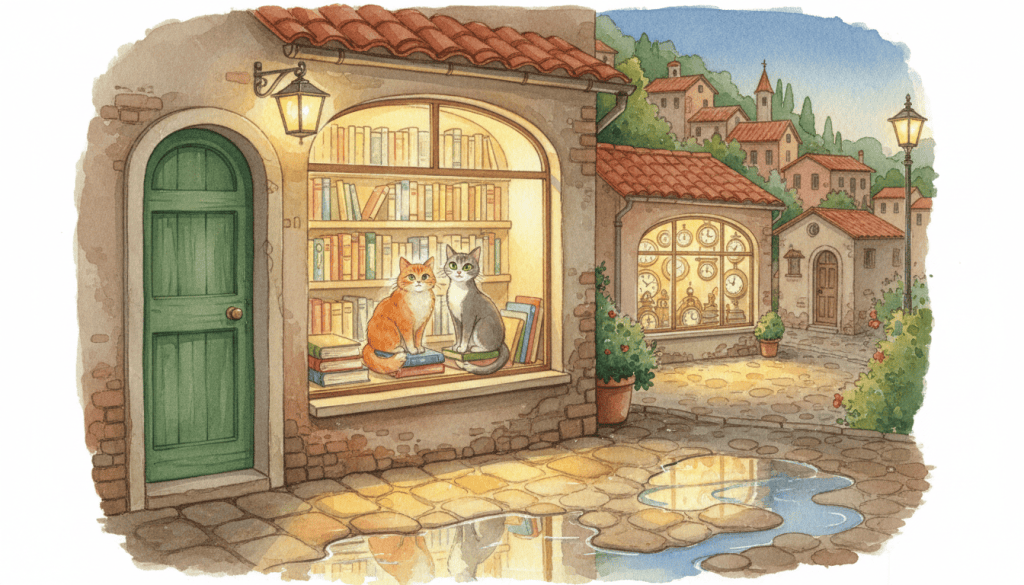
On a grey Tuesday afternoon in November, with the wind lifting the awnings along Via dell’Orologio, she was walking back from the post office with an empty envelope and a full chest. She had not meant to stop. But the rain began, the sort that comes sideways, and a small green door with a brass bell stood open exactly where she needed it.
Above the door, painted in curling gold letters, were the words La Pagina che Fa le Fusa.
The Shop That Purred
The bell gave a cheerful little shake as she stepped in, and the warmth of the place met her like a hand on the shoulder. There were shelves to the ceiling, a ladder on a brass rail, and lamps with fringed shades that made the whole room look as if it were holding its breath before a story. Somewhere a kettle was ticking as it cooled. The air smelled of paper, orange peel and something green and gentle that she could not name.
“Close the door behind you, please, or the rain will think it is invited,” said a voice from the back. “Although it is welcome to look through the window.”
A woman appeared from between two shelves, tall, with silver-streaked hair pinned up by what appeared to be a pencil, and a cardigan the colour of heather. Her sleeves were pushed to the elbows. She carried a stack of books against her hip and set them down on the counter with the ease of someone who had done it ten thousand times.
“I’m Moira,” she said. “Moira Hopes. This is my shop, and these are my colleagues.”
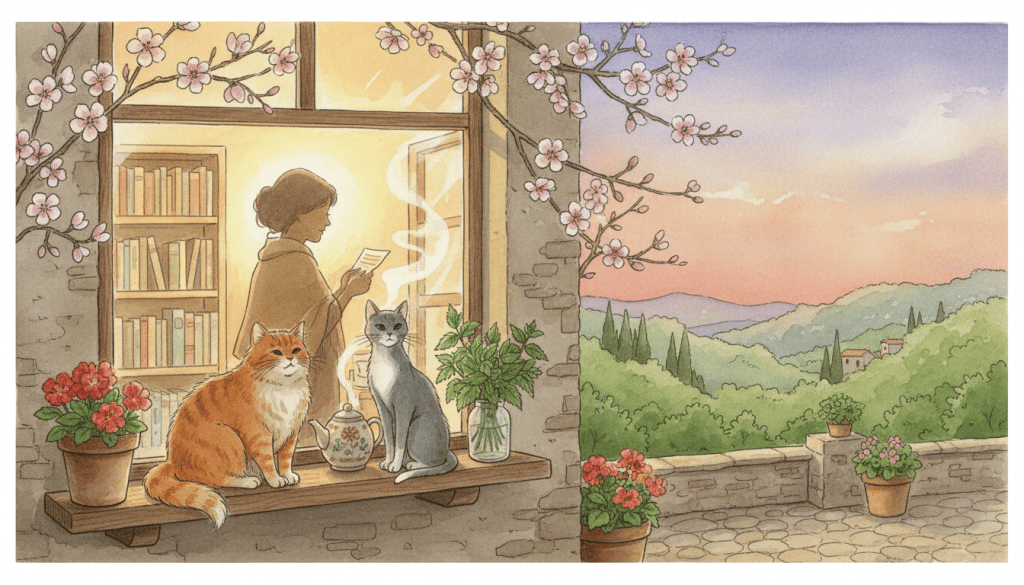
Nadia looked down. A vast ginger cat was lying across the middle of the rug like a rolled-up carpet that had decided to become sentient. As she watched, he opened one amber eye, assessed her, and let it close again. From the floor came a sound so low that she felt it in the soles of her shoes before she heard it, a slow, enormous hum, like a distant ship’s engine.
“That is Ashwaganda,” said Moira. “Fifteen pounds of ginger tabby, and the purr is about twenty-five hertz, which is lower than most cats manage. He does not do it for everyone. Consider yourself assessed and approved.”
“And that one?”
A slender grey cat sat on the windowsill with her paws tucked together, four immaculate white mittens, and green eyes the colour of sea glass. She was looking at Nadia the way a customs officer looks at a passport.
“That is Toe. She is still deciding. Do not take it personally. She decided about the postman in the fourth month.”
Nadia laughed, a short surprised sound, and then felt her eyes sting, which was ridiculous. She put it down to the wind.
Moira, who missed very little, did not remark on it. She only said, “You look as though you have walked a long way in a short distance. Come and sit. The kettle is warm, and I was about to make tea whether anyone came or not.”
A Question Over the Counter
There was a small round table in the corner of the shop, with two mismatched chairs and a lamp the shape of an upturned tulip. Nadia sat. Almost at once, Ashwaganda rose, stretched in the slow, thorough way of an old accordion, crossed the rug, and arranged himself against her feet with a grunt of deep contentment. The hum came up through her ankles and settled somewhere under her ribs.
“He has chosen you,” Moira said, setting out two cups. “It saves a great deal of conversation.”
“I’m not sure I’ve been chosen by anyone for a while,” said Nadia, and then, hearing it, shook her head. “Sorry. That sounded dramatic. I’m fine. I just moved here. I’m a cartographer. I work from home, which is to say I work from a flat with a very good view and no one in it.”
“Ah,” said Moira.
“I’m told it’s a lovely village. It is. Everyone’s perfectly kind. The baker calls me ‘the young lady from the north’, and I’m thirty-eight. But I don’t know how to turn kind into something else.” She turned her cup in her hands, though there was no tea in it yet. “I’ve always been good at maps. I can tell you where every road goes. But I have no idea how you make a friend. Not as a child, when you share a desk, but now, as a grown woman who doesn’t go to an office. Is there a method? Everyone else seems to have a thousand years of history with each other, and I feel as if I’m standing outside a lit window.”
Moira was quiet for a moment, in the unhurried way of someone who treats a question as a guest rather than a problem. On the sill, Toe’s ears turned a fraction.
“Nobody has ever asked me that quite so plainly,” Moira said at last. “I think it is the most honest question of the year. Let me make the tea first. A question like that deserves a proper cup.”
The Tea for Standing Outside Lit Windows
The kettle clicked. Moira moved along her shelf of jars like a conductor going down a row of strings, and Nadia, watching, found that she was breathing more slowly.
“For someone who is tired of being brave in a quiet way,” Moira said, “I think a warm, round blend. Rooibos for the base, which is soft and a little sweet and has no caffeine to keep your mind spinning. Dried orange peel, for brightness. One stick of cinnamon, for the feeling of a coat that has been left on a radiator. And a pinch of fennel seed, because it makes a cup feel as though it has been made for company.”
She poured. The tea came out the colour of an amber window, and a thread of steam rose and turned in the lamplight.
Nadia wrapped her hands around the cup. It was almost too hot, and she was grateful for it.
“There is no medicine in this,” Moira added with a smile. “I want to be clear. It will not fix loneliness. Tea is simply a good excuse to sit still for ten minutes in the company of another person. That part is real, and it matters.”
Nadia sipped. The orange arrived first, bright and clean, and then the warmth of the cinnamon rolled in behind it. She sat back, and the chair seemed to remember her.
At her feet, Ashwaganda’s purr deepened by a note.
What Toe Brought
For a while they simply drank, and the rain made patterns on the glass. Moira did not rush to fill the quiet. Nadia noticed, with some surprise, that it did not feel like the quiet of her flat. This one had people in it.
There was a small soft thud on the table. Nadia looked down.
Toe had crossed the room without a sound and was now sitting at the edge of the table, one white paw resting on a bookmark that she had apparently fetched from the shelf behind the counter. It was a strip of old card, a little frayed, with a tiny hand-drawn compass rose in the corner. She placed it, with great seriousness, in front of Nadia’s saucer, and looked up with her sea-glass eyes.
“Well,” said Moira softly. “She has decided.”
“What does it mean?”
“It means you are not outside the window anymore, or at least that one of us has opened it.” Moira’s eyes were bright. “Toe brings that bookmark to people she thinks will come back. She has done it four times in six years. The last was a retired schoolteacher who now comes in every Thursday to read the newspaper aloud to the cats, and is, I believe, the happiest I have ever seen her.”
Nadia picked up the bookmark. The compass rose had been drawn by someone with a patient hand. She ran her thumb over it, and her throat did something complicated.
“I’ve never had a cat,” she said. “I’ve always thought I wasn’t the sort of person animals choose.”
“Animals are very honest about who is paying attention,” said Moira. “That is usually the whole secret. People are a little slower, but they are rather the same.”
How Long It Really Takes
Moira topped up both cups and sat back, pulling her cardigan around her. Ashwaganda, evidently feeling that the conversation was now reaching its proper subject, rolled onto one side and offered his stomach to the rug.
“You asked if there is a method,” she said. “I am a bookseller, not a scientist, so I will tell you only what I have read, and I will tell you where I am unsure. But there is some research that I find rather comforting.”
Nadia leaned in. A mapmaker, Moira thought, would always want to see the evidence.
“A few years ago, a researcher named Jeffrey Hall, at the University of Kansas, studied how much time it takes for people to become friends. He followed adults who had recently moved to a new place, and he asked them to keep track of their hours with new acquaintances. The estimate that came out of it, and I should say this is one study, so it is a rough guide and not a law of nature, was that it takes something like fifty hours together to move from acquaintance to casual friend. Around ninety hours to become a friend. And more than two hundred hours to become a close one.”
“Two hundred hours,” Nadia repeated.
“The important part is what the hours were made of. It was not only big, dramatic conversations. A lot of it was ordinary time, together, doing small things, with a little talk in between. Time spent in the same room, with a task or a pause to share.” Moira lifted her cup. “Which means, you see, that nobody is born knowing how to make a friend. We simply accumulate hours, and we are often too impatient, or too shy, to let the hours build.”
Nadia was silent for a long moment. “So I haven’t been doing it wrong. I’ve just only logged a few hours.”
“You have logged forty-one days of walking past people,” Moira said gently. “That is not nothing. That is, in fact, the beginning of something.”
The Quiet Power of Seeing the Same Faces
“There is a second thing,” Moira said. “And this one is older and rather lovely. Back in the sixties, a psychologist named Robert Zajonc described what has come to be called the mere exposure effect. Roughly, it says that we tend to feel a little warmer toward things and people we have simply seen again and again, even when nothing in particular has happened between us.”
“The baker,” said Nadia slowly. “The man with the lemons.”
“Quite possibly. When you pass them every day, something in you is already making a small, quiet place for them. And, hopefully, something in them is doing the same for you. Researchers have also found, and again I would hedge, because people differ enormously, that even brief, friendly exchanges with the people we see regularly, the baker, the neighbour, the person at the post office, are linked to feeling more connected and more at ease in a place. They call these weak ties, and for a long time people underestimated how much they matter.”
She smiled. “I have lived here for twenty-two years. I can tell you that every close friend I have began as a weak tie. A nod, a joke, a borrowed umbrella. Nothing at all that looked like the start of anything.”
Nadia looked at the compass rose in her hand. “I think I’ve been waiting for a friendship to arrive all at once, like a parcel. I didn’t realise it might be something I’d have to build from small pieces.”
“Most things worth having are,” said Moira. “That is the part nobody puts in the photographs.”
Ashwaganda gave a slow, rumbling sigh against her feet, as if to confirm every word.
A Problem of Cartography
They sat for a while without speaking, and the rain softened to a patter.
“May I ask you something practical?” said Moira. “What is your work, exactly? A cartographer, you said. What do you map?”
“Mostly coastlines, for a shipping firm. Sometimes city plans for tourists.” Nadia hesitated. “Lately I’ve been drawing in the evenings, for myself. I started a map of Speranza. But it has no names on it. I don’t know any, so I just draw the streets and leave the labels blank. It looks rather sad, actually. A map of a village where nobody lives.”
Moira’s eyes lit as if a lamp had been turned up inside her.
“Nadia,” she said, “do you know Signor Corrado?”
“The clock-mender? On this street? I’ve walked past his shop. He has about forty clocks in the window, and none of them agree.”
“They are not supposed to agree. He says each clock keeps its own opinion.” Moira laughed. “He is eighty-one. His wife died three winters ago, and he has been telling me for a year that the tourists never find his shop because there is no decent map of the old town. The council’s leaflet has Via dell’Orologio drawn as a little line with no names at all, and half the shops left off. He mutters about it every time he buys a book.”
Nadia sat very still.
“I am not telling you what to do,” said Moira. “I would never. A friendship is not a project, and I would be horrified if you walked into his shop to cure his loneliness, or yours. But I will say this. You have a skill that this village needs. And skills, I have noticed, are the most dignified way to meet people, because they give both of you something to look at together, instead of at each other.”
“Looking at the same thing,” said Nadia slowly, “instead of at each other. That is much easier.”
“It is much easier for almost everyone. There is a reason the old friendships tend to form over shared work, a shared table, a shared garden wall.” Moira tipped her head. “Researchers who study friendship often point out that it tends to grow in the space where people repeatedly meet and share something, rather than from effort aimed at the friendship itself. So you give the hours something to do.”
Nadia looked down at the half-drawn map folded in her bag, and for the first time in forty-one days, it did not look sad. It looked unfinished, which was a different thing entirely.
The Third Cup
Moira refilled the pot, and for a while they spoke of smaller things: of the best way to carry a map in the rain (inside your coat, against the heart, apparently), of the baker’s famous cousin who had once lost an argument with a goat, of how the bell tower had leaned a little further each decade and the village had grown fond of the lean.
Toe left the sill, walked along the back of Nadia’s chair, and arranged herself on the cushion beside her, so close that a white paw rested against Nadia’s sleeve. It was the lightest weight imaginable, and it felt like being trusted with something.
Nadia found she had stopped counting. Not the steps, not the swallows, not the hours. She simply sat in the lamplight, between a purring giant and a grey cat who had made up her mind, drinking orange-and-cinnamon tea, and it occurred to her that she was, at that moment, exactly where a person might be if she were part of a village.
“I think,” she said carefully, “that I have been waiting to feel like I belong, and then planning to start talking to people. And it may be the other way around.”
“I believe it usually is,” Moira said. “You do not wait to belong and then join in. You join in, in small, slightly awkward ways, and the belonging sneaks up on you while you are looking at something else.”
Via dell’Orologio
The rain stopped, the way it does in Speranza, all at once, as if somebody upstairs had closed a tap. Pale gold light slid across the cobbles, and every puddle on the street held a little piece of sky.
Nadia stood at the shop door with her bag over her shoulder and the compass-rose bookmark tucked safely into her coat pocket, against her heart, where Moira had advised.
“I am going to go and look at the clocks,” she said. It sounded absurd and brave. “I’m not going to say anything clever. I’ll just say I draw maps and that the old-town leaflet is wrong. And that I could make him a better one.”
“That is a perfect thing to say,” said Moira. “It is true, it is useful, and it leaves room for him to say something back.”
“And if he says no?”
“Then you will have logged a nice small conversation with a clock-mender, which is a perfectly good hour.” Moira smiled. “And Thursday is the schoolteacher’s day for reading to the cats. You are very welcome to come and listen. No obligation. Ashwaganda requires an audience, and Toe is a stern critic.”
On the rug, Ashwaganda lifted his massive head, blinked once, and let out a short rumble that was unmistakably an endorsement.
Nadia laughed, properly this time, the sound loosened and warm, and stepped out into the washed-clean street. The air smelled of wet stone and bread. A short way up the hill, forty clocks sat in a window, quarrelling softly about the time, and a light was on behind them.
She walked towards it, and counted nothing at all.
Moira stood in the doorway until the grey coat had turned the corner by the pharmacy. Then she went back inside, where Toe had already moved to the warm cushion Nadia had left, and Ashwaganda was rearranging himself across the rug with the air of a cat who has done his shift and would like it noted.
“Well,” said Moira, to both of them. “That went rather nicely.”
Toe washed one white paw, which, in her language, was applause.
Moira’s Reflection
I have come to think that loneliness is rarely a shortage of kind people. It is more often a shortage of hours, and of a reason to spend them together. We tend to imagine friendship as a lightning strike, when most of the time it is closer to a slow warm tide: a nod, a repeated hello, a shared task, a cup of something hot, and the same faces on the same street until one day they are simply yours. The research I mentioned is only a rough guide, and people differ a great deal, but I find it kind. It says that it takes time, and that nobody is doing it wrong simply because it has not happened yet.
If you are standing outside a lit window tonight, you do not need to be braver than you are. You only need one small thing to do next to someone: say good morning again, ask about the clocks, carry the map. The belonging sneaks up on you while you are looking at something else. And if it feels slow, remember that every close friend anyone has ever had began, once, as a stranger on the same street.
What is one small thing you could do this week to add an hour to a friendship that is just beginning? We would love to hear it in the comments, and if you have a story of how a friendship grew from something small, Moira and the cats would very much like to read it.
A Cup for This Story
- 1 heaped teaspoon of rooibos
- A few strips of dried orange peel (or a thin curl of fresh peel)
- 1 small cinnamon stick
- A pinch (about ten) of fennel seeds, lightly crushed
- 250 ml of just-boiled water; steep for 5 to 6 minutes, then sip slowly with a friend or a cat nearby
Herbal teas are a comforting ritual, not a medicine, and they are not a substitute for professional advice if you are struggling.
Press Play and Stay a While
If you have a few quiet minutes, press play on the little song below and let the village hum along while your tea cools.




Leave a Reply