Calm for Carers · Story 1. For everyone who spends their days holding other people together.
The Woman in the Green Clogs
It was a quarter past seven in the morning, which is not an hour when bookshops are open, and Moira Hopes would never have noticed the woman at all if Ashwaganda had not been sitting in the window.
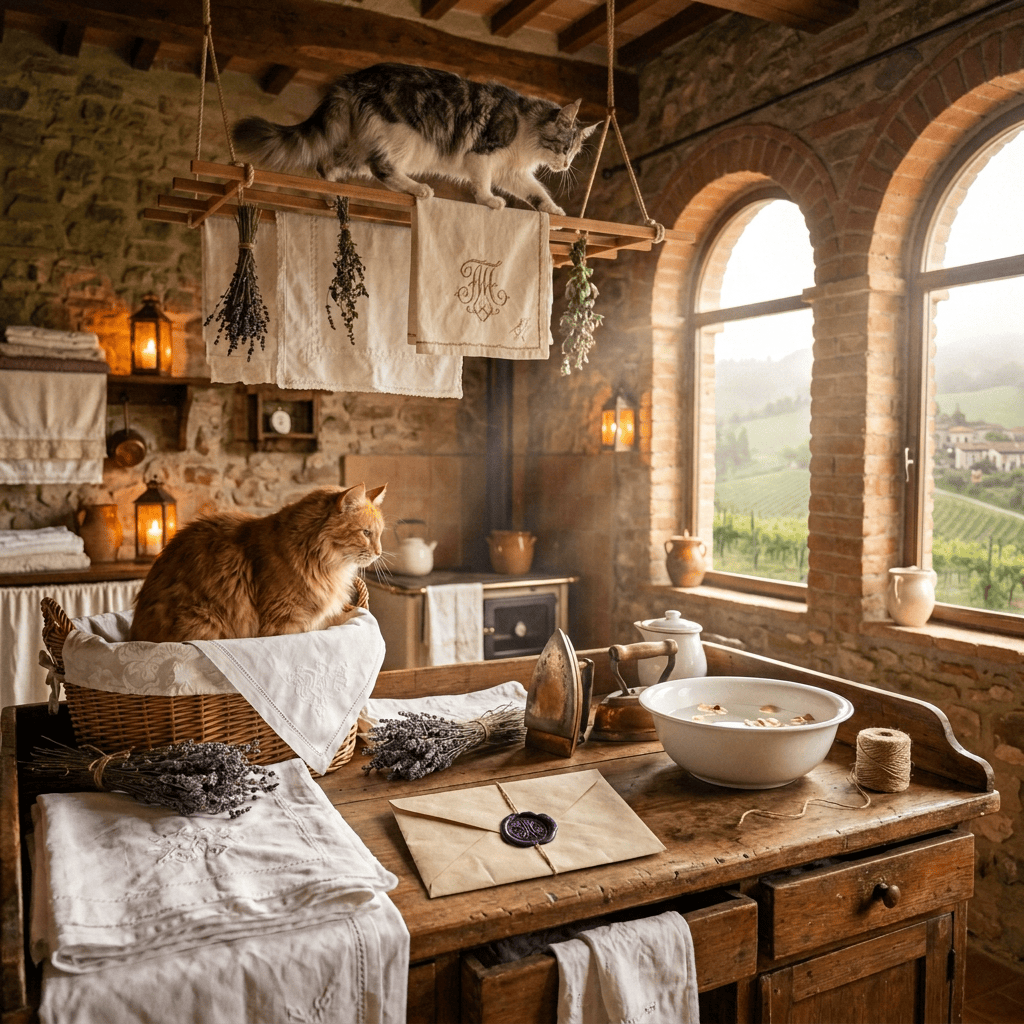
The ginger cat had been there since dawn, fifteen pounds of orange patience arranged on the sill like a loaf left to rise, watching the street. And on the bench across Via dell’Orologio, under the clock that has been four minutes slow since before anyone can remember, sat a woman in a navy coat thrown over pale green hospital scrubs, with a pair of green rubber clogs on her feet. She was not reading. She was not looking at her phone. She was simply looking at the cat, the way a person looks at a fire.
Moira watched her for a full minute through the glass. Then she unlocked the door, put her head out into the cold, and said, “The kettle is already on. It seems a waste to boil it for one.”
The woman blinked, as if surprised to be seen. “I’m fine,” she said, automatically. “I’m just waiting for the bus.”
“The first bus to the valley leaves at eight-ten,” said Moira. “And the cat would very much like to meet you. He has been staring at you since six.”
That made the woman laugh, a small, tired, surprised laugh, and she stood up.
Twelve Hours Under the Lights
Her name was Chiara. She was a scrub nurse at the hospital in the valley, and she had just finished a night shift that had begun at seven the previous evening and had not, at any point, slowed down. She said all this in short sentences, sitting in the green armchair by the stove, still wearing her clogs, while Ashwaganda climbed into her lap with the care of a cat who knows exactly how much he weighs.
“A road accident around midnight,” she said. “Then an emergency caesarean. Then a long one, nearly five hours, a man about my father’s age.” She stopped. Her hand found the cat’s back and stayed there. “We did everything. Everyone did everything right. And at a quarter past five the surgeon put down his instruments and said the time out loud, and we all stood there for a second, and then the phone rang for the next case and we cleaned the room and started again.”
Toe, the slender grey cat with the immaculate white paws, came down the stairs from the poetry loft, crossed the floor without a sound and sat at her feet, looking up at her with his serious green eyes.
“I’ve done this job for nineteen years,” Chiara said. “I’m good at it. I am calm when everyone else is shouting. I know where every instrument is before the surgeon asks. But this morning I walked out of the hospital and I couldn’t remember which way my car was. I just walked until I sat down on that bench. And I’ve been sitting there for an hour, looking at your cat, because he was the only thing in the world that didn’t need anything from me.”
“He is very good at not needing things,” said Moira. “Apart from breakfast. Let me make you something.”
A Tea for the End of a Long Night
Moira took down three jars. Lemon balm, the soft green leaf that smells faintly of lemons and summer, and that herbalists have used for centuries as a gentle calmer of nerves. A pinch of dried lavender, purple and fragrant. And a curl of dried orange peel, for brightness, because, as she said, “after a night like that you need something that tastes like morning.”
“I should tell you,” said Moira as she poured the water, “that tea will not fix anything. I am a bookseller. But a warm cup gives your hands something to hold while the rest of you catches up. And you have been holding things all night.”
Chiara held the cup with both hands and breathed in the steam. Ashwaganda began to purr, that low, steady rumble that seems to come from the floorboards rather than from the cat.
“Can I ask you something?” Chiara said. “Is it normal to feel nothing? Not sad. Not anything. Just empty. Like someone turned the volume down inside me.”
The Cost of Caring
Moira sat down on the footstool. She did not answer quickly.
“I’m not a doctor or a psychologist,” she said, “so please take this as a friend’s reading, not a diagnosis. But I have read a little, because many people who work in hospitals end up in that chair. There is a name researchers use for something like what you describe. Compassion fatigue. It was written about by a psychologist called Charles Figley, among others. The idea is that people who spend their working lives caring for others who are suffering can, over time, become emotionally exhausted by that care. Not because they care too little. Because they have cared so much, for so long, without enough chance to recover.”
“That’s not the same as burnout?”
“They overlap, and people argue about the edges. Burnout, as researchers like Christina Maslach describe it, is usually linked to the conditions of the work itself: exhaustion, a growing distance from the job, a sense that what you do doesn’t count. Compassion fatigue is more about the weight of other people’s pain. Many carers feel a bit of both. The important thing, I think, is that neither is a personal failing. Both are what happens when a person keeps giving and nobody refills the cup.”
Chiara looked down at her own cup, and then laughed despite herself. “That’s a very bookseller thing to say.”
“It is a very true thing to say,” said Moira. “Drink.”
The Pause
For a while they sat in silence. Outside, the town was waking up: a shutter going up at the bakery, a bicycle bell, the clock grinding toward the half hour. Toe jumped onto the arm of the chair and laid one white paw on Chiara’s wrist, as if checking her pulse.
“You said something earlier,” Moira said gently. “That when the surgeon said the time, you all stood there for a second, and then the phone rang.”
“There’s never time,” said Chiara. “There’s always the next patient.”
“I once read about a nurse in an emergency department in the United States, Jonathan Bartels, who started something he called The Pause. After a patient died, the team would stop for a few seconds, fifteen or thirty, and stand in silence to honour the person and the effort everyone had made. That’s all. No speeches. Some hospitals have taken it up since. People who practise it say it helps them close one door before opening the next, instead of carrying every unfinished moment home with them. I can’t tell you it works for everyone. But I liked the idea that even in the busiest place in the world, thirty seconds can be found.”
Chiara was quiet for a long moment. “We never did that,” she said. “Not once in nineteen years. We just clean the room.”
“Then perhaps,” said Moira, “we could do it now. For the man who was about your father’s age. And for the team that tried so hard.”
And so, in a small bookshop in Speranza, at twenty-five past seven on a cold morning, a scrub nurse and a bookseller sat in silence for thirty seconds, while a ginger cat purred and a grey cat kept one white paw on a tired wrist. When it was over, Chiara wiped her eyes with the back of her hand and said, very quietly, “Thank you.” And something in her face, Moira thought, came back on, the way a lamp does when the power returns.
Who Takes Care of the Carers?
“Can I tell you what I think?” said Moira, refilling both cups. “You are very good at taking care of people. You have probably been the calm one in every room for nineteen years. But calm people are often the last to ask for anything. So here is a small list, from a bookseller who has no authority whatsoever.”
- Close the door before you open the next one. If your team can’t pause together, take thirty seconds alone in the corridor. It counts.
- Have one place that needs nothing from you. A bench, a garden, a bookshop with a cat. Go there on purpose, not only by accident.
- Tell one person. Not everything. Just “it was a hard night.” Carers often carry things in silence because they think everyone else is carrying more.
- Notice when empty becomes a habit. One numb morning is a long night. Weeks of it deserve a conversation with your doctor or the support service at your hospital. That is not weakness. That is maintenance.
Chiara read the list twice, as if memorising an instrument tray. Then she gently lifted Ashwaganda, who protested in a long, offended rumble, and set him back on the windowsill.
“My car is in the hospital car park,” she said, smiling for the first time. “I remember now.”
At the door she turned. “The bench,” she said. “Can I come back to the bench? After the bad nights?”
“The bench belongs to the town,” said Moira. “But the kettle is mine. And it is always on.”
Moira’s Reflection
We admire people who care for others: nurses, doctors, parents, those who look after an ill partner or an ageing mother. We call them strong, and we mean it kindly. But “strong” can quietly become a reason never to ask how they are. The truth is that caring is work, and like all work it needs rest, recovery and someone who notices. Thirty seconds of silence, a cup of tea, a cat that asks for nothing: small things, but small things done on purpose are how carers stay whole.
Do you look after others, at work or at home? What helps you close the door after a hard day? Tell us in the comments. Someone reading may need your answer.
A Cup for This Story
- 1 heaped teaspoon dried lemon balm
- 1 small pinch dried culinary lavender
- 1 small curl of dried orange peel
- 250 ml water just off the boil, steeped covered for 5 to 7 minutes
Herbal teas are a comforting ritual, not medicine. If you are pregnant, breastfeeding, taking medication or have a health condition, check with your doctor or pharmacist first. If you are struggling, please talk to your doctor or your workplace support service.







Leave a Reply