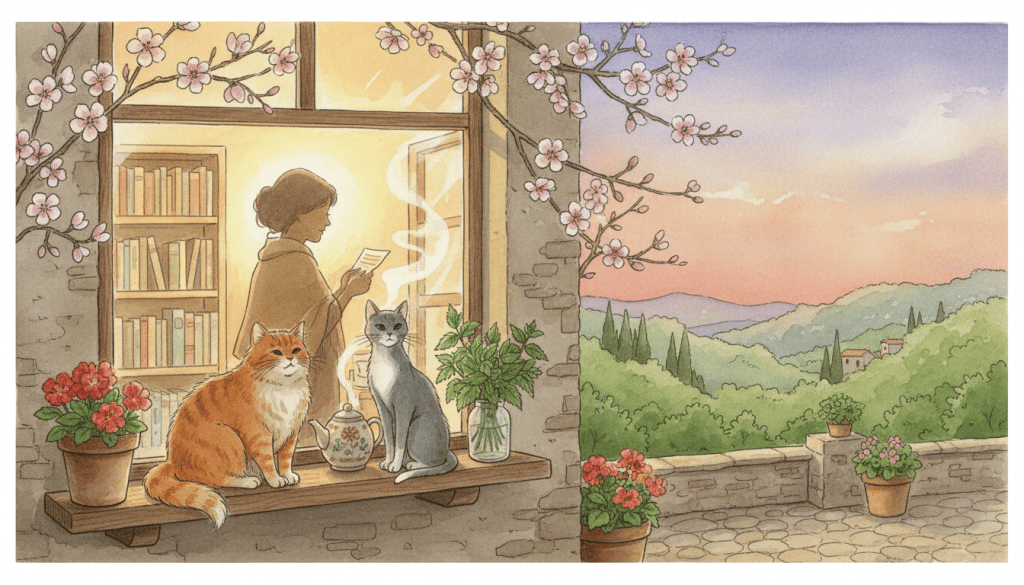
A cozy bedtime story from the village of Speranza, told in five visits.
The First Sunday: A Calendar With Too Many Squares
The woman who came into La Pagina che Fa le Fusa on the last Sunday of February was carrying a wall calendar rolled up like a baton. She had pushed the door open with her shoulder, because both hands were busy, and the little bell above it gave a startled jingle.
Moira Hopes looked up from the counter, where she was pricing a box of secondhand poetry. On the windowsill behind her, Ashwaganda, a fifteen-pound ginger tabby with the dignity of a retired bishop, opened one eye and closed it again. Toe, the slender grey cat with white paws, did the opposite. She slid off her cushion, crossed the floor without a sound, and sat down exactly one metre from the visitor’s shoes.
“I need a long book,” the woman said. She was perhaps fifty-eight, with silver hair pinned up in a hurry and the kind of tidy coat that people wear when they are holding themselves together by the buttons. “A very long book. One that will last until the twenty-first of March.”
“That is twenty-one days away,” said Moira, who had counted on the shop calendar without meaning to. “Do you read fast?”
“I read nothing at all,” the woman said. “I buy books and I put them on the table and I look at them. My name is Agnese. My husband is chief engineer on a cargo ship. He has been away since the beginning of October, and on the first day of spring his ship is due in Genoa.” She unrolled the calendar on the counter. Every square up to that Sunday had been crossed out in red pencil, firmly, as if each one had personally offended her. The squares ahead were bare except for one, ringed three times in green: Tullio.
“I came to Speranza because my sister told me you make tea for people who cannot sit still,” Agnese went on. “I can sit. That is the problem. I sit for hours. I have forgotten what I used to do with the hours when he was here. The house is very clean. I have cleaned it four times. I have stopped cooking properly because it feels ridiculous to roast a chicken for one. I just wait. And the waiting is so heavy that I cannot lift anything else.”
Moira did not say anything wise. She said, “Come and sit by the stove,” and she put the kettle on.
The tea she chose that afternoon was nothing grand: dried nettle leaf, a little dried peppermint, and a thin curl of lemon peel. It smelled of green fields after rain, with a clean cool edge on top. “Nettle is a spring plant,” Moira said, setting the cup in Agnese’s hands. “The first thing to come up green when everything else is still deciding. It seemed right for someone who is waiting for spring. It also tastes better than it sounds, I promise.”
Agnese drank. Toe, having inspected the shoes, climbed into her lap with the confidence of an inspector who has passed the paperwork. Agnese laughed, a small surprised sound, and said that Tullio’s last cat had done exactly that to him in 1998.
It was the first time in weeks that she had mentioned him without her voice going flat.
Why Waiting Feels Like Holding Your Breath
Agnese stayed until the light went blue in the window. By then she had told Moira the whole shape of it: thirty-one years of marriage, and for twenty-two of them Tullio had spent months at a time at sea. She knew the routine. She knew how to do it. This time, though, there had been two postponed arrivals already, a bad connection that cut his messages into fragments, and a feeling she could not name.
“It is the not-knowing,” she said. “If someone told me he would be back on the twenty-first, or even the twenty-fifth, I could plan. If someone told me it would be April, I could be sad and then get on with it. But it is this: maybe the twenty-first, maybe not, depends on the weather and the port and a hundred things nobody can tell me.”
“You have described it better than most textbooks,” said Moira, and she meant it. “There is a piece of research I think of when people tell me this. A team at University College London, in 2016, put volunteers in a computer game where they turned over rocks, and under some of them there was a snake that delivered a mild but unpleasant electric shock. They measured the volunteers’ stress through their pupils, their sweat, and their reports. What surprised the researchers was that people were most stressed not when a shock was certain, but when the odds were fifty-fifty. Uncertainty itself seemed to be the heaviest part.”
“So I am not being silly,” said Agnese.
“You are not being silly. It was a small laboratory study, and a rock game is not a marriage, so I would not press it too hard. But it fits what many people feel when they wait for news. It is not the length of the wait that wears you down so much as the not being able to see the end of it.”
Agnese looked at the calendar on the counter, with its bare squares and its triple green ring. “Then I have been making it worse. Every morning I check the ship’s position on the little website. Every evening I check it again. Sometimes at night.”
“Checking is very human,” said Moira. “It feels like doing something. But I wonder whether it keeps the uncertainty fresh instead of settling it. What if you gave yourself two checks a day, at times you choose, and the rest of the day was for something else?”
Agnese did not promise. She bought one very long novel, a Russian one with a family tree at the front, and she left with her calendar rolled under her arm and a paper bag of dried nettle and mint. At the door she stopped. “Moira? Does the tea work?”
“It is a warm cup and a green smell and ten minutes with your hands busy,” said Moira. “That is all it promises. The rest is up to you and the long Russian novel.”
The Second Sunday: Gloves
A week later, Agnese came back with scratched knuckles and a basket.
“I have not read the novel,” she announced. “I have read eleven pages of the novel. But I went out to the edge of the vegetable plot, where Tullio’s mother always let the nettles grow, and they are up. Small and very green, the new tops. I picked them with the kitchen gloves and I cursed the whole time. I made a frittata. I ate the whole thing standing at the counter and it was the best thing I have eaten since October.”
“Young nettle tops are lovely cooked,” said Moira. “The sting disappears completely with heat. In the Italian countryside people have always put them into frittate, risotto and fillings for fresh pasta, usually in the first weeks of spring when little else is growing.”
“I felt ridiculous,” said Agnese. “Standing in the mud with scissors, talking to a weed.”
“What did you say to the weed?”
Agnese went pink. “That Tullio would be furious if I let it take over the tomato bed.”
Ashwaganda, on the windowsill, made the low rumbling noise that Moira had long ago decided was approval. Toe was already on Agnese’s lap.
They talked, that Sunday, about the thing Moira had been turning over all week. “There is an old finding in economics that I find tender,” she said. “In 1987 a researcher named George Loewenstein published a paper called Anticipation and the Valuation of Delayed Consumption. In one of his experiments he asked students how much they would pay for a kiss from the film star of their choice, at different times. Many of them said they would pay more for a kiss three days from now than for one immediately. The waiting itself, the thinking about it, had value.”
Agnese raised an eyebrow. “You are telling me to enjoy this.”
“I am telling you nothing of the kind. Waiting for a man who may be delayed at sea is not a thought experiment about film stars, and it can be hard and lonely whatever the economists say. But I do think there is a small door in there. Psychologists who study what they call savouring, Fred Bryant and Joseph Veroff among them, describe anticipation as one of the ways people can notice and stretch good feelings, looking forward on purpose instead of only enduring the gap. It does not take the ache away. It just lets something else sit beside it.”
“What would something else look like?” asked Agnese.
“You tell me. What did he like, when he came home?”
Agnese was quiet for a while, stroking the grey cat. “He likes bread with oil and salt,” she said at last. “Very simple. Always the first thing, before he even takes off his boots. And he likes the radio on. And he likes to open every window, even in March, because the cabin on the ship has one tiny porthole.”
“Then you have a list,” said Moira. “Not a calendar of days to cross out. A list of things to get ready.”
The Third Sunday: Very Short
On the third Sunday Agnese did not stay for tea. She stood at the door with her coat still on and said, “Two checks a day. Nine in the morning and six in the evening. I wrote it on the fridge.” Then she held up a long envelope. “And I am writing him a letter, a real one, on paper. He will not read it until he is home, which makes no sense, but I find I am saying things to the paper that I cannot say on the telephone.”
“What kind of things?”
“That I was angry with him for going, in October. I never told him. I was too busy being brave.”
She left before Moira could answer. Through the window they watched her walk down Via dell’Orologio with her shoulders a little lower than before, and the almond tree by the church, which had been bare the week before, had tiny white flecks along the highest branches.
The Fourth Sunday: The Day the Square Moved
The fourth Sunday was grey and the wind rattled the shutters on the clock tower. Agnese arrived at ten past four with her umbrella inside out, and she did not take off her coat. Moira put the kettle on without asking.
“Four days,” Agnese said. Her voice was thin and level. “A storm in the Bay of Biscay and a berth that is not free. The new date is the twenty-fifth. Maybe.”
She did not cry. She sat very straight, and Toe climbed into her lap and she held onto the cat the way you hold onto a railing.
Moira thought of several things she could say. That four days was not so long. That ships are delayed all the time. That the sea has its own calendar. All of it was true, and none of it would have been welcome, so she said nothing and poured the tea. Ashwaganda heaved himself off the windowsill, which he did perhaps twice a year, walked over with the swaying gait of a small ginger barrel, and leaned his whole weight against Agnese’s shin.
“I made the bread,” Agnese said eventually. “Yesterday. I made it for the twenty-first because I thought, it will be ready for him. And now it is stale and he is not here. I threw it to the sparrows and then I stood in the kitchen and I could not see properly.”
“That sounds very hard,” said Moira.
“Yes. It is.” Agnese drank her tea and looked into the cup for a long time. “I think I had put all of myself into one date, and the date moved. Is that what you were telling me? That a date is a thin thing to stand on?”
“I think a date can be a lovely thing to look toward,” said Moira, carefully. “It is just not a place to live. You have been living somewhere else for four weeks, Agnese. You picked nettles. You wrote a letter. You told him you were angry. None of that moved when the ship did.”
Agnese gave a short, wet laugh. “The sparrows enjoyed the bread.”
“I am sure they did.”
They sat for a long time in the lamplight with the wind pushing at the glass. Before she left, Agnese took the pencil from the counter and, very deliberately, crossed out the green ring around the twenty-first. Then she drew a new one around the twenty-fifth, but a thinner one, a little loose at the edges. “A ring in pencil,” she said. “To be rubbed out if necessary.”
The Day Before: Open Windows
It was the twenty-fourth of March when Moira turned the sign on the door to Open, and a slant of real warmth came with it. She propped the door with a stack of Italian cookbooks. Someone had left a bunch of almond blossom in a jam jar on the step, pink-white against the stone. Nobody ever confessed to that sort of thing in Speranza.
Agnese came in at noon, which was unlike her. She was not wearing the buttoned coat. She wore a cardigan the colour of a ripe apricot and her hair was down, just a little, and she was carrying her phone in front of her with both hands, as if it were a bird that might fly.
“He is in the channel,” she said. “Off the coast. They think tomorrow morning, early. The pilot boat is going out.” She put the phone on the counter with great care. “I came to buy a book for him. Not a long one. A short one. He never reads at sea, he says, because the sea is the book.”
Moira found her a slim volume of sea poems in translation, secondhand, with a pencilled name on the flyleaf. Agnese turned it over and read a few lines silently. She smiled and put it in her bag.
“I opened all the windows this morning,” she said. “In the whole house. It is still cold, and the cat from next door came in and walked around as if she owned the place. The radio is on. The bread is in the oven for tomorrow, and this time I did not make it for a date. I made it because I like the smell of it.”
“And the Russian novel?”
“Page ninety. They have all got very complicated cousins.” Agnese looked, at last, at the cats. Toe was already at her feet. Ashwaganda was a distant ginger loaf on the sill, sound asleep, in a patch of sun. “I do not know what I will say when I see him. I wrote it all in the letter. Perhaps I will just hand him the letter and the bread and open another window.”
“That sounds like a good plan,” said Moira.
On the way out, Agnese stopped at the stack of cookbooks holding the door and looked at the almond blossom in its jar. “It will be spring tomorrow whether or not he is here,” she said, and seemed slightly surprised to hear herself. “The almond does not wait for the ship. But it is very nice that they will both be here.”
She did not say goodbye. She said, “Until the next Sunday,” as if it were a promise she had decided to keep, and the bell rang her out into the light.
A week and a half later, a postcard arrived at the shop. On the front was the harbour of Genoa at dusk, the old lighthouse called La Lanterna standing against an orange sky. On the back, in a steady hand, it said: Docked on the 25th, ten minutes before six in the morning. The bread was still warm. All the windows are open. Thank you for the tea. A. Beneath, in a different handwriting, a heavy, careful hand, was added: And for the cat. T.
Moira pinned it to the board beside the till, between a lost-glove notice and an advertisement for olive pruning. Toe sat underneath it for most of the afternoon, with the air of someone who has been mentioned in dispatches.
Moira’s Reflection
Waiting is one of the oldest human jobs and nobody trains us for it. We tend to treat it as empty time, a corridor to be walked through as fast as possible, and then we wonder why the corridor feels so long.
What Agnese found, I think, was not a trick for making time pass. It was a way of living in the middle of the wait, not only at its two ends. She kept her checking to a small, fixed amount, so that the uncertainty was visited instead of inhabited. She did something with her hands and the season. She wrote down the true thing she had been carrying. And she let a date be a place to look toward, written in pencil, instead of a floor she had to stand on.
I would add, gently, that none of this is a cure for missing someone. The ache is a measure of the love, and it is allowed to be there. The research I mentioned is modest, a small experiment here, a long-running line of thought about savouring there, and I would not claim it solves anything. But it suggests that how we hold the waiting can change how heavy it is, even if it never changes how long it lasts.
So here is my question for you: what are you waiting for at the moment, and what is one small thing you could get ready for it, not to make the time go faster, but because it is already, quietly, part of the story?
A Cup for This Story
Nettle and Mint for the Waiting Days (one large cup)
- 1 tablespoon (about 2 g) dried nettle leaf
- 1 teaspoon dried peppermint leaf
- 1 thin strip of unwaxed lemon peel, no white pith
- 250 ml water, just off the boil
- Optional: a small spoon of honey, for adults and children over one year
Put the nettle, mint and lemon peel in a cup or small teapot. Pour the hot water over them, cover, and leave for 7 to 8 minutes. Strain, add honey if you like, and drink slowly, ideally near an open window. Nettle gives a gentle, grassy, slightly mineral flavour, and the mint lifts it.
A note: herbal teas are comforting drinks, not medicine, and this one will not treat or cure anything. Nettle is generally treated with caution in pregnancy, and if you take regular medication, especially for blood pressure, diabetes, or blood thinning, or you take diuretics, please check with your doctor or pharmacist before drinking it often. If you pick your own nettles, wear gloves, choose a clean spot away from roads and sprays, and cook or dry them before eating.
This story began with an old note on this blog: SPRING IS COMING.






Leave a Reply