Is it wrong to feel envious of someone you truly love, and what might the feeling be trying to tell you?
A Knock Just Before Closing
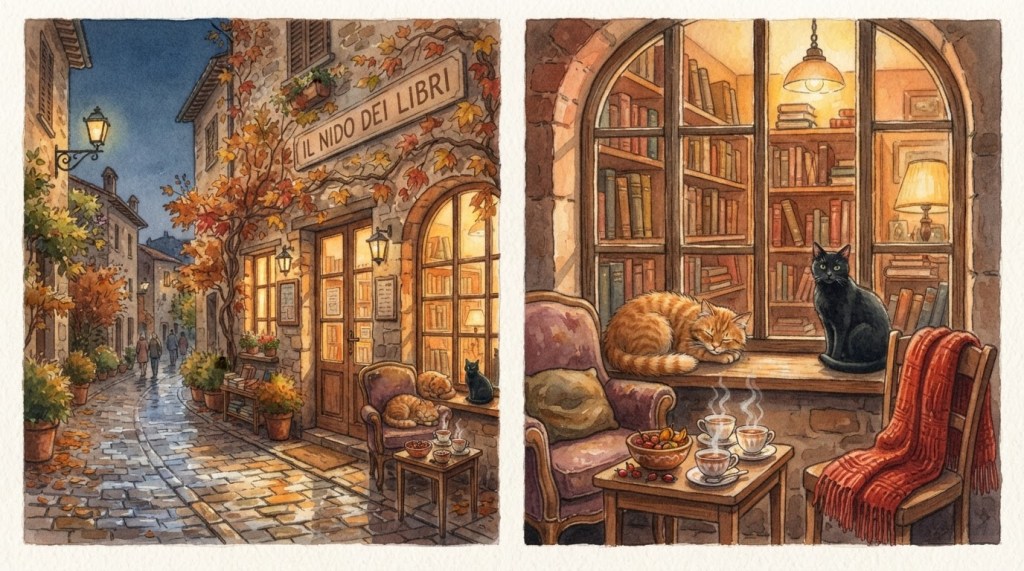
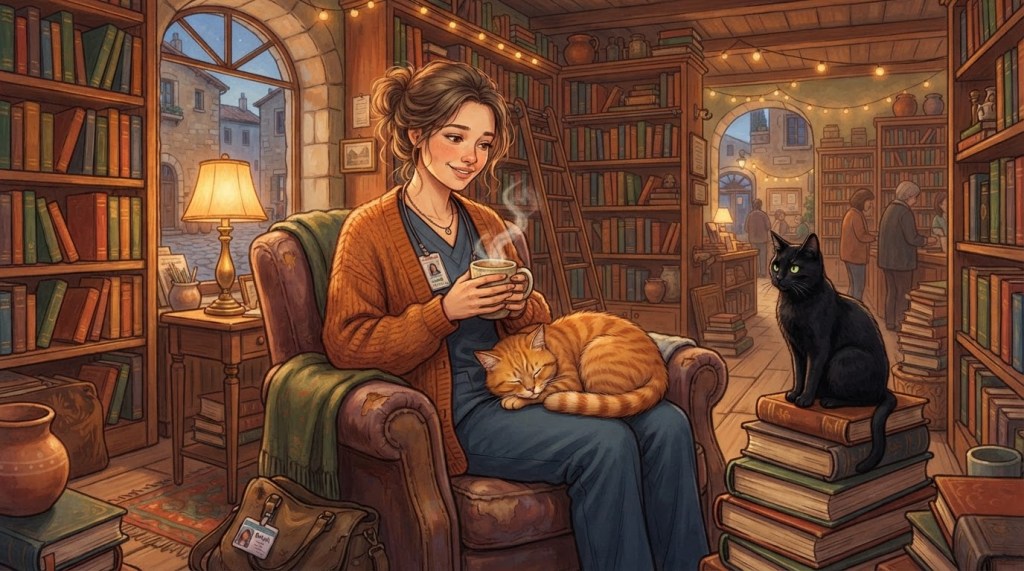
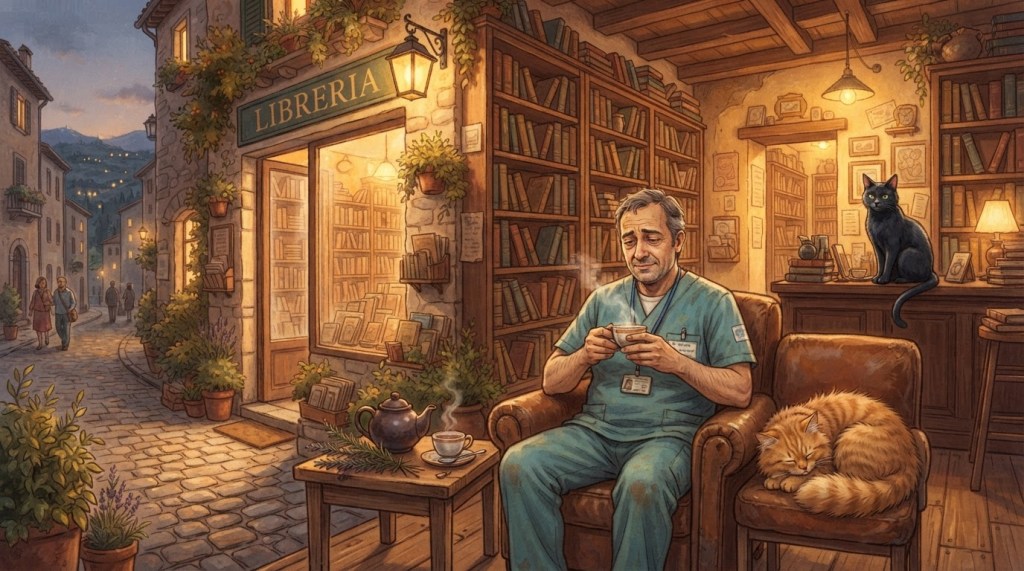
The last Sunday of November had been grey since breakfast, the kind of grey that makes the whole village of Speranza look like a pencil drawing someone forgot to colour in. By five o’clock the lamps along Via dell’Orologio had flickered on, the clock in the piazza had struck its slightly late hour, and Moira Hopes was doing what she did every evening at that time: turning the little brass key in the bookshop’s stove, straightening the spines on the poetry shelf, and negotiating with a fifteen-pound ginger tabby who believed the armchair by the window was a lease, not a loan.
“Ashwaganda,” she said gently, “I am only asking you to move your tail. Not your whole self. Your tail.”
Ashwaganda opened one amber eye, considered the request with great dignity, and closed it again. His purr, a deep slow rumble somewhere around twenty-five hertz, went on rolling through the floorboards like a very distant, very kind train. On the windowsill, Toe, the sleek black cat with green eyes, watched the street with the bright patience of someone who was always, quietly, looking for something that had gone missing. He was the one who found things: lost buttons, forgotten bookmarks, once, memorably, the shopkeeper’s reading glasses inside a flowerpot.
The bell above the door gave its small brass cough. Moira turned, expecting a late customer after a postcard. Instead she found Federica Sanna, the seamstress from the alley behind the church, standing on the mat with her coat still buttoned wrong and a paper bag of pins clutched against her chest, as if she had meant to go somewhere else entirely and her feet had simply refused.
“I’m sorry,” Federica said. “You’re closing. I only wanted to… I don’t know what I wanted. I walked past three times.”
“Four,” said Moira kindly. “Toe counted. He’s very thorough.” She turned the sign on the door so that it faced inward, which in Speranza meant not closed but come in and stay a while. “The kettle is already warm. Sit wherever a cat isn’t.”
Rosehip and Orange Peel
Federica chose the small round table near the stove, the one with the green cloth, and she sat very straight, the way people do when they are trying not to take up room with their trouble. Moira disappeared behind the little curtain at the back of the shop where the tea cupboard lived. It was an old pharmacist’s cabinet with forty tiny drawers, each labelled in her careful handwriting, and she opened three of them without hesitation.
“Dried rosehips, first,” she said, speaking half to herself and half over her shoulder. “They’re tart and a little bright, like the end of a long argument you’ve finally forgiven. A strip of orange peel, because bitterness and sweetness are best friends in the cup, as in life. And a pinch of lemon balm, which has been used in kitchens and herb gardens for centuries as a gentle, soothing leaf. I make no grand promises for it. It simply tastes like someone opening a window in a stuffy room.”
She poured the hot water over the herbs in a blue-glazed pot, set a small sand timer beside it, and returned to the table with two cups and a plate of almond biscuits from the bakery. Ashwaganda, who could detect an almond biscuit through two walls and a closed door, abandoned his lease and padded over, settling across Federica’s feet like a warm, heavy, orange sandbag.
Federica looked down at him and let out a laugh that was almost a sob. “He’s very large.”
“He’s thorough about comfort,” said Moira. “Different cat, same principle as Toe.”
They waited for the sand to run out. Outside, a few fat drops of rain began to tick against the glass, and the stove answered with a low, contented crackle. When Moira poured, the tea came out the colour of a late sunset, a warm, rosy amber, and the smell of orange rose up between them like a small, polite sun.
“Drink a little before you say anything,” Moira said. “Words come easier with something warm in the hands.”
Federica wrapped both palms around the cup. For a while she said nothing at all. Then, in a voice scarcely above the rain: “My oldest friend, Marisa, opened her shop on the piazza last week. The little atelier with the blue shutters. Dresses she designs herself. You must have seen the queue.”
“I did,” Moira said. “Half of Speranza seemed to be there.”
“And I should be so happy for her. I am happy for her. I held her hand when she signed the lease. I cried at the opening, and I meant it.” Federica’s voice cracked. “But then I went home, and I lay awake, and what I felt, Moira, was not joy. It was this hot, ugly little knot. I kept counting her customers. I kept thinking, why her, why not me. And then I felt so ashamed that I could hardly look at my own hands. What kind of friend does that?”
The Scales in Federica’s Chest
Moira did not rush to reassure her. She had learned, over many years of evening visitors, that comfort offered too quickly sounds like a door closing. Instead she sipped her tea, set the cup down, and said, “Tell me what the knot feels like. Where does it sit?”
Federica pressed two fingers to the middle of her chest. “Here. Like a stone. And it gets heavier whenever someone says her name with admiration.”
“Then let me tell you something, and you may take it or leave it,” said Moira. “In 1954, a psychologist named Leon Festinger put forward what he called social comparison theory. His idea was simple, and it has held up remarkably well in the decades since: human beings have a deep, almost automatic habit of evaluating themselves by looking at other people. How am I doing? Compared to whom? We do it with income, with looks, with cooking, with how our children behave in church. Most of the time we do it without noticing.”
“So it’s a habit,” Federica said slowly. “Not a defect.”
“It looks very much like an ordinary feature of how our minds work. Envy is what can happen when the comparison lands somewhere tender: when the person ahead of us has something we want, in an area that matters to us. Researchers who study the emotion tend to find that it hurts most when the other person is close to us, similar to us, and doing well in a field we care about. A stranger who wins the lottery barely registers. A friend who opens the shop you once dreamed of opening, in your own village, with a queue? That is the perfect storm.”
Federica went very still. “I never said I dreamed of opening a shop.”
“No,” Moira agreed softly. “You said nothing of the kind. I only guessed it from the way you held that bag of pins.”
Toe, who had been sitting so quietly on the windowsill that he might have been a piece of the night itself, dropped lightly to the floor. He crossed the boards without a sound, hopped onto the arm of Federica’s chair, and began, with great concentration, to nose at the pocket of her coat. Not roughly. Methodically, the way a clerk checks a drawer.
“Toe,” Moira said, amused. “Manners.”
“It’s all right.” Federica reached into the pocket to see what he wanted, and her hand closed around something folded small and soft with age. She drew it out. It was a sheet of paper, creased into eighths, the edges furred from years of being carried and never quite thrown away.
What Toe Found
She unfolded it on the green tablecloth and smoothed it flat with the side of her hand. It was a drawing, pencil and a little watercolour: a long, narrow dress the colour of rosehips, with a collar cut like a folded wing and tiny buttons marching down the back. Along the bottom, in a younger, bolder handwriting, someone had written: Atelier Sanna. Via dell’Orologio. One day.
Nobody spoke for a long moment. Even the rain seemed to hold its breath.
“I drew that when I was nineteen,” Federica whispered. “I carried it everywhere. And then I took in hems, and then I took in more hems, and then my mother was ill, and then it was twenty years later and I told myself I was too old and the village didn’t need another dress shop. I stopped even looking at it. I didn’t know it was still in that coat.”
“Toe knew,” said Moira. “He generally does.”
Toe, satisfied, sat down on the arm of the chair and began to wash one black paw with the air of a cat who has returned a library book on time.
Federica laughed again, and this time the laugh had water in it. She wiped her eyes with the back of her wrist. “So that’s what the stone is. It isn’t that I want Marisa to fail. I would never. It’s that she walked through a door I stood in front of for twenty years.”
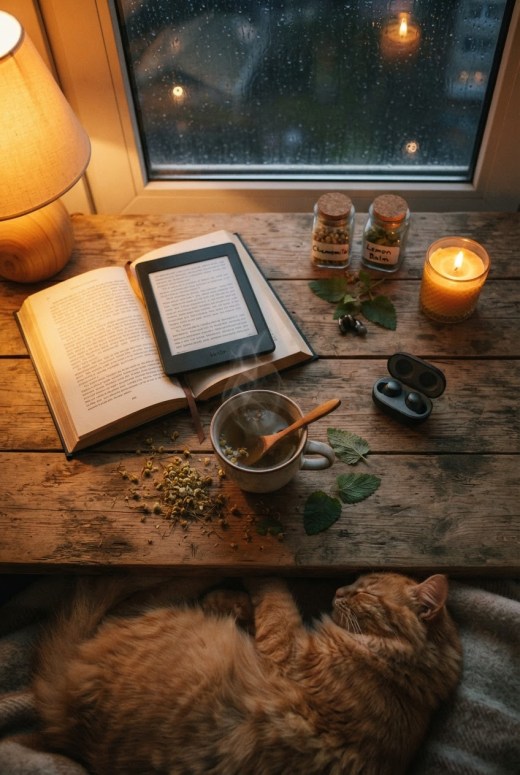
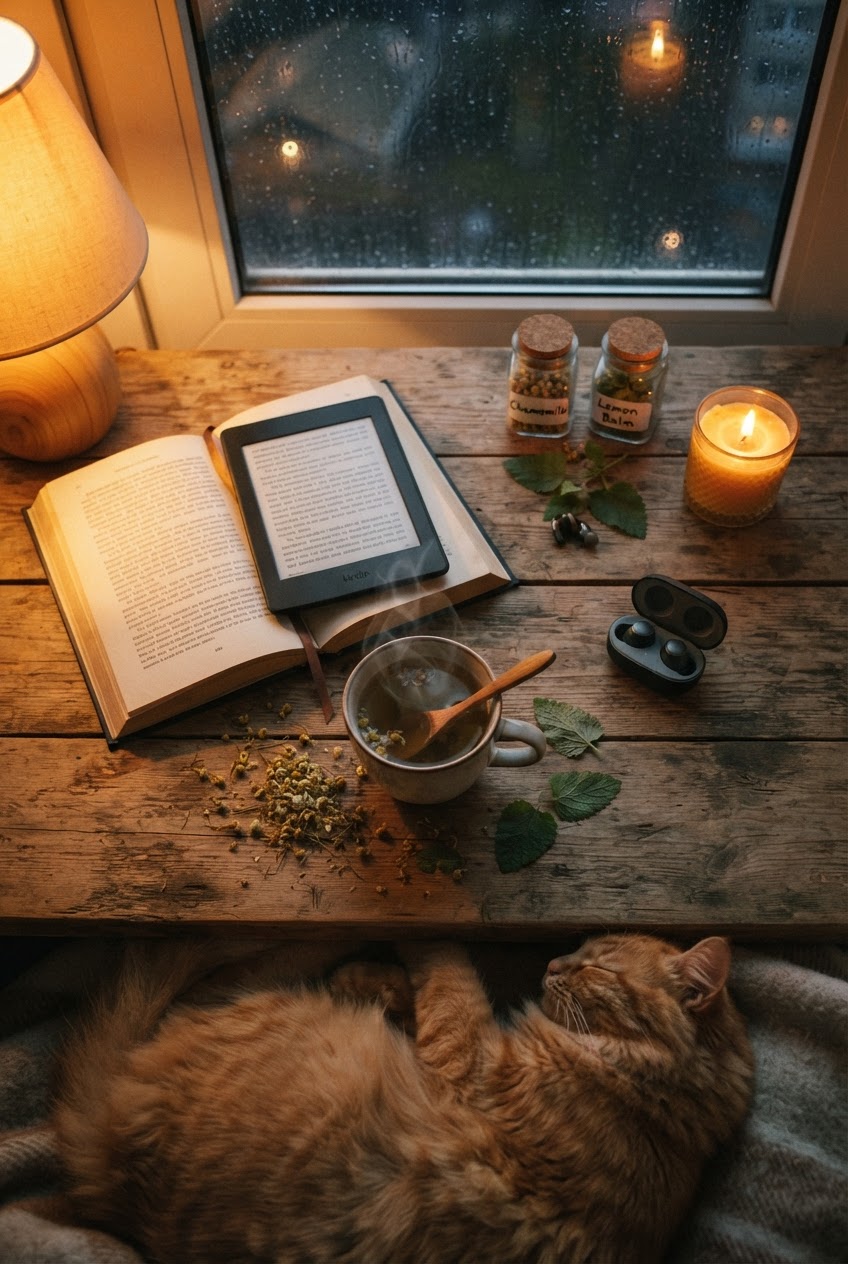
A small aside, dear reader, while Federica gathers herself: six of my favourite evening mysteries, the kind you read slowly with a warm cup nearby, are gathered in a little book on Kindle called Tales of Speranza. If tonight’s story keeps you company, perhaps those evenings will too.
Two Kinds of Envy
Moira refilled both cups. The rosehip tea had deepened as it steeped, and the steam now carried a warm, tart sweetness that seemed to fill the whole corner of the shop.
“May I tell you the part I find most hopeful?” she asked. “A group of Dutch researchers, led by a psychologist named Niels van de Ven, published a series of studies in 2009 suggesting that envy is not one single feeling. They distinguished two flavours. One they called malicious envy: the kind that wants the other person to fall. It tends to come with resentment, with pulling someone down, with the quiet hope that their luck turns. And the other they called benign envy, which sounds almost like a contradiction. It hurts just as much, but it points the other way. It says: I want what they have, and perhaps I can reach for it too.“
“And the benign kind,” Federica said, “makes you want to work harder?”
“In those studies, it was associated with greater motivation to improve one’s own situation, yes. I should be honest with you: this is a young area of psychology, results vary between situations and cultures, and no one can promise that a feeling will turn out one way or the other. But I find it a lovely way of looking at things. The sting may not be a verdict on your character. It may be a compass needle. It points, with some bluntness, at what you care about.”
“It pointed me at a piece of paper in my pocket,” Federica said, almost to herself.
“It did. And notice what you did not do. You did not tell Marisa her dresses were ordinary. You did not pass the atelier on the other side of the street with your face turned away. You counted her customers in the dark, and then you came here and called yourself a bad friend. Someone who wanted her to fail would hardly be so troubled by the feeling.” Moira smiled. “Guilt is often a sign that the love is still standing guard.”
Federica traced the little buttons on the drawing with one fingertip. “But what do I do with it? I can’t open an atelier. I’m forty-four. I have no savings worth mentioning, and the village has one already, and it’s my best friend’s.”
“Who said anything about opening an atelier tonight?” Moira asked mildly. “The compass doesn’t hand you the whole map. It only says which way is north. Perhaps the first step is far smaller than a shop. Perhaps it is a single dress, made only for the pleasure of it. Perhaps it is telling Marisa the truth over a cup of coffee: that you are proud of her and that you are also, a little, aching. Friendships can usually hold more honesty than we fear they can.”
Ashwaganda, apparently feeling that the conversation had reached a point of seriousness requiring a physical contribution, heaved himself up with a groan, planted his front paws on Federica’s knee, and pressed his broad ginger forehead against the folded drawing. The purr that followed was loud enough to make the teacups tremble faintly in their saucers.
“There,” said Moira. “That’s the official opinion of the bookshop.”
A Little Science of Comparing
Federica let the cat settle, and for a few minutes the three of them, four counting Toe, simply sat. The rain had thickened to a steady, friendly drumming. Someone passed the window under an umbrella, and the lamp-light flowed along its curve like oil on water.
“There’s one more thing worth knowing,” Moira said at last, “because it may keep you from being unkind to yourself next week. Studies on how people compare themselves to others have repeatedly found that we tend to compare our insides with other people’s outsides. We know every doubt, every unpaid bill, every Tuesday-night fear in our own lives. But about Marisa, we see only the blue shutters, the queue, the smile on opening day. We have no view of the sleepless nights before it, the loan, the afternoons she almost gave it up. Comparison works on very incomplete information, and the mind rarely points that out.”
“Marisa did cry in my kitchen last spring,” Federica admitted. “About the rent. I’d forgotten.”
“Of course you had. Envy has a poor memory for other people’s struggles. That is not a flaw in you, only in the way the feeling is built.”
Federica gave a long, slow breath, the first full one Moira had seen from her since she crossed the threshold. Some of the straightness went out of her back, and her shoulders came down from around her ears. She looked at the empty cup, then at the drawing, then at the rain-dark window, where her own reflection looked back at her, somewhat tired, somewhat younger than she had expected.
“Is it strange,” she asked, “that I feel lighter and sadder at once?”
“Not at all. You’ve just put down something heavy that you had been calling by the wrong name. There’s often a little grief when that happens. Twenty years is a long time to carry an unanswered question. But grief that has somewhere to go is a gentler weight than a stone.”
The Walk Home
It was nearly seven when Federica stood and buttoned her coat, this time correctly. She folded the drawing along its old creases, hesitated, and instead of putting it back in the pocket, slid it carefully into the paper bag of pins, flat against the cardboard, where it would not be crushed.
“I think,” she said, “I’m going to knock on Marisa’s door tomorrow morning. Not to ask for anything. Just to bring her a pastry from the bakery, and tell her the dresses are beautiful, because they are. And then maybe, if my courage holds, I’ll ask if she has a spare corner of table I could borrow on Sunday afternoons.”
“That sounds like benign envy at its very best,” said Moira. “A compass, a pastry, and a small first step.”
At the door, Federica bent down and, to the visible astonishment of both cats, kissed Toe on the top of his sleek black head. He accepted it with the grave courtesy of a diplomat. Ashwaganda, not to be outdone, leaned his whole weight against her ankle until she had to steady herself on the frame, and then released her with a little chirrup that meant, as clearly as any words, go on, then.
She stepped out into the rain with her umbrella unopened, for a moment, simply letting the drops fall on her upturned face. Then she opened it, and the amber lamp-light on Via dell’Orologio swallowed her shape, and the clock in the piazza, slightly late as always, began to strike seven.
Moira stood in the doorway a moment longer than necessary. Behind her, the stove ticked, and two cats arranged themselves on the armchair in a ginger-and-black patchwork, as if the evening had ended precisely the way it was supposed to.
Moira’s Reflection
Envy has a terrible reputation, and perhaps it has earned some of it. But I have come to think that it is less a vice than a very blunt kind of messenger. It rarely arrives with good manners, and it almost never says what it means. Yet underneath the sting there is often a plain, honest sentence: this matters to me. When we can hear that sentence without being ashamed of the way it was delivered, the feeling loses some of its power to poison and gains some of its power to point.
The people we envy are rarely our enemies. More often they are mirrors held up at an awkward angle, and what we see in them is a part of ourselves that has been waiting, sometimes for twenty years, to be taken out of a coat pocket and looked at again. So be gentle with the knot in your chest. Ask it what it is pointing toward. You may be surprised how quickly it softens once someone listens.
Has a friend’s good fortune ever stung you, and what did the sting turn out to be pointing at? Tell us in the comments if you like. Someone else reading tonight may need to hear that they are not alone in it.
A Cup for This Story
Moira’s rosehip and orange tea, for two cups:
- 1 tablespoon dried rosehips, lightly crushed
- 1 strip of orange peel (unwaxed), about the length of your finger
- 1 pinch of dried lemon balm
- 500 ml of just-boiled water
- Steep covered for 7 to 8 minutes, strain, and add a little honey only if you like it softer
A note from the bookshop: herbal teas are a small comfort, not a medicine, and they are not a replacement for advice from a doctor or other professional.
P.S. If tonight’s question about envy and the doors we stand in front of stayed with you, six more evenings like this one wait in Tales of Speranza on Kindle. If you’ve read it, a two-line review there helps the bookshop more than you know.
Listen in Speranza
🎧 Moira’s bookshop also has a voice. Tales from Speranza is our free podcast of slow evening stories, read aloud for the end of the day. Listen on Spotify.
📅 New stories, verses and recipes every day of the week: see A Week in Speranza.
Press Play and Stay a While
If your own evening is winding down, let the bookshop keep you company a little longer with this gentle welcome from Speranza.





Leave a Reply