Why is it so hard to ask for help, even when we are sure the people around us would give it gladly?
The Ladder by the Door
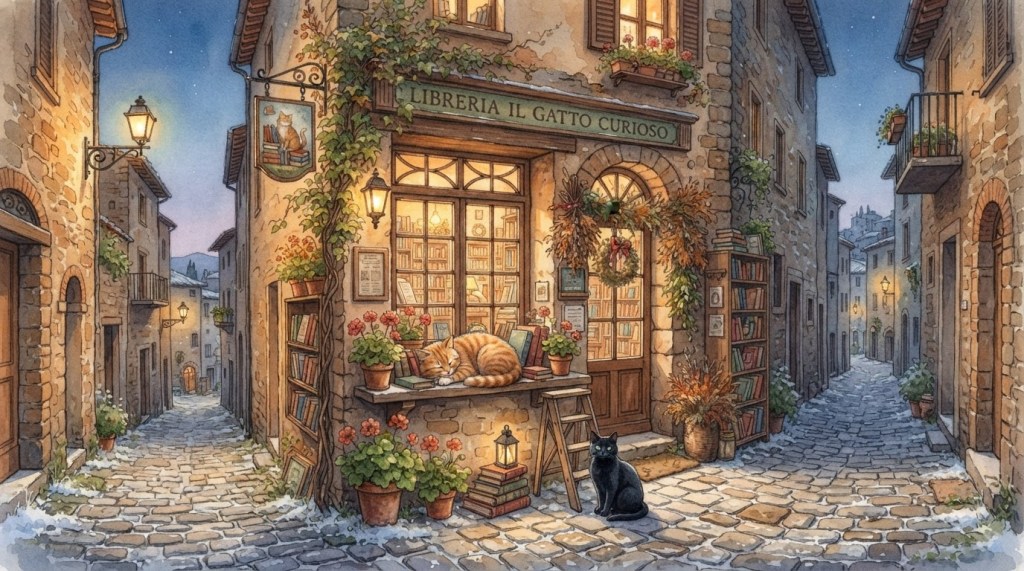
The first frost of the winter came to Speranza on a Saturday, quietly, the way a cat arrives on a bed. By late afternoon every cobblestone on Via dell’Orologio wore a thin silver coat, and the breath of the people hurrying home hung in the air in small white clouds that took their time to disappear.
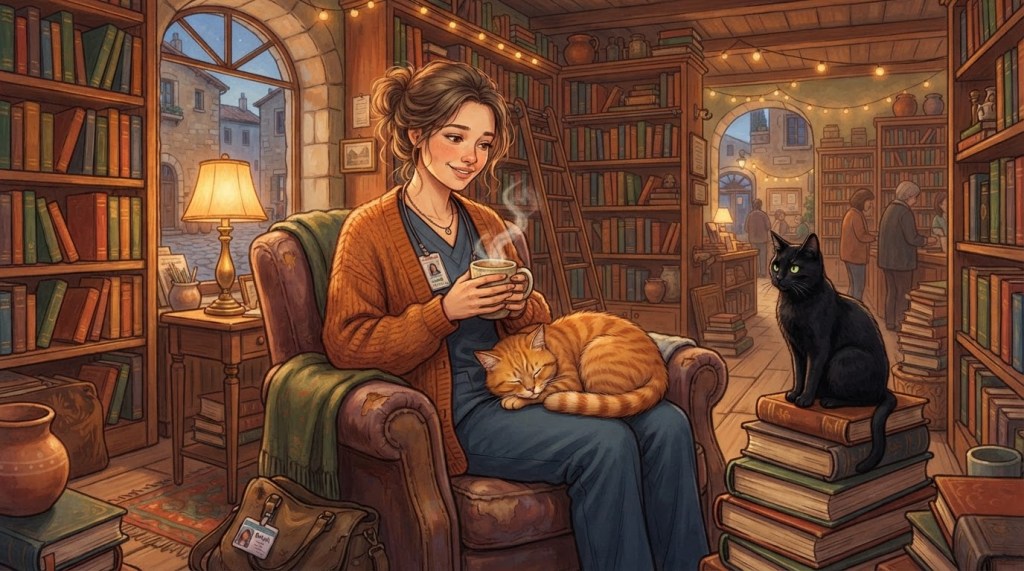
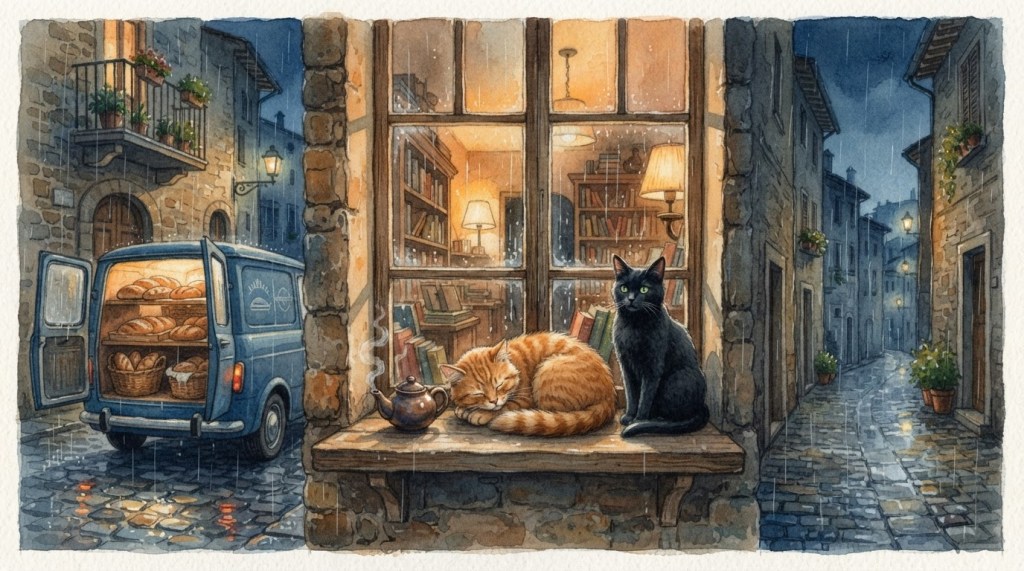
In the bookshop called La Pagina che Fa le Fusa, the stove was lit and the lamps were on. Moira Hopes was dusting the poetry shelf with the slow, unhurried strokes of someone who is not really cleaning but simply keeping her hands company while her mind rests. On the windowsill, taking up approximately the space of two ordinary cats, lay Ashwaganda, the big ginger tabby, fifteen pounds of warm fur with a purr so deep that the teaspoons in the little tea corner hummed faintly along with it. Beside him, neat as a full stop, sat Toe, the sleek black cat with green eyes, who had that very morning found Moira’s lost reading glasses inside a flowerpot and had been looking quietly pleased ever since.
It was Toe who noticed first. His ears turned toward the street, and then his green eyes followed. Outside, a man was standing on the frosty pavement and looking at the bookshop door as if it were a mountain he had decided not to climb.
Moira knew him at once. Everybody in Speranza knew Rino, the carpenter, a broad, weathered man who had built half the doors in the village and mended the other half. If your shutter stuck, Rino fixed it. If the church pew creaked, Rino fixed it. If a neighbour needed a shelf by Sunday, Rino made it on Saturday night and refused any payment beyond a coffee. What the village could not remember, in all its years, was a single time when Rino had asked anyone for anything.
Tonight, his right wrist was wrapped in a thick white bandage, and beside him on the pavement, leaning against the shop wall, stood a tall wooden ladder. He had carried it all the way from his workshop with one hand.
A Wrist Wrapped in Pride
The bell above the door gave its small silver laugh, and Rino came in sideways, the way large men enter small rooms. He stamped the frost from his boots on the mat, nodded at the cats, nodded at Moira, and said, to the general air of the shop, “I was passing.”
“On a Saturday evening, in the frost, carrying a ladder,” said Moira gently. “That is a very determined sort of passing.”
Rino looked at the ladder through the glass of the door, and then at his bandage, and then at the floor. “The gutter above your window is hanging loose,” he said. “I saw it on Thursday. It will fill with frost and pull away from the wall and come down on someone’s head. I meant to fix it today. I was going to say nothing and just fix it. Then I slipped on my own workshop step this morning and…” He lifted the bandaged wrist an inch and put it down again, as if it were a small embarrassing animal. “Sprained. The doctor says two weeks, no lifting. Two weeks! I have eleven doors to hang before Christmas.”
“So you carried the ladder here with your good hand,” said Moira.
“It is a light ladder.”
“It is a twelve-rung oak ladder, Rino.”
A reluctant half-smile crossed his face and fled. Ashwaganda, who had been watching with the patience of a creature who has never in his life hurried toward a conclusion, rose from the windowsill, stretched in a long ginger wave, dropped to the floor with a soft thud, and walked directly to Rino’s boots. He sat down on them. Not near them. On them. Fifteen pounds of cat, pinning the carpenter to the floorboards as firmly as any anchor.
“He wants you to stay,” said Moira. “And frankly, so do I. There is a stool by the stove, and the kettle is already warm. Sit, Rino. Nobody is going to ask you to fix anything.”
Rino opened his mouth to protest, found a fifteen-pound reason not to, and sat.
Rosehip, Orange Peel and a Pinch of Cinnamon
Moira went to the tea corner, where the shelves held jars labelled in her round, careful handwriting. She took down dried rosehips, the little red-orange husks that taste of sunlit tartness, then a strip of dried orange peel, and a thin curl of cinnamon bark. She dropped them into the blue teapot and poured on water that had stopped just short of boiling.
“Rosehip for the winter in the cupboard,” she said, as the steam rose and the shop began to smell of oranges and warm spice. “It is one of the few things that grows bright red in the coldest months, and I find that comforting. Orange peel for brightness. Cinnamon because it makes a cup feel like a hand on your shoulder. It will not mend your wrist, mind you. It is only tea. But it is a good tea for sitting still, and sitting still is the very thing you are afraid of.”
“I am not afraid of sitting still,” said Rino, taking the cup in his good hand. “I have simply never been very good at it.”
“That is the same thing wearing a different coat.”
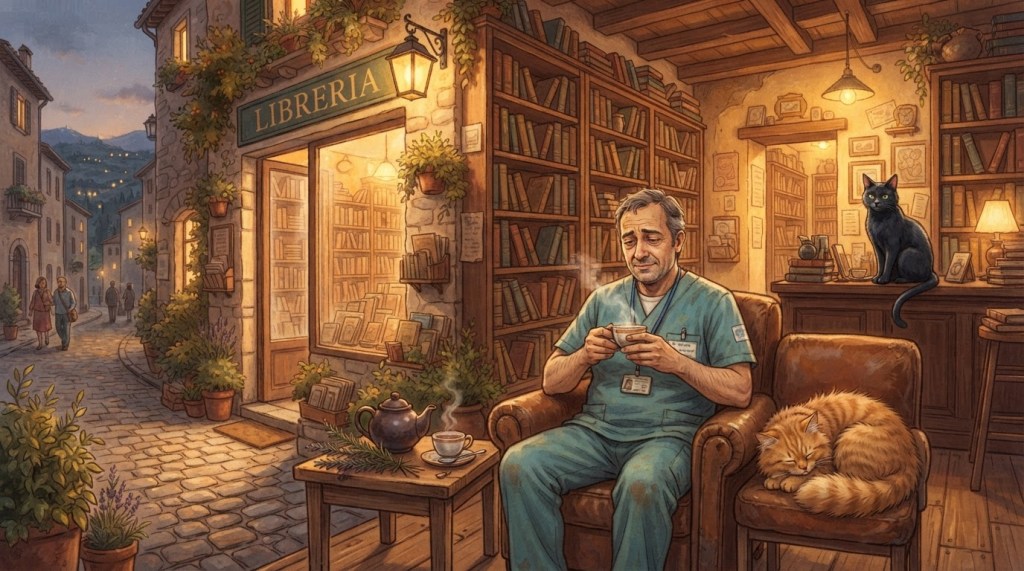
He drank. The tea was sweet-sour and warm, and something in his shoulders, which had been held up near his ears since the morning’s fall, came down by about an inch. Toe, who rarely sat in anyone’s lap, hopped onto the arm of the stool and settled there like a small black bookend, his green eyes half closed.
“Tell me about the doors,” said Moira.
And so Rino told her. Eleven doors, ordered by families who wanted them hung before the winter holidays: one for Claudia’s hair salon on the piazza, whose old door stuck whenever it rained, one for the new back room of the inn, where Ofelia wanted a proper door between the pasta kitchen and the corridor, and nine more besides. A man could hang them all in two weeks with two good hands, he explained. With one, it would take two months, and half of Speranza would spend Christmas with a draught.
“And who have you asked to help you?” said Moira.
Rino stared into his cup as if the answer might be floating there with the rosehips. “Nobody.”
“Why not?”
“Because they are busy. Everyone is busy before Christmas. Because it is my work, my mistake and my wrist. Because…” He stopped and turned the cup slowly on its saucer. “Because I have spent forty years being the man people come to. If I go to them with my hand held out, what am I then? A man who cannot manage. A burden. I would rather work through the night with one hand than stand in somebody’s doorway and say, please, I need you.”
The stove ticked. Ashwaganda, still seated on the boots, began to purr, and the purr rolled across the floorboards and up through the stool, so low and steady that Rino felt it in his knees before he heard it.
What the Ginger Cat Knew
“Do you know what that sound is?” said Moira, nodding at Ashwaganda. “Cat purrs tend to sit somewhere between twenty-five and a hundred and fifty hertz, and his is down at the very bottom of that range, a deep slow twenty-five. There is some research suggesting that vibrations in those low frequencies might help with the healing of bone and tissue, though I always say might, because the evidence is still thin, and I would not want you to throw away your bandage and rely on a cat. But I will tell you something I am quite certain of. Look at what he did tonight.”
“He sat on my feet.”
“He did not wait for you to ask him. And he did not make you feel like a burden for needing to stay. Cats are not troubled by this at all. They simply say, with their whole bodies, I would like to be near you, and you are welcome to be near me. No ledger. No score. We humans are the ones who invented the ledger.”
Rino laughed, a short surprised sound, and Toe opened one green eye at him as if to say that cats had known this for centuries.
A small aside, dear reader, while the kettle sings again: six of my favourite evening mysteries, the kind that wait patiently until the lamps are lit, are gathered together in a little book on Kindle. If you would like another slow evening in the company of the cats, you will find it as Tales of Speranza on Amazon, whenever you are ready for it.
The Mathematics of Asking
Moira refilled his cup and sat on the low step of the poetry shelf, her own cup warming her hands. “Let me tell you something that surprised me when I first read it, Rino. A group of psychologists, Francis Flynn and Vanessa Lake among them, ran a series of experiments about exactly this. They asked people to guess how many strangers they would have to approach before someone agreed to a small favour, such as borrowing a phone for a quick call or filling in a short questionnaire. Then they sent the people out to ask.”
“And?”
“The askers guessed badly, and always in the same direction. They underestimated how many strangers would say yes by a very large margin, and in some of the studies the real number of people willing to help was roughly twice what they had predicted. The researchers’ explanation, as I understand it, is that when we ask, we are staring at the cost of asking: the awkwardness, the risk of refusal, the little blush of vulnerability. But the person being asked is looking at a different thing entirely. For them, the awkward part would be saying no. Saying no to a face feels harder than most of us expect, so people tend to say yes.”
Rino frowned into his tea. “So when I imagine going to Ofelia and asking for a pair of hands, I am picturing a refusal that mostly will not come.”
“That is the idea, with the usual honest caution: it was a handful of experiments, mostly with small favours, and a big ask may land differently. But the pattern is a gentle one. We tend to guess that the world is stingier than it is.”
“There is still the other part,” said Rino slowly. “The part where I owe them. I do not like owing.”
Moira smiled, because this was exactly the door she had been walking toward. “Then you will like this even less, and perhaps more. Have you heard of Benjamin Franklin and the book?”
He shook his head.
“Franklin wrote in his autobiography about a rival in the Pennsylvania legislature, a man who disliked him and made no secret of it. Instead of trying to win him over with gifts or flattery, Franklin wrote him a note asking to borrow a rare and curious book from his library. The man sent it at once. Franklin returned it a week later with a warm thank-you. The next time they met, the rival spoke to him civilly, and, Franklin says, they became friends for life. His conclusion was that someone who has done you a kindness once is more ready to do you another than someone you have yourself obliged.”
“That is a story from a book,” said Rino, the carpenter’s suspicion of anything he could not hold in his hands rising up.
“It is, and a single anecdote proves nothing. But in 1969, two psychologists, Jon Jecker and David Landy, tested something like it. In their experiment, some people were asked by the researcher to hand back the prize money they had won, as a personal favour, and those people later rated the researcher more warmly than people who had not been asked. Researchers now call it the Franklin effect. It has been studied in a few different ways since, and the results are not all identical, so I hold it lightly. But the idea is this: when we help somebody, we tend to feel closer to them, not further away. Helping seems to say something to our own minds, this is a person I care about. Your asking may not only let people help you. It may let them feel what you have felt for forty years, every time you hung a door for a neighbour.”
The shop was very quiet. Outside, the first stars were out above the roof of the clock tower, and the frost glittered on the ladder that still leaned against the wall.
Two Small Words
Rino set down his empty cup. He looked at the bandage, then at the two cats, then at Moira, and for a long moment he looked like a man standing at the top of a very high diving board.
“I think,” he said, “that I have been giving, all my life, so that nobody would ever have the chance to give to me. As if it were a kind of insurance.”
“That is a very honest thing to say.”
“It is not comfortable.”
“The true things often are not, for a minute,” said Moira. “Then they become the most comfortable thing in the room.”
Toe slipped off the arm of the stool, trotted to the door, and sat beside it, looking back over his shoulder. Toe, as everyone in Speranza knew, was the cat who found things. Lost glasses, dropped keys, a runaway button, a single earring behind the radiator. He did not find them by searching, but by sitting down in the right place and waiting for the world to catch up. Tonight, apparently, he had found something else.
The bell above the door gave its silver laugh again. A young man stood on the threshold with his scarf up to his chin, cheeks red from the cold: Giulio, who ran errands for the inn and had once, years ago, spent a whole summer sweeping shavings out of Rino’s workshop for the price of an ice cream a day.
“Rino!” he said. “Ofelia told me you hurt your hand. I was passing, and I saw the ladder, and I thought…” He looked at the ladder, then at the wall, and then up. “That gutter is about to fall. I can fix it for you, if you tell me how. I would like to, honestly. I never got to thank you for the summer.”
Rino looked at Moira. Moira looked, with great innocence, at the poetry shelf.
“Giulio,” said Rino, and his voice was a little unsteady, the voice of a man testing ice. “I have eleven doors to hang before Christmas, and one working hand. Would you help me? Would you be my other hand, for two weeks? I can pay you, and I can teach you, and I will be… I would be grateful.”
Giulio’s whole face lit up, as if somebody had turned on a lamp behind it. “Yes,” he said. “Of course. Yes. I was hoping you would ask.”
“You were hoping?”
“Everyone was hoping you would ask,” said Giulio, as though it were the most obvious thing in the world. “You have never needed anything. We did not know how to start.”
The Gutter and the Frost
They fixed the gutter together in the last of the dusk, Rino standing at the foot of the ladder with his good hand pointing and his voice calling out, “Left a little, now the bracket, no, the other bracket,” and Giulio at the top with a screwdriver and a lantern. Moira stood in the doorway wrapped in her wool shawl, and the two cats sat in the lit window behind her like a pair of furry bookends, one ginger, one black, their eyes bright.
Claudia the hairdresser came by on her way home from the piazza, stopped to see what the commotion was about, and was told about the eleven doors. “Mine is the first, I hope,” she said. And without being asked she added that her nephew was good with a plane and had nothing to do all winter. By the time the gutter was fixed, three people on Via dell’Orologio had offered Rino an hour, a pair of hands, or a tray of warm cake. He accepted two of the three, and had to be talked into the cake, and then he ate it.
Before he left, Rino stood on the step of the bookshop with the oak ladder under his good arm, which Giulio now carried for him from the other end.
“I think I came here tonight to fix a gutter,” he said.
“You came here,” said Moira, “to stand outside my door for ten minutes before you walked in. That was the real work. The gutter was easy.”
He bent, with the awkwardness of a big man who rarely bends, and ran his good hand once along Ashwaganda’s back. The purr rose to meet him. Toe, never one to be left out, put one black paw on the carpenter’s boot for a moment and removed it. Then Rino went out into the frosty night, the ladder between him and the young man, and the lamplit window followed them down the street like a small warm moon.
Moira’s Reflection
It is strange how often we imagine that being needed and being a burden are the same thing. We carry the first like a medal and flee the second like a fever, and then we are surprised to find ourselves lonely at the top of our own ladders. Yet nearly everything the research suggests, and nearly everything I have seen from behind this counter, points the other way: that most people are more willing than we guess, and that most of them are quietly waiting for a door to be left ajar.
Asking for help does not make us smaller. At its best it is an invitation, a small gift in the shape of a request, which says to another person: you matter enough to me that I will let you see where I cannot manage alone. Rino learned that tonight at the cost of a sprained wrist. I hope we can learn it more cheaply. Which brings me to my question for you: what is one small thing you have been carrying by yourself that someone might be glad to share? Tell us in the comments, if you like, and let us keep each other company.
A Cup for This Story
- 1 tablespoon dried rosehips, lightly crushed
- 1 strip of dried orange peel
- 1 small curl of cinnamon bark
- 2 cups of water just off the boil
- Steep for 7 to 10 minutes, strain, and sip slowly. A little honey is lovely if you like.
Herbal teas are comforting companions, but they are not medicine. If you are unwell or pregnant, or take regular medication, please check with your doctor before trying a new herb.
P.S. If tonight’s question about asking for help stayed with you, six more evenings like this one wait in Tales of Speranza on Kindle. If you’ve already read it, a two-line review there helps the bookshop more than you know.
Listen in Speranza
🎧 Moira’s bookshop also has a voice. Tales from Speranza is our free podcast of slow evening stories, read aloud for the end of the day. Listen on Spotify.
📅 New stories, verses and recipes every day of the week: see A Week in Speranza.
Press Play and Stay a While
If you would like a few quiet minutes before sleep, press play below and let the bookshop keep you company.






Leave a Reply