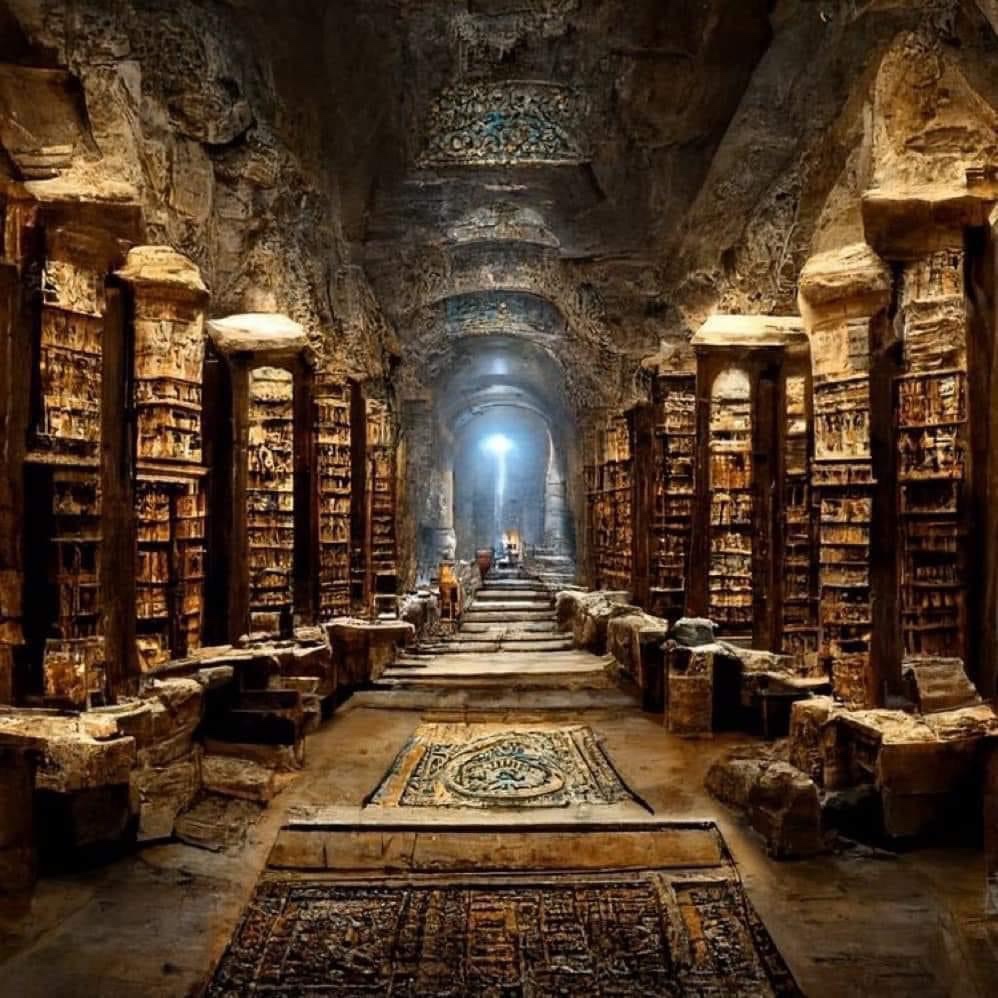
The Library of Alexandria was one of the most famous libraries of the ancient world, and it was located in the city of Alexandria, Egypt. The library was founded by Ptolemy I Soter, one of the generals of Alexander the Great, in the 3rd century BCE, and it became a center of learning and scholarship in the ancient world.
The library was a massive complex that housed hundreds of thousands of books, scrolls, and manuscripts from all over the ancient world. The library was not only a repository of knowledge, but it was also a center of scholarship and scientific research, with scholars and intellectuals from all over the ancient world coming to Alexandria to study and exchange ideas.
The Library of Alexandria was destroyed in a series of fires and other disasters over the centuries, and its exact location and contents are the subject of much historical debate and speculation. However, the legacy of the Library of Alexandria lives on in the many works of scholarship and scientific discovery that were produced there, and in its enduring reputation as a symbol of the power of knowledge and learning.
The destruction of the Library of Alexandria is a subject of much historical debate and speculation, and there is no definitive explanation for its demise. However, there are several theories and historical events that may have contributed to its destruction:
- Fires: One of the most likely causes of the Library’s destruction was a series of fires that occurred in the city of Alexandria over the centuries. These fires could have been accidental or intentional, and they may have destroyed many of the books and manuscripts housed in the Library.
- Invasion: Alexandria was invaded several times over the centuries, by Romans, Persians, and other conquerors. These invasions may have led to the destruction of the Library, either as a direct result of the violence of the invasions or as a result of neglect and lack of resources in the aftermath of the conflicts.
- Decline of the city: The decline of the city of Alexandria may have contributed to the decline of the Library. As the city’s influence and power waned over the centuries, the Library may have fallen into disrepair and neglect, leading to the loss of many of its books and manuscripts.
- Religious conflicts: Some historians have suggested that religious conflicts may have contributed to the destruction of the Library. Alexandria was a center of Christian and pagan intellectual activity, and it is possible that conflicts between these groups led to the destruction of the Library and its contents.
The exact reasons for the destruction of the Library of Alexandria are unclear, and it is likely that a combination of factors contributed to its demise over the centuries. However, the legacy of the Library lives on in the many works of scholarship and scientific discovery that were produced there, and in its enduring reputation as a symbol of the power of knowledge and learning.
The Library of Alexandria was a vast repository of ancient knowledge and scholarship, and it is believed to have housed hundreds of thousands of books, scrolls, and manuscripts from all over the ancient world. Many of these works have been lost to history, and their exact contents and authors are unknown. However, some of the most important works that were housed in the Library include:
- Homeric epics: The Iliad and the Odyssey, two of the most famous epic poems of ancient Greece, were likely housed in the Library.
- Euclid’s Elements: This work is one of the most influential mathematical treatises of all time, and it laid the foundation for much of modern mathematics.
- Ptolemy’s Almagest: This work was a groundbreaking treatise on astronomy and the motion of celestial bodies, and it influenced scientific thinking for centuries.
- Hippocratic Corpus: This collection of medical texts is one of the earliest and most important works on medicine and health care in the ancient world.
- Aristarchus’ work on heliocentrism: This work argued that the sun, not the earth, was the center of the universe, anticipating the later theories of Copernicus and Galileo.
- The Histories by Herodotus: This work is considered one of the earliest works of history and a valuable source of information on ancient cultures and civilizations.
- The plays of Aeschylus, Sophocles, and Euripides: These works were some of the most famous and influential plays of the ancient world and continue to be studied and performed today.
The Library was a treasure trove of ancient knowledge and scholarship, and it played a crucial role in the development of many fields, including mathematics, astronomy, medicine, and literature. Although much of its contents have been lost to history, its legacy continues to inspire scholars and thinkers around the world.