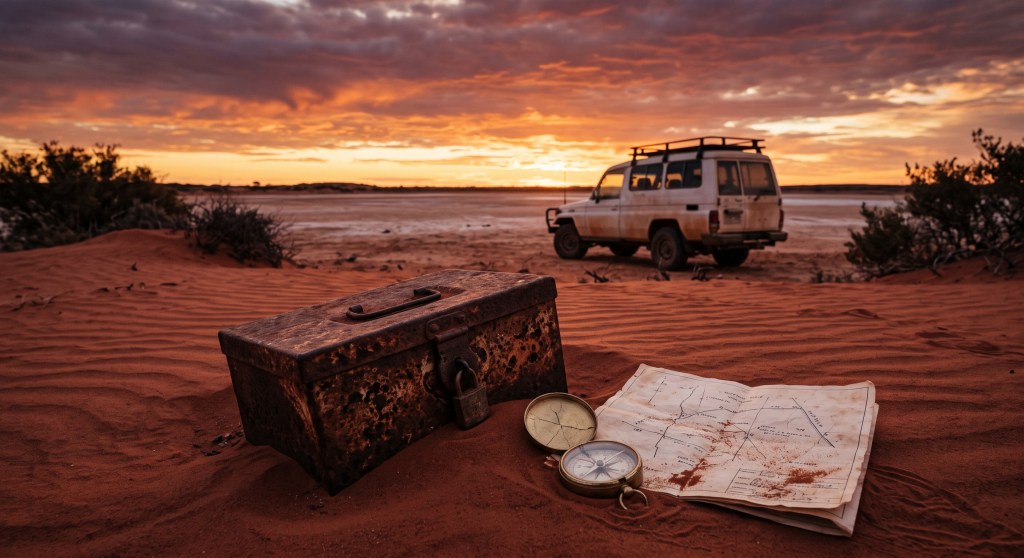
The midday wind blew red sand across the bonnet of the Toyota Troopcarrier. Liam leaned against the front bullbar, his boots sunk deep into the soft rim of the dry clay pan. Around him, the land stretched flat and silent for sixty miles in every direction. The heat rose from the earth in shimmering waves that made the distant gum trees on the creek bed look like dark smoke.
Behind him, Darcy unscrewed the cap of a heavy plastic water drum. The splash sounded loud in the quiet air.
“How far to the next bore?” Darcy asked, wiping sweat from his forehead with the back of his dusty hand.
“Forty miles along the old stock route,” Liam answered, checking the handheld compass. “If the track hasn’t washed out near the creek.”
Noah stepped down from the back door of the vehicle, holding an iron bar he had used to dig out a flat tyre ten minutes earlier. He pointed toward a line of pale sand hills that rose like white walls against the red plain. “Look over there. The wind shifted the dune face. There’s something stuck in the clay.”
Chloe walked over, shading her eyes beneath her broad-brimmed hat. “It looks like an old oil drum.”
“No,” Liam said, stepping forward. “It’s too square for a drum.”
The four of them walked toward the low ridge. The ground here was hard and crusted with salt, baked solid by months without rain. Sticking out of a shelf of pale sand was the corner of a heavy, dark metal box. The wind had stripped away the top layer of dirt only hours before, leaving the grey iron bare under the bright sun.
Noah set the tip of the iron bar under the exposed lip and pushed down. The baked clay cracked like dry bread. Liam knelt in the dust, taking hold of the iron handle on the side. With a hard pull, the box came free.
It was an old army ammunition case, heavy and sealed shut with lead solder around the seams. Across the top lid, someone had stamped a set of initials and a date: D.V. – 10/11/1974.
“That’s fifty years old,” Chloe murmured. “What’s inside?”
“Only one way to find out,” Darcy said, handing Liam a cold chisel from his tool roll.
Liam wedged the chisel into the solder seam and struck the head with the back of a wheel brace. The soft lead gave way with a dull crunch. He worked the steel point all the way around the rim until the seal popped open.
Inside lay three objects wrapped in thick, oil-soaked canvas: a heavy brass pocket watch with a cracked face, a spiral-bound leather surveyor’s journal, and a rolled paper map marked with red wax stamps.
Liam unrolled the paper across the warm hood of the vehicle. The map showed the sheep runs and stock corridors between the Darling River and the Barrier Ranges as they had been surveyed decades ago. Red ink lines marked a sequence of seven boundary markers, each labelled with a depth, a bearing, and a strange four-letter code: B-O-R-E, T-A-N-K, G-A-T-E, F-I-R-E.
“These aren’t standard lease marks,” Liam noted, his finger tracing a line that cut straight across an old dry salt lake toward the north. “A lease line runs on straight cardinal points. These zig-zag between old dry wells.”
Noah picked up the brass watch. He turned the winding stem, but it was frozen stiff. On the back casing, deep scratch marks formed a set of numbers: 142.18.04 / -31.45.12.
“Coordinates,” Noah said. “That’s less than twenty miles north of where we are right now. Near the old Black Swamp ruins.”
“Let’s check the shortwave,” Chloe suggested. “Old Mac at the outback roadhouse monitors the stock routes. He knows every station manager who worked this line back in the seventies.”
They packed the box and climbed back into the Landcruiser. The engine turned over with a deep roar, and Liam swung the wheel north along the faint dirt track. Red dust billowed behind them, hanging in the still air like a red curtain.
Liam clicked the microphone of the high-frequency radio on the dashboard. “Base station, this is Mobile Three on the western track. Mac, you on channel twelve?”
Static crackled from the speaker. For several seconds, only the hiss of dry desert air filled the cabin. Then a dry, slow voice answered.
“I hear you, Mobile Three. Mac’s down in Adelaide for the week. This is Tom. I’m minding the pumps and the radio at the junction. Where are you boys sitting?”
“Twenty miles south of Black Swamp,” Liam said. “We just pulled an old iron survey case out of the clay. Marked D.V., dated seventy-four. Got a map inside with seven coded markers.”
There was a long pause on the other end. The static hissed and popped.
“D.V.,” the voice said slowly. “That would be Donald Vance. He was the chief water surveyor for the district before the big flood in seventy-six. Walked off his lease and never came back. What did the map say, son?”
Liam hesitated for a second, glancing at Darcy. “Just some bearings between old bore holes. And coordinates scratched into a watch.”
“Don’t leave that box behind,” Tom’s voice came through, clearer now, almost sharp. “Vance hid his claim stakes when the mining board tried to pull his water rights. If you follow those markers in sequence, they lead straight to his main supply depot at the old sheep wash. Go to the coordinates on the watch first. Look for an iron peg driven into the limestone shelf beside the windmill. Tell me what numbers are stamped on the collar.”
“Copy that, Tom,” Liam said, hanging the microphone back on its bracket.
Darcy looked at Liam. “You notice how quick he was with the name?”
“He didn’t even look at a ledger,” Liam agreed. “He knew the date and the name without asking twice.”
“Maybe he’s just old and remembers the locals,” Chloe said.
“Maybe,” Liam replied, shifting the high-low transfer stick into four-wheel drive as the red sand grew deeper. “Keep your eyes open.”
They reached the coordinates an hour before sunset. The country had changed from open salt flats to low rocky hills covered in grey mulga bush. In the middle of a dry gully stood the skeleton of an old Southern Cross windmill. Its blades were bent and twisted by years of storms, hanging silent against the orange evening sky.
Liam brought the truck to a halt beside a low stone trough filled with windblown dirt. The crew jumped down and fanned out across the limestone shelf around the tower.
“Over here,” Noah called out from the base of the tank stand.
Driven deep into a fissure in the rock was a square iron survey pin. The top was rusted red, but a brass collar sat tight below the head. Liam wiped the dirt away with his thumb. Stamped into the metal were two words: CHECK THREE.
“Look at the map again,” Darcy said, spreading the paper on the flat stone.
Liam laid the surveyor’s journal next to it. He turned the brittle pages until he found the entry for November 1974. The handwriting was neat and small, written in black fountain pen:
“They believe the value is in the water. Let them look for the water. The third peg is not at the windmill. The third peg sits four hundred paces east of the stone chimney at Black Swamp. If the radio asks, give them the bearing from the false peg.”
Liam stared at the page. The hair on his arms stood up.
“The radio asked,” Chloe whispered, stepping closer. “Tom specifically told us to check the collar on the peg by the windmill.”
“Which means whoever is on that radio already knows the old survey,” Liam said quietly. “And he’s using us to find the spots he couldn’t reach himself.”
“Why couldn’t he reach them?” Noah asked.
“Look at the date in the journal,” Liam said, pointing to the last page. “November 1974. In 1974, the whole Darling basin went under ten feet of floodwater for two years. All the tracks were wiped out, fences were buried under mud, and the landmarks moved. If you didn’t have the master notebook, you’d never find where the original pins were driven once the silt settled.”
“And we have the notebook,” Darcy finished.
The radio in the truck began to squawk. The tone was steady and insistent: two clicks, a pause, then the voice.
“Mobile Three, this is junction base. Have you reached the windmill peg?”
Liam walked back to the driver’s window and took the mic. He kept his voice steady and flat. “We’re at the windmill, Tom. The brass collar is worn flat. Can’t make out any numbers.”
A short burst of static cut in. “Look closer, son. Clear the rust with a knife. The number should be a three-digit bearing.”
“Nothing here,” Liam lied smoothly. “Too much weather damage. We’re going to make camp here for the night and check the creek line in the morning.”
“Negative, Mobile Three,” the voice snapped back instantly, losing its calm drawl. “Don’t stop at the windmill. Drive three miles north to the Black Swamp chimney before dark. The track gets dangerous after sundown. Acknowledge.”
Liam didn’t press the button. He lowered the mic and looked back at his crew.
“He knows where the chimney is,” Noah said, his voice tense. “And he’s not at the roadhouse. Listen to the signal. There’s no generator hum in the background. Every outback roadhouse runs a diesel generator twenty-four hours a day.”
“He’s running off a mobile set in a vehicle,” Darcy said. “He’s out here with us.”
“Pack the gear,” Liam ordered. “We leave the lights off.”
They packed their tools in silence. Liam started the diesel engine without turning on the headlights, letting the glowing dashboard lights guide his hands. Using only the orange glow of the fading horizon, he eased the four-wheel drive off the main track and down into the bed of a dry gravel creek.
The gravel crunched softly under the big tyres. Liam kept the speed down to ten miles per hour, following the winding wash toward the east where the low ridge of Black Swamp rose against the dark purple sky.
After twenty minutes of slow driving, they reached the ruins of the old homestead. Only a single stone chimney and three crumbling mud-brick walls remained standing among the dry saltbush. The roof had collapsed decades ago.
Darcy jumped out with a small flashlight, keeping the beam pointed down at his boots. “Four hundred paces east from the hearth,” he said, counting out his strides as he walked into the darkness.
Noah and Liam followed with the shovel and the iron bar. At exactly four hundred paces, their boots struck a low shelf of red ironstone. Darcy knelt and swept his light across the rock.
There was no iron pin driven into the stone. Instead, a circle of heavy quartz stones lay arranged in an arrow pointing directly at a split in the rocks fifty yards further out.
“He didn’t use an iron peg,” Chloe said, joining them. “Iron pegs show up on metal detectors. Quartz doesn’t.”
They reached the split in the rocks. Deep inside the crevice sat a heavy square steel lockbox, smaller than the first, coated in thick green grease to keep out the moisture.
Liam pulled the box out and scraped the grease from the front latch. The keyway was protected by an old four-letter brass combination lock.
“The codes from the map,” Noah said excitedly. “What were they?”
“B-O-R-E, T-A-N-K, G-A-T-E, F-I-R-E,” Liam recalled. “Try the last one.”
Liam spun the brass wheels on the padlock to spell F-I-R-E and pulled the shackle. The lock snapped open with a sharp metallic click.
He lifted the heavy lid. Inside lay four canvas bags tied with copper wire, each one heavy and dense. Darcy cut the wire on the nearest bag and poured a small handful of its contents into his open palm.
Under the beam of the flashlight, rough, milky-white stones gleamed with flashes of bright green, electric blue, and deep red fire.
“Solid seam opal,” Darcy whispered, his eyes wide. “Untouched. That’s hundreds of ounces of rough black and crystal opal from the old White Cliffs field.”
“Donald Vance didn’t survey water,” Liam said, turning a large stone over in his fingers. “He found the lost feeder seam before the floods hit, mined it out quietly, and cached it across the lease before the company could claim the rights.”
Suddenly, the night sky behind them lit up.
Two high-beam halogen spotlights cut through the darkness from the crest of the hill, three hundred yards away. A heavy four-wheel drive had come up over the ridge with its lights blazing, pinning Liam and the gang against the white quartz rocks.
The roar of a modified V8 engine tore through the quiet desert air. The vehicle accelerated down the slope, heading straight for the ruins.
“Back to the truck!” Liam yelled, shoving the canvas bags back into the lockbox and slamming the lid.
The four of them sprinted across the rough ground. The high beams from the approaching vehicle cast long, wild shadows across the rocks ahead of them. Dust swirled in the blinding glare as the stranger’s truck slid sideways across the dirt track, blocking the path back to the main road.
The driver’s door of the second vehicle swung open. A tall, thin man stepped out into the glare of his own headlights. He wore a faded canvas coat, heavy work boots, and an old wide-brimmed felt hat pulled low. In his hands, he held a long iron tyre lever.
“Put the box down on the bonnet, son,” the man called out. His voice was exactly the same dry, scraping voice that had come through the shortwave radio. “You did a fine job tracking the quartz. Saved me three weeks of digging up the whole valley.”
Liam stood by the front fender of his Landcruiser, holding the grease-coated box in both hands. Darcy and Noah moved slowly to the left and right, spreading out.
“You’re not Tom from the roadhouse,” Liam said, keeping his voice level. “And you’re not minding any pumps.”
The man gave a short, dry laugh that sounded like gravel grinding together. “Old Mac died five years back, kid. That roadhouse has been shuttered since the bypass was paved. I’ve been sitting on the frequency waiting for someone to bring those field books back out into the open.”
“You’re Donald Vance,” Chloe said from behind the passenger door.
The man tilted his hat up slightly. In the harsh glare of the lights, his weathered face looked like cracked leather, his eyes sharp and pale. “Vance was my brother. He drowned in the seventy-six flood trying to get his tractor across the Darling with the original notebook in his shirt pocket. I spent forty years looking for where he stashed the secondary ledger.”
“And you couldn’t find the cache without the quartz coordinates,” Liam said.
“The water changed the whole run of the creek,” the man said, taking a step forward. “Buried the landmarks under three feet of red mud. But Donald always had a pattern. I knew if the field book turned up, the pegs would tell the real story. Now hand it over, and you can drive out of here with your fuel tanks full.”
Liam looked at the man, then glanced down at the ground between them.
Right beneath the front wheels of the stranger’s heavy rig lay a wide, flat patch of pale, powdery grey sand—a classic outback “bulldust” hole, where deep, flour-fine silt collected in dry washouts, looking completely solid on the surface until weight was applied.
“You took the wrong line coming down that ridge, Vance,” Liam said calmly.
“Don’t try to get clever, boy,” the man snarled, taking another two steps forward.
Liam didn’t move toward him. Instead, he swung his arm and threw the heavy iron box five yards to the left, straight into the middle of a dense patch of thorny saltbush.
“Get it!” Vance yelled, lunging forward instinctively toward the bush.
His right boot struck the soft crust of the bulldust pocket. The fine silt instantly collapsed under his weight like dry water, sending him plunging knee-deep into the powder. He stumbled hard, dropping the iron bar as he tried to catch his balance.
“Now!” Liam shouted.
Noah and Darcy bolted forward, grabbed the grease-coated box from the scrub, and sprinted for the Landcruiser. Liam threw the transmission into reverse and hit the starter. The diesel fired up with a roar.
Vance scrambled out of the dust pit, cursing loudly, and lunged back into his cab. He slammed his gear shifter into drive and mashed the throttle.
His oversized rear tyres spun violently, digging instantly into the powdery silt bed. Within three seconds, the chassis of his heavy vehicle dropped flat onto the red sand, its wheels spinning uselessly in the air, throwing clouds of white and red dust into the night sky.
Liam spun the wheel, backed out of the gully, and swung the truck around onto the firm gravel track. Noah pulled his door shut and locked it as they surged forward, leaving the trapped vehicle revving its engine behind them.
They drove south through the night, keeping a steady forty miles per hour along the hard-packed clay plains. The hours passed slowly beneath the massive dome of the desert stars.
By sunrise, the jagged crests of the Barrier Ranges appeared on the horizon, painted deep purple and gold in the morning light. They rolled into the outskirts of the nearest mining township just as the first road trains began moving along the highway.
Liam pulled up directly outside the local police station and turned off the engine. The silence of the morning washed over them.
Darcy looked at the heavy green-greased box sitting between their feet on the floorboards. “What do we do with the opals?”
“Hand them over to the mining registrar,” Liam said, stepping down from the cab. “The lease reverted to the Crown forty years ago. There’ll be a proper claim process, and Vance’s brother won’t be able to touch a single stone.”
They walked inside, placed the iron case and the old surveyor’s journal onto the front counter, and spent the next three hours giving their official statements to the desk sergeant. The officer catalogued the rough opals, sealed them in evidence bags, and verified the 1974 survey records against the state archives.
When they finally walked back out into the bright midday sunshine, the air was warm and clean.
“That’s done,” Noah said, stretching his arms. “We’re clear. We can head down to the river, pitch camp, and finally get some rest.”
Liam smiled, reaching into his pocket for the keys to the Landcruiser.
His fingers brushed against a small, hard object in the corner of his pocket.
He pulled his hand out. In his palm lay the heavy brass pocket watch from the first ammunition box—the one with the cracked face and the frozen winding stem.
Darcy glanced over. “I thought you gave the watch to the sergeant with the rest of the kit.”
“I thought I did too,” Liam said, staring down at it.
As they stood together by the truck, the frozen second hand inside the cracked glass gave a sharp, audible tick.
Then another.
The watch began to tick steadily in Liam’s hand.
Behind the scratched numbers on the casing, a tiny, faint red light began to pulse from deep inside the brass gearwork—slowly, evenly, like a beacon sending a signal into the empty desert behind them.






Leave a Reply