Can you forgive someone who never said sorry?
The Man on the Bench
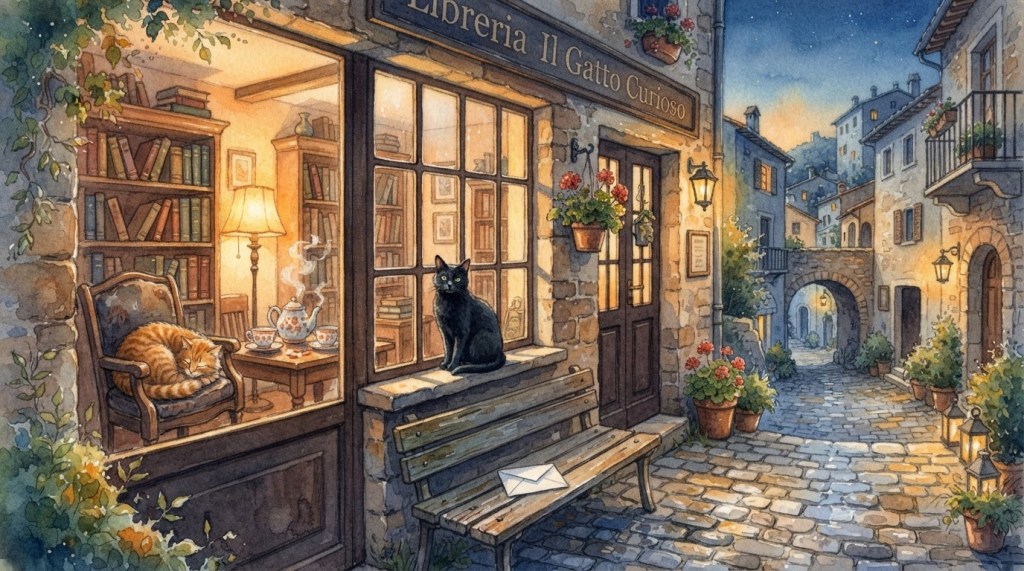
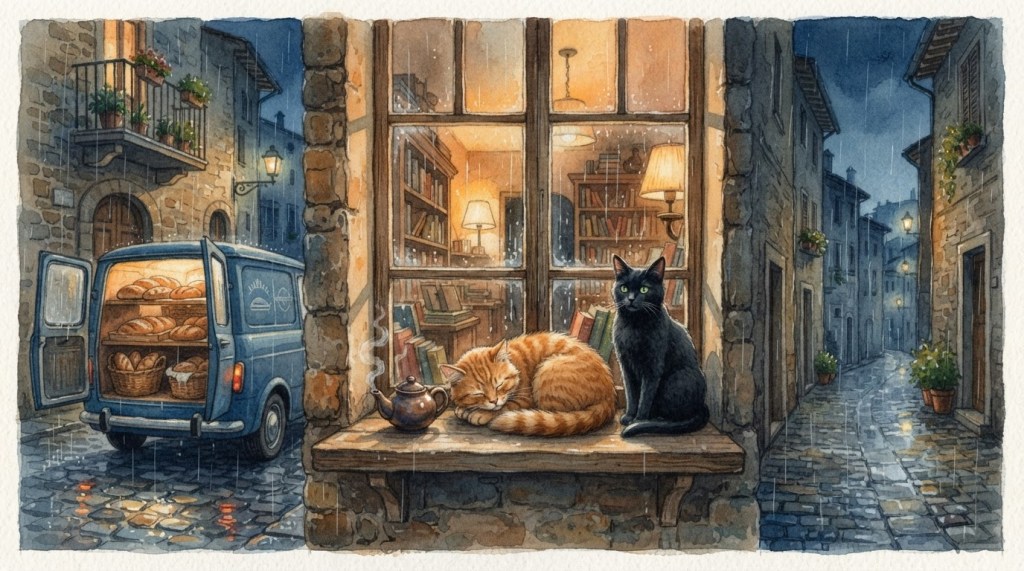
It had rained in Speranza since the middle of the afternoon, the soft, patient kind of rain that does not hammer the roofs but simply settles over them like a grey wool blanket. By six o’clock the lamps along Via dell’Orologio had come on one by one, each wearing a small halo, and the cobblestones shone like the backs of fish.
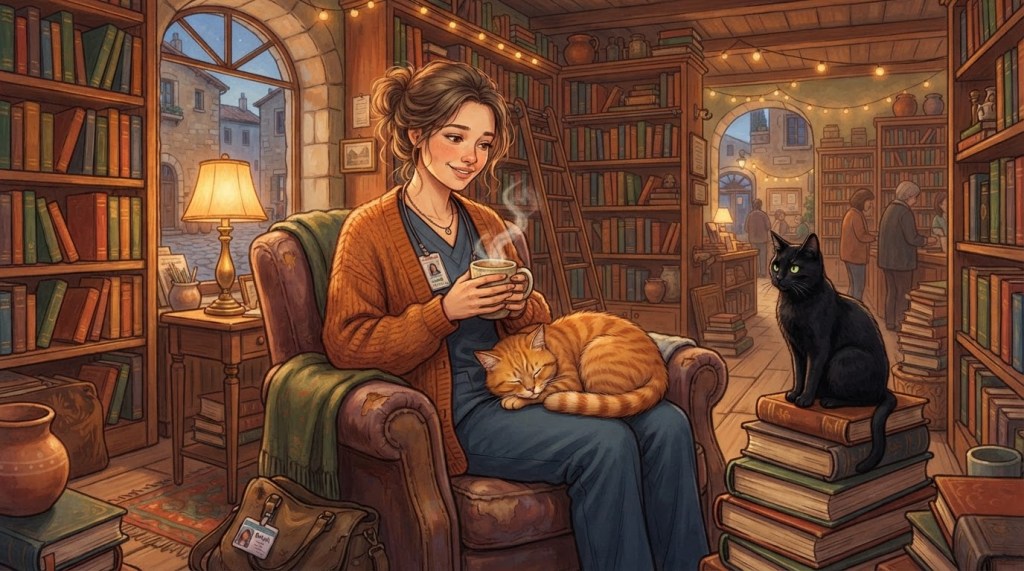
Inside La Pagina che Fa le Fusa, Moira Hopes was doing what she always did at that hour: setting the kettle on the little stove behind the counter, straightening a stack of poetry that nobody had asked her to straighten, and pretending not to notice that Ashwaganda had once again taken possession of the best armchair. The big ginger tabby lay stretched across the cushion like a loaf of bread that had given up all ambition, his purr rumbling so low that the teaspoons in the saucers trembled very slightly. Fifteen pounds of cat, and a purr you could feel in your ribs.
Toe, on the other hand, was not in his usual place. The sleek black cat, whose green eyes could catch a streetlamp from across the square, was sitting on the windowsill with his nose almost against the glass. His tail curled once around his paws, then twitched.
“What is it, il Ombra?” Moira asked, wiping her hands on her apron. “Have you found something?”
Toe did not answer, of course. He only looked at her, then back at the window, and she understood. Toe was the one who found things: lost buttons, a missing earring, a ten-euro note that had slipped behind the shelves in 2019. And sometimes, on evenings like this, he found people.
Across the street, on the wooden bench under the clock, a man sat with his collar turned up and his hands pushed deep into his coat pockets. He had been there, Moira realised, for a good while. The rain dripped from the brim of his cap. Every so often he took one hand out, looked at something small and pale that he was holding, and put it away again.
Moira took down a second cup. Then she went to the door, opened it, and let the little brass bell announce her to the evening.
“Excuse me,” she called across the wet street, not too loudly. “The kettle is nearly ready, and it is a shame to boil water for one.”
The man looked up, startled, as if he had been caught at something. For a moment she thought he would simply shake his head. Then he rose, crossed the street with his shoulders hunched against the drizzle, and stopped on the threshold, dripping onto the doormat.
“I was only waiting for the rain to stop,” he said. “I am not a customer. I am Giulio.”
“Moira,” she said. “And in this shop, Giulio, you do not need to be a customer. You only need to be a little damp. Come in.”
A Tea Chosen with Care
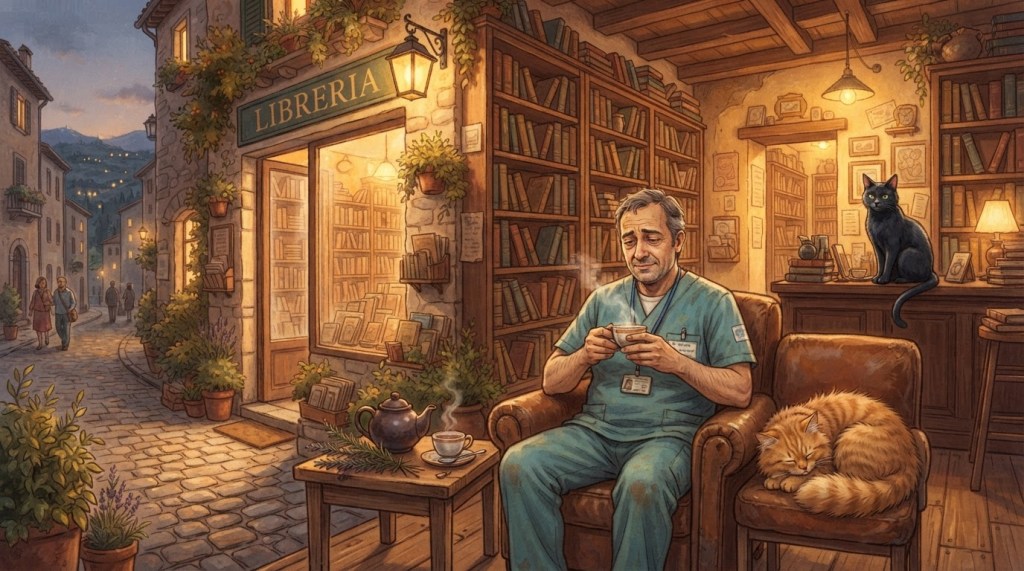
Giulio was perhaps fifty-five, with the weathered hands of someone who worked outdoors, and a face that had learned to keep itself still. He sat where Moira pointed, in the small wooden chair by the stove, and took off his cap and held it on his knee as if it were a hat he was about to return to someone. Toe left the windowsill, crossed the floor without a sound, and sat down at a polite distance from the visitor’s boots. Ashwaganda opened one amber eye, assessed the situation, and went back to purring.
Moira did not ask him anything yet. She never did. She turned to the shelf of glass jars behind the counter, the one where the dried herbs lived in rows, each with a handwritten label in her slanting script, and she took her time, because choosing a tea for a person is a little like choosing a book for them. You look at how they sit. You look at their hands. Giulio’s right hand kept closing around something in his coat pocket and then letting go.
“Linden blossom,” she said at last, mostly to herself, lifting down a jar of pale golden flowers that smelled of summer evenings and warm honey. “And a little lemon balm, and a few dried rose petals. Nothing dramatic. This is a tea for loosening a clenched jaw.”
Giulio gave a short, surprised laugh. “How did you know about my jaw?”
“You have been holding it since you crossed the street,” said Moira gently. “People do not notice it, but the face is often the first place a long worry settles.”
She warmed the teapot, measured the herbs with a small wooden spoon, and poured the steaming water over them. The scent rose at once, sweet and green and a little like a garden after rain. She let it steep, turning the little hourglass on the counter, and in those three minutes the only sounds in the shop were the rain on the glass, the tick of the old clock, and the slow, deep thrum of Ashwaganda, who seemed to have decided that this stranger needed to be purred at, whether he liked it or not.
When she handed him the cup, Giulio wrapped both hands around it as one does with something precious. He drank, closed his eyes for a moment, and something in his shoulders came down by about an inch.
“My brother used to make tea like this,” he said, very quietly. “Not this exactly. Linden, from the tree behind our father’s workshop. We would pick the blossoms in June, he and I, and dry them on newspaper in the attic.” He turned the cup in his hands. “Rino. His name is Rino.”
“Used to,” Moira repeated, softly, without pressing.
“We have not spoken in six years.”
The Letter That Was Never Sent
It came out slowly, the way water comes out of a stone fountain that has not run in a long time: first a trickle, then a little more. Their father had owned a carpentry workshop at the edge of the village, and when he died, it was supposed to be shared. Instead there was a disagreement about money, then about a promise somebody remembered one way and somebody else remembered another way, and then, one evening in the workshop doorway, there were words. Giulio did not repeat the words to Moira. He did not need to. The shape of them was in his voice.
“He said I had never really worked there,” Giulio said. “That I only came to collect what was left. After thirty years of Saturdays in that place.” He pressed his lips together. “And then he sold the workshop to a stranger. Without a word to me. And he has never said sorry. Not once. Not a card, not a phone call. I heard from Claudia, at the hairdresser’s, that he had a grandchild last spring. A granddaughter. I heard it from Claudia.”
Toe stood up, stretched his glossy black body in a long arch, and then did something he did only rarely: he put one paw, very lightly, on Giulio’s boot. Giulio looked down. The cat looked back with those steady green eyes, the way you might look at someone who is about to say the important part.
“There is something in your pocket,” said Moira, “that you keep taking out and putting back.”
For a long moment Giulio did not move. Then he reached into his coat and drew out an envelope, creased and softened at the corners, as if it had been handled many times. It was blank on the front.
“I wrote it three weeks ago,” he said. “Then I wrote it again. I have written it nine times, I think. This is the last one. I walked to the post box on the piazza tonight, and I could not do it. So I sat on the bench.” He gave a helpless half-smile. “I do not even know what it says any more. Part of it says that I forgive him. Part of it says he owes me an apology first. I cannot make the two halves agree.”
“Then perhaps that is the real question,” said Moira, “and not the post box.”
“What question?”
“Whether forgiveness has to wait for the sorry.”
The rain tapped at the window. Giulio stared into the cup, where a single rose petal had unfolded and was turning slowly in the golden tea.
Forgive me for stepping out of the scene for a moment, dear reader. Toe has just curled himself against Giulio’s boot like a warm black comma, and the kettle is singing its second verse, so it seems a good time to whisper that many of my favourite evenings in this shop, the ones with a visitor, a pot of tea and a cat or two, are gathered together in a little book called Tales of Speranza. Now, back to our man with the envelope.
What the Body Remembers
“May I tell you something I have read,” said Moira, settling onto the stool behind the counter, “and you may keep as much of it as is useful and leave the rest on the shelf?”
Giulio nodded.
“There is a psychologist named Everett Worthington who has spent a large part of his career studying forgiveness, and one of the first things he and other researchers insist on is that forgiveness is not one single thing. It is not pretending the hurt did not happen. It is not saying the other person was right. And it is certainly not the same as reconciliation, which needs two people willing to walk back toward each other. Forgiveness, in their sense, is something that happens inside one person. They tend to separate two kinds. There is a decision, where you resolve that you will not seek revenge and will not treat the other person as an enemy. And there is a slower change of feeling, where the heat actually goes out of the memory. The decision can come in an afternoon. The feeling can take years, and it does not always arrive on schedule.”
“So I can decide without feeling it yet,” said Giulio slowly.
“Many people in this field would say yes, and that the decision often opens the door for the feeling to follow. I should be honest that the research is still debated, and people are not laboratory samples; every grief has its own weather. But there is one study I have always found rather moving, because it is so physical.”
She told him about it as she poured him a little more tea. In 2001, a team led by the psychologist Charlotte Witvliet asked volunteers to think about someone who had hurt them, in two different ways. First they were asked to dwell on the grudge: to rehearse the offence and nurse the resentment. Then they were asked to imagine seeing the other person as a human being, with their own history and needs, and to picture offering them forgiveness. Throughout, the researchers measured things the body does without asking permission: heart rate, blood pressure, the tiny tension of the muscles in the face. When people held the grudge, those measures tended to climb. When they practised empathy and forgiveness in their imagination, the readings tended to settle down.
“It was a small, short experiment,” Moira added, “done on people imagining a hurt, not people living one for six years, so I would not make too much of it. But it suggests something that anyone who has lain awake rehearsing an argument already suspects. The body does not always know the difference between a quarrel that is happening and a quarrel we keep replaying. Each time we replay it, it may be doing a little of the same work on us as the first time.”
Giulio looked at his own hand, the one that kept returning to the pocket. “Six years of replaying,” he said. “I know every word by heart. I could recite it for you.”
“I believe you. And there is a gentle point in that, too. Nursing a grievance can feel like guarding something. It can feel as if, by holding on tightly, we are keeping the injustice from being forgotten. But the other person is rarely in the room while we guard it. Often we are the only one standing watch.”
Outside, a delivery scooter hissed along the wet street and was gone. In the armchair, Ashwaganda stretched, rolled onto his other side, and let out a long, rumbling sigh. His purr deepened. Cats purr at around twenty-five to a hundred and fifty cycles a second, and Ashwaganda lived at the very bottom of that range, a sound more felt than heard, like a distant train that never arrives.
The Cats Take a Side
“The difficulty,” said Giulio after a while, “is that if I send it, he wins. He gets his forgiveness and he never had to ask for it.”
“Is that what it feels like? A contest?”
“Six years of it,” he admitted, and his voice cracked a little on the last word. “I think it has been a contest for so long that I forgot there was a brother underneath it.”
Nobody spoke. Then, without any ceremony at all, Ashwaganda got down from the armchair. It took him a moment, as it always did; he lowered the front half of himself, then the back, like a very large and very dignified ship being launched. He padded across the floor, stopped in front of Giulio, looked up at him with a long considering gaze, and then, with a small grunt of effort, hopped into the man’s lap and turned around twice.
“Oh,” said Giulio, startled. “Oh, he is heavy.”
“Fifteen pounds,” said Moira. “Of pure conviction.”
The purr rolled up through Giulio’s coat and into his chest. He did not push the cat away. Slowly, almost without meaning to, he began to stroke the broad ginger back, and the hand that had spent the evening clenching and releasing finally had something to do.
Meanwhile Toe had slipped away. Moira heard a faint scrabbling from beneath the lowest shelf of the travel section, and then the black cat reappeared, backing out with great concentration, pulling something along the floor with his teeth. He trotted over and laid it at Giulio’s feet with the air of a cat who has completed a difficult commission.
It was a pencil. A short, stubby carpenter’s pencil, flat and red, the kind with no eraser, sharpened with a knife.
Giulio stared at it. “That is not possible,” he said. “I have not seen one of those in years. My father only used those.”
“It must have come in with a book, years ago,” said Moira, who had never in her life seen that pencil before. “Toe finds things. He does not always explain why he finds them.”
Giulio turned the pencil over in his fingers. For a while he said nothing. Then he looked at the creased envelope on his knee, and he laughed, a real laugh this time, short and wet. “Nine drafts,” he said, “and every one of them has a sentence that begins ‘You should have’.”
“And if the letter did not need one?”
He looked up at her.
“What if,” Moira said, picking her words carefully, “it only said what you can say without being owed anything back? A few true lines. Not ‘I forgive you’, which is a verdict, and not ‘you owe me’, which is a bill. Just something that opens a door a hand’s width and leaves it there.”
She tore a clean sheet from the pad she kept by the till and set it on the counter beside him. Giulio shifted the sleeping weight of the cat, leaned over, and began to write.
Three Lines and a Linden Tree
He wrote slowly, in big, careful, workman’s letters, and he crossed out the first line twice. Moira busied herself with the cups so as not to read over his shoulder. Toe sat beside the pencil like a small black sentry. The clock ticked toward seven.
When he had finished, he read it aloud, haltingly, as if testing a floorboard before putting weight on it.
“Rino. I heard you have a granddaughter, and I am glad. I have been angry for a long time and I am tired of carrying it. The linden behind the workshop will be in flower in June, if you ever want to pick it together. Giulio.”
Silence settled in the shop, warm and unhurried.
“It does not say he was wrong,” said Giulio.
“No.”
“And it does not say I was right.”
“No. It says you would like to put the heavy thing down. Whether he walks through the door you have opened is his to decide, and a reply may come, or not, or come late. That part of the story is not yours to write. You have only to write your own part, and you have written it.”
Giulio folded the page in three, slid it into the old envelope, and, after a moment’s thought, wrote his brother’s name and address across the front with the red carpenter’s pencil. His handwriting did not shake. He looked at the result for a long moment, then offered Moira the pencil back.
“Keep it,” she said. “Toe found it for you. I suspect it was always meant for the envelope.”
He lifted Ashwaganda off his lap with both hands and the tabby, with enormous dignity, allowed himself to be set on the rug, where he promptly lay down in the exact spot Giulio’s boots had warmed. Giulio put on his cap, buttoned his coat, and then, at the door, paused with his hand on the brass handle.
“The rain has stopped,” he said, in a tone of faint wonder.
It had. Through the glass, Moira could see the street washed clean and silvered, the clock tower floodlit against a sky that was beginning to show a few stars through the thinning cloud. Across the piazza, the post box stood waiting, red and patient, under its lamp.
“Buona sera, Moira,” Giulio said. “And tell your cats thank you. Both of them.”
She watched him cross the street, not hunched this time, his hands out of his pockets. He stopped at the post box. He stood there for the length of one slow breath. Then there was the small, soft sound of an envelope dropping into the dark, which carries across a quiet square more clearly than you would think.
On the windowsill, Toe’s green eyes caught the lamplight, and he blinked once, slowly, which in cat language is a very good review.
Moira’s Reflection
I do not know whether Rino will answer. Sometimes a letter like Giulio’s is met with a long silence, and sometimes with a phone call the very next week, and I have learned not to bet on either. What I do know is that forgiveness is not a reward we hand out to people who have earned it. It is more like setting down a heavy bag we have been carrying for someone else, long after they stopped noticing we were holding it. The sorry would have been welcome, as sorries always are. But a life should not have to wait on one.
That does not mean the hurt was small, or that trust is owed again at once, or that we must forget. We can forgive and still keep our boundaries, still choose carefully who is allowed into the workshop. The door a hand’s width open is a very good size for some evenings. And the heart, as far as I can tell, mends at the pace of linden trees: quietly, season by season, and mostly when we are not watching.
Is there a letter in your own pocket, one you keep taking out and putting back? What would the three truest, kindest lines of it be? Tell us in the comments, and Ashwaganda promises to purr at every one.
A Cup for This Story
Moira’s Linden and Lemon Balm Tea, for loosening a clenched jaw:
- 1 heaped teaspoon of dried linden blossom
- 1 teaspoon of dried lemon balm leaves
- A few dried rose petals, for scent
- 250 ml of freshly boiled water, poured over the herbs
- Steep covered for 5 minutes, strain, and sip slowly. A little honey is welcome, and so is a cat.
Herbal teas are a comforting ritual, not medicine. If something is troubling you for a long time, please talk to a doctor or a trusted professional.
P.S. If tonight’s question about forgiveness stayed with you, there are more slow, gentle evenings like this one, with a visitor, a pot of tea and a cat or two, in Tales of Speranza.
Listen in Speranza
🎧 Moira’s bookshop also has a voice. Tales from Speranza is our free podcast of slow evening stories, read aloud for the end of the day. Listen on Spotify.
📅 New stories, verses and recipes every day of the week: see A Week in Speranza.
Press Play and Stay a While
Before you go, here is the little song that welcomes everyone to Speranza. Let it play softly while the tea cools.





Leave a Reply