
Why is it so hard to rest without feeling guilty?
The Lamp Left On
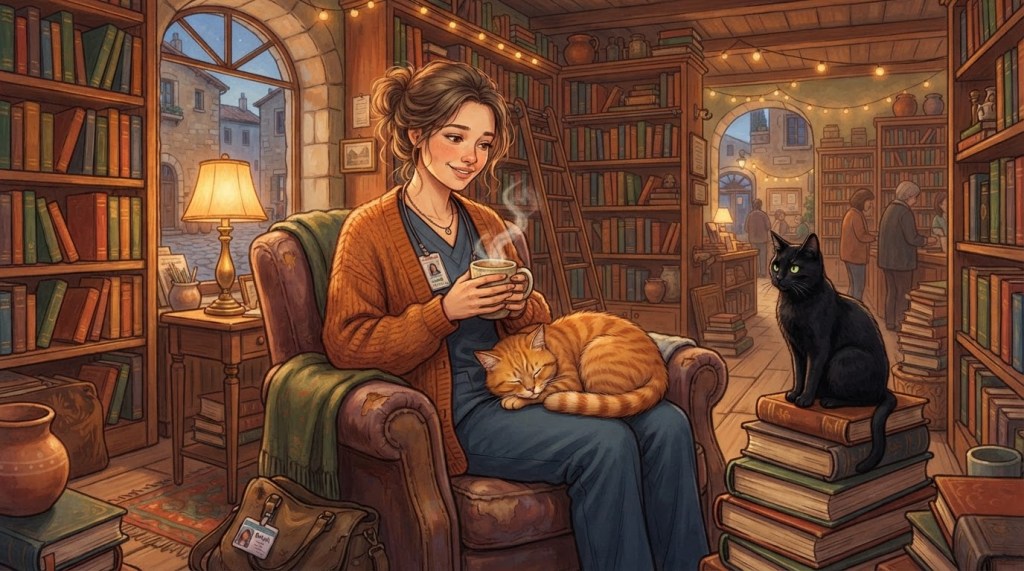
The first frost of the year had come to Speranza without any announcement. By six o’clock the cobblestones of Via dell’Orologio were silvered, the fountain in the little square had grown a thin lid of ice, and every chimney in the village was sending up its own slow ribbon of smoke. In the window of La Pagina che Fa le Fusa, the bookshop at number nine, a single lamp glowed amber against the blue of the dusk.
Moira Hopes had meant to close at half past five. She had turned the sign, counted the day’s small takings, and put the kettle on the stove in the back room. But she had left the lamp in the window burning, as she often did, because in her experience a lit lamp is the cheapest and kindest kind of invitation. Somebody always seemed to need it.
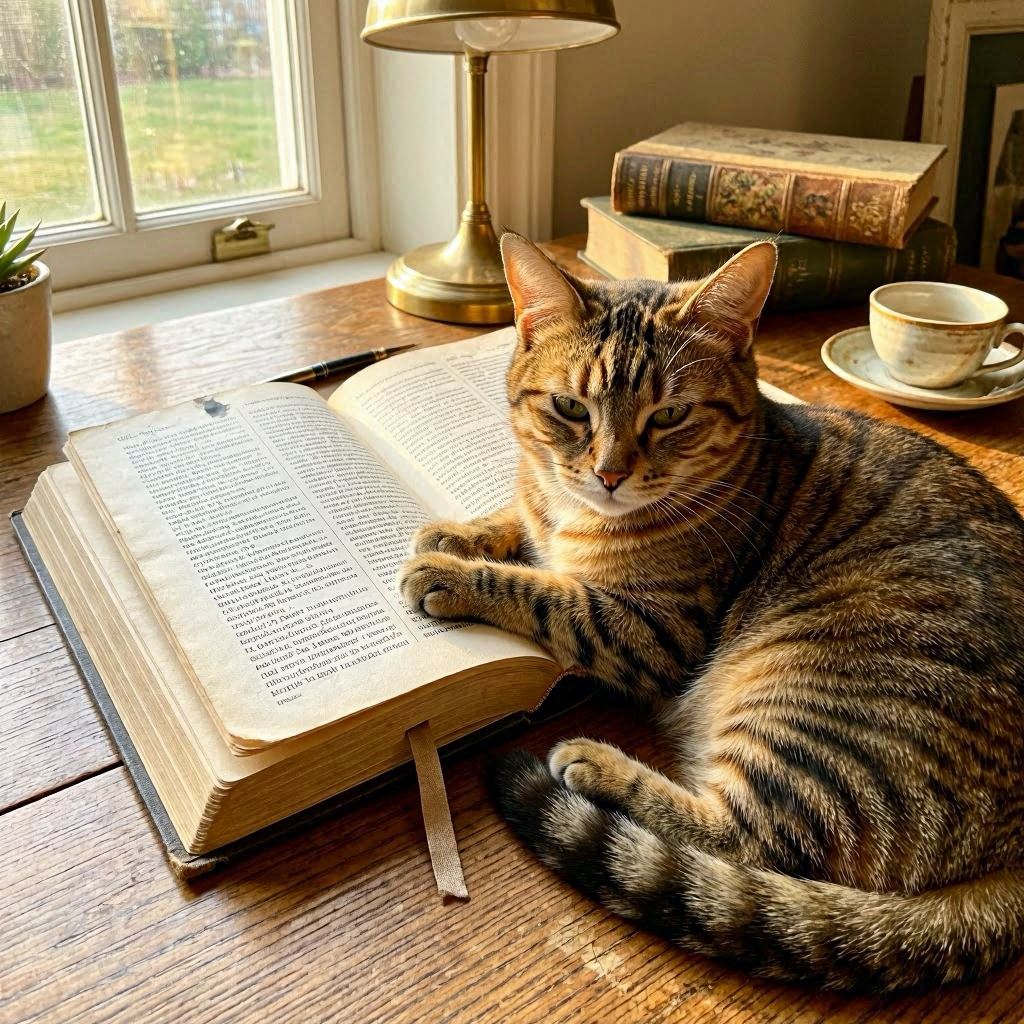
Ashwaganda, the great ginger tabby, had taken his usual place on the cushion by the radiator, all fifteen pounds of him arranged like a loaf of warm bread. His purr was already running, that deep, slow rumble that Moira had once measured, out of curiosity and with a borrowed phone app, at somewhere near twenty-five hertz. Toe, the sleek black cat with the green eyes, sat on the top step of the library ladder like a small, polite shadow, watching the door. He was the one who found things. Lost buttons, dropped earrings, the pencil Moira had sworn she’d put behind her ear: Toe found them all, and usually delivered them with the air of a detective closing a case.
At ten to six, Toe’s ears turned toward the door. A moment later the bell above it gave its small, silvery jingle, and a man came in on a breath of cold air.
A Man Who Could Not Sit
He was perhaps forty-five, tall, with a good wool coat and a laptop bag over one shoulder that he held against his side the way some people hold a child in a crowd. His phone was already in his hand. He glanced at it, put it in his pocket, took it out again, and only then seemed to notice where he was.
“I’m so sorry,” he said. “You’re closed. I saw the lamp, and I thought… I’ll only be a minute. I just need to look at something to read on the train tomorrow.”
“The lamp is there on purpose,” said Moira, smiling. “Come in. You’re letting out the warmth, and the cats are very particular about that.”
He stepped inside and closed the door, but he did not take off his coat. He walked along the shelves with quick, scanning eyes, the way a person walks through an airport, and picked up a book, turned it over, put it down, and picked up another. Moira watched him with the gentle patience of someone who has watched many people arrive at a bookshop and not know what they were really looking for.
“My name is Elio,” he said, without turning around. “I live up the hill, past the old well. I translate technical manuals. Pumps, mostly. Irrigation systems. I work from home, so I’m always about forty steps from my desk, and I have been meaning to come in here for two years.”
“And now you have,” said Moira. “Would you like to sit down, Elio?”
He turned, and for an instant she saw something cross his face that looked almost like alarm. “I should really get back,” he said. “I have a delivery due on Thursday and I’m two chapters behind. I only came out because my sister Marisa told me, very firmly, that if I did not leave the house at least once today she would drive over and carry me out herself.”
“Marisa sounds like a wise woman.”
“She sounds like a tired one. She says I haven’t rested properly in years.” He gave a short laugh with no joy in it. “The strange thing is that I don’t even know what it would look like. When I sit on the sofa in the evening, I feel as if I’m stealing. As if somebody is going to knock at the door and ask what I’ve done to deserve it. So I take the laptop with me, ‘just to check one thing,’ and then it’s midnight.”
Moira said nothing. She had learned long ago that the most useful thing a bookseller can do, once a person has said something true, is to leave a little quiet around it. In that quiet, Toe came down the library ladder one step at a time, walked across the floor without a sound, and stopped at the shelf of travel books. He put one paw on a worn green volume at knee height, pushed it out a few centimeters, and looked up at Elio with his steady green stare.
“He wants you to take it,” said Moira. “He’s rarely wrong.”
Elio drew the book out. It was an old guide to the lakes of northern Italy, its cover softened by many hands. As he opened it, a postcard slid from between the pages and landed on the floorboards. Toe pounced on it as if it were a mouse, then sat back, satisfied, and began to wash a paw.
Elio picked it up. On the front was a painting of a lake at evening, with a single small boat at anchor. On the back, in faded blue ink, someone had written: Nothing to do today. Wishing you the same.
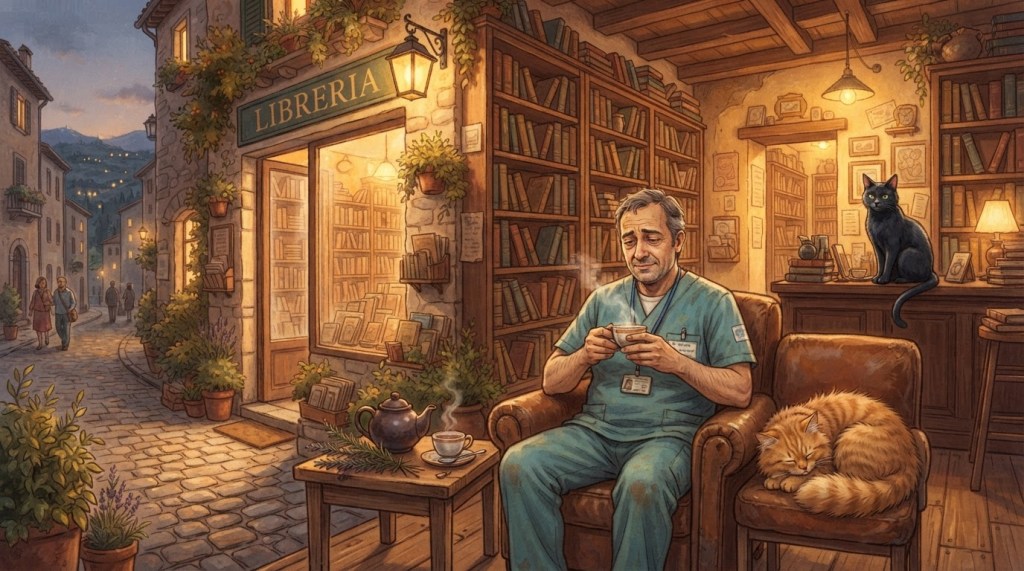
He read it twice. Then, to Moira’s quiet delight, he sat down in the armchair by the radiator, still in his coat, with the laptop bag across his knees like a shield.
Toe has just done what he does best, so allow me a small aside while our visitor settles. On evenings like this, when the frost is on the window and a stranger is deciding whether to stay, I often think the whole shop is really one long conversation. Some of my favourite of those conversations are gathered in a little book, Tales of Speranza, for anyone who likes their stories with a cat on the windowsill. Now, back to Elio.
The Tea
Moira went into the back room, where the kettle had begun to sing. She did not ask Elio what he wanted. She had looked at his shoulders, which were up near his ears, and at his hands, which kept drifting toward his pocket, and she knew what the evening called for.
On the shelf above the stove stood her row of old glass jars, each labeled in her round handwriting. She took down dried spearmint, a few cracked fennel seeds, and a pinch of lemon verbena, and she warmed the blue teapot first, as her grandmother had taught her, so that the water would not be shocked by cold china. She poured the boiling water over the leaves and listened to the small hiss they made as they opened. The room filled with a smell like a green meadow after rain, sweet and a little peppery.
When she came back with the tray, Elio was holding the postcard in both hands, and Ashwaganda had moved. The big tabby had walked, with great dignity and no hurry at all, across the room, and was now looking at the arm of the chair as a mountaineer looks at a summit.
“You don’t have to let him,” said Moira. “But he will ask, in his way.”
“I haven’t had a cat on my lap since I was a boy,” said Elio, and he said it in the voice of a man confessing something rather than describing it.
She set the cup in his hands. He wrapped his fingers around it and breathed in the steam, and Moira watched his shoulders come down, a centimeter, perhaps two.
“Mint, fennel, a little lemon verbena,” she said. “Nothing clever. It is simply warm, and it tastes of something green, and it gives your hands a job for ten minutes. That is most of what a cup of tea does.”
Elio took a sip. “It’s very good,” he said, and then, after a pause, almost to himself: “I haven’t tasted anything properly in a while. I eat at the desk.”
What the Brain Does When You Stop
Moira sat down opposite him, in the small wooden chair she kept for just this purpose, and poured her own cup.
“May I tell you something I find comforting?” she said. “It’s about what your brain is doing when you think you are doing nothing.”
“Please. I’m a translator. I like the technical explanation.”
“For a long time,” said Moira, “scientists assumed that a resting brain was a quiet brain, a machine with the engine switched off. Then, around the turn of this century, a neurologist named Marcus Raichle and his colleagues noticed something odd in their scans. When people lay still and were told to do nothing in particular, a certain network of brain regions did not go quiet. It became more active, compared with when they were concentrating on a task. They gave it a rather dull name: the default mode network.”
“What is it for?” asked Elio.
“That is still being studied, and I would be wary of anyone who says they know exactly. But researchers have linked that network to remembering the past, imagining the future, thinking about other people, and making sense of our own lives. It seems to be a kind of background workshop. So when you let your mind wander on a sofa, you are not necessarily wasting time. Your brain may be sorting the day’s papers and putting them in folders. It’s not the same as work, but it may be a kind of work.”
Elio looked at the cup in his hands. “That is a very flattering way of describing a man staring at a wall.”
“I’m not selling it as a miracle,” said Moira. “It’s one finding among many, and the science of mind-wandering is still young and full of arguments. But I find it a useful corrective to the little voice that says rest is theft.”
At that moment Ashwaganda, having judged the silence sufficiently respectful, leapt onto the arm of the chair, turned around twice, and poured himself into Elio’s lap with a soft thump, laptop bag and all. The bag slid sideways. Elio opened his mouth, closed it, and then, very slowly, rested one hand on the cat’s broad back.
The purr started like a distant engine and deepened until Moira could feel it in the floorboards.
“Oh,” said Elio. “He’s… that’s very loud.”
“Twenty-five hertz or so,” said Moira. “There’s some research suggesting that low-frequency vibrations in roughly that range may have effects on tissue and bone, though honestly the evidence is limited, and I would never promise anyone a cure. But I can tell you from long experience that it is very hard to be in a hurry with fifteen pounds of cat in your lap.”
Elio laughed, properly this time, and the sound surprised him.
The Unfinished List
They sat for a while without talking. Outside, the frost thickened on the glass. Somewhere up the street, a shutter banged and a dog barked twice and gave up. Elio’s phone buzzed in his pocket, and his hand twitched toward it. Then Ashwaganda shifted his weight, and Elio left it where it was.
“Here is my difficulty,” he said at last, stroking the cat’s ear. “Even now, I’m not really here. I’m thinking about Thursday. I’m thinking about the two chapters, and the client who writes at midnight, and whether I answered the one email from this morning. It’s like having ten browser tabs open in my head, and every one of them is playing a different sound.”
“May I tell you about a Russian psychologist named Bluma Zeigarnik?” said Moira.
“The name is familiar.”
“In the 1920s she noticed that waiters seemed to remember unpaid orders in great detail, and forget them the moment the bill was settled. The idea that unfinished tasks cling to the mind more stubbornly than finished ones became known as the Zeigarnik effect. I should say that later researchers have had trouble reproducing it in its simplest form, so I hold it lightly. But there is a more recent study I like better. In 2011, two psychologists, E. J. Masicampo and Roy Baumeister, found that people who had an unfinished goal on their minds were more distracted, and that simply making a specific plan for when and how they would deal with it reduced the intrusion. They did not have to finish the task. They only had to give the worry an appointment.”
“Give the worry an appointment,” Elio repeated slowly.
“It is one study, and a small one, so I would not stake my life on it. But it matches what many people find. The mind keeps shouting about a task because it is afraid you will forget it. If you write it down somewhere trustworthy, with a time attached, the shouting can quieten.”
She stood, took a small card and a pencil from the counter, and handed them to him. Toe, who had appeared at her heel, hopped onto the arm of the chair and sat like a clerk waiting to witness a signature.
“Write it all,” said Moira. “Thursday, the chapters, the email. And next to each one, write when you will deal with it. Not ‘soon.’ A real hour.”
Elio balanced the card on the cat’s back, which Ashwaganda tolerated with the air of a piece of furniture, and wrote. His handwriting was small and neat. Chapter 7: tomorrow, nine to eleven. Chapter 8: tomorrow, two to four. Email: eight-thirty, before coffee. Thursday: Wednesday evening, final read. When he had finished, he looked at the card for a moment.
“It looks so small,” he said. “All of it, on one card.”
“Most things do, once they leave the head,” said Moira.
He tucked the card into the pocket of his coat, over his heart, and let out a long breath that seemed to come up from somewhere below his ribs.
Where the Guilt Comes From
Moira refilled his cup. The tea had cooled just enough to drink in long sips.
“Can I ask you something?” she said. “When you say it feels like stealing, whose voice is it? Is it yours?”
Elio was quiet for a long time. The purr rolled on beneath his hand.
“My father’s, I suppose,” he said at last. “He ran a hardware shop in the next valley. He opened at seven and closed at eight and never, as far as I remember, sat down in front of me. When he was ill at the end, the nurse had to tell him to lie back, and he apologised to her. He apologised for being in bed.” He stopped, and swallowed. “I think I decided as a boy that a person who rests has stopped being useful, and a person who has stopped being useful has stopped being loved.”
Moira did not hurry to fill that silence either. When she spoke, her voice was very soft.
“It’s an old belief, and a very common one. We learn what rest means by watching the people we love. If the grown-ups around us only ever stopped when they were ill or beaten, we may come to feel that stopping is a kind of failure. I’m no psychologist, Elio, only a woman who sells books and listens a great deal. But I have noticed that guilt about rest is usually less about the rest and more about a rule we absorbed long ago and never examined.”
“And if I examine it?”
“Then perhaps you ask whether your father would want you to be ill from tiredness in order to honour him. And whether the man at the hardware shop, who apologised for being in bed, was happy to apologise.”
Elio put his free hand over his eyes. For a little while the only sounds in the shop were the purr, the tick of the radiator and the faint, familiar creak of the building settling against the cold. Toe, without being asked, walked across the chair arm and pressed his small black head briefly against Elio’s wrist, once, like a full stop.
Ten Quiet Minutes
When he took his hand away, his eyes were wet but his face was easier, as faces are after weather has passed.
“I don’t think I can change in a night,” he said. “I’d be lying if I said so.”
“Nobody changes in a night,” said Moira. “But I can suggest something very small. Ten minutes. Once a day, ten minutes where you sit with a cup of something warm and do nothing that produces anything. No phone, no book you must finish, no list. Just the window, or the cat, or the steam. Call it an experiment, if the word helps. Translators are good at experiments.”
“Ten minutes,” said Elio. He said it the way a man tests ice with one foot. “I could do ten minutes.”
“And if the guilt arrives, as it will, you need not argue with it. You can just say, ‘Hello, I see you, I’ll be back to work at nine.’ It will grumble, but it usually quietens when it notices you aren’t running away.”
He smiled, a little crookedly. Then his phone buzzed again, and this time he took it out, looked at the screen, and laughed under his breath.
“Marisa,” he said. “She’s written, ‘Have you left the house yet?’”
“Then answer her honestly.”
He typed with one thumb, careful not to disturb the cat: I’m in a bookshop with a very large ginger cat on my lap, drinking mint tea, and I am not going to move for ten more minutes. The reply came almost before he had finished: three exclamation marks and a small heart.
He put the phone face down on the arm of the chair, and, for what was possibly the first time in two years, he looked at the window and did nothing at all.
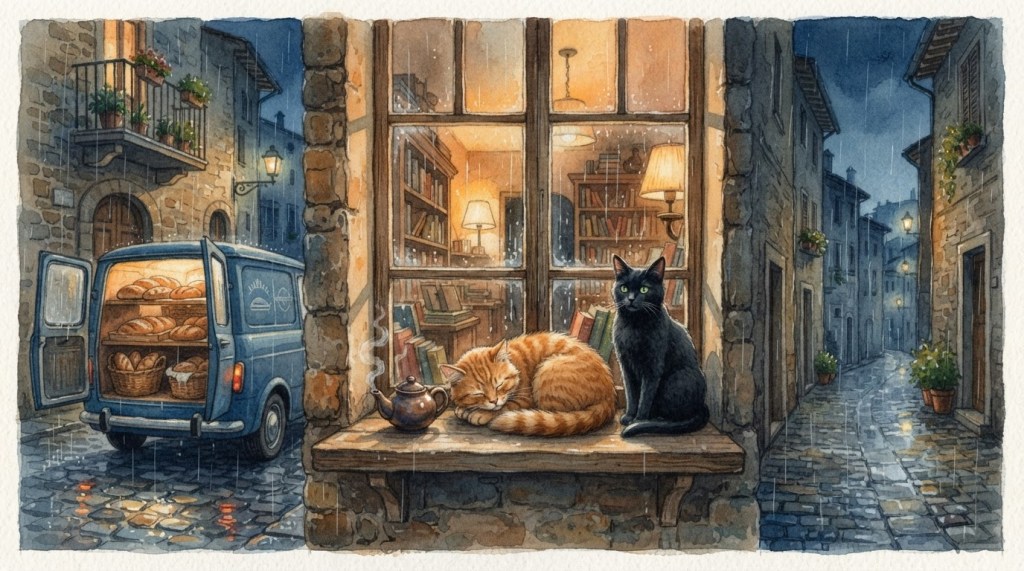
The frost was drawing slow white ferns across the glass. The lamp made a golden pool on the cobblestones outside. Ashwaganda’s purr rumbled on like a small, contented engine, and Toe curled himself into a black comma on the windowsill, his green eyes half-closed, keeping watch over the quiet. Moira sipped her tea and said nothing, because nothing was exactly what the evening needed.
When Elio finally stood, the clock above the counter said ten past seven. He lifted Ashwaganda gently onto the cushion, where the tabby re-formed himself into a loaf without opening an eye. He bought the old guide to the lakes, and slipped the postcard back between its pages, and held the book against his chest with both hands.
“I’ll bring it back when I’ve finished,” he said.
“There’s no hurry,” said Moira, and she watched the word land, and saw him smile at it.
At the door he stopped, with his hand on the brass handle, and looked back at the shop: the lamp, the books, the two cats, the small pot of cooling tea.
“Thank you for leaving the light on,” he said.
“It’s the cheapest kindness I know,” said Moira.
The bell jingled. The cold air came and went. Through the window she watched him walk up Via dell’Orologio under the street lamps, not quickly, his breath white in front of him, the book held close, and she noticed that he stopped once at the old fountain, just to look at the ice.
Moira’s Reflection
I have come to think that guilt about rest is rarely about the rest itself. It is a rule written in us long ago, often by people who loved us and were simply tired, and it goes on running in the background long after we have forgotten who wrote it. We do not need to fight it. We only need to notice it, thank it for trying to keep us safe, and put it gently down for ten minutes.
What we call doing nothing is not quite nothing. A mind at rest may be sorting, remembering and imagining, and a body at rest is mending in ways we cannot see. A worry written down with a time beside it often grows quieter, and a purring cat, I find, makes an excellent chaperone. Rest is not the opposite of being useful. It is part of how a person stays kind enough to be useful at all.
What about you? When did you last sit down with nothing to prove, and whose voice did you hear when you did? Tell us in the comments: Ashwaganda and Toe would love to know.
A Cup for This Story
- 1 teaspoon dried spearmint leaves
- A few cracked fennel seeds (about 5 to 6)
- A pinch of dried lemon verbena
- 1 cup of freshly boiled water, poured over the leaves
- Cover and steep for 6 to 8 minutes, strain, and drink slowly, with nothing else to do
Herbal teas are a pleasant ritual, not medicine; if you are pregnant, on medication or unwell, check with your doctor before trying new herbs.
P.S. If tonight’s question about rest and guilt stayed with you, there are more slow evenings like this one, with tea and cats and a little honest science, in Tales of Speranza.
Listen in Speranza
🎧 Moira’s bookshop also has a voice. Tales from Speranza is our free podcast of slow evening stories, read aloud for the end of the day. Listen on Spotify.
Press Play and Stay a While
Before you go, here is the little song that welcomes visitors to Speranza. Press play, put your feet up, and let the evening take its time.





Leave a Reply