How do you choose between two paths when both of them are good?
Two Envelopes at Dusk
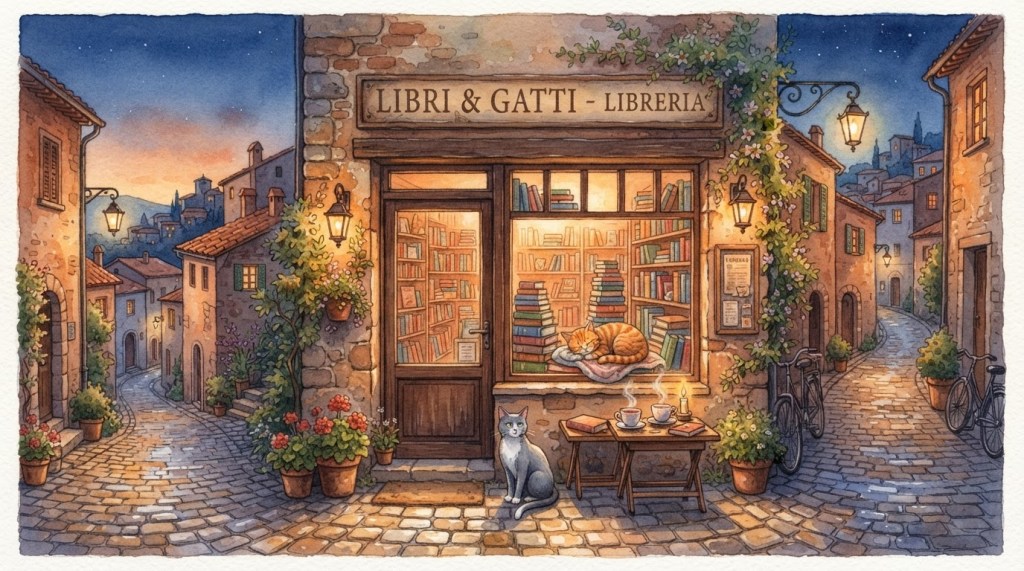
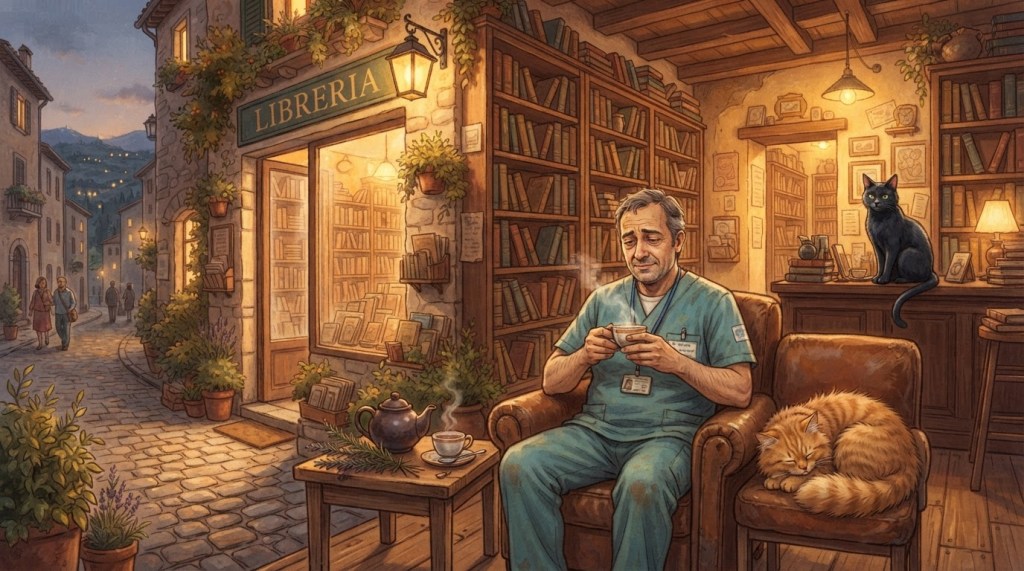
On the last Monday of November, Via dell’Orologio smelled of woodsmoke and wet stone. The church clock had struck five a little while ago, and the sky above Speranza was doing the thing it does at that hour: going from peach to lilac to a deep, soft blue, as if someone were slowly turning down a lamp.
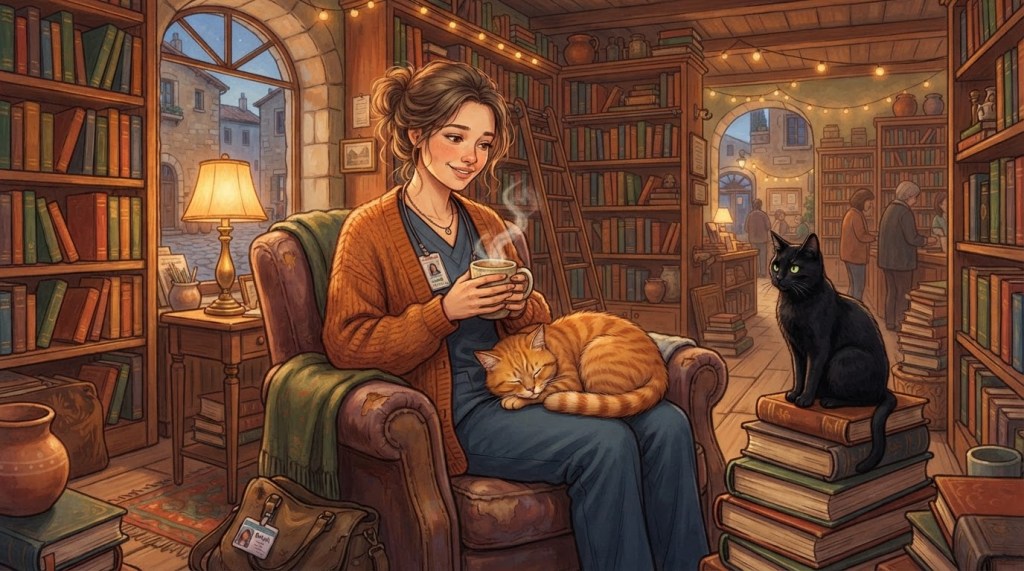
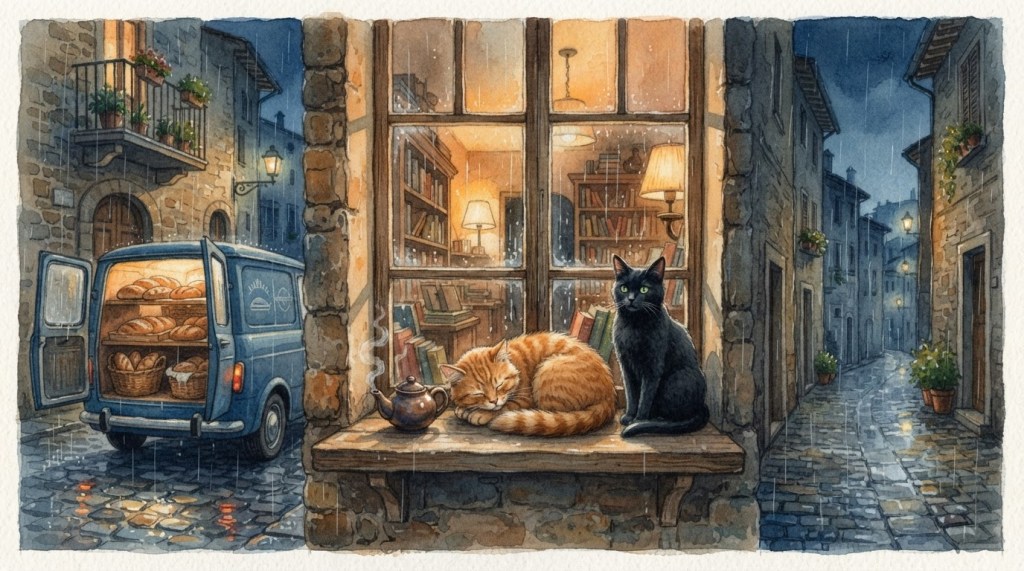
Inside La Pagina che Fa le Fusa, Moira Hopes was shelving the last of the afternoon’s returns when the bell above the door gave its small, apologetic jingle. Ashwaganda, the fifteen-pound ginger tabby, lifted one eyelid from his cushion in the window and decided the visitor was not worth a whole eye. Toe, the slender black cat with green eyes, did the opposite. He slid off the counter, crossed the floorboards in four silent steps, and sat down in front of the newcomer with his green eyes wide open.
The visitor was a young woman in a green wool coat, perhaps twenty-eight, with a scarf wound twice around her neck and a pair of envelopes held in her hands like cards she did not want to play. Her name was Federica Sanna. Moira knew her a little, the way you know everyone in a village of nine hundred people: she was the one who stayed late at the stationery shop on the square, the one who could find you the exact shade of green ink you had been looking for since 2009.
“Buonasera, Federica,” said Moira. “You look like someone carrying two very heavy letters.”
Federica laughed, and then, to her own surprise, her eyes filled. “They’re not heavy,” she said. “That’s the problem. They’re lovely. They’re both lovely. And I haven’t slept properly in nine days.”
Moira put down the book in her hands, a battered paperback about lighthouses, and turned the sign on the door to chiuso. It was not closing time. But some visitors need the door closed so that the room becomes a small, private country, and this was clearly one of them.
“Sit,” she said. “By the stove. The tea will take ten minutes, and the story will take as long as it takes.”
The Tin with the Lemon on the Lid
The reading corner of the bookshop had two armchairs that did not match, a rug that had been red once, and a low table with a lamp whose shade was patched with a piece of an old map. Federica sank into the larger chair. Toe leapt onto the arm of it at once, as though he had been hired for the job.
Moira disappeared behind the curtain at the back and came out with the old copper kettle, the brown teapot, and a tin with a faded lemon painted on the lid. “Lemon balm,” she said, lifting the lid so that the smell rolled out, bright and green and faintly sweet. “Melissa officinalis. The monks grew it by their doors for centuries, and I like to think they sat down next to it when they had decisions to make. I’ll add a few dried orange peels, because the evening needs a little brightness, and just three lavender buds, because more than three and it tastes like a drawer full of soap.”
Federica smiled through the last of her tears. The kettle began to sing.
“Now,” said Moira, pouring the water over the leaves and setting the little sand timer on the table, “tell me about the envelopes. Start with the thin one.”
“The thin one is from Turin,” Federica said. “A two-year course in paper conservation. Old manuscripts, maps, the pages that fall apart when you look at them. I applied in the spring because I thought, well, nothing will come of it, and then something came of it. I have a place. It begins in January.”
“And the thick one?”
“Signor Ferri’s shop.” She said it almost in a whisper. “He is seventy-six, Moira. His knees hurt, his daughter lives in Canada, and he told me last week he would rather hand the keys to me than to a stranger or to nobody. He has put it in writing. The lease, the stock, the old ledger, everything. I’ve worked in that shop since I was nineteen. I know where every pencil lives. I love it. I really do.”
“So you love Turin, and you love the shop.”
“I love both, and I am afraid of both, and when I try to imagine choosing one I hear a little door closing on the other, and it is the sound of that door that keeps me awake.” She pressed the heels of her hands against her eyes. “Everyone says, just follow your heart. But my heart is sitting at the table with two forks and one plate.”
Moira laughed, a warm low laugh, and the sand timer ran out.
Two Lists and Two Cats
She poured the tea into two small cups, pale gold, with a steam that smelled like a lemon tree in an orchard on a warm afternoon. Federica wrapped both hands around hers and breathed in. For the first time in nine days, her shoulders came down from around her ears.
“Have you made lists?” asked Moira.
“Dozens.” Federica reached into her coat and took out a folded sheet, then another, then a third, covered in her small, tidy handwriting. “Pros and cons. Pros and cons of the pros and cons. I made a table with weights. I gave Turin a seven for meaning and the shop an eight for people, and then I changed my mind and swapped them. My sister Lucia says I should flip a coin. I told her the coin would not know what I want. She said that’s the point of a coin, and I hung up on her. Then I called back and apologised.”
Toe, who had been watching the papers with a scholar’s attention, stepped from the arm of the chair onto the sheet that said TURIN and settled down upon it with his black paws neatly folded. A moment later, as if the room had to be fair, Ashwaganda rose from his cushion, crossed the floor with the slow dignity of a small ginger ship, heaved himself onto Federica’s lap, and lay across the sheet that said THE SHOP.
Federica burst out laughing. “They’ve picked sides.”
“They’ve picked laps,” said Moira. “Cats are very good at that. A cat does not weigh the warmth of the sunny windowsill against the warmth of the radiator. A cat lies down where it is warm, and when it stops being warm, it moves. Feel that.”
Federica felt it. Under her hand, Ashwaganda’s whole body was humming with his deep, low purr, a vibration so steady that the teacup trembled very slightly in its saucer.
“Twenty-five hertz or thereabouts,” Moira said fondly. “Domestic cats purr somewhere between about twenty-five and a hundred and fifty hertz, and some researchers have suggested that frequencies in that range might be soothing to bones and to people. I say might because the evidence is thinner than the legends. But I can tell you that I have never once seen a person get worse at deciding with a cat on her lap.”
Federica put the lists down on the table, very gently, so as not to disturb either cat’s paperwork.
It was a good moment, and as the lamp glowed and the stove ticked, Moira did the thing she did most evenings, and spoke a little to the reader she imagined listening somewhere beyond the walls.
Forgive me, dear reader, while Toe adjusts his paws on that paper and the lemon balm does its quiet work: I should tell you that the evenings I love best in this shop have been gathered, like pressed flowers, into a small book called Tales of Speranza. It is for nights when you want to sit still for a while. Now, back to Federica, who is about to hear about jam.
The Jam Table
“Let me tell you about a famous table of jam,” said Moira, settling into the other armchair with her cup.
“Jam?”
“In the year 2000, two psychologists, Sheena Iyengar and Mark Lepper, set up tasting tables in a California supermarket. On some days the table offered twenty-four kinds of jam. On other days, only six. The big table attracted more people who stopped to taste. But the small table produced far more purchases, about ten times as many in their report, as I remember. Too many options, they said, can leave people less likely to choose at all. It was called choice overload, and it became one of the best-known stories in the psychology of decisions.”
Federica nodded slowly. “That’s me. Twenty-four jams.”
“Almost. But here comes the honest part, because I never want to hand you a tidy fable without the footnotes. Later researchers tried to repeat the finding and the results were mixed. In 2010, Benjamin Scheibehenne and his colleagues gathered dozens of experiments and found that, on average, the effect was close to zero. Sometimes too many options hurt. Sometimes they helped. It seems to depend on things like how hard the options are to compare, how clearly you know what you want, and whether you are under pressure. So I wouldn’t say that choices always paralyse us. I’d say that when the options are hard to compare and our wishes are unclear, more information can bury us rather than help us.”
“And my two envelopes are hard to compare.”
“They’re as hard to compare as a sunrise and a lullaby. You are trying to weigh a seven for meaning against an eight for people, but those numbers are made of different stuff. No spreadsheet can add them up, because the columns don’t share a unit. That is why your lists have been making you more tired, not less.”
Federica looked at the three sheets on the table with something like affection, and something like relief. “So the lists are not wrong. They just can’t do the last bit.”
“The lists are excellent at the first bit. They show you what you are afraid of and what you long for. The last bit is yours.”
Good Enough Is a Compliment
Outside, a light rain had begun, the kind that does not fall so much as hang in the lamplight. Moira refilled the cups. The cats had not moved.
“There is a word I’d like to hand you,” Moira said. “Satisficing. It was coined by the economist and psychologist Herbert Simon in the 1950s, a blend of satisfy and suffice. His idea was that real people, with limited time and limited knowledge, rarely hunt for the single best option in the universe. We search until we find something that meets our needs, and then we stop. He thought this was not a flaw in human thinking, but a sensible way of living in a world too big to calculate.”
“That sounds like giving up.”
“It sounds that way because we have been taught to worship the best. But listen. In 2002, the psychologist Barry Schwartz and his colleagues described people they called maximizers, who feel they must find the very best choice, and satisficers, who are content with one that is good enough. In their surveys, the maximizers tended to report more regret and less happiness, even when their choices looked objectively better. Now, that was a survey, so it shows a pattern and not a cause. Perhaps unhappy people are more likely to maximize, rather than the other way around. We don’t know. But it should make us curious about the habit of asking, of every good thing, but is it the best?“
Federica ran a thumb along the rim of her cup. “I think I am a maximizer. I once spent forty minutes choosing a notebook.”
“You sell notebooks. It’s a forgivable weakness.” Moira smiled. “But here is the question I would put to you instead of which is better. Is either of these paths good enough to build a life on? Because if both are, then you are not standing at a fork where one road leads to a cliff. You are standing at a fork where both roads lead somewhere green, and the trouble is only that you can’t walk both at once.”
Federica was quiet for a long while. A log shifted in the stove. Ashwaganda sighed, a sound like a bellows.
“Both are good enough,” she said at last. “More than good enough. That’s why it hurts.”
“Then it hurts for a good reason. It’s the hurt of having been given more than one gift.”
The Door That Closes
“May I ask what frightens you most?” said Moira, after a while. “I don’t mean which option. I mean the feeling.”
Federica considered it, turning her cup. “Regret,” she said. “Imagining myself in five years, in the wrong life, remembering the other one.”
“Ah. Then let me tell you two small, hedged things about regret, and you may weigh them however you like.”
“The first is from the psychologist Daniel Gilbert and his colleagues. They have studied what is sometimes called the impact bias: we tend to overestimate how strongly, and for how long, a future event will make us feel, good or bad. We forecast a disaster, and then, when it comes, we find that our minds have quietly gone to work, finding reasons, reframing, getting used to it. Gilbert calls this a kind of psychological immune system. It does not make us immune to sorrow, mind you. But it means the feeling you are dreading tonight is probably going to be smaller and shorter than the one you are imagining.”
“And the second?”
“The second is stranger, and I love it. In a well-known study from the early 2000s, Gilbert and Jane Ebert had students develop photographs and choose one to keep. Some were told they could swap their choice within a few days. Others were told the choice was final. Afterwards, the ones whose choice was final liked their photo more than those who could still change their minds. The open door, it seemed, kept people from settling into what they had. One study, I’ll remind you, with students and photographs, so it is not a law of nature. But it suggests that the very thing you fear, the closing of the door, may be the thing that lets a choice grow warm.”
Federica stared into the fire. “So the sound of the door closing might be the beginning of the good part.”
“It might. When we commit, we start telling ourselves the story of the path we are on, and we begin to notice its pleasures. When we hover, we keep one foot in each story and never quite live in either.”
Toe, on the sheet marked TURIN, stretched out one black paw and, very deliberately, pushed the page off the table. It fluttered to the rug. Everyone looked at it. Federica felt something in her chest do a small, surprised leap, and she understood, with a clarity that felt almost rude in its simplicity, which way she had hoped the cat would push.
“Oh,” she said.
“Mm,” said Moira, not looking up from her tea.
“That was not the cat’s decision.”
“No, cara. Cats are terrible at decisions. But they are splendid at the moment of the coin toss, when you hear yourself shouting best of three. People sometimes flip a coin not to let it choose, but to learn what they are hoping for while it is in the air.”
Federica leaned down, picked the paper up from the rug, and looked at it for a long moment. “I want to go,” she said slowly. “I think I want to go to Turin. I want to learn how to save the pages that are falling apart. But I want it with my whole heart only if the shop does not fall apart too, and that is the thing I can’t bear.”
“Now that,” said Moira, “is a much better question than the one you came in with.”
The Third Thing
“You came in asking which one,” Moira went on, “as if the world had given you a menu with two items. But often, when we stop staring at the two envelopes, a third thing is standing quietly behind them. Not a compromise exactly. A question you hadn’t dared to ask because both options looked so final.”
“Such as?”
“I can’t answer that, I’m only a bookseller. But I can wonder out loud. Signor Ferri trusts you. Does he need the keys in January, or does he need to know that the shop will go on? Is there a cousin who might mind the counter, or a young person in the village who would love the work and learn the ledger? Might he sell you the shop later, or lease it to someone you choose? Would the course allow you to return in summer? I don’t know the answers. But I notice that you have not yet asked him any of those questions, because you were busy being afraid of the answer to the first.”
Federica put her hand over her mouth. “I never even asked him. I assumed that if I said Turin, the shop would close forever. I assumed he would be hurt.”
“People who love us are rarely as fragile as we imagine,” said Moira. “Another thing we tend to do when afraid: we make a decision on behalf of somebody else, and call it kindness.”
Ashwaganda, who had been entirely still, yawned so enormously that his whiskers trembled. The clock above the door chimed the half hour. The rain had thinned to almost nothing, and in the dark window the lantern outside made a small gold circle on the wet cobbles.
“Tomorrow morning,” Federica said, “I will go to the shop, and I will make coffee for Signor Ferri, and I will tell him the truth. That I am torn. That I want to learn how to mend old paper. That I love his shop more than he knows. And then I will ask him what he thinks is possible.”
“That sounds like a very good Tuesday.”
“It does, doesn’t it?” She laughed again, lightly now, the laugh of someone who has put down a bag she did not realise how long she had been carrying. “And if he says no? If there is no third thing?”
“Then you will choose, with your eyes open, one of two good paths, and you will let the door close behind you, and the immune system of your heart will get to work. I would not be afraid of that, Federica. I’d be a little afraid of the other thing: of standing in the doorway for another nine nights, until the choice is made for you by the calendar.”
The Bell and the Blue Hour
When Federica finally stood to go, Ashwaganda slid off her lap with the offended grace of a duke dismissed from a throne, and went to look for his supper. Toe followed her to the door and watched her button the green coat, the scarf twice around, the three sheets of paper folded into a pocket she did not seem to need now.
Moira slipped a small paper bag into her hands. “Lemon balm and orange peel, with three buds of lavender. Brew it tomorrow night, after you’ve talked to Signor Ferri, whatever he says. Drink it slowly, and don’t make any decisions until the cup is empty.”
“What if I make one anyway?”
“Then at least you will have made it with a warm cup in your hands.”
Federica hugged her, a quick, fierce hug, and stepped out into the blue hour. Moira stood in the doorway and watched her go up Via dell’Orologio, her breath making little clouds, until she reached the corner where the two lanes of the village meet. There, under the lantern, she paused, just for a breath, and looked down one lane, and then the other.
Then she smiled, and turned toward the square, where a single window was still lit above the stationery shop.
“Well,” said Moira softly, closing the door. At her feet, Toe sat with his black paws together, looking up. “Don’t look at me like that. I didn’t tell her what to do.”
Toe blinked his green eyes, slowly, which in the language of cats means of course you did not, and also well done.
Moira’s Reflection
When two paths are both good, the difficulty is rarely a lack of information. It is that we are asking a spreadsheet to do the work of a heart, and a heart is not built for sums. Lists are wonderful for showing us what we fear and what we long for. They are poor at telling us which of two kinds of happiness we would rather live inside.
So perhaps the gentlest questions are these: Is each path good enough? What am I really afraid of, the choice or the feeling? And is there a third thing, a conversation I have not had yet, standing quietly behind the two envelopes? A choice made with open eyes and a warm cup does not need to be perfect. It only needs to be ours, and then lived in, patiently, until it begins to feel like home.
Now I’d love to hear from you. Is there a choice you are standing at the edge of tonight, or one you made long ago that turned out warmer than you expected? Tell us in the comments, and the cats and I will read every word.
A Cup for This Story
- 1 heaped teaspoon of dried lemon balm leaves
- A small strip of dried or fresh orange peel
- 3 dried lavender buds, no more
- 250 ml of just-boiled water
- Steep, covered, for 7 minutes, then strain and sip slowly, ideally with a cat nearby
Herbal teas are comforting little rituals, not medicine, and they are not a substitute for professional advice.
From Moira’s shelf, if you’d like to make this cup at home: dried lemon balm · dried orange peel · dried food-grade lavender. (Amazon links: we may earn a small commission, at no extra cost to you.)
P.S. If tonight’s question about choosing between two good paths stayed with you, there are ten more slow evenings like this one in Tales of Speranza.
Listen in Speranza
🎧 Moira’s bookshop also has a voice. Tales from Speranza is our free podcast of slow evening stories, read aloud for the end of the day. Listen on Spotify.
Press Play and Stay a While
Before you go, here is the little song of the village. Let it play while your tea cools and the evening settles around you.




Leave a Reply