
CHAPTER FIVE
The Strategy of the Python
The Ispettore’s words hung in the air, dismantling Moira’s tidy reality piece by piece. The rare poison. The impossible cost. In that single, stark moment of revelation, the entire narrative of the past week inverted itself, the heroes becoming villains, the victims becoming architects. The book’s riddle exploded in her mind with the shocking, brilliant clarity of a lightning strike.
The songbird cages itself. Viviana had poisoned herself, a desperate act of self-sabotage designed to look like an attack.
The fox runs for the serpent. Albinoni, the forger, was not an independent criminal. He was a pawn, a collaborator working for Viviana, the serpent with the silver clasp and the venomous plan.
Look not for the stolen prize, but the unseen debt. It was never about the insurance money for the fake statue. That was just a distraction, a sideshow to create chaos and a believable local suspect. The true prize, the “unseen debt” the crime was meant to settle, was the multi-million-euro insurance policy on Viviana’s legendary voice.
It was a desperate, brilliant, terrifying gambit. Moira sank into a chair, her mind reeling as it re-assembled the past few days through this new, horrifying lens. She saw Viviana’s grand entrance not as the arrival of a diva, but as the first move of a master strategist. She saw the public argument with Silvio not as a coincidence, but as a calculated move to establish a credible local fall guy. She saw the self-poisoning not as a moment of victimhood, but as an act of supreme, painful control. Viviana had expertly framed both Luca, her resentful but ultimately harmless assistant, and Silvio, the grumpy but innocent farmer, knowing their obvious motives would create a smokescreen so thick no one would look beyond it. She had even brought the calendula flowers herself, planting the cure alongside the crime, a final, arrogant flourish.
Moira now understood the true nature of Albinoni’s role. He was a man with a past, a disgraced academic blackmailed into service. His forgery was not for his own gain, but a necessary piece of the puzzle, designed to create a public spectacle and a plausible reason for the police to be distracted while the real crime—the insurance fraud on Viviana’s voice—was committed and certified. His “ransacked” room, his “stolen” prize; it was all a carefully constructed stage.
As these thoughts cascaded through her mind, she looked up and out the front window of her shop. The streetlights of Speranza cast long, quiet shadows down the cobblestone alley. And into one of those shadows, a sleek, black car with Roman plates now silently glided to a stop. The driver’s door opened, and a man in a sharp, impeccably tailored suit stepped out. Even from a distance, he radiated an aura of cold, ruthless power. Moira recognized him from the financial pages—a notorious and unforgiving art collector from Rome, a man known for collecting debts as avidly as he collected masterpieces.
Then, from the deeper shadows of the alley opposite her shop, a figure emerged. It was Signora Viviana Bellini. The frail, victimized diva was gone. In her place stood a woman of formidable composure and icy resolve. A triumphant, almost predatory smile played on her lips as she approached the collector. She carried no handbag, but Moira could almost see the phantom glint of the silver serpent on her wrist. Viviana handed him a thick, official-looking envelope—no doubt the initial insurance paperwork, the first payment on her “unseen debt.”
It was a scene of such audacious, cinematic villainy that Moira felt a tremor of pure, unadulterated awe. She had been a spectator, a pawn, in a game far more cunningly crafted than any she had ever read.
Just as the collector took the envelope, another car, quieter and less assuming, pulled up behind his. Its headlights flashed once. Ispettore Salomone stepped out, no longer weary, but radiating a cold, focused anger. He was not alone. The game was over.
Moira watched, breathless, as the quiet drama unfolded under the dim lights of her village. She looked down at the floor. Ashwaganda was calmly washing a paw, his work done. Toe, seeing the reflection of the flashing police light on the window, began to bat at it playfully, a tiny black shadow oblivious to the grand deceptions of the human world.
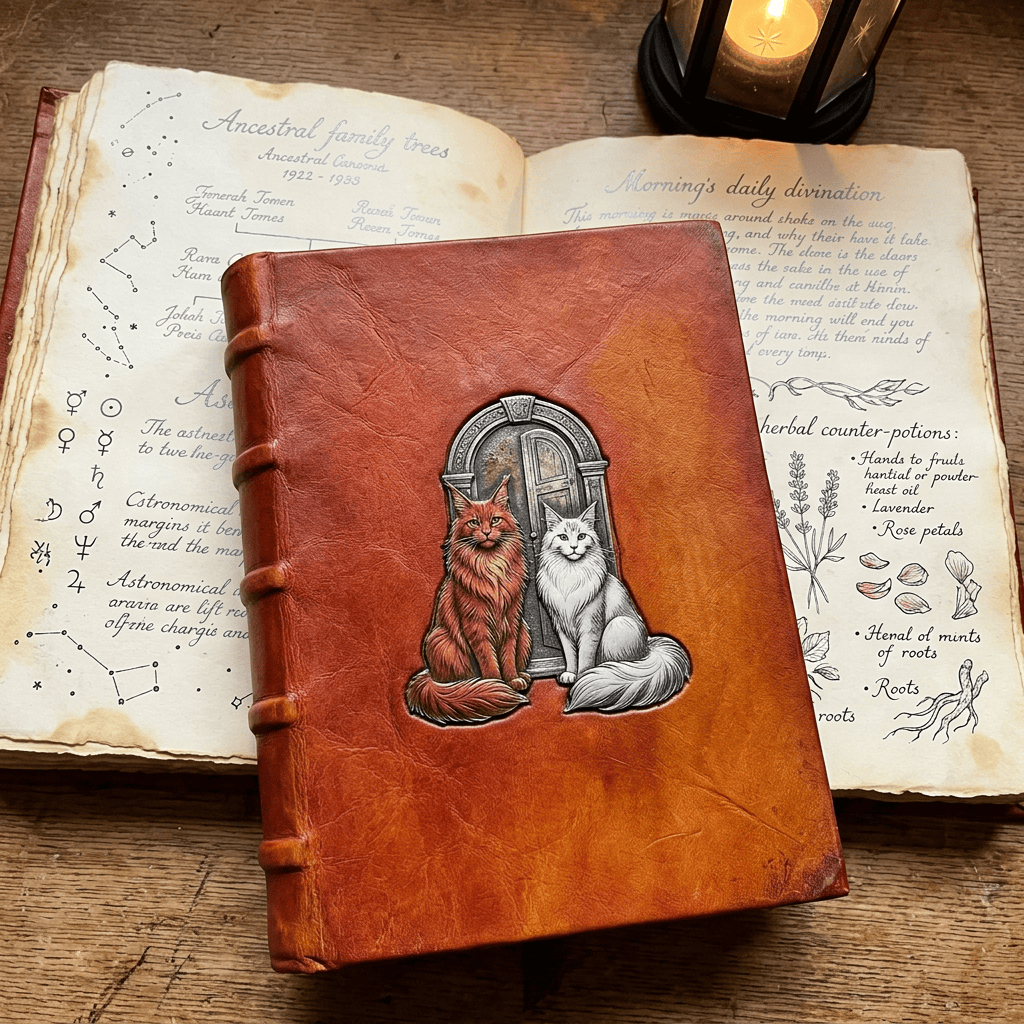
She picked up Days of your Dreams from the table, its peacock-blue cover cool beneath her fingers. It hadn’t given her easy answers. It had forced her to look deeper, to question the obvious, to understand that the most elegant solutions are often the most deceptive. She had learned that a quiet village like Speranza wasn’t just a place of peaceful, sun-drenched hills; it was a place of deep, hidden currents, of desperate gambits played out in the shadows. And she, the quiet proprietor of a tea shop, was no longer just a spectator. She was a reader of secrets, a skill taught to her by a magical book, and by the profound, unwavering, and furry smartness of her two feline masters. The shop was quiet again, the scent of rosemary mingling with the crisp night air, and for the first time, the silence felt less like peace and more like a held breath, waiting for the next story to begin.
THIS is a guide to some of the terms, places, and botanicals featured in the stories of Moira Hopes and “La Pagina che Fa le Fusa.”
Part 1: Italian Terms & Places
- Speranza
- Explanation: The name of the fictional Italian hill village where the story is set. The word literally translates to “Hope” in English, adding a layer of gentle optimism to the setting.
- Pronunciation: speh-RAHN-tsah (The ‘z’ sound is sharp, like the ‘ts’ in “cats”).
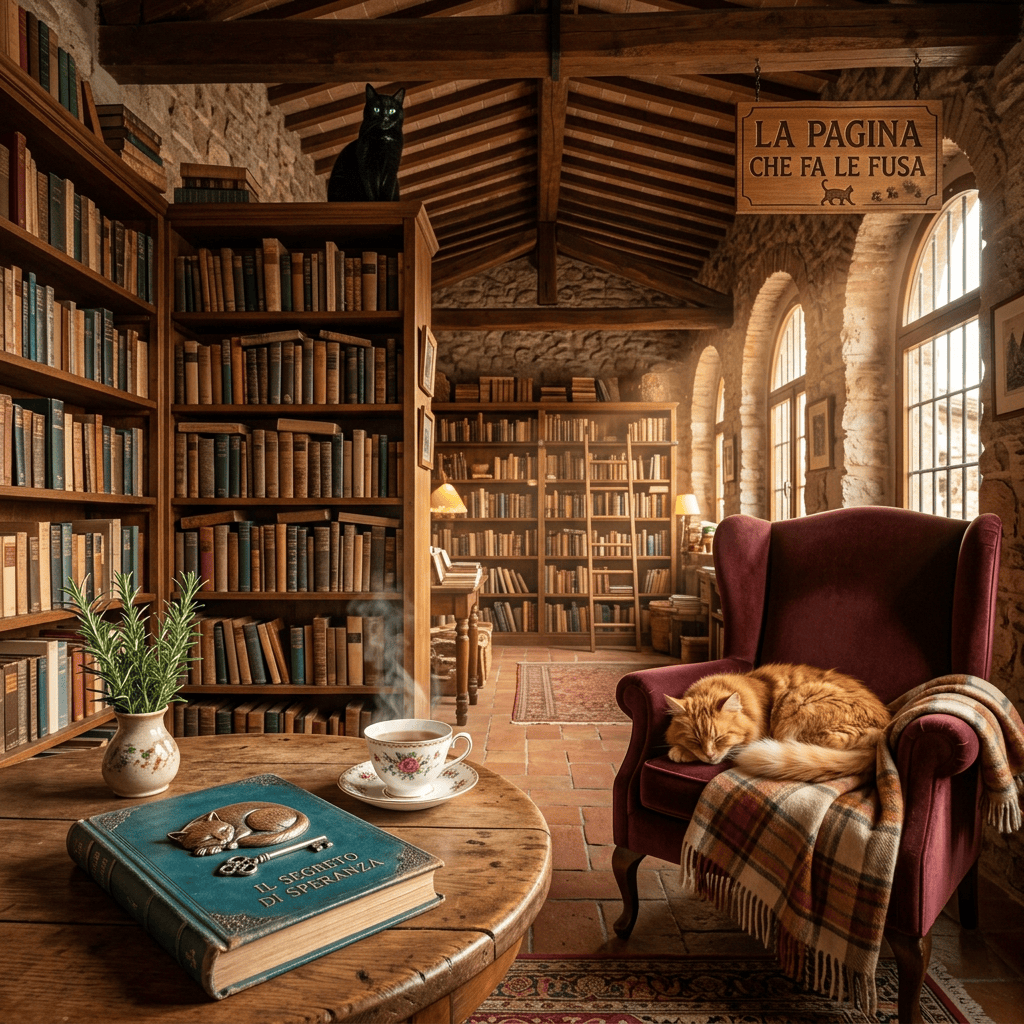
- La Pagina che Fa le Fusa
- Explanation: The whimsical name of Moira’s tea shop. It translates literally to “The Page that Purrs,” perfectly capturing the shop’s dual themes of books and cozy cats.
- Pronunciation: lah PAH-jee-nah kay fah lay FOO-sah.
- Signorina
- Explanation: A formal and polite Italian title for an unmarried woman, equivalent to “Miss” in English. It’s used by Ispettore Salomone when addressing Moira Hopes.
- Pronunciation: seen-yo-REE-nah.
- Ispettore
- Explanation: The Italian title for a police “Inspector.” It is the proper rank for the character Salomone in the Italian police force (Polizia di Stato or Carabinieri).
- Pronunciation: ees-pet-TOH-ray.
- Pensione
- Explanation: A type of guesthouse or small, family-run hotel common in Italy. It suggests a more modest and intimate lodging than a large hotel, fitting for a small village like Speranza.
- Pronunciation: pen-see-OH-nay.
- Erboristeria
- Explanation: An Italian herbalist’s shop. These stores specialize in medicinal herbs, tinctures, natural cosmetics, and herbal remedies.
- Pronunciation: er-boh-rees-teh-REE-ah.
- Salomone
- Explanation: The surname of the police inspector. It is the Italian version of the name “Solomon,” famously associated with wisdom.
- Pronunciation: sah-loh-MOH-nay.
Part 2: Teas, Herbs, and Key Substances
A note on herbal use: The descriptions below are for informational purposes based on traditional and modern understanding. The uses within the story, particularly for poisons and antidotes, are fictional plot devices.
- Rosemary (Rosmarino)
- Usage & Meaning: A staple Mediterranean herb, its pine-like, pungent aroma perfumes the air around Moira’s shop. In Italy, it’s used extensively in cooking (especially with roasted meats and potatoes). Symbolically, it’s associated with remembrance and clarity of mind.
- Approach with Care: While a common culinary herb, concentrated rosemary oil can be potent and should be used with caution, especially during pregnancy.
- Lapsang Souchong
- Usage & Meaning: A Chinese black tea known for its signature smoky aroma and flavor, achieved by smoke-drying the leaves over burning pinewood. Its bold, savory, and powerful character makes it a very distinctive and acquired taste.
- Approach with Care: Like all black teas, it contains caffeine.
- Chamomile (Camomilla)
- Usage & Meaning: One of the most popular herbal teas in Italy and worldwide. It is renowned for its calming and soothing properties, often taken in the evening to promote relaxation and restful sleep. Its flavor is gentle, apple-like, and floral.
- Approach with Care: Generally very safe, but individuals with allergies to the daisy family (like ragweed) may have a reaction.
- Licorice Root (Radice di Liquirizia)
- Usage & Meaning: Used in Moira’s blend for Signora Bellini. It has a long history of use for soothing sore throats and coughs due to its demulcent properties. It has a naturally intense, sweet flavor.
- Approach with Care: Overconsumption or long-term use of licorice root can lead to increased blood pressure and low potassium levels. It should be used with caution by individuals with hypertension or heart conditions.
- Marshmallow Leaf (Foglia di Altea)
- Usage & Meaning: Another key ingredient in the diva’s tea. Like the root, the leaf contains mucilage, a gel-like substance that coats and soothes irritated mucous membranes, making it a traditional remedy for throat and lung issues.
- Approach with Care: It is generally considered safe but can sometimes interfere with the absorption of other medications if taken at the same time.
- Calendula
- Usage & Meaning: Also known as “pot marigold.” Traditionally, its bright golden-orange petals are not primarily used for tea but are infused in oils to create salves and creams for skincare. It is prized for its anti-inflammatory and wound-healing properties. In the story, its role as a magical antidote is a key fictional element.
- Approach with Care: Primarily for topical use, though sometimes used in teas. Those with allergies to the daisy family should be cautious.
- Yew Tree (Tasso)
- Usage & Meaning: This tree was featured in an earlier version of the story as a poison source. In reality, the Yew is a common ornamental evergreen.
- EXTREME WARNING: All parts of the Yew tree (needles, bark, seeds) are highly toxic to humans and animals. Ingesting even a small amount can be fatal due to cardiotoxins that cause cardiac arrest. It should never be handled without care or consumed in any form. Its use in the story highlights the existence of potent, natural poisons.
General Rule for Approaching Herbal Products: Always consult with a qualified healthcare professional or a certified herbalist before using any herbs for medicinal purposes. This is especially critical if you are pregnant, breastfeeding, have a pre-existing medical condition, or are taking other medications, as herbs can have powerful effects and interact with pharmaceuticals.






Leave a Reply