Can you feel lonely even when you are surrounded by people, and what does that feeling want from you?
The Fog on Via dell’Orologio
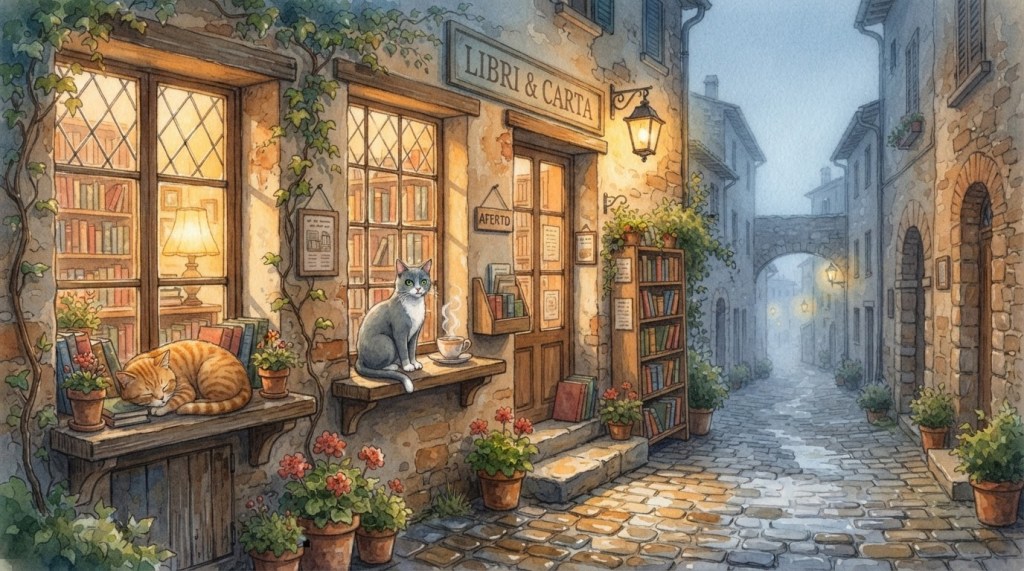
The fog came up from the valley in the middle of the afternoon, the way it does in Speranza at the end of November, and by five o’clock it had swallowed the church tower, the fountain, and most of the cobbles of Via dell’Orologio. The streetlamps wore soft haloes. The shop windows along the lane were smudges of yellow, like candles seen through wet paper.
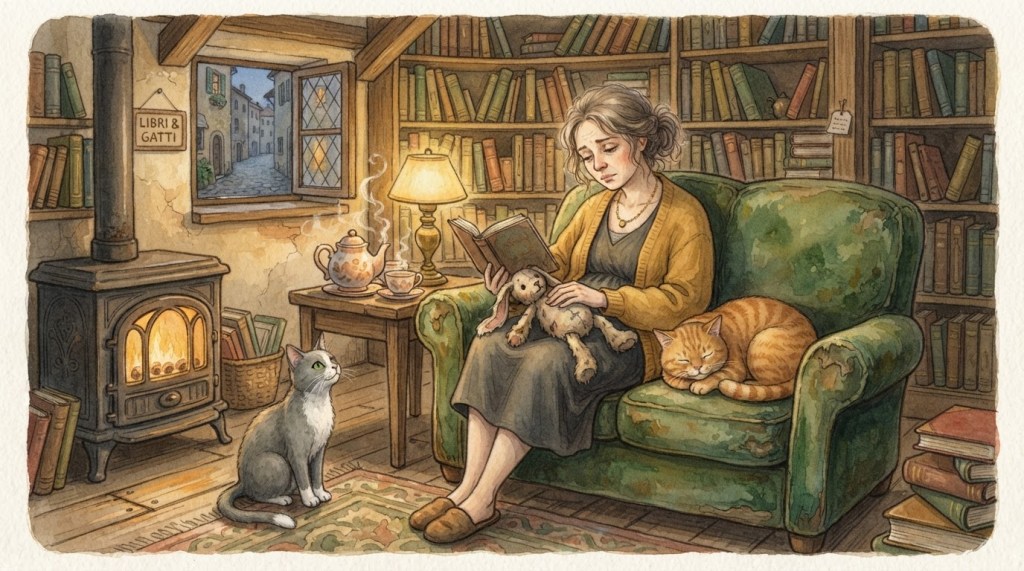
In the bookshop called La Pagina che Fa le Fusa, Moira Hopes had lit the lamp in the window and turned the sign to “open,” though she did not expect anyone. On foggy evenings the village tends to stay home with its soup. She carried a small stack of poetry books to the front table, straightened them twice, and then gave up pretending to be busy and went to put the kettle on.
Ashwaganda, the great ginger tabby who weighs fifteen pounds and carries every one of them with dignity, was spread across the radiator shelf like a warm loaf of bread. His purr, deep enough to make the teaspoons hum in their saucers, filled the shop at about twenty-five hertz. Toe, the slender grey cat with the immaculate white paws and the green eyes, sat upright on the windowsill, watching the fog with the seriousness of a lighthouse keeper.
“Anyone out there, Toe?” Moira asked.
Toe did not turn her head. Her tail gave one slow twitch, which in Toe’s language means yes, and be patient.
A minute later the little brass bell over the door gave its shy, two-note ring.
A Visitor Who Would Not Sit
The woman who stepped in was perhaps forty, in a good camel coat with the fog beaded on its shoulders, and she carried a phone in one hand and an umbrella she had clearly not needed. She had the posture of someone who has been walking quickly for a long time without arriving anywhere. Her hair was pinned up in a way that suggested it had been tidy at breakfast and had been holding on ever since.
“Good evening,” said Moira. “Come in out of the soup.”
“Oh. Thank you. I only wanted to… I saw the light.” She laughed a little, as if the sentence embarrassed her. “I’m Solange. Solange Lipsia. I’m not really a book person, I’m afraid. I mean, I used to be. I’m not sure when I stopped.”
“Nobody checks at the door,” said Moira. “We only ask that you let the cats inspect you.”
Toe had already come down from the windowsill. She walked a slow circle around Solange’s ankles, brushed one white paw against the hem of the camel coat, and sat down in front of her, looking up. Solange, who had been about to say something polite and brief and leave, found that she could not step over a cat who was looking at her like that.
“She likes you,” said Moira. “That is not automatic. She is very particular.”
“I’ve done nothing.”
“That is often exactly what she likes. Will you have some tea? The kettle has just come to the boil, and I always make too much.”
Solange looked at her phone, which had lit up with a message, and at the fog pressing against the glass. “I should be at a dinner,” she said, and then, strangely, her voice caught on the word. “It’s a good one. Eight people. It’s in the old mill restaurant, the one everyone talks about. I said I’d come. I got as far as the bottom of your street and my feet just… turned.”
“Then your feet may know something,” said Moira gently. “Sit. The armchair by the radiator is the best one, if you can negotiate with the occupant.”
The occupant of the radiator shelf opened one amber eye, considered the matter, and closed it again. This was permission.
The Kettle and the Question
Moira kept her teas on a high shelf behind the counter, in jars with handwritten labels, and she did not choose among them quickly. She watched how Solange sat down: on the edge of the armchair, coat still on, phone face-down on her knee, shoulders lifted a little toward her ears. Then she took down three jars. Lemon balm, with its crinkled green leaves that smell like a lemon dreaming. Linden blossom, pale and honeyed. And a few strips of dried orange peel from the winter batch she made with Adelmo’s oranges, the baker’s cousin sending crates up from Sicily every year.
“Is it for me or for the dinner?” Solange asked, watching her.
“It’s for the person who walked down my street at five o’clock and turned around. She seems to need something warm and not too clever.” Moira poured the water over the leaves and set the little hourglass on the tray. “Three minutes. Meanwhile, you may tell me about the dinner, or about nothing at all. Both are allowed.”
Solange held the cup that Moira handed her in both hands, the way people do when they have forgotten how to hold something simply. She took a sip. Her shoulders came down, perhaps an inch.
“The dinner is lovely,” she said at last. “That’s the stupid part. They are all lovely. I have friends, Moira. I do. My calendar is full. There’s the book club I never read for, the Thursday choir, the group chat that never stops. Tonight someone is celebrating a birthday. Last month it was a christening. People ring me. I ring them back. And yet.” She looked down into the tea. “Last Sunday I was standing in my kitchen at four in the afternoon and I realised that nobody in the world knew what I was doing at that exact moment. Not out of neglect. Just because there was nothing to know. And the feeling that came with it was so large, so… hollow, that I sat down on the floor. In a house full of invitations, I felt like the last person on earth.”
Ashwaganda’s purr deepened by a hair, as if he had been listening and approved of the honesty.
“And you thought there must be something wrong with you,” said Moira.
Solange looked up sharply. “Yes. How did you…?”
“Because everyone does. Lonely in a crowd sounds like a contradiction, so we conclude we are broken. Please put that idea down for a minute. It’s heavier than the feeling itself.”
Toe, who had not left Solange’s feet, stepped lightly onto the arm of the chair, then onto the camel coat, and settled in the crook of the woman’s elbow with her chin on the cup’s saucer-edge. Solange, startled, stopped breathing for a moment. Then she let out a long breath, and with it, almost against her will, she laughed.
What the Feeling Is Actually Measuring
“May I tell you something I find comforting?” asked Moira, settling on the footstool with her own cup. “It’s not magic. It’s only what researchers have learned, as far as I understand it, and I’ll tell you where I’m unsure.”
“Please.”
“Psychologists who study loneliness have long drawn a distinction. Being alone is a fact about how many people are in the room. Loneliness is a feeling, and the classic definition, from work in the 1980s by Letitia Anne Peplau and Daniel Perlman, is that it comes from a gap between the connection you have and the connection you want. Not the number of contacts. The match. You can be in a stadium and feel the gap. You can live alone in a cottage on a hill and feel entirely full.”
Solange turned the cup slowly. “So my calendar is not the measure.”
“Your calendar measures how many events you attend. The feeling measures something quieter: whether you are known. Whether anyone has a true picture of your ordinary Sunday afternoon. Those are different quantities, and one can be full while the other is empty.”
Moira let that rest for a moment, then went on. “There’s a second idea I like, though it comes with a gentle warning, because it is a hypothesis rather than a settled fact. The late John Cacioppo, who spent his career studying loneliness, proposed that the feeling works rather like hunger or thirst. Hunger is not a defect in the stomach. It is a signal that tells you to find food. In the same way, he suggested, loneliness may be a signal that tells a deeply social animal, which is what we are, to repair its connections. Not a verdict on your worth. A message. Uncomfortable, because it is meant to be noticed.”
“A message,” Solange repeated. “From whom?”
“From the oldest part of you, which has always known that people survive better together. It does not read your diary or count your party invitations. It only asks, quietly: Is there someone who really sees me? And when the honest answer is ‘not quite,’ it sounds the alarm, whether or not you are surrounded by perfectly nice people.”
The hourglass on the tray had long since emptied. Neither of them turned it.
“That’s a strange relief,” Solange said slowly. “To think of it as hunger. If I were hungry I wouldn’t ask what was wrong with me. I’d just look for bread.”
“Exactly so. And if I may say, you tried to eat tonight, in a way. You put on your coat, you walked to the mill. Your feet turned around because the meal in front of you was a very large, very noisy table, and what you are hungry for is a small, quiet one.”
Solange looked at the cat in her arm, and at the fog, and her eyes shone. “I think that’s right,” she whispered.
On the radiator shelf, Ashwaganda rose with the enormous effort of a sleeping bear, stretched until his claws tapped the wood, and flopped back down a foot closer to the chair, as though to say that quiet tables were his specialty.
Forgive me while I top up the pot, dear reader. The fog does make me talkative. If you ever want a little company on an evening like this one, I have gathered my favourite nights in the shop into a small book, Tales of Speranza, and it sits very well beside a warm cup. Now, back to Solange.
Toe Walks to the Door
They drank the second cup in a silence that was not awkward, only full. Outside, the fog thinned a little; someone passed in the lane with a small dog, and the lamp from the dog’s collar bobbed past the window like a firefly.
Then Toe stood up, stretched one white paw after the other, and trotted to the shop door. She sat in front of it and looked back at the two women, one eyebrow of whiskers raised.
“She wants to go out?” Solange asked. “In this?”
“No, she doesn’t go out in fog. She is making a suggestion, I think. She does it now and then.” Moira smiled. “Look at the window.”
Across the lane, in the window of the little tobacconist’s, a woman with a grey braid, Safronia Poletti, was pulling down the shutter and glancing up at the bookshop light. She lifted one hand in a small wave, the way people wave at a neighbour they’ve greeted every evening for thirty years without ever being introduced to properly.
“Do you know her?” asked Moira.
“I think I’ve bought stamps from her. Twice.” Solange hesitated. “I’ve lived in Speranza for six years. Isn’t that awful? I know the names of people in four countries and I couldn’t tell you what the lady who sells me stamps likes to eat.”
“It’s not awful. It’s very ordinary. And, if you’ll let me, there is a little science about that too, because I think it might be the other half of your hunger.”
The Small Threads
Moira fetched the teapot, refilled both cups, and sat again. Toe returned from the door and arranged herself across Solange’s lap with the air of someone who had made her point and could now rest.
“Two sets of studies come to my mind,” said Moira. “The first is by the psychologists Gillian Sandstrom and Elizabeth Dunn, published about ten years ago. They asked people to keep track of their daily interactions, not only with close friends and family, but also with what sociologists call weak ties: the barista, the neighbour you nod to, the person at the stamp counter. The finding, as I remember it, was that people who had more of those small interactions on a given day reported feeling happier and a stronger sense of belonging that day. Beyond what they got from their close relationships.”
“The stamp lady counts?”
“The stamp lady counts, in the sense that the study suggests such moments carry some weight. I’d add the usual honesty: these were correlations in surveys, so they cannot prove that small hellos cause happiness, and surely a cheerful person talks to more people to begin with. But the direction is encouraging.”
“And the second study?”
“It is my favourite, because it is so funny. The researchers Nicholas Epley and Juliana Schroeder asked commuters on trains and buses in Chicago to do one of three things: sit in solitude, behave as usual, or try to start a conversation with a stranger beside them. Before the ride, they asked everyone to predict how it would go. People were quite sure that talking to a stranger would be unpleasant. Then the commuters did what they had been assigned. The ones who talked reported, on average, a more pleasant ride than the ones who sat in silence. And no, nobody was bothered by it as much as the predicting group imagined.”
Solange gave a small, rueful laugh. “So we think everyone wants to be left alone, and mostly they don’t mind us.”
“Often they would welcome us. The study, again, had limits, since it was a commuter setting and not everyone’s world. But it suggests that we may underestimate how kindly others will respond. We stay in our coats and our headphones, afraid of a rejection that mostly doesn’t come.”
“My coat,” said Solange, and looked down at it. She was still wearing the camel coat, buttoned to the throat, after an hour beside a radiator. “I haven’t taken it off.”
“No. You haven’t.” Moira said it without a trace of teasing. “It is a very good coat. It may also be a very good wall.”
For a long moment Solange said nothing. Then she shifted Toe carefully, unfastened the top button, and the second, and slipped the coat from her shoulders. She folded it over the arm of the chair. It was such a small thing that nobody in the world but the three creatures in that room would have seen it. But the grey cat’s green eyes slid half shut, and the great ginger one let out a rumble so low that the saucers shivered.
The Homework of Three Hellos
“I don’t give advice,” said Moira, “but I do sometimes give homework, and only if you ask for it.”
“Please,” said Solange, almost eagerly. “I’d like homework.”
“There are two small tasks and one very small one. The very small one is tonight. You said your feet turned from the dinner, and I don’t think you should punish them. Send your friends a warm message, tell them the fog got the better of you, and give your love to the birthday person. People who are truly fond of you will survive.”
“And the two small tasks?”
“The first is a hello a day. One. Not a speech. The stamp lady, the baker, whoever is closest. Ask a single question you actually want the answer to: what her favourite thing on the shelf is, or what he has in the oven. And remember the answer. Weak ties become stronger by being remembered.”
“And the second?”
“The second is harder, so it is deliberately small. Choose one person from the large, lovely table, one only, and invite them to something quiet. A walk. A bowl of soup. Say, as plainly as you can, that you’d like to hear how their real week has been, and tell them yours. Not the calendar version. The Sunday-afternoon-on-the-kitchen-floor version.” She smiled. “You don’t need eight people to be known. You need one who is willing to ask a second question.”
Solange nodded slowly, her eyes full. “I think I know who. Elena, from the choir. She once stayed after rehearsal to help me carry the music stands and asked me if I was all right, and I said ‘wonderful,’ and she looked at me for a second too long. I’ve been thinking about that second for weeks.”
“Then that second has been waiting for you,” said Moira.
Solange picked up her phone, and this time she did not hold it like a shield. She typed two messages with her thumbs: one short one to the birthday table, with a heart; and a longer one, deleted twice and rewritten, to Elena Lanzi. Are you free for soup on Tuesday? Not the choir kind. The kind where I tell you how I’ve actually been. Her finger hovered over the arrow for the length of a long breath, and under her arm the grey cat shifted, and pressed one white paw, quite deliberately, against her wrist.
The message went. Almost at once the phone buzzed against her palm. She read it, and her whole face opened, like a window in the morning.
“She says yes,” Solange whispered. “She says she’s been hoping I’d ask.”
Ashwaganda, who had been watching all this from the radiator with the expression of a very old judge who rules entirely in favour of the defendant, closed his eyes and purred as though it were the only possible ending.
The Walk Home
When Solange finally got up, the fog had thinned to a pearly veil and the church tower had come back out of it, like a thought returning. She took a small volume of poems from the front table, one Moira had straightened twice, and said she would read it on Tuesday while waiting for the soup to cool. She said she would be back to tell Moira how it went. Moira said that would please everyone in the shop, cats included.
At the door she stopped, and, with a little visible courage, she did not turn left toward home. She crossed the lane. Through the glass Moira saw her speak to Safronia Poletti, who had paused with her keys in the tobacconist’s door. She saw Safronia tilt her head, and say something, and laugh, a big, surprised laugh that lit up the lane. They stood there for a minute, two coats in the lamplight, and then Solange put her hand over her heart and pointed at the bookshop window, and Safronia waved at it again, as she had for thirty years.
Moira turned down the lamp by a notch. Toe, back on the windowsill, tucked her white paws under her chest and said nothing at all, which is what Toe says when she is very pleased.
Moira’s Reflection
I used to think loneliness was a sort of shortage, that if you had enough people around, it would be solved by arithmetic. Years of tea and of listening to the people who come through my door have taught me that it is more like a question. It asks: Is there a place where I am known? And a question like that cannot be silenced by noise. It can only be answered, slowly, by a few small acts of being seen and of seeing.
If you carry that ache tonight, be gentle with yourself. You are not broken; you may simply be hungry for a smaller, quieter table. Take off the coat for a moment. Say one real hello. Ask someone a second question. The science suggests, hedged and humble as science always is, that such small things matter more than we dare to expect, and our fellow travellers are usually kinder than we fear.
So tell me, dear reader: who is the one person who would say yes if you asked them for a quiet bowl of soup? And what small hello could you try tomorrow? I would love to read your thoughts in the comments.
A Cup for This Story
Lemon Balm and Linden “Open Coat” Tea
- 1 heaped teaspoon dried lemon balm leaves
- 1 teaspoon dried linden blossom
- 1 small strip of dried orange peel
- 250 ml of just-boiled water, steeped covered for 5 minutes
- A little honey, if you like, and a second cup for a friend
A gentle note: herbal teas are a comforting ritual, not medicine. If you are pregnant, take medication, or have a health condition, check with your doctor before trying a new herb. If loneliness feels heavy or lasts a long time, please reach out to a doctor or someone you trust.
P.S. If tonight’s question about loneliness and small connections stayed with you, there are ten more slow evenings like this one in Tales of Speranza.
Listen in Speranza
🎧 Moira’s bookshop also has a voice. Tales from Speranza is our free podcast of slow evening stories, read aloud for the end of the day. Listen on Spotify.
Press Play and Stay a While
Before you go, here is the little song of the village. Let it play softly while the tea cools.




Leave a Reply