Calm for Carers · Story 9. For everyone who spends their days holding other people together.
The Woman With the Little Black Bag
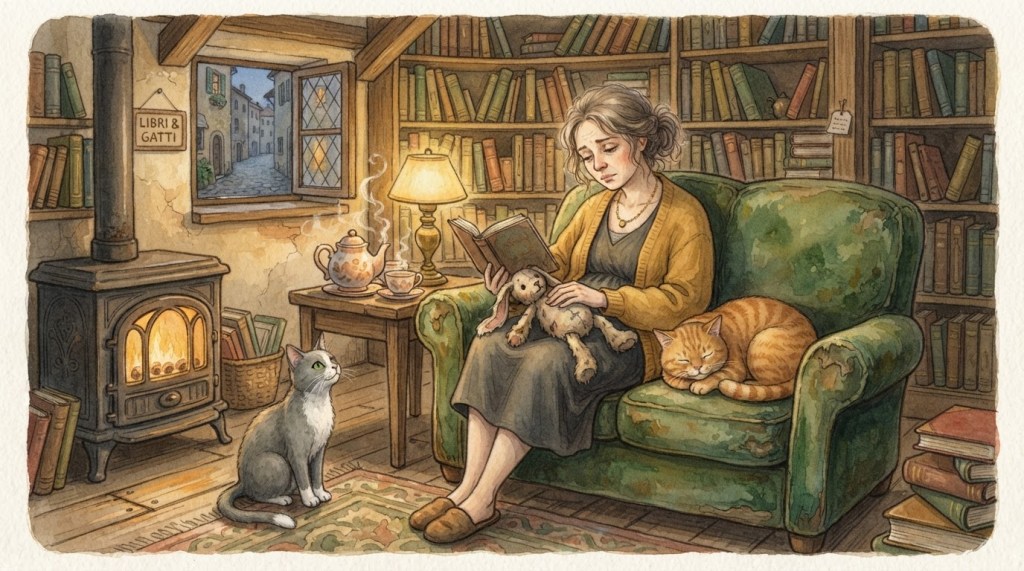
On Thursday afternoons the light in Via dell’Orologio turns the colour of honey, and Moira Hopes, who has lived in Speranza long enough to know such things, always says it is the village’s way of apologising for the grey mornings. The slow clock on the corner had just struck four, four minutes late as usual, and the bookshop called La Pagina che Fa le Fusa was in its quietest hour. The stove murmured. A book of Calabrian fairy tales lay open on the counter where a customer had abandoned it to find her purse. Ashwaganda, the fifteen-pound ginger tabby, lay across the warm floorboards by the radiator like a dropped orange cushion, and Toe, the slender grey cat with the immaculate white paws and green eyes, sat on the third step of the poetry loft, supervising.
The bell above the door gave its soft, lingering note, and a woman came in so quietly that Moira almost did not hear her. She was perhaps forty, in a raincoat the colour of porridge, and she carried a small black bag over her shoulder that she held against her side with one elbow, the way people hold something that must never be dropped. She stopped just inside the door and looked around at the shelves, the lamps, the cats, with the expression of someone who has walked into a church by mistake and does not want to disturb anyone.
“Good afternoon,” said Moira. “Browse as long as you like. The kettle is on, and nobody here will ask you to buy anything.”
“I only have forty minutes,” the woman said at once. “The school finishes at half past four. I just needed somewhere to sit that wasn’t my car.” She said it quickly, as if she had rehearsed it, and then looked a little ashamed of having said so much.
“Forty minutes is a perfectly good amount of time to sit,” said Moira. “The green armchair by the stove is the best one. Ashwaganda will be offended if you don’t try it.”
The woman crossed the floor and lowered herself into the armchair without letting go of the black bag. Ashwaganda lifted his great head, assessed the situation, and with a long, comfortable grunt rose, stretched, and arranged himself across her feet instead, which is a thing he does only for people who are very tired and who he has decided are worth the effort.
Forty Minutes
Her name was Solange Lipsia. She lived in a village on the far side of the valley, she told Moira, and she had a son called Rino who was eight years old, who loved dinosaurs and a particular goalkeeper and the colour orange, and who had a chronic health condition that had arrived when he was three and was going to stay with him for the rest of his life.
“I won’t bore you with the details,” she said, and then did not stop. “It is the kind of condition that never takes a day off. There are checks in the morning and checks at night, and checks in the middle of the night. There is a schedule on the fridge and a copy of the schedule in my bag and a copy in my phone and a copy at the school. I know the school nurse better than I know my own sister. I carry this,” she patted the black bag, “everywhere. If I leave it in the car, my heart stops until I go back for it.”
Moira put the kettle on the little stove behind the counter and did not interrupt. She had learned long ago that people who say “I won’t bore you” are usually the ones who most need to be bored, slowly, at length, with a cup in their hands.
“My husband Elio is wonderful,” Solange went on. “He does the mornings so I can sleep, in theory. But I don’t sleep. Even when it is his turn, I wake up at two, at four, I lie there listening. I have not slept a whole night through in five years. People say, you must be so strong. I am not strong. I am just never allowed to stop, which looks the same from the outside.”
Toe came down from the loft, crossed the shop without a sound, and sat himself in front of her with his white paws neatly together, looking up with his serious green eyes. Solange looked back at him. “Is he allowed on the chair?” she asked.
“Toe is allowed everywhere,” said Moira. “That is his whole philosophy.”
The grey cat leaped neatly onto the arm of the chair, then onto her lap, turned once, and settled with a sigh that seemed to come from somewhere very deep inside such a small animal. And Solange, who had not cried in the pharmacy or the school corridor or at the specialist’s desk, felt her face crumple, and put her free hand over it, and said, from behind her fingers, “I am so sorry. This is ridiculous. He’s fine. He’s at school. He’s perfectly fine today.”
“Today he is fine,” said Moira gently. “And you are allowed to be tired on the days when he is fine, too. Perhaps especially then. It’s often only when the emergency pauses that the body finally lets you notice how long you have been running.”
A Tea for Light Sleepers
Moira went to the shelf behind the counter, the one with more jars than a chemist’s, and took down three. Chamomile, the little white-and-gold flowers that have been brewed for centuries to take the edge off a long day. A handful of dried apple pieces, sweet and a little tart, because she thought a person who has been giving all day deserves something that simply tastes nice. And a short stick of cinnamon, for warmth.
“Before I pour this,” said Moira, “I should say what I always say. I am a bookseller, not a doctor or a psychologist. This tea will not fix anything, and it will not make your son’s condition any smaller. What it does is give your hands a job that is not worrying. Sometimes that is enough to get through a Thursday.”
She poured the hot water over the flowers and the apple and let the cinnamon stand in the cup like a little brown mast. The smell rose at once, honey and orchard and warm spice, and Solange, still half-hidden behind her hand, breathed it in and took her hand away from her face.
“It smells like my grandmother’s kitchen,” she said. “She used to make apple peel tea when we were ill.”
“Then it has done half its work already,” said Moira.
What the Researchers Noticed
Solange drank slowly, and for a few minutes the only sounds were the stove, the cats and the faint ticking of rain beginning on the window. Then she said, in a smaller voice, “Do other parents feel like this? Or is it just me being weak?”
Moira sat on the footstool, her hands around her own cup. “I will tell you what I have read, and then you can decide what to make of it. There is a research paper I came across, a systematic review, which is where researchers gather many earlier studies and look at them together. It was published in 2013, in a journal about paediatric psychology, by Melissa Cousino and Rachel Hazen, and it looked at parenting stress among the caregivers of children with chronic illness. What they found, in broad terms, was that these parents on average reported higher levels of parenting stress than parents of healthy children. And that the stress was not only about the illness itself. It could be about the daily work of managing it, about worry for the future, about the strain on everything else in the family.”
“So it is not just me.”
“It is not just you. I would be careful, though, because averages are not people. Some parents cope better than the numbers suggest, and some find it harder, and I am not able to tell you where you stand. But the main message, as I understand it, is that being worn out in your situation is a normal human response to a heavy load, not a character flaw.”
Solange was quiet. Then she said, “There is something else. Something I have never told anyone, because it sounds terrible.”
Ashwaganda began to purr, low and steady, a sound like a distant train that never arrives. “Nothing you say in this shop will sound terrible,” said Moira. “The books have heard worse. Some of them were written by Russians.”
That earned the ghost of a laugh. “I love him more than anything,” said Solange. “I would do all of it again tomorrow. But sometimes, at the school gate, I see the other mothers talking about swimming lessons and summer camps and sleepovers, and I feel a grief so sharp I can hardly stand. Not for Rino. For the life I thought we would have. And then I feel guilty for feeling it, as if grieving for the easy version means I love the real one less.”
A Sadness With a Name
Moira did not hurry to answer. Outside, a bicycle went by through the rain with its bell ringing twice, as if apologising to the puddles.
“I think there may be a word for what you are describing,” she said. “Again, take this as a bookseller’s reading, not a diagnosis. In 1962 a social worker called Simon Olshansky wrote about what he called chronic sorrow in parents of children with serious, lasting disabilities. His idea was that the grief of these parents is not a single event that you pass through and leave behind. It can return in waves, often at milestones, such as the first day of school, a birthday, a moment when other children move on and yours cannot, or does so differently. Since then, researchers have written a good deal about it. There is an integrative review of the literature on chronic sorrow in parents of children with chronic illness or disability, published in 2017, which gathers many of these studies. As I read it, the main point is that this sadness is understood as a natural and common response, not as a sign that something is wrong with the parent, and not as a sign that you love your child any less.”
Solange sat very still. Her hand had stopped moving on the grey cat’s back. “A natural response,” she repeated.
“That is how I understand it. You can love someone completely and still miss the life you imagined. Those two things can sit in the same chair. If the sadness is heavy or won’t lift, or if it frightens you, that is the moment to tell your doctor or a counsellor, and many hospitals that treat children have family support services for exactly this reason. But the sadness itself is not a betrayal. I wanted you to hear that from someone, out loud, before the school bell rings.”
Solange looked down at the grey cat in her lap. When she spoke again her voice was steadier. “Nobody ever said it had a name,” she said. “I thought it was just me being ungrateful.”
“Ungrateful people do not carry a black bag everywhere with one elbow pressed against it,” said Moira.
The Pharmacist Who Knew
The bell above the door chimed again, and an elderly man in a tweed cap shook the rain from his shoulders on the mat and came in with the tidy, careful steps of someone who has stood behind counters for fifty years. It was Signor Ferri, who ran the pharmacy on the square and bought one Ngaio Marsh paperback every Thursday and read it by Saturday. He looked at the stranger in the green chair and the grey cat on her lap and the bag at her side, and something in his face softened with the instant understanding of a man who has spent a lifetime handing medicine to frightened people.
“Signora,” he said, with a small bow of the cap, and went to the shelf for his book, saying nothing more. But on his way out, he paused by the armchair. “My daughter had a child with a long illness,” he said, not looking at her, looking at the rain. “For twelve years she did not take one afternoon for herself. I told her what I am going to tell you. A parent who is empty cannot pour. The child needs the mother, not the martyr.” He touched his cap again. “Forgive an old man. Good afternoon.”
The door closed behind him. Solange stared after him. “He’s right,” she said slowly. “Isn’t he? I have not left Rino with anyone except Elio and the school nurse in five years. My sister-in-law Marisa offers every month. I always say no. I say nobody else knows how.”
“Perhaps nobody else does yet,” said Moira. “But knowing can be taught. You could write it all down, the schedule on the fridge, the signs to look for, who to call, and let Marisa sit with it for an afternoon while you sit somewhere that does not need you. It would be a slow beginning. But the first time is always the hardest and, I have noticed, the world does not end.”
Small Permissions
The clock on the corner struck the quarter, four minutes late. Solange glanced at it and stood up, carefully lifting Toe, who allowed it with the dignity of a small king being moved to a better throne. Ashwaganda groaned at the loss of her feet but did not get up.
“I have to go,” she said. “The school.”
“You have ten minutes,” said Moira. “That is just long enough for me to give you a short list. It comes from a bookseller with no authority at all, so take what is useful and leave the rest on the shelf.”
- Write the routine down. A clear page that someone else can follow makes it possible for another trusted adult to help, even if only for an afternoon.
- Accept one offer this month. The next time someone says “let me help”, say yes to something small, even if it feels clumsy.
- Name the sadness out loud. To a friend, a partner, a counsellor or a parents’ group. Grief that has a name is easier to carry than grief that hides.
- Protect one small thing that is only yours. A walk, a book, a cup of tea in a bookshop. It does not have to be big. It has to be regular.
- Ask the care team about support. Many children’s clinics have social workers, psychologists or family services. Asking for help for yourself is part of caring for your child.
- Tell a professional if exhaustion or sadness will not lift. That is not failure. That is maintenance.
Solange read the list standing up, her lips moving slightly, as if memorising a medicine schedule. Then she folded it in her mind, which is a thing people do with good advice, and slipped it into the pocket of her porridge-coloured coat.
“I could call Marisa tonight,” she said. “Just to ask. Not to do anything yet.”
“Asking is a perfect first step,” said Moira.
At the door Solange turned. “Can I come back? On another Thursday?”
“Come every Thursday,” said Moira. “The armchair is yours from four o’clock, and the cats have already decided.”
Three Thursdays Later
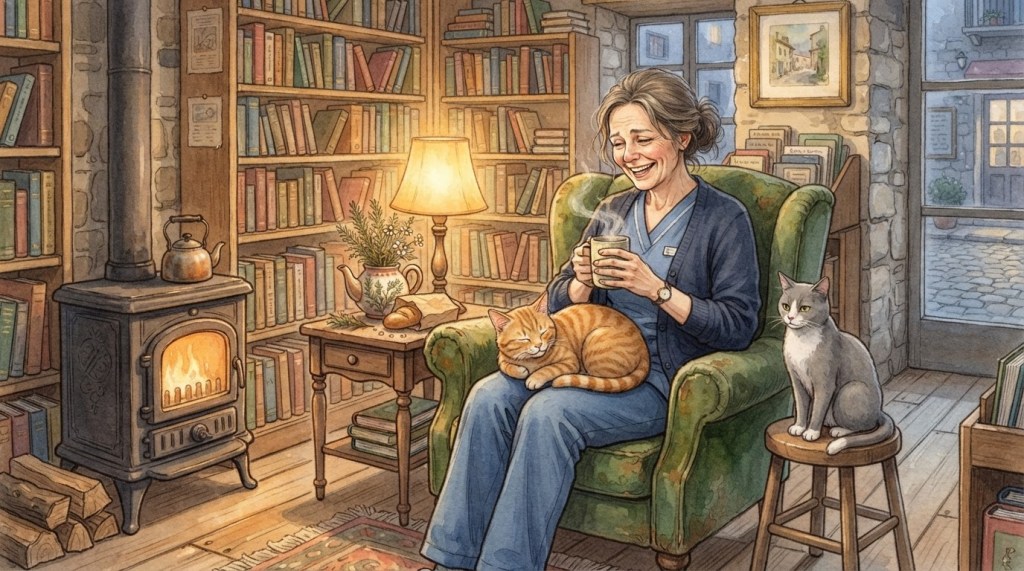
Three Thursdays later, the light in Via dell’Orologio was honey again, and the slow clock was four minutes behind again, and Ashwaganda was in the window with his chin on the sill. A woman in a porridge-coloured raincoat crossed the square under a wet umbrella. But this time she was not alone. A boy of eight trotted beside her in an orange scarf, holding a plastic Tyrannosaurus in one fist, and a woman in a green cardigan, a little behind them, carried a small black bag over her own shoulder with great and obvious care.
Moira opened the door. Solange smiled, rather shyly, and gestured at the woman in the cardigan. “This is Marisa. I wanted her to learn the bag. She has been practising. She did the whole routine on Saturday afternoon while I sat in a café and read for two hours.” She lowered her voice. “I checked my phone fourteen times. But I read nine pages.”
“Nine pages is an excellent start,” said Moira gravely. “Some people take a year to read nine pages.”
The boy marched straight to the window and held out the plastic dinosaur to Ashwaganda, who regarded it with the weary tolerance of a cat who has met far larger beasts in his dreams, and then, to everyone’s astonishment, licked it once. Rino shrieked with joy. Toe came down the stairs, one white paw at a time, and sat at the boy’s feet as if reporting for duty.
Solange lowered herself into the green armchair and, for the first time in five years, put the black bag down on the floor beside her, not against her side, and left it there. She noticed it a moment later and looked at it, and then at Marisa, who nodded once, and then at Moira.
“I’ll put the big pot on,” said Moira. “There will be enough for everyone, and a biscuit for the dinosaur.”
Moira’s Reflection
When a child is unwell for a long time, we tend to look at the child, which is right, and forget to look at the person holding the child’s days together. Parents of children with chronic illness often become experts, nurses, schedulers, advocates and night watchmen, all at once, and the world applauds them for being strong without asking what strength costs. As far as I understand the research, their stress is real, common and understandable, and so is their grief, which can come in waves long after the first diagnosis. None of that is a failing. It is what love looks like when it has been working without a day off.
If you look after a child, a parent or a partner with a long illness, what is one small thing that is only yours? And is there something, however small, that you could let someone else carry this week? Tell us in the comments. Someone reading may be waiting for exactly your answer.
A Cup for This Story
- 1 heaped teaspoon dried chamomile flowers
- 1 tablespoon dried apple pieces
- 1 short stick of cinnamon
- 250 ml water just off the boil, steeped covered for 5 to 7 minutes
Herbal teas are a comforting ritual, not medicine. If you are pregnant, breastfeeding, taking medication or have a health condition, check with your doctor or pharmacist first. If you are struggling, please talk to your doctor or your workplace or family support service.




Leave a Reply