The Inn’s Pasta School. Early on Sunday mornings, before the ragù goes on, Ofelia rolls the pasta on the big wooden board at the back of the inn’s kitchen. If you stand quietly by the door you can hear it: a soft tlac, tlac of wood on wood. Ashwaganda usually hears it first. This is her lesson, written down exactly as she teaches it.
Rolling egg pasta by hand without tearing it, and without leaving thick edges, is not a question of strong arms. It is about sideways stretching, the weight of your body and how the dough grips the wood. You do not squash the sheet from above: you guide it and stretch it from the centre outwards.
The tools and how to stand
- A long rolling pin. The Bolognese kind is 85–100 cm long, perfectly straight with no handles, about 4.5–5 cm thick, in heavy hardwood such as beech, cherry or pear. Its own weight does half the work.
- A wooden board. Natural, unvarnished wood. Its slightly rough surface grips the dough so it stretches instead of shrinking back like an elastic band.
- Posture. Feet slightly apart, one half a step in front of the other, hips resting against the edge of the table. The pressure comes from rocking your upper body forward, never from tensing your shoulders.
The four steps
- The first disc. Let the dough rest wrapped for at least 30 minutes, so it relaxes and does not spring back. Dust the board with the lightest veil of flour, flatten the ball with your palm, place the pin in the centre and push it forward to the far edge. Turn the dough an eighth of a turn and repeat, until you have an even circle about 25–30 cm wide and half a centimetre thick.
- Roll it up and let your hands slide. Once the disc is larger than 30 cm, pushing is no longer enough. Wrap the edge nearest to you around the pin two or three times. Rest your open palms on the wrapped dough in the middle of the pin, fingers together and relaxed. Roll the pin forward and back three or four times with short, rhythmic movements, and as it goes forward, slide your palms from the centre towards the ends, pulling gently left and right. That sideways slide is what stretches the dough without tearing it.
- Keep turning. Unroll the sheet, lift it gently and turn it a quarter of a turn, then wrap it again from the new edge and repeat. Turning all the time changes the direction you are stretching in, so the sheet stays round and the same thickness everywhere, instead of going oval or thin only in the middle.
- The final stretch. When the sheet is large, wrap almost all of it on the pin and let the last part hang over the edge of the board towards you: its own weight helps to stretch it. Push the pin forward firmly, letting your hands run right to the ends where the thicker edges hide. This is when you hear the tlac, tlac.
How to avoid holes, tears and thick edges
- Use almost no flour. This is the most common mistake. With too much flour the pin slides over the dough instead of gripping it, so you push harder and tear it, and later the tortellini will not stick closed. Use flour only in the first minutes. If a spot starts to stick, unroll, touch just that spot with a barely floured hand, and carry on.
- Never press with your fingertips or thumbs. All the pressure goes through the fleshy base of your palm, near the wrist. A thumb on a thin sheet makes a hole at once.
- Thick edges. In the last rounds, do not start with your hands in the middle of the pin, where the sheet is already thin. Start halfway out and slide only over the last 15–20 cm on each side.
- The light test. Lift the edge of the sheet and slip your other hand underneath. For lasagne, stop when you can just see the shadow of your hand (about 0.8–1 mm). For tortellini, give it four or five more rounds until it feels like silk, 0.5–0.6 mm, and cut it straight away, before the air dries the edges.
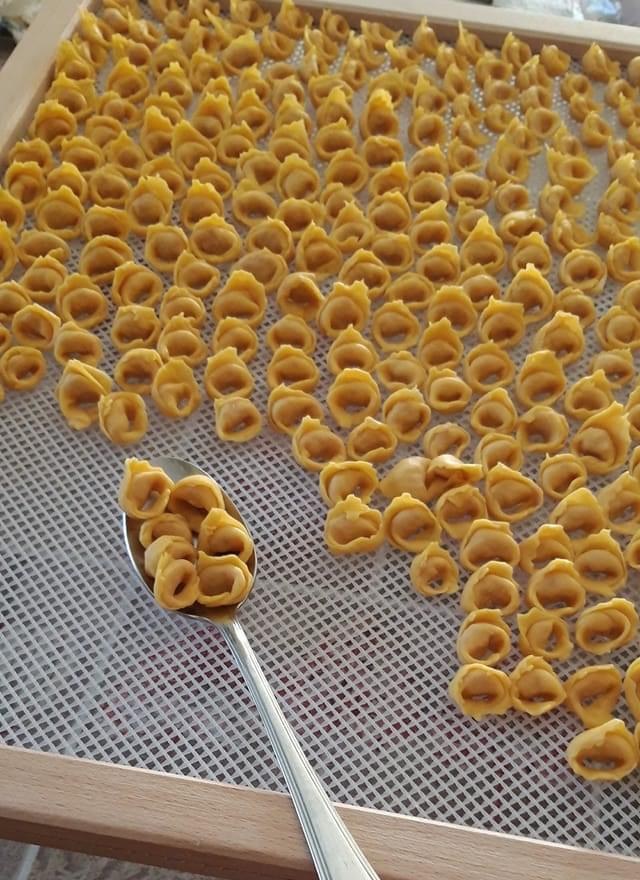
Ofelia’s own rule is shorter: rough and thin, but never with a hole. A slightly rough sheet holds the sauce and seals the tortellini; a smooth, floury one does neither. The photo shows the result, tortellini resting on a tray before they go into the broth.
P.S. While the pasta rests for its thirty minutes, there is just enough time for one of the evenings in Tales of Speranza.









Leave a Reply