Calm for Carers · Story 8. For everyone who spends their days holding other people together.
The Woman Who Was Laughing on the Cobbles
On Via dell’Orologio, the clock was four minutes slow, as it had been for as long as anyone in Speranza could remember, and the lamp over the door of La Pagina che Fa le Fusa had just been switched on against the early November dusk. Moira Hopes was turning the sign in the window when she heard a sound she did not expect at that hour: a woman laughing, helplessly, on the cobbles outside.
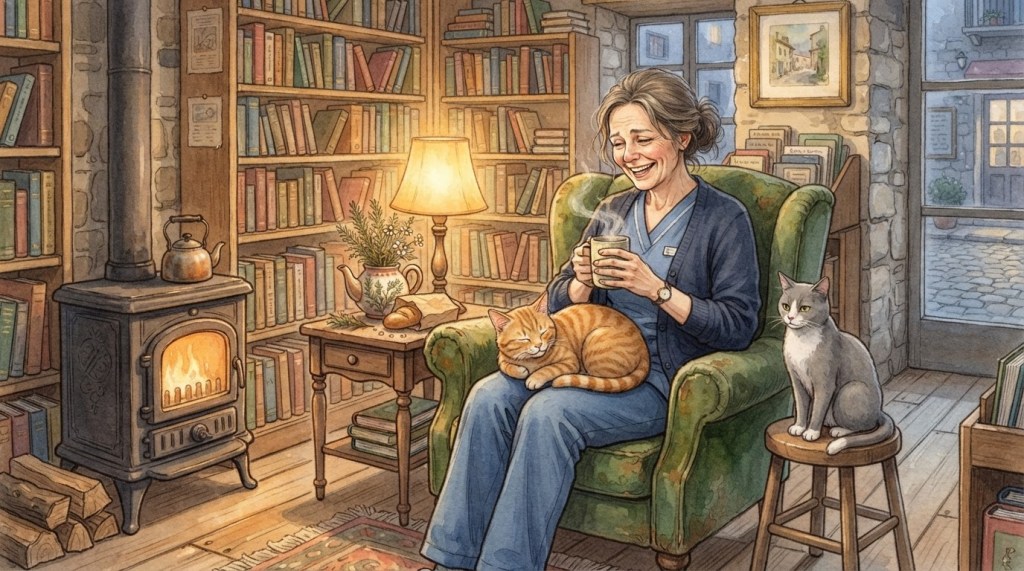
It was not a happy laugh, exactly. It was the kind that arrives when something has been held too tightly for too long and finally slips. The woman stood under the slow clock in a dark blue ward tunic with a coat over it, a lanyard still swinging from her neck, one hand pressed to her mouth. And then, as Moira watched, the laugh changed. It stuttered. It turned into something wetter and quieter, and the woman stood very still with her shoulders shaking, and Moira put down the sign and opened the door.
“I’m so sorry,” the woman said at once, wiping her face with the heel of her hand. “I don’t know what is wrong with me. I’m not usually like this.”
“Nothing is wrong with you that a chair and a hot cup won’t help,” said Moira. “And I should warn you that there is already a cat holding the chair.”
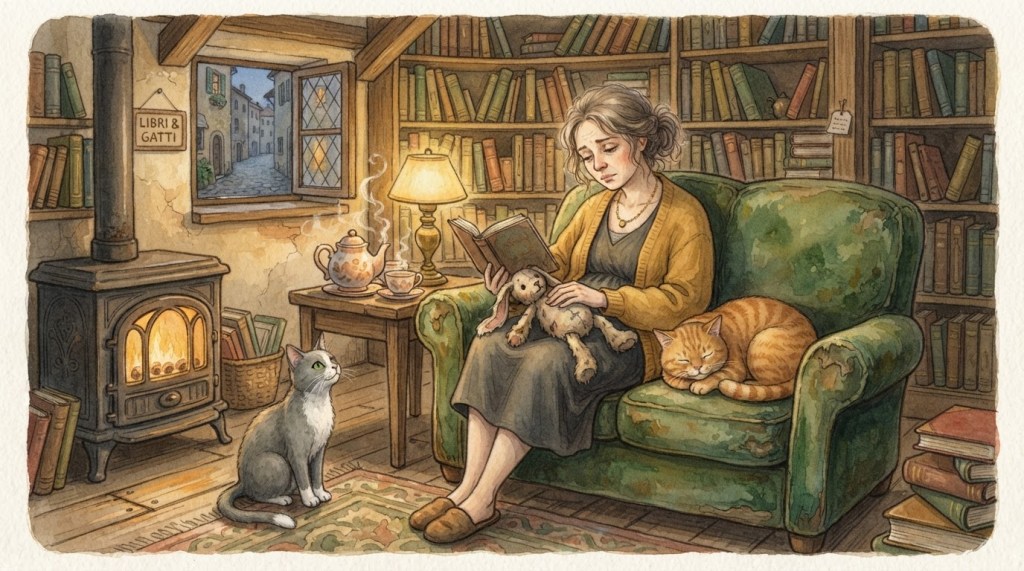
Ashwaganda, the fifteen-pound ginger tabby, was indeed arranged across the green armchair by the stove like a rug that had decided to be alive. He opened one amber eye, assessed the visitor, and began to purr, a deep rumble that seemed to start somewhere beneath the floorboards. Behind him, on the arm of the chair, Toe, the slender grey cat with the immaculate white paws, sat upright with his green eyes fixed on the stranger, as if waiting for her to state her business.
The woman laughed again, a little more softly. “Is he always so… official?”
“That one is Toe. He supervises. The big one is Ashwaganda, and his only duty is to be warm. Please, sit. You can have the footstool if the armchair is taken.”
She sat on the footstool, because she was the kind of person who would not dream of disturbing a cat, and Moira understood a great deal about her from that alone.
The Joke on the Ward
Her name was Rosaria. She was a nurse on a medical ward at the hospital in the valley, and she had come off a twelve-hour day shift with a feeling in her chest that she could not name. Moira put the kettle on, and while it began to tick and murmur on the stove, Rosaria told the story the way tired people do, starting in the middle and circling back.
“It was a terrible shift,” she said. “Two admissions at once. A man on the ward who was very frightened and kept pulling at his lines. A relative shouting at me in the corridor because the doctor was late, and the doctor was late because he was with someone who was dying. Everyone was running. And at about four o’clock we all ended up in the little treatment room at the same moment, three of us, grabbing supplies, and Gianni, who has worked on that ward for thirty years, looked at the stock cupboard and said, completely deadpan, that the hospital’s idea of a well-stocked cupboard was clearly the same as its idea of a well-staffed ward: a beautiful rumour.”
She stopped and pressed her lips together.
“And we laughed. All three of us. We laughed until we had to hold on to the shelves. It was the first time all day anyone had breathed out. And then I went back onto the ward and saw the man’s wife sitting by his bed, holding his hand, and I thought: what kind of person laughs on a day like this? What kind of nurse? She is sitting there in the worst week of her life and I was in a cupboard giggling about stock.”
“And then you went home,” said Moira.
“And then I went out of the door and started laughing again at the bus stop, for no reason, and it turned into the other thing, and I got off two stops early because I couldn’t stop. And I walked up the hill, and your lamp was on.”
Toe, who had been listening with perfect gravity, stepped down from the chair arm, crossed the floor without a sound, and sat on Rosaria’s foot. It was a small, deliberate weight, like a paperweight placed on a loose page.
A Tea the Colour of Spring
Moira went to the shelf behind the counter, the one that holds more jars than a chemist’s, and took down three of them. The first held lemon verbena, long narrow leaves that smell of lemon sweets and warm summer evenings, dried to the colour of faded green silk. The second held spearmint, bright and cool. The third held a few dried petals of calendula, which she dropped into the pot for no reason except that, as she said, “a cup ought to look kind as well as taste kind.”
“I should say, before I pour this,” she added, “that I am a bookseller and not a doctor, and this is only tea. It will not fix your day. But there is something about holding a warm cup with both hands that gives the rest of you permission to stop.”
She poured the water, and the shop filled with the smell of lemon and mint. Rosaria wrapped her fingers around the cup and breathed in, and her shoulders came down from somewhere near her ears. Upstairs, a shelf settled with a small wooden sigh. In the green armchair, Ashwaganda turned over, offering his belly to no one in particular, and his purr climbed half a tone.
“Can I ask you something?” said Rosaria, after a few sips. “Does it mean I’m cold? That I can laugh like that, on a day like that? Gianni says it’s how you survive the job. But some days I think it just means you’ve stopped feeling things.”
Moira sat down in the old wooden chair by the counter and took her time. “I don’t think I can answer that for you,” she said, “and I would be wary of anyone who says they can, in one sentence. But I have read a little about it, because people in your line of work come into this shop more often than you might guess. Would you like to hear what I found? With the understanding that I’m a bookseller reading other people’s research.”
“Please,” said Rosaria.
Four Kinds of Laughter
“There is a psychologist called Rod Martin,” said Moira, “who has spent a long part of his career studying humour. In 2003 he and his colleagues published a paper in the Journal of Research in Personality describing a questionnaire that measures what they call humour styles. The idea is that not all humour is the same thing. People use it for very different jobs.”
She counted them off on her fingers, and Toe, on Rosaria’s foot, watched the fingers with interest.
“The first they call affiliative humour: joking in order to amuse others and bring people closer together. The second is self-enhancing humour: using a humorous outlook to cope with stress and keep some perspective when things are hard. Those two are the gentle ones. Then there is aggressive humour, which is sarcastic or belittling, humour that puts someone else down. And there is self-defeating humour, which means excessive self-mockery, or joking in order to hide a problem, or to win approval at your own expense.”
Rosaria was very quiet. “So it’s not just funny or not funny.”
“It seems to depend a great deal on what the laughter is for, and who it is aimed at. And I want to be honest about the limits here, because I would not want to hand you a pretty theory and call it a fact. Those four styles come from questionnaires, from people describing themselves. They are a way of thinking about humour, not a ruling on any one laugh in any one cupboard. I can’t tell you what happened in that treatment room, and neither can a questionnaire. But I can say that researchers who study this do not treat all laughter the same, and neither, I think, do most people when they stop and consider it.”
“What Gianni said about the cupboard,” said Rosaria slowly. “Who was he laughing at?”
“You tell me.”
She looked into her cup for a long time. “The system,” she said at last. “The cupboard. The rota. Not the man in the bed. Not his wife. Not anyone who was suffering. It was the three of us against the mess of it, a bit like… being in a boat together. And it let the pressure out. For about forty seconds, nobody was holding their breath.”
“Then it sounds to me,” said Moira, “like laughter that was holding your team together, rather than pulling anyone apart. I can’t promise that is the whole truth. But it is a different thing from what you accused yourself of at the bus stop.”
What Happens Behind the Treatment Room Door
The bell above the shop door gave its soft, lingering note, and Baldo the baker put his head in, flour pale in the creases of his knuckles, carrying a paper bag that smelled of rosemary and warm olive oil. He took in the stranger in the dark blue tunic, the cat on her foot, the teapot, and understood everything the way people in small villages do.
“Focaccia,” he said, setting the bag on the counter. “The corner pieces. The best ones. They are no good to customers because they are too crunchy, and they are no good for me because I have already eaten four.” And he was gone before anyone could thank him, because Baldo believes that bread should be given quickly and talked about slowly.
They tore into the focaccia, and for a while there was only the sound of chewing and the stove ticking. Rosaria ate the way hospital people eat, quickly and without noticing, until Moira nudged the plate toward her again and said, “Slowly. You are allowed to taste it.”
“Gianni used to say that humour is a form of anaesthetic,” Rosaria said, tearing a piece into smaller pieces for no reason. “Not for the patients. For us. And I laughed at the time. But I wonder now whether he thinks it too. Whether he is okay. He has been on that ward since before I qualified. He never says when something has been hard. He just says something funny.”
“That is one of the things worth noticing,” said Moira. “Remember the fourth style, the one that is not about connection but about hiding. A joke can be a window or it can be a shutter. A shutter is not wicked. Sometimes every one of us needs to pull one down. But if every hard thing is only ever answered with a joke, if nobody ever says the plain sentence, it might be worth asking quietly whether the person behind the shutter is all right. Not to take the humour away. Just to leave a door ajar next to it.”
“A door ajar,” Rosaria repeated.
“And you could do the same for yourself,” said Moira gently. “At the bus stop, when the laugh turned into the other thing. That was not a malfunction. Sometimes the body takes a laugh, and a cry, and a long breath, and it is all one thing coming out. I am not a clinician, so I will not tell you what it was. I will only say that it did not look to me like a woman who has stopped feeling.”
Rosaria set down the bread. The cup trembled very slightly in her other hand, and Ashwaganda, without opening his eyes, slid one enormous orange paw off the arm of the chair and laid it on her sleeve, claws sheathed, like a man tapping a friend on the shoulder in a crowded room.
The Wife by the Bed
“What bothers me most,” said Rosaria, after a while, “is the wife. She couldn’t hear us. The door was shut. But if she had…”
“What would she have thought?”
“That we don’t care.”
Moira turned her cup in her hands. “I have been a bookseller for a long time, and I have watched a great many people at funerals and in waiting rooms and at my own counter on the worst days of their lives. And I have noticed that the people who care most are very rarely the ones who look solemn all the time. Think about the nurse you would most want at your own bedside. Would she be the one who never smiles?”
Rosaria thought about it. “No,” she said. “It would be the one who can make me laugh at three in the morning, and then sit with me when I cry.”
“Then perhaps the question is not whether you laugh,” said Moira. “Perhaps it is where, with whom, and what you do with the rest. A closed door, a trusted colleague, laughter aimed at the situation rather than the person suffering within it: that sounds to me like care wearing a different coat. And afterwards, when you step back through that door and the wife is holding her husband’s hand, you can bring all of your attention with you. Many carers find that they can do both. The laugh does not take anything from the tenderness. It sometimes seems to make room for it.”
“You can’t know that,” said Rosaria, but she said it with a small, rueful smile.
“I can’t,” Moira agreed at once. “I only know what I have seen. And what I have seen is that the people who give themselves permission to be human are usually the ones who can stay longest at the bedside. But you know your ward and your patients, and you will judge better than any bookseller. If there is a moment when a joke would hurt, you will feel it. You have been feeling it all along. That is exactly why you are sitting here with your heart in your throat, instead of back in that cupboard, not caring.”
For a long moment nobody spoke. Toe lifted his white paw off Rosaria’s shoe, looked at it, and set it down again, as if checking that the world was still where he had left it.
A Small List for the Laughing and the Tired
“Would it be silly,” said Rosaria, “if I asked you for a list? I keep lists. It’s the only way I survive a shift.”
Moira found a pencil and a scrap of paper with a drawing of a cat on one corner, and wrote while she spoke. “This is from a bookseller, so use what fits and leave the rest. It is not clinical advice, only things that seem kind.”
- Aim the joke at the situation, not the person. Laugh at the rota, the broken printer, the cupboard. Be careful with jokes at the expense of a patient, a relative or a colleague who is struggling.
- Choose the room. Share dark humour behind a closed door with people who understand it, not in corridors, lifts or waiting areas where someone grieving might overhear.
- Leave a door ajar. Once in a while, answer a colleague’s joke with a plain, gentle “was today hard for you too?” Let them say yes if they want to.
- Notice what the laugh is covering. If every difficult feeling gets turned into a joke, or you only feel okay when you are making fun of yourself, that is worth a quiet conversation with someone you trust.
- Let it out after, too. If laughing turns into crying, or the other way round, let it. A bench, a bath, a bookshop chair. Your body may simply be finishing what the shift would not let it finish.
- Ask for help when it lasts. If numbness, dread or low mood continue for weeks, speak to your doctor or the support service at your workplace. That is not weakness. It is looking after the person who looks after everyone.
Rosaria read the list twice, folded it into quarters, and tucked it inside her lanyard, behind her hospital badge, where a nurse keeps the things she means to keep.
Gianni’s Shutter
“I think I will talk to him,” she said at last. “Gianni. Not make a big thing of it. Just say, on a quiet night, that the cupboard joke was the best part of my day, and then ask what was the worst part of his.”
“And if he makes another joke instead of answering?”
Rosaria considered this, and a real smile, not a nervous one, crept across her tired face. “Then I will laugh, because it will be funny. And I will ask again next week.”
“That,” said Moira, “is the best plan I have heard all year.”
She wrapped the last of the focaccia in a clean cloth and pressed it into Rosaria’s hands. Outside, the dusk had turned to a deep ink blue, and the clock on Via dell’Orologio cleared its throat in the way it always does before striking, four minutes behind the rest of the world and, as far as anyone in Speranza was concerned, perfectly on time. Rosaria stood, and Toe, with great dignity, removed himself from her foot. At the door she turned back and looked at the shop: the shelves, the lamp, the stove, the huge ginger cat drowsing in the chair.
“May I tell you something silly?” she said. “I feel lighter. Not fixed. Just… as if someone had said that I was allowed to be a person at work.”
“You always were,” said Moira. “You only needed someone to say it out loud. Come back on the next bad day. The kettle is always on, and Ashwaganda is always warm.”
The Following Friday
It was the following Friday, a little after seven in the evening, when the bell above the door rang again. Rosaria came in first, her cheeks pink from the cold, and behind her, stooping slightly under the lintel, came a broad grey-haired man in a heavy coat, holding his cap in both hands like a boy summoned to the headmaster.
“This is Gianni,” said Rosaria. “He doesn’t believe in herbal tea.”
“I believe in coffee,” said Gianni gruffly, “and in a good strong grappa on the right occasion. I have been told there was a cat involved.”
“There are two,” said Moira. “One is the supervisor. The other is the cushion.”
Toe immediately jumped down from the poetry loft stairs and inspected the newcomer’s boots from every angle, then, apparently satisfied, sat on the left one. Gianni looked down at the grey cat with an expression of such deep and unwilling affection that Rosaria had to turn away and pretend to study the shelf of local history.
They drank the lemon verbena. Gianni pulled a face at the first sip and, after the third, quietly held out his cup for more. He told one joke, about a patient and a vending machine, and it was a very good joke, and all three of them laughed. And then, a little later, without anyone asking, and while looking at the stove instead of at anyone in the room, he said in a different voice that the man in the bed on the ward had died on Wednesday, peacefully, with his wife beside him, and that he had not been able to say so out loud to anyone until now.
Nobody made a joke. Ashwaganda, who had slept through the whole evening, rolled over and presented the great warm slope of his ginger side to Gianni’s knee. After a long time, the old nurse’s hand came down and rested there, and the purr rose to meet it.
“Thirty years,” said Gianni, and cleared his throat. “And I thought I was the only one who laughed so I would not do the other thing.”
“You were never the only one,” said Rosaria softly. “You were just the first one to go through the door.”
Moira’s Reflection
We tend to imagine that caring is a solemn business, and that anyone who laughs at work has stopped caring. But most of us know better. The people who do the hardest jobs often have the best sense of humour, and the humour is rarely a sign of coldness. Researchers who study it point out that humour comes in different kinds, some that bring us closer and help us cope, and some that wound or hide. The useful question is perhaps not “should I laugh?” but “what is this laugh doing, and who is it for?” And behind many a good joke there is someone who would be glad, once in a while, to be asked how they really are.
Do you laugh at work, in a hospital, a care home or at a bedside at home? Has a joke ever got you through a terrible day, or made you feel guilty afterwards? Tell us in the comments. Someone reading may need to hear that they are not the only one.
A Cup for This Story
- 1 heaped teaspoon dried lemon verbena leaves
- 1 teaspoon dried spearmint
- A few dried calendula petals, just for colour
- 250 ml water just off the boil, steeped covered for 5 to 7 minutes, then strained
Herbal teas are a comforting ritual, not medicine. If you are pregnant, breastfeeding, taking medication or have a health condition, check with your doctor or pharmacist first. If you are struggling, please talk to your doctor or your workplace support service.




Leave a Reply