When someone we love is gone, are we really losing them each time a memory fades?
The Parcel on Via dell’Orologio
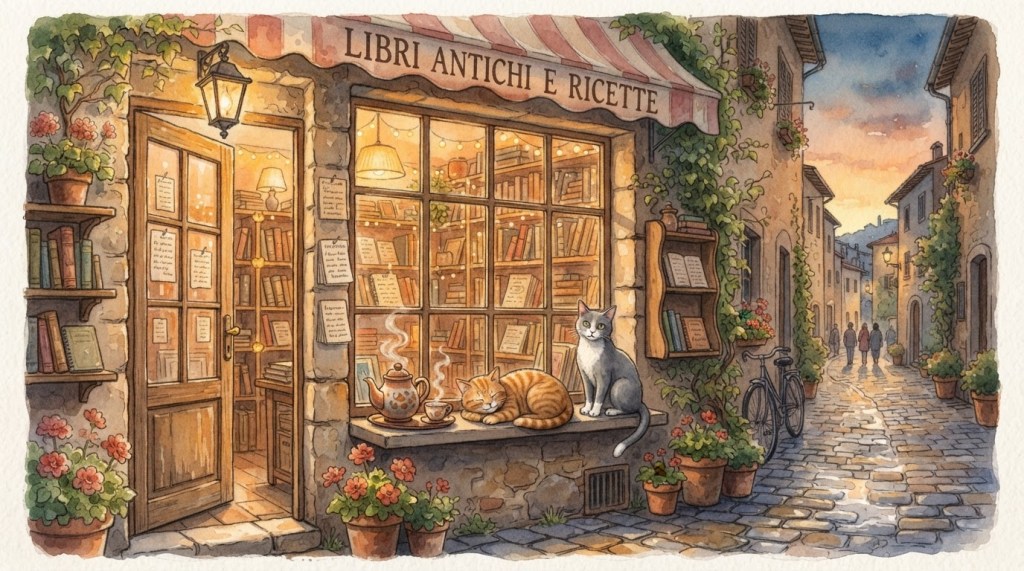
It was one of those mid-November evenings when Speranza seems to fold itself up like a letter. The fog had come down from the hills at four o’clock and settled between the stone houses, and by six the lamps along Via dell’Orologio were small gold moons floating in the damp. The clock in the square, which had not told the right time since before anyone could remember, struck what was probably seven. Nobody minded. In Speranza, the clock is understood to be more of an opinion than an instrument.
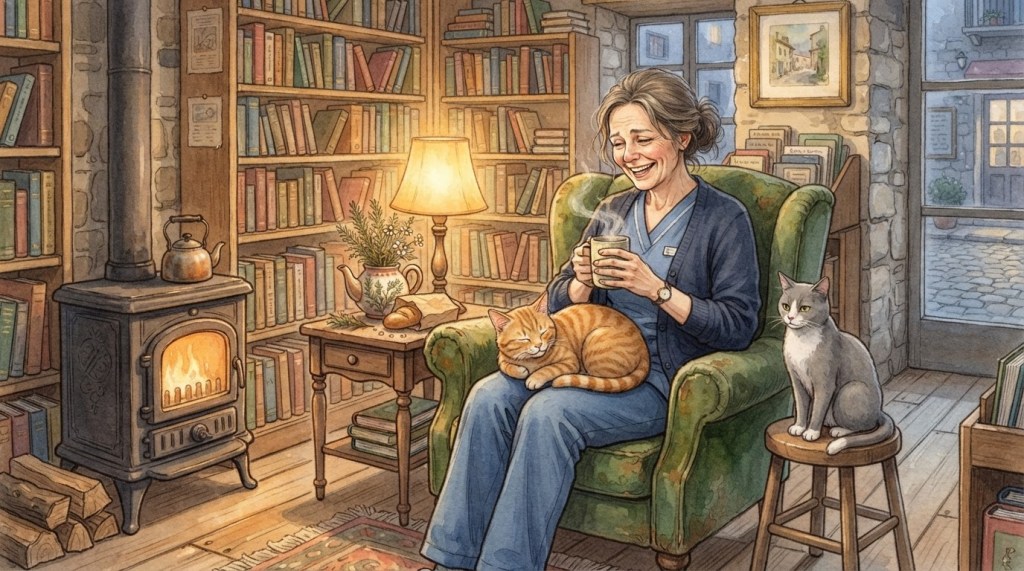
Inside the bookshop called La Pagina che Fa le Fusa, Moira Hopes was standing on the little wooden ladder, sliding a row of poetry books back into their places. The shop smelled the way it always did at this hour: old paper, beeswax polish, a thread of woodsmoke from the stove, and underneath it all something green and dried from the jars on the tea shelf. On the broad windowsill, in the exact patch of lamplight that he considered his by right, lay Ashwaganda, fifteen pounds of ginger tabby, arranged like a loaf of bread that had given up on the world. His purr, which measured somewhere near twenty-five hertz and could be felt through floorboards, rumbled quietly under the sound of the stove.
Toe, the slender grey cat with the immaculate white paws and the green eyes, was not on the windowsill. She was sitting very upright on the counter, staring at the door with the focus of a cat who has heard something before the humans have.
“What is it, Toe?” Moira asked, without turning around.
The bell above the door gave its small, apologetic jingle. A woman stood on the threshold with fog clinging to her dark coat and a battered cardboard box held against her chest, the way one holds something that might spill or might wake. She looked about thirty-five. Her hair was pinned up in a hurry, and her eyes had the particular tiredness of someone who has been thinking in circles for days.
“Sorry,” she said. “I saw the light. I know it’s late. I’m not even sure I want to buy anything.”
“Good,” said Moira, climbing down from the ladder. “Those are my favourite customers. Come in out of the fog. The stove is warm and the kettle is already thinking about it.”
A Box Full of Handwriting
Her name was Anselma Bruni. She was a translator, she said, who worked from home in a flat in Milan with a view of a wall, and she had come up to Speranza for three days because her grandmother’s house, in a village two valleys over, was being emptied and sold.
“Nonna Ersilia,” she said, setting the box on the reading table by the stove. “She died in March. I didn’t cry properly at the funeral. There were so many people, and so many casseroles, and so much to organise. I thought, I’ll grieve later, when it’s quiet. And now it is quiet, and I’m in her kitchen packing plates in newspaper, and I’ve realised something terrible.”
Moira lit the burner under the kettle and said nothing, which was one of the great skills of her trade. Ashwaganda lifted his head from the windowsill, considered the situation, and dropped himself heavily to the floor with a thump like a dropped sack of flour. He padded across the boards and leaned his entire warm weight against Anselma’s shins.
She laughed, a short surprised sound, and sat down on the nearest chair. “I can’t remember her voice,” she said. “That’s the terrible thing. I can remember her hands. I can remember that she smelled of lemon peel and flour. But when I try to hear her say my name, there’s nothing. It’s like a radio between stations. Eight months. I used to call her every Sunday for fifteen years, and I can’t hear her.”
Toe jumped silently onto the table and walked in a slow, careful circle around the cardboard box. She sniffed one corner of it, then sat down beside it with her white paws tucked neatly together, like a small grey guardian.
“What’s in the box?” Moira asked gently.
Anselma opened the flaps. Inside lay a stack of notebooks with cracked oilcloth covers, tied together with kitchen string, and a loose bundle of index cards soft as cloth with age. Every page she turned was covered in the same slanting, determined handwriting: recipes, but also small notes squeezed into the margins. Too much salt, Aldo’s fault. Use the green bowl for the dough, never the blue. Rain today, the bread will be slow.
“Forty years of recipes,” Anselma said. “I thought I’d cook my way back to her. I made her ragù last week, following the notebook exactly, and it tasted fine. But it wasn’t hers. And the worst part is that when I tried to picture her standing at the stove, I couldn’t tell whether I was remembering her or inventing her. Everything felt a little blurred, like a photograph that has been copied too many times. I came here because I felt I was losing her a second time. A little more every day, and there’s nothing I can do to stop it.”
The Tea Shelf
Moira crossed to the tea shelf at the back of the shop, where the jars stood in rows with their handwritten labels, each one a different shade of green or amber or dusty gold. She did not choose quickly. She ran her finger along the lids, tilting her head as though listening, and finally took down three.
“Lemon balm,” she said, unscrewing the first jar so that the bright, citrus-and-mint smell lifted into the air. “It’s an old kitchen-garden herb. People have been drinking it for a very long time to feel calmer, and there are some small studies suggesting it may gently help with tension, though I’ll be honest and say the evidence is modest. Mostly it tastes like a sunny afternoon, which is no bad thing on a foggy night.”
“Rosemary,” she continued, opening the second. The smell was resinous and sharp, a Mediterranean hillside in a jar. “You may know the line from Shakespeare, there’s rosemary, that’s for remembrance. The folklore is centuries old. Students in ancient Greece were said to wear sprigs of it while studying. Now, I’m not going to tell you rosemary will give you back your grandmother’s voice. A few small experiments have looked at whether the aroma affects alertness or recall, and the results are interesting but far from settled. I use it because it smells like the very thing we’re talking about, and because a scent can be a doorway. We’ll come to that.”
“And the third?” said Anselma.
“Dried orange peel. Just a few curls of it.” Moira smiled. “You said she smelled of lemon peel. I haven’t any lemon peel dried, but orange is a cousin, and I think you might like the cousin.”
She warmed the old brown teapot with a splash of water, measured the herbs with a wooden spoon, poured the steaming water over them and set a small sand-timer on the counter. As the leaves unfurled, the shop filled with a scent that was green and warm and faintly sweet. Anselma closed her eyes without meaning to.
“Oh,” she said, very quietly.
“What do you see?”
“A courtyard. Summer. There’s a lemon tree in a pot, and she’s shelling peas into her apron. I’m about seven. She’s telling me something about the neighbour’s goat, and she’s laughing so hard she has to stop.” Her eyes opened, bright and startled. “I haven’t thought about that in years. Where did that come from?”
Moira set the cups on the table. “From the nose, partly. Pour yourself a cup, and let me tell you why.”
The Short Road Between Scent and Memory
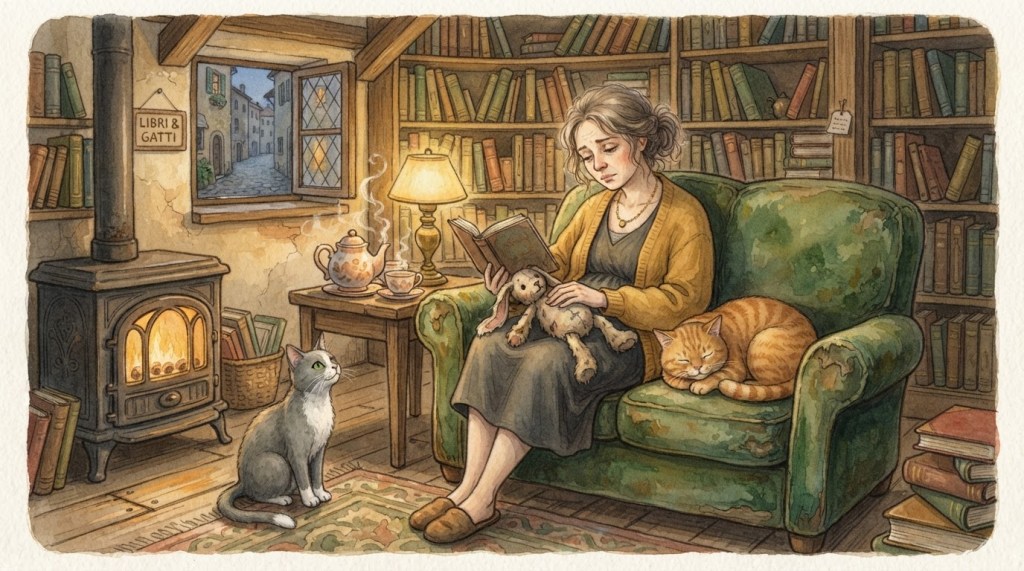
The tea was pale gold. Anselma wrapped both hands around the cup, and Toe, deciding that this was the moment, stepped delicately into her lap and began to knead the wool of her coat with those spotless white paws. Ashwaganda, still leaning on her shins, increased his purr by what felt like a full octave of floorboard vibration.
“Here is what we know,” Moira said, settling into the armchair opposite. “Smell takes an unusually direct route in the brain. Most of our senses are relayed through a central switching station before they reach the areas that handle emotion and memory. Smell, by comparison, travels from the nose to the olfactory bulb and then on to regions close to the amygdala and the hippocampus, both of which are deeply involved in emotion and in forming memories. It’s a short road. Researchers often describe it that way, anyway, and it fits what people report so often: a whiff of something and you’re suddenly eight years old. Psychologists even have a name for it, after Proust and his famous madeleine, though the science is a little more nuanced than the literary legend.”
“So that’s why I saw the courtyard.”
“Very possibly. And notice what it brought you. Not a fact, not a date. A scene, with a goat in it and a laughing grandmother. The memory was there all along. You hadn’t lost it. You hadn’t been standing at the right door.”
Anselma looked down at the cup. “But the voice. I still can’t hear the voice.”
“Let me tell you a second thing,” Moira said, “and I want you to hear it as good news, though it may not sound like it at first.”
Memory Is Not a Recording
The sand in the little timer had long since run out. The stove ticked. Outside, the fog pressed softly at the glass.
“Most of us carry around an idea that memory works like a video archive,” Moira said. “Something happens, it’s recorded, and later we press play. But decades of research suggest memory is far more like a story we rebuild each time we tell it. When you recall something, your brain reassembles it from scattered pieces: images, sounds, feelings, what you’ve learned since. And there’s good evidence that when a memory is recalled, it becomes briefly flexible, a process researchers call reconsolidation, before it settles again. That’s why memories can shift subtly over the years. They feel like a photograph, but they behave more like a living thing.”
“That sounds worse,” Anselma said. “That sounds like I really am inventing her.”
“It sounds that way. But think about what it means. The blur you feel isn’t a sign that you’ve stopped caring or that she is slipping away through a hole in you. It’s how healthy memory works for everyone, always, about everything. The pieces fade at different rates. Faces and voices tend to be among the most fragile, partly because they are rich, fine-grained sensory details, and partly because we hear them less once the person is gone. In the 1880s, a German psychologist named Hermann Ebbinghaus tested himself on lists of nonsense syllables and found that forgetting is steepest at the start and then slows right down. The famous curve is about syllables, not grandmothers, so please don’t take it too literally. But it points at something comforting: the fast loss doesn’t continue forever at the same pace.”
Toe stopped kneading and curled up in Anselma’s lap, as if she’d heard the word comforting and decided it was her department.
“There’s one more piece,” Moira went on. “Psychologists talk about something called the reminiscence bump, the finding that older adults tend to recall a disproportionate number of vivid memories from their teens and twenties. And for emotionally important things, the feeling often outlasts the details. You may not remember what she said in the courtyard, but you remember how safe you were. That feeling is also memory, perhaps the deepest kind. It doesn’t need a voice to survive.”
Anselma was quiet for a while. When she spoke, her voice was thinner than before. “I think I’ve been treating it like a test. As if the more details I keep, the more I loved her. And every time I fail to recall something, it’s evidence against me.”
“That’s a very human mistake,” said Moira. “Love and recall are not the same ledger.”
What Toe Found in the Margin
It was Toe who changed the evening. Without any warning she stood up, stretched, stepped from Anselma’s lap onto the table, and placed one immaculate white paw squarely on the open notebook. She pressed down on a single line in the margin, as if she were holding it in place so that nobody could turn the page.
“Toe,” Moira said mildly, “that’s a private document.”
But Anselma was already leaning in. The line under the paw read, in that slanting hand: Sing while you knead, or the dough sulks. Ask Anselma to sing, she has the voice of a cracked bell, the dough loves it.
She read it twice. Then she began to laugh and cry at once, the way people do when something has been waiting a long time under the surface.
“She wrote me into her recipes,” she said. “I didn’t know. I didn’t know she thought that. I used to sing in her kitchen to annoy her. I was awful. She always said, stop, stop, you’ll curdle the milk, and then she’d tell me to keep going.”
“There,” said Moira softly. “Do you hear it?”
Anselma stared at the page, and for a moment her face changed. “Stop, stop, you’ll curdle the milk,” she whispered, and then, in a different voice, lower, a little rough and full of amusement: “Anselma, mia, keep going.“
The shop was very still. Ashwaganda’s purr rolled on beneath everything, steady as a heartbeat.
“It was there,” Anselma said, wonderingly. “It was there the whole time. It just needed a door.”
“The handwriting was a door,” Moira agreed. “So was the scent, in its own way. A cue, a small specific reminder, is often what retrieval needs. Psychologists have studied this for a long time under names like cue-dependent recall: a memory can be intact and still unreachable until the right cue turns up. Which means something rather lovely about your box of notebooks. You aren’t only holding recipes. You are holding forty years of cues, written down by the very person you want to remember. She left you a key for every door.”
The Second Cup
Moira refilled the cups. The second steeping was softer, rounder, the rosemary receding and the orange coming forward. Anselma drank it slowly, turning pages, reading aloud the small margin notes. Too much salt, Aldo’s fault made her smile. Rain today, the bread will be slow made her go quiet and then smile again. Every few pages she stopped and said, “Oh, I remember this one,” and told a short story, and Moira listened without interrupting. Toe sat beside the notebook like a very small, very grey librarian.
At some point she said, “I wonder if I should write down what I do remember. Before it fades any further.”
“I’d say yes, with one gentle suggestion,” said Moira. “Don’t write it as a test you might fail. Write it the way your nonna wrote her margins: small, specific, a little funny. The goat. The lemon tree. The cracked-bell voice. Writing a memory down doesn’t freeze it perfectly, remember, because we’ve just agreed memory is a living thing. But it gives future you another door to walk through. And it’s an act of love, which is a better reason than most.”
Anselma nodded. She looked at the shelves, the lamplit spines, the cats, the cooling teapot. “I came in here to stop losing her,” she said. “I think what I actually needed was permission to stop gripping so tightly.”
“The tighter we grip a memory, the more we tend to worry about it,” said Moira. “Strictly speaking, that’s my own observation, not a lab result. But I’ve watched it a lot in this shop.”
Leaving Through the Fog
It was nearly nine when she stood to leave. She had bought nothing yet, and then, standing at the counter, she bought a small jar of the lemon balm and rosemary blend, a blank notebook with a green cloth cover, and a bookmark Moira insisted she take for free.
Ashwaganda escorted her to the door in his heavy, dignified way and pressed his forehead against her ankle once, firmly, as if signing a document. Toe watched from the counter, white paws together, green eyes steady.
“Tomorrow,” Anselma said at the threshold, “I’m going to finish packing the kitchen. But I’m going to keep the green bowl. The notebook says never the blue.”
“A sound rule for dough and for life,” said Moira.
The bell gave its small jingle. Through the window Moira watched her walk away down Via dell’Orologio with the box held loosely in her arms now, not clutched, her breath a faint cloud under the lamps. Somewhere in the fog the unreliable clock struck what might have been nine. And from the middle of the street, thin and cheerfully off-key, came the sound of a woman humming to nobody at all.
“A cracked bell,” Moira murmured, smiling. “The dough will love it.”
Moira’s Reflection
We tend to measure our love for the people we have lost by how much of them we can recall, as if memory were a receipt. But memory was never built to be a perfect archive. It is a living, rebuilding thing, and its fading is not a verdict on the heart. Often the detail goes while the feeling stays: the safety of a courtyard, the warmth of a kitchen, the sense of being someone’s favourite person.
What helps is not gripping harder but leaving ourselves doors: a scent, a handwritten line, a song, a story told aloud. The people we love often leave more of those doors than we realise. We only have to be quiet enough, and kind enough to ourselves, to go looking for them.
What is one small thing, a smell, a song or a sentence, that opens a door to someone you miss? Tell us in the comments. We would love to read it.
A Cup for This Story
Anselma’s Remembering Tea (for one generous pot):
- 1 heaped tablespoon dried lemon balm leaves
- 1 small sprig of rosemary (fresh) or half a teaspoon dried
- 2 or 3 curls of dried orange peel
- 500 ml of water just off the boil; steep, covered, for 7 to 8 minutes
- Optional: a small spoonful of honey, and a second steeping for a softer cup
Herbal teas are a comforting ritual, not medicine, and they cannot treat grief or any health condition. If rosemary or other herbs may not suit you (for example in pregnancy or alongside medication), check with your doctor first.
Listen in Speranza
🎧 Moira’s bookshop also has a voice. Tales from Speranza is our free podcast of slow evening stories, read aloud for the end of the day. Listen on Spotify. (Stories read by an AI-generated voice.)
Press Play and Stay a While
If you would like a little music while your tea cools, here is the song of the village itself. Press play, settle in, and stay as long as you like.




Leave a Reply