The autumn morning in the hill village of Speranza arrived on a soft tide of golden fog that drifted down from the high limestone ridges, settling gently across ancient terracotta rooftops and winding cobblestone alleys. Time in Speranza did not hurry; it moved with the slow, measured grace of an artisan polishing a piece of aged walnut. Tucked away in a quiet, narrow passage where stone houses leaned together like old friends whispering secrets, an archway covered in thick green ivy framed a heavy dark oak door. Beside the iron latch hung a small wrought-iron sign with flowing letters: La Pagina che Fa le Fusa.
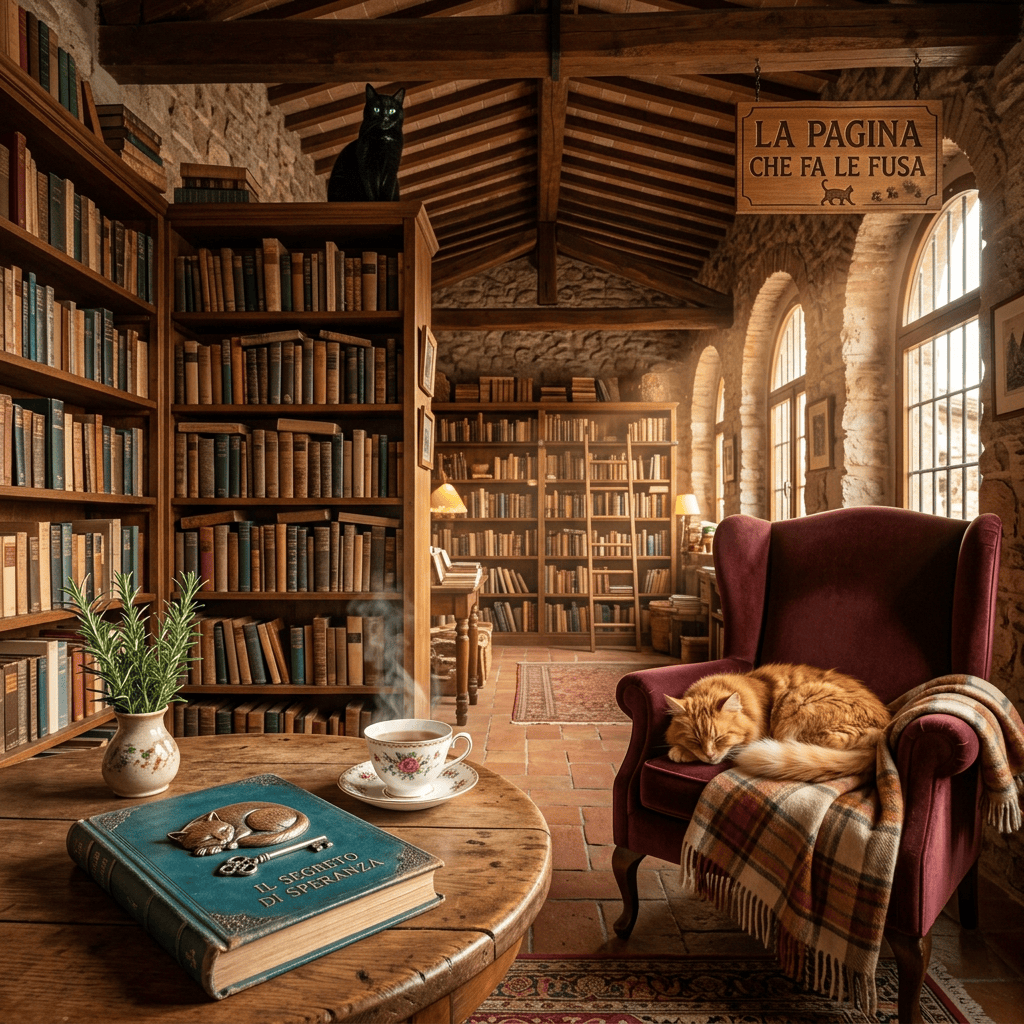
To cross that threshold was to step out of the cold mountain air and into a haven of warmth and quiet mystery. The air inside was dense with comforting aromas: dried chamomile blossoms, fresh rosemary, sweet fennel seed, beeswax polish, and the dry, vanilla-tinged scent of antique paper. High overhead, dark timber beams bore the weight of centuries. The walls were made of rough, pale stone, lined from the terracotta floor to the ceiling with towering wooden bookshelves that bent slightly under thousands of volumes. There was no sterile order here; leather-bound classics with cracked spines leaned against modern paperbacks, while tidy towers of histories, botanical treaties, and poetry rested beside low armchairs and footstools.
At the center of the room sat a large bordeaux velvet wingback armchair, its fabric softened by years of quiet reading. Curled tightly on a plaid wool blanket in the seat was Ashwaganda, a long-haired ginger cat whose thick orange coat rose and fell in a steady, unbroken rhythm. A low, deep purr vibrated through his chest, providing a comforting heartbeat for the whole shop. High above, balanced with athletic precision on the topmost mahogany shelf, sat Toe, a sleek black cat whose emerald-green eyes caught every shifting ray of light that filtered through the arched glass windows.
Behind the wide oak counter stood Dr. Moira Hopes. With calm, deliberate movements, she laid out four fine porcelain cups, a copper kettle of hot spring water, and small ceramic dishes filled with sprigs of fresh rosemary gathered at dawn from her garden terrace.
For weeks, Moira had studied the mysterious volume she had rescued from the village flea market: Days of your Dreams, a book bound in supple, faded peacock-blue leather that bore no printed title, only a tarnished silver emblem of a sleeping cat curled protectively around an intricate key. Its thick, deckle-edged parchment pages crackled when turned, and its words were written in shimmering silver ink that seemed to move under the lantern glow. The book had proven to be a storehouse of forgotten remedies, botanical counter-agents, and subtle natural philosophies.
Yet this morning, a second volume lay side by side with the first on the oak counter.
Just two days prior, while clearing a blocked storage recess behind the ancient stone hearth, Ashwaganda had scratched relentlessly at a hollow cedar panel. Behind the wood, wrapped in oiled linen and preserved with dry bay leaves, Moira had discovered the twin book.
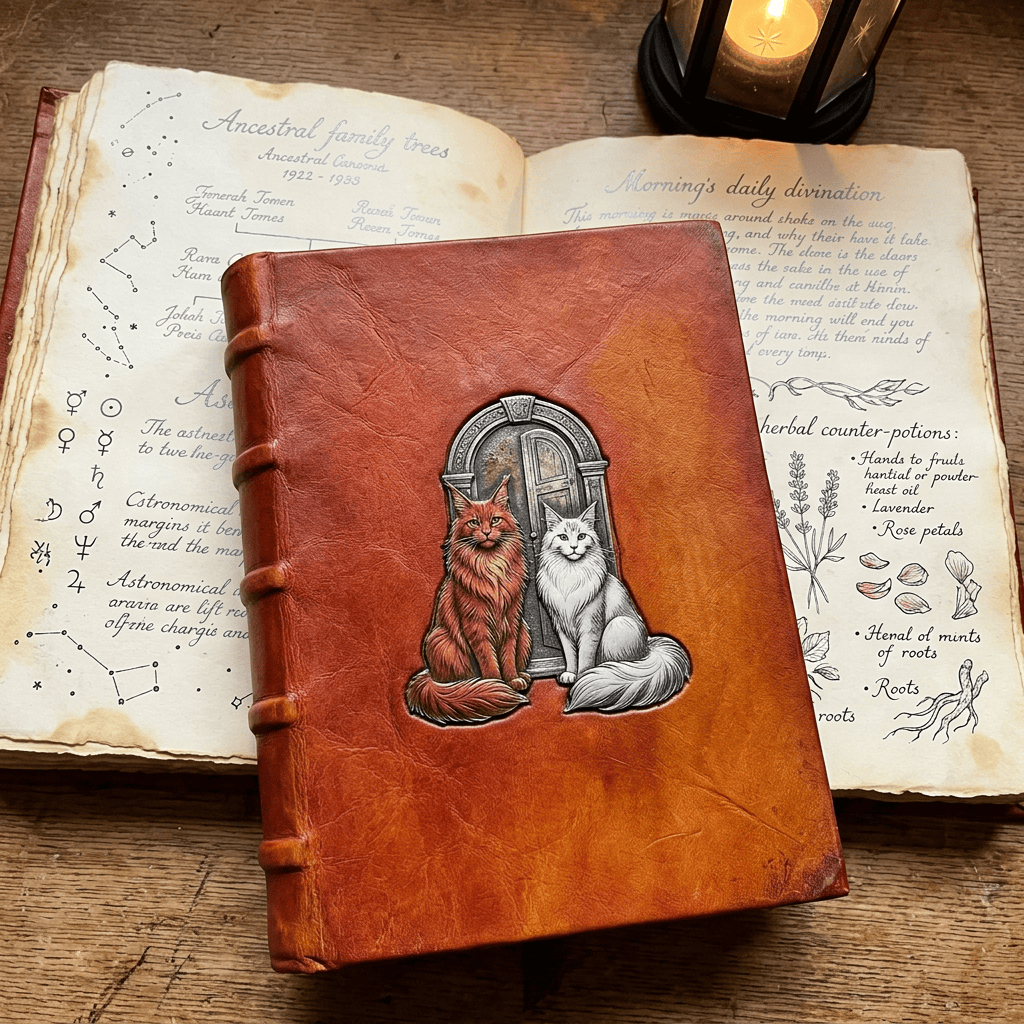
This sister volume was bound in leather the color of dark terracotta and burnt amber, worn smooth at the corners and creased along its three raised spine bands. In place of the sleeping cat, its tarnished silver centerpiece depicted a sleek feline standing alert, its tail arched beside an antique door that stood slightly open. If the peacock-blue volume was dedicated to the physical world—to healing herbs, hidden poisons, and the secret properties of plants—this amber volume, entitled Nights of your Memory, was dedicated to the human soul and time itself.
Moira opened Nights of your Memory. The heavy, creamy-yellow pages released an aroma of dried lavender and old ink. Unlike an ordinary book, it contained the handwritten genealogies and secret deeds of every family line in Speranza stretching back three hundred years. More strangely still, at the start of every dawn, a fresh verse of daily divination formed across the central blank page in lustrous silver calligraphy.
Moira adjusted her spectacles and read the daily divination penned for this crisp autumn day:
When past deceit demands the crown,
A bitter cup will cast it down.
The tree with rotten roots shall claim
A borrowed coat, a stolen name.
Look to the sweet that hides the freeze,
And test the bloodline in the breeze.
As Moira copied the verse into her notebook, the brass bell above the heavy oak door chimed with vigor. The door opened wide, letting in a brisk mountain gust along with three familiar, lively figures.
Altea arrived first, unbuttoning her charcoal wool coat. As the proprietor of the Cigars House, she brought with her the rich, earthy fragrance of cured tobacco leaves, cedarwood humidors, and sweet pipe smoke. Behind her came Anna, wiping flour and sugar from her hands, carrying a steaming copper jug of dark, rich espresso from the Coffee Taverna across the piazza. Last was Marisa, carrying an embossed brass tin from Mint Choccolet, her boutique chocolate treasure house renowned across northern Italy for importing single-origin cocoa, spiced pralines, and exotic confectionery from every corner of the world.
“The village square is full of gossip this morning,” Altea remarked, pulling up a low walnut armchair near the fireplace. “A grand gentleman arrived late last night in a silver motorcar from Milan. He calls himself Conte Vittorio Lanfranchi. He claims his family was unjustly driven out of Speranza eighty years ago, and he intends to reclaim the old vineyard estates and the ancient cellars above the gorge.”
“He stopped at the tavern for morning coffee,” Anna said, pouring four small cups of dark roast to blend with Moira’s herbal infusion. “He spoke to everyone as though we were servants. When I handed him his cup, he complained that the crema was thin and threatened to buy the freehold of the square to install a modern franchise.”
“And he marched straight into Mint Choccolet an hour ago,” Marisa added, her delicate brow furrowing as she opened her brass tin to reveal dark chocolate squares filled with wild mint ganache. “He demanded my entire stock of Venezuelan Criollo cocoa, scoffed at the price, and boasted that by next month, he would own every commercial lease along the main street. He carried an antique silver cane with an eagle’s head, tapping it against the display cases like a magistrate inspecting a prison.”
Moira listened attentively, her fingers lightly brushing the open parchment of Nights of your Memory. “Lanfranchi… that name is recorded here.”
The three friends gathered around the counter as Moira traced the silver lines of calligraphy in the terracotta volume. The genealogical tree branched across the page, showing the original Lanfranchi bloodline of Speranza.
“The true Lanfranchi line ended in 1944,” Moira pointed out, reading the delicate silver script. “The last legitimate heir was a young cartographer named Giancarlo, who vanished during the mountain skirmishes without children. If this visitor claims to be the direct grandson, there is a missing branch—or a deliberate fabrication.”
Toe shifted on his high shelf, his ears swiveling forward as his green eyes fixed on the street outside. Down in the piazza, a sudden commotion broke the morning calm: raised voices, the screech of iron chair legs against stone flags, and a woman’s sharp cry of alarm.
The four friends hurried out of La Pagina che Fa le Fusa, crossing the ivy archway toward the central square.
Outside the Coffee Taverna, a crowd of villagers had gathered in a tense, hushed circle. At a marble-topped table beside the fountain, Conte Vittorio Lanfranchi was slumped sideways across an iron chair. His tailored wool coat was rumpled, his silver-topped cane had rolled into the dry fountain basin, and his eyes stared blankly toward the autumn sky. On the table sat a porcelain coffee cup, shattered into three pieces, with dark liquid pooling across a half-eaten pastry and an open velvet case containing historical property deeds.
“Stand back, everyone!” Moira called out, stepping through the crowd with the natural authority of a veteran physician.
She knelt beside the fallen man, pressing her fingers against his neck. There was no pulse. His jaw was firmly clenched, the skin around his lips had turned a faint, dusky blue, and his fingernails showed marked cyanosis. Moira leaned close to the spilled liquid on the marble table. Beneath the roasted scent of dark coffee and sweet vanilla pastry, her senses caught a subtle, acrid undertone—like crushed wild cherry bark mixed with an intense, icy chemical coldness.
“He collapsed less than two minutes after sitting down,” whispered Giorgio, the young waiter at the tavern. “He ordered a double espresso with hot milk, took one sip, reached for his throat, and fell like a felled pine.”
Within minutes, Ispettore Salomone arrived, accompanied by two junior carabinieri. The inspector rubbed his temple with a weary sigh, his sharp grey eyes scanning the scene.
“Dr. Hopes,” Salomone said, touching the brim of his fedora. “I assume this was not a sudden heart seizure?”
“It was not, Ispettore,” Moira replied softly but clearly. “The locked jaw, the rapid respiratory arrest, and the characteristic cyanosis point to a concentrated neurotoxin—specifically, a volatile synthetic glycoside engineered to stop the cardiac muscle within sixty seconds of ingestion.”
“Then we have a murder in broad daylight,” Salomone said grimly. “And since the drink was served from the Coffee Taverna, we must examine every hand that touched that tray.”
Anna turned pale, her hands trembling as she looked at her own apron. “I pulled the espresso myself, Inspector! I used the same coffee beans and the same machine that served twenty other villagers this morning!”
“Nobody is accusing you, Anna,” Moira said, placing a steadying hand on her friend’s shoulder. “The poison was not in the coffee pot. An agent this concentrated would have contaminated every subsequent cup. It was introduced into his specific cup or applied to a vessel he touched directly.”
Salomone ordered his men to cordon off the square, secure the victim’s silver automobile, and gather every witness inside the tavern for preliminary statements.
While the police began their formal questioning, Moira noticed a shadow dart across the cobblestones. Ashwaganda had trotted across the square, keeping low beneath the outdoor tables. He stopped near the base of the fountain where the silver-topped eagle cane lay among the dry autumn leaves. The ginger cat did not touch the metal; instead, he sniffed the eagle’s beak from two inches away, sneezed sharply, and backed away with a low hiss.
Above them, Toe walked along the stone rim of the tavern roof with noiseless steps, his gaze locked onto the open window of a second-floor guest room overlooking the piazza.
“Come,” Moira whispered to Altea and Marisa. “We need to consult the twin volumes before the evidence is disturbed.”
Back inside La Pagina che Fa le Fusa, the door was bolted from within, and the hearth fire crackled brightly, casting dancing shadows over the bookshelves and terracotta tiles. Moira laid both ancient books open side by side under the soft light of the reading lamps.
On the left lay Days of your Dreams, its faded peacock-blue leather holding formulas for botanical extractions, natural poisons, and traditional antidotes. On the right lay Nights of your Memory, its burnt-amber leather open to the Lanfranchi genealogical record and the morning’s silver divination.
“Let us examine the puzzle with proper method and diagnostic rigor,” Moira began, adopting the calm, analytical posture of a classical detective. “We have three distinct mysteries intersecting in a single moment: the identity of the victim, the delivery mechanism of the toxin, and the motive behind his sudden arrival in Speranza.”
Marisa set down a tray of herbal mint tea. “Who was he really, Moira? If the Lanfranchi line ended in 1944, who was the man lying by the fountain?”
Moira turned the pages of Nights of your Memory. As her fingers moved over the parchment, the silver ink shimmered, revealing an unrecorded offshoot of the family tree.
“Look here,” Moira said, pointing to a name written in fine script beneath the main trunk. “In 1943, the estate steward, a man named Dario Valenti, fled Speranza after embezzling the parish emergency fund. He moved to Genoa, changed his surname to Lanfranchi using forged baptismal papers, and raised a family on stolen prestige. Vittorio was Dario Valenti’s grandson. He was an imposter carrying forged deeds, attempting to claim lands that rightfully belong to the village trust.”
“A fraud,” Altea muttered, her eyes narrowing as she lit a thin wooden spill from the hearth to warm her unlit cigar. “Which means anyone who knew the real history had a reason to expose him. But who would kill him?”
“Look at the second part of the divination,” Moira said, reading aloud from the terracotta page:
The tree with rotten roots shall claim
A borrowed coat, a stolen name.
Look to the sweet that hides the freeze,
And test the bloodline in the breeze.
As if summoned by the words, Toe leaped down from the top bookshelf, carrying a small object between his teeth. He dropped it onto the counter before Moira with a soft click.
It was a tiny glass ampoule, no larger than a sewing thimble, with a micro-perforated rubber stopper. The glass was clean, but when Moira uncorked it with a pair of fine silver tweezers, a potent scent filled the air: the same icy, artificial sweetness that had tainted the coffee cup.
“Where did he find this?” Marisa gasped.
“Toe was watching the upper guest rooms of the pensione,” Moira said, examining the ampoule under a magnifying lens. “This ampoule was dropped from the second-story sill into the drainpipe. It contained a synthetic menthol derivative combined with aconitine extract—a deadly poison derived from mountain monkshood, formulated to numb the taste buds instantly so the victim cannot detect the bitter taste of the lethal dose.”
Ashwaganda jumped onto the counter, walked to the tea tray, and gently nudged Marisa’s brass chocolate tin with his nose.
“Not your chocolates, Marisa,” Moira observed, watching the ginger cat’s movements carefully. “Ashwaganda is pointing out the form of the sweet. Look at the eagle’s cane that Vittorio carried. The head of the cane was hollowed out. The killer did not poison the espresso in the kitchen. The killer offered Vittorio an antique silver sugar cube or mint lozenge, disguised as an aristocratic luxury, just before he sat down at the table.”
“And who had access to the guest rooms at the pensione?” Altea asked, leaning forward.
“Only three people,” Moira said calmly. “Signorina Clara, the archivist from Florence who arrived on the morning bus to verify Vittorio’s deeds; Roberto, the local notary who stood to lose his practice if the fraudulent land claims were upheld; and Enrico, the quiet antique clock restorer whose grandmother was the true heir to the village vineyard trust before the steward stole the records in 1943.”
Moira closed both books with a soft, decisive sound. “The stage is set. It is time to assemble everyone at La Pagina che Fa le Fusa and allow the truth to present itself in full light.”
By five o’clock that evening, the autumn dusk had turned the sky over Speranza into a deep violet. A cold wind rustled the dry ivy around the stone archway, but inside the tea sanctuary, the fire burned bright and steady, illuminating the high rafters and crowded shelves.
Ispettore Salomone stood near the dark oak counter, his notebook open, while his officers guarded the entrance.
Seated around the circular wooden tables were the three primary suspects:
- Signorina Clara, the elegant, sharp-featured archivist from Florence, clutching her leather document portfolio.
- Signor Roberto, the portly village notary, constantly wiping his forehead with a monogrammed handkerchief.
- Enrico, the quiet, elderly clock restorer, wearing his worn leather work apron with hands stained from machine oil and brass polish.
Altea, Anna, and Marisa stood beside Moira, forming a quiet, supportive presence. Ashwaganda was curled comfortably on his bordeaux velvet armchair, his ears twitching toward every breath in the room, while Toe sat completely still atop a wooden ladder, watching the assembly like an impartial judge.
Moira poured a cup of warm, fragrant rosemary tea for each guest, her demeanor poised, courteous, and immovably calm.
“Messieurs and Madames,” Moira began, her voice carrying the clear, melodic resonance of a classical investigator addressing an audience. “We are gathered here to resolve what seemed to be an impossible murder. A man dies in the center of a crowded square from a virulent poison within seconds of tasting a public cup of coffee. The immediate suspicion falls upon the tavern, upon the kitchen, upon the random cruelty of chance. But in crime, as in medicine, symptoms are never random; they follow an exact etiology.”
Signor Roberto shifted in his seat, clearing his throat loudly. “Dr. Hopes, we all respect your medical knowledge, but this is a police matter! Why must we sit in a bookshop while our businesses are closed?”
“Because, Signor Roberto,” Moira answered with a gentle smile, “the answer to this murder was written in books long before Vittorio Lanfranchi stepped foot into our piazza.”
Moira picked up the terracotta-bound volume, Nights of your Memory, and opened it to the genealogical chart.
“The victim was not Conte Vittorio Lanfranchi,” Moira stated clearly. “His real name was Vittorio Valenti. He was the grandson of an absconding steward. He arrived in Speranza armed with forged land titles, planning to evict twelve local families and sell our communal hills to an industrial conglomerate.”
Clara straightened her back, her eyes flashing with academic disdain. “That is precisely what I discovered in the Florence state archives yesterday. I came to Speranza to confront him with the certified historical registers! But that does not make me a poisoner.”
“Indeed, Signorina Clara,” Moira replied smoothly. “You had no need of poison. You possessed the legal power to destroy his scheme with a single stamped certificate. Your weapon was the law, and you intended to use it publicly at tomorrow’s council hearing.”
Moira turned her gaze toward Signor Roberto, the notary. “You, Signor Roberto, were terrified because you had notarized the preliminary title transfer without verifying the archival seals, hoping for a lucrative commission. But you are a cautious, bureaucratic man. You would never risk the guillotine or life imprisonment for a crime that could be settled by shredding a few draft contracts.”
Roberto sank back into his chair, letting out a long, trembling breath of relief.
“That leaves only the true method of execution,” Moira continued, walking slowly toward the center of the terracotta floor. “The killer did not touch the coffee machine. The killer understood that Vittorio had a refined, obsessive habit: he always took his espresso with a single pastille of artisanal peppermint chocolate to cleanse his palate.”
Marisa gasped softly. “My shop window… the display case was unlocked for five minutes during the morning delivery!”
“Precisely,” Moira said. “The killer took a hollow mint pastille, filled it with a lethal dose of aconitine dissolved in pure menthol oil, and placed it inside the victim’s antique silver cane holder while Vittorio was admiring the historical clocks in the village workshop earlier this morning.”
The room fell into complete, breathless silence.
Moira stopped directly in front of Enrico, the clock restorer.
“You repaired Vittorio’s silver cane this morning, Enrico,” Moira said gently, her voice full of sorrow rather than anger. “He brought it to you because the screw mechanism on the handle had jammed. You opened the secret compartment, saw the forged family seal inside, and recognized the name of the man who ruined your grandparents eighty years ago.”
Enrico’s weathered hands tightened around his knees. He looked up, his faded blue eyes swimming with unshed tears.
“He sat in my workshop,” Enrico whispered, his voice cracking with old grief. “He laughed as he boasted about how he would tear down the old olive groves my grandfather planted by hand. He showed me the forged deed. He said the peasants of Speranza were born to be tenants. My grandfather died in poverty because of his family’s lies. I could not let him take the land too.”
“Where did you obtain the monkshood extract, Enrico?” Ispettore Salomone asked quietly, stepping forward.
“My garden on the northern slope,” Enrico replied without hesitation. “I distilled it three years ago to preserve wood against beetle infestations. I put the paste inside the hollow mint pastille and slipped it into his cane handle. When he took his coffee, he took the sweet from his cane, dropped it into the cup, and drank his own destruction.”
Toe climbed down from the ladder, padded across the terracotta tiles, and rubbed his black head gently against Enrico’s worn leather boot. Ashwaganda let out a soft, mournful meow from his velvet chair.
“Murder cannot right an ancient wrong, Enrico,” Moira said softly, placing a hand on the old craftsman’s shoulder. “The truth in the books would have saved the village without costing you your peace.”
Enrico bowed his head. “I know, Dr. Hopes. But the bitterness was too old, and my heart was too tired.”
Ispettore Salomone placed a gentle hand on Enrico’s arm. “Come, Enrico. Let us go to the station. The rain is starting.”
As the police led the old restorer out through the ivy archway, Clara gathered her archives, promising Salomone that the village land titles would be returned permanently to the communal municipal trust.
By nine o’clock that evening, the heavy oak door of La Pagina che Fa le Fusa was once again securely latched against the night. Outside, a gentle autumn rain tapped steadily against the arched windowpanes, washing the dust from the cobblestones of Speranza.
Inside, the four friends sat close together around the low wooden table near the glowing hearth.
Anna served fresh, steaming cups of dark hazelnut coffee, while Marisa passed around a porcelain plate of handmade orange-blossom truffles. Altea sat back in her chair, a warm, contented expression softening her features as the aroma of cedar and dried rosemary filled the room.
Ashwaganda was stretched out across Moira’s lap, purring so loudly that the teacups on the tray seemed to chime in resonance. Toe was curled tightly on the corner of the oak counter, his black paws tucked beneath his chest, his green eyes half-closed in deep, restful satisfaction.
Moira opened Nights of your Memory one last time. The silver ink on the terracotta parchment had altered once again. Beneath the genealogy of Speranza, a new inscription had appeared in flowing, luminous script:
The soil remembers every tear,
Yet justice needs no blade nor fear.
In peaceful halls where shadows sleep,
The true guardians their vigil keep.
Moira ran her fingers over the soft, aged leather of the twin volumes—the peacock-blue and the terracotta-amber—resting side by side among the teapots and fresh herbs.
In the quiet hill village of Speranza, where ancient stones guarded centuries of stories and two clever cats listened to the rhythm of the world, peace had been restored once more. The hearth fire burned warm and bright, and within the cozy sanctuary of La Pagina che Fa le Fusa, the night settled into a long, tranquil dream.





Leave a Reply