The newest sister
On the morning Tiana Vesperis opened her laundry, someone hung a pair of enormous white bloomers across the entrance to the piazza.
“A declaration of independence,” Altea said.
“A tablecloth folded badly,” Anna corrected, balancing a tray of cups.
Tiana looked up from the doorway beneath the lower arcade, pressed both hands over her mouth, and laughed. It was the first time Moira had seen her forget to be nervous.
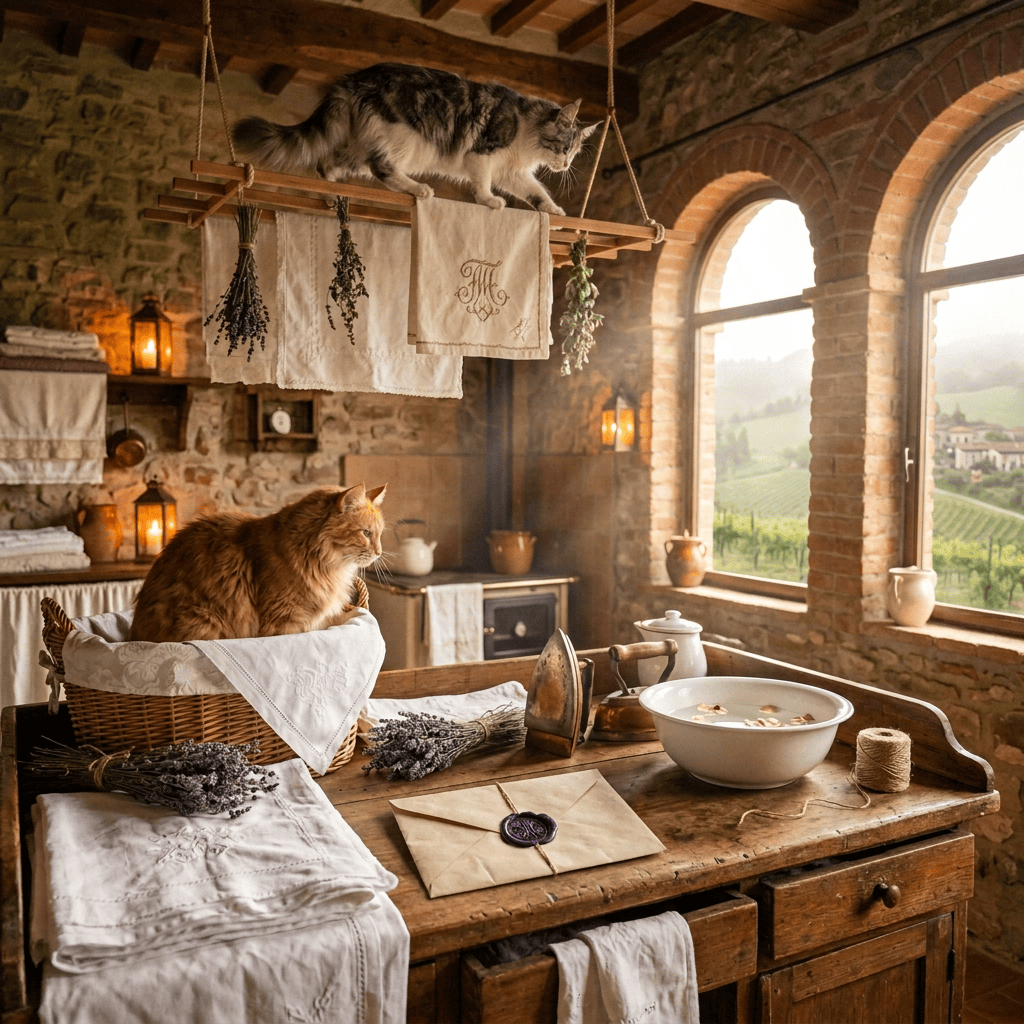
Above the shop, a wooden sign read La Lavanderia dei Sogni di Tiana. Below it, copper basins caught the pale morning light. There were cedar drying racks, shelves of carefully labelled soaps, and a long counter covered in linen the colour of fresh cream. Nothing matched exactly. Everything had been scrubbed, mended, polished, or persuaded into usefulness.
Moira understood that sort of place.
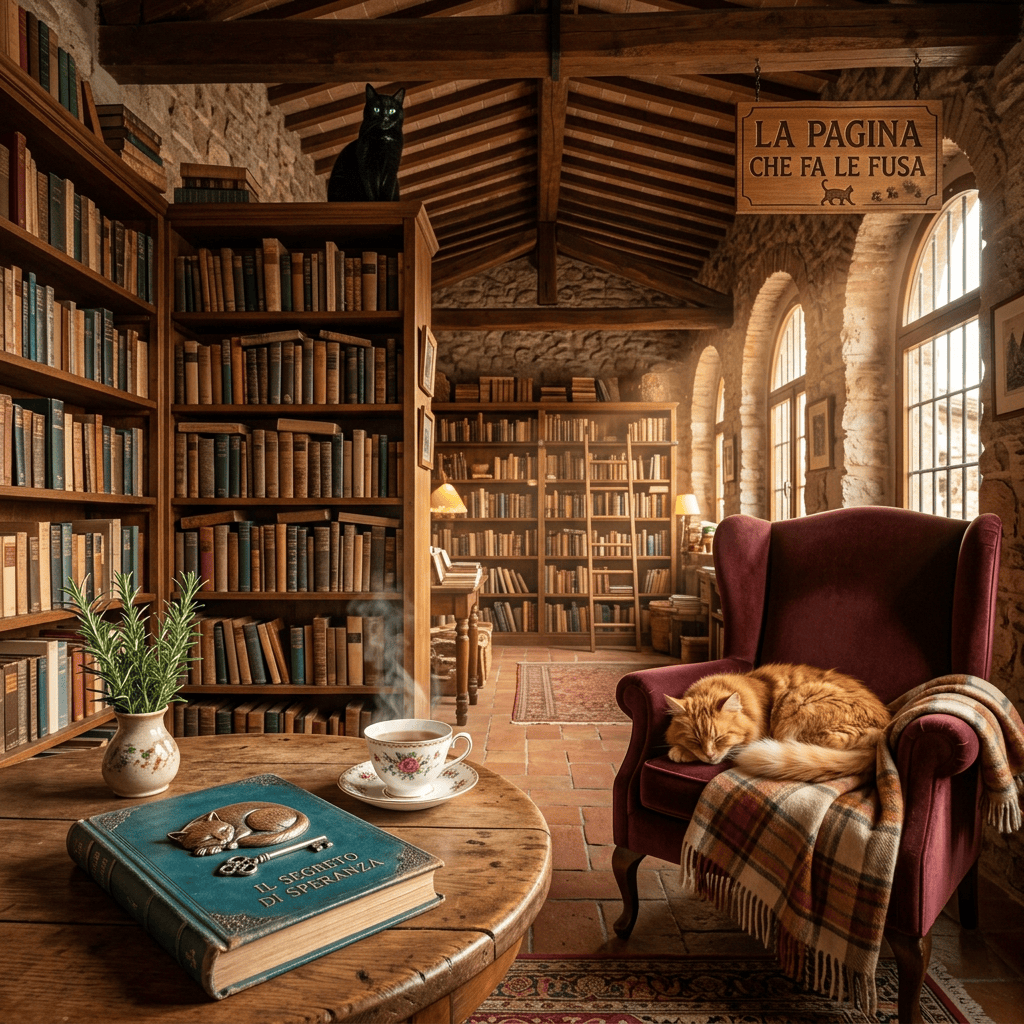
At La Pagina che Fa le Fusa, two alleys uphill, she had built her own refuge out of worn books, a stubborn kettle, and chairs that nobody could bear to throw away.
Tiana had arrived in Speranza six months earlier with two trunks and a silver thimble. Since then she had repaired the church curtains, rescued Anna’s favourite apron, and restored a shawl that Marisa had thought beyond saving. She charged what people could afford and tried, unsuccessfully, to pretend she did not notice when they paid her in eggs.
Now she stood in her own doorway, wearing a blue dress with a pinprick of white thread on one sleeve.
“You should take that off,” Moira said.
Tiana glanced down. “The thread?”
“The expression that says you must apologise for being happy.”
Behind them, Marisa emerged from Mint Choccolet with a tin of little chocolate irons. Altea carried a bottle; Anna had brought coffee. The four women gathered around Tiana, who looked from one to the next as though she had been given more than she knew how to hold.
“Our newest sister,” Altea announced.
A muffled complaint came from Moira’s basket.
“And an honorary member of the inspection committee,” Moira added.
Ashwaganda rose from his wool-lined nest, revealing his great ginger head. Toe, who disliked committees, had already found a high beam overlooking the room.
The man with the yellow folder
By eleven, the arcade was crowded.
Marisa photographed the new sign, the chocolate irons, and Tiana standing beside her grandmother’s linen hanging. It was the oldest thing in the shop: heavy cloth embroidered with a narrow silver border, displayed between two cedar uprights.
“She told me never to sell it,” Tiana said, touching the hem.
“Your grandmother had excellent taste,” Marisa replied.
“She also told me never to trust a man who measures a room before saying good morning.”
They both turned as a stranger stepped through the doorway.
He wore an expensive coat and carried a yellow document folder. Behind him came a thin young man who had to turn sideways to avoid the drying racks.
“Signor Castaldi,” Tiana said.
The name disturbed the room more effectively than a shout.
Gualtiero Castaldi owned textile mills in the valley. Over the preceding weeks, he had sent Tiana several letters concerning the spring that supplied the old wash house. Each letter had been less courteous than the last.
“Your reply is overdue,” he said.
“My solicitor has asked for the original records.”
“Then your solicitor should learn to read the copies.”
His clerk hovered beside the refreshments. Marisa, still holding her phone, moved a little to include the flowers in her photograph.
The clerk lifted one of the cider glasses, turned away from the crowd, then set it apart from the others.
“No coffee for Signor Castaldi,” he said. “He prefers the cider.”
Moira noticed the gesture because the young man’s hand shook against the stem. Castaldi noticed nothing.
He opened the folder on Tiana’s counter.
“Thirty thousand euros,” he said. “Or the supply is closed.”
Outside, the village bell began to strike.
“Not today,” Altea said.
“The calendar does not alter an obligation.”
Tiana’s eyes went to the linen, then to the basins she had polished before dawn.
“Nor does a folder prove one,” Moira said.
Castaldi gave her a thin smile. His clerk offered him the waiting glass.
“To commercial reality,” Castaldi said, and drank.
The interrupted toast
At first, Moira thought he had swallowed badly.
His smile vanished. He put the glass down too hard, missed the counter, and caught at the cedar upright. Linen slid across his shoulders as the rack tipped.
The sound of breaking glass silenced the room.
Moira was beside him before the first scream.
“Anna, call an ambulance. Altea, clear the doorway.”
The women moved. Marisa took Tiana’s arm and drew her away from the shattered glass.
Moira listened to the dispatcher’s questions and answered as briefly as she could. Around her, the frightened voices receded; there was Castaldi, the voice on the phone, and the doorway that must remain clear.
Her bag was brought from the shop. The minutes until the paramedics arrived seemed much longer than the morning that had preceded them.
When they took over, she gave a brief account of what she had seen. One of them asked about the drink.
“That glass,” Moira said. “Not the jug. Please keep it.”
Only after Castaldi was on the stretcher did she see the dark shape beneath the fallen linen.
Toe had descended from the beam. He was hooked into a loose silver thread, offended by its refusal to come free.
“Leave it,” Tiana whispered.
He pulled.
A section of the hem opened. Something pale and tightly rolled slipped onto the floor beside his paw.
Ashwaganda approached, sniffed the little cylinder, and sat down upon it.
For the first time since the glass had broken, Tiana made a sound that was almost a laugh.
“He does that with bills,” Moira said.
She waited until the stretcher had gone and the paramedics no longer needed the space. Then she lifted the cat and retrieved the roll by its torn wrapping.
The ambulance departed with Castaldi. Nobody followed it with applause.
Tiana watched until it disappeared beneath the upper arch.
“He might have died here.”
“Yes,” Moira said.
She did not offer a gentler answer. She took Tiana’s cold hand instead.
The silver seam
Ispettore Salomone arrived while the chairs were being carried outside.
Moira told him about the separate glass. Marisa showed him the photographs, handing over her phone without scrolling through them first.
In the last image before the toast, Castaldi stood at the counter with his folder open. Behind his shoulder, the clerk’s bent head and hands were visible above the refreshments.
“His name?” Salomone asked.
“Severino,” Tiana said. “He brought the letters.”
The inspector looked towards the back door.
Severino had his coat on.
“Leaving?”
“Signor Castaldi’s car. I thought somebody should move it.”
“Someone will.”
Salomone asked an officer to remain with him, then returned to the counter. He recorded what Moira and the others had seen and arranged for the glass fragments and drinks to be examined.
He did not call the photograph proof of poisoning.
“It tells me whom to question,” he said. “That is a beginning.”
When the police had finished with the hanging, Tiana wrapped it in a clean sheet and carried it uphill. Her shop was closed, but she could not bear to leave her grandmother’s cloth there alone.
At La Pagina che Fa le Fusa, Anna put the kettle on.
The room smelt of rosemary, paper, and the faint dampness of coats drying beside the hearth. Ashwaganda climbed into his bordeaux armchair with the exhaustion of someone who had personally summoned the ambulance.
Toe followed the bundle of linen to the counter.
The little roll contained a narrow strip of parchment. Its handwriting was faded at the edges, with a silver glimmer where the light caught it.
Tiana read aloud.
Where patient hands preserve a name,
The hidden water keeps its claim.
Beneath the sign the swallows knew,
Remember what was held for you.
“My grandmother wrote that,” she said.
“You recognise her hand?”
“The long tail on the last letter. She used to tell me it gave the word somewhere to rest.”
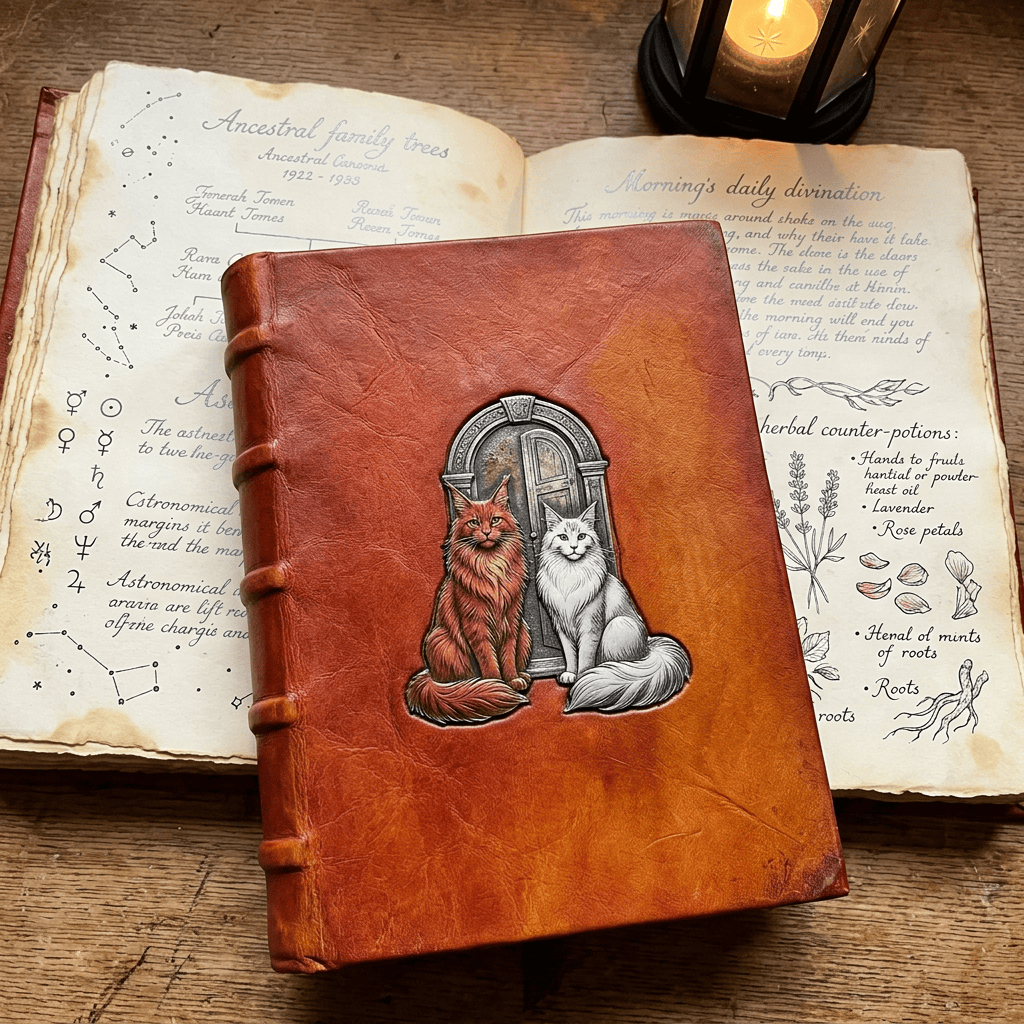
Moira placed Days of Your Dreams beside the parchment. The old peacock-blue cover remained closed.
From the shelf behind her, Nights of Your Memory made a dry, distinct sound.
Its amber cover had lifted.
Altea, who had seen too much in Speranza to waste time pretending surprise, brought it to the counter.
On an otherwise blank page, a small drawing appeared in silver ink: a swallow over a three-arched bridge.
“That used to be painted above the municipal store,” Anna said. “Before they moved the records.”
Moira took a pencil.
“Then we ask where the records went.”
She copied the drawing. The book offered nothing else.
What the folder concealed
Two days later, Salomone returned.
He found Tiana at the bookshop window, sorting the damaged fringe of the hanging. Her laundry had reopened for collections, though she had postponed the celebration.
“Castaldi is recovering,” the inspector said.
Her fingers stopped.
“Good.”
“He has given a statement. There are questions about money that Severino was handling for him.”
Moira set down her cup.
Salomone put a copy of a letter on the table, covering the address with his notebook.
Castaldi had discovered payments diverted from the business. He had told Severino that an accountant would inspect the records on Monday.
“That morning, he made the threat again,” Salomone said. “In the car.”
Altea looked towards the window. “And Severino chose the opening because there would be strangers, food, drinks.”
“And a convenient person to blame,” Tiana said.
“Yes.”
The photograph and the accounts had given the inspector grounds to investigate further. Tests on the recovered glass and material found among Severino’s belongings had strengthened the case. The details would be set out in the investigation, Salomone said; he had come to tell Tiana that she was no longer under suspicion.
“He has admitted tampering with the drink,” he said. “He also prepared papers intended to conceal the missing money. He thought Castaldi’s death would give him time to use them.”
“Did he say why he picked her shop?” Marisa asked.
Salomone’s silence was answer enough.
Tiana laid her mending on her lap.
“Because I would look like the person with a reason.”
“A reason to be angry is not proof of a crime,” the inspector said.
From his chair by the fire, Ashwaganda opened one eye. Toe, perched above the dictionary shelf, continued to watch the street.
A promise in writing
The question of the water took longer.
Tiana took the parchment to her solicitor, hoping it might settle everything. He studied it, then asked about the sign in the drawing and the records that had once been stored beneath it.
There were old accounts to find and signatures to compare. Tiana bought a folder of her own.
Following the swallow mark led Tiana’s solicitor to a box transferred from the old municipal store. In it were agreements, maintenance accounts, and a plan of the spring with the wash house marked in careful red ink.
Several signatures on the older pages bore the name Vesperis.
The solicitor asked for more time to examine them. Castaldi’s demand was challenged; the proposed closure did not go ahead.
Tiana kept the letter confirming that beside her till.
Castaldi wrote to her from hospital.
His apology occupied half a page. The rest concerned his withdrawal of the immediate demand and his agreement to let the records be reviewed properly.
“He has underlined ‘without prejudice’ twice,” Altea observed.
“I am not asking him to become a different man overnight,” Tiana said.
She folded the letter and put it away.
“Only to stop treating my life as an inconvenience.”
The name that waited
A week after the interrupted opening, they tried again.
There were fewer people this time. Anna brought coffee, Marisa brought another tin of chocolate irons, and Altea arrived carrying the enormous folded tablecloth.
“A declaration of independence,” she said.
Tiana laughed before she could help herself.
They hung it properly over the trestle table.
When the last neighbour had gone home, Tiana joined the four women at the bookshop. The autumn rain had begun, quietly enough that it sounded like someone turning a newspaper in the street.
Her grandmother’s linen lay across the counter, its opened seam held with temporary stitches.
“Will you close it?” Moira asked.
“Not until I know whether there is anything else inside.”
“Sensible.”
Tiana took the small silver key from the chain beneath her collar. She laid it beside the parchment.
“She gave me these things at different times,” she said. “The key, the cloth, the name. Perhaps she thought I would understand them when I was older.”
“Do you?” Anna asked.
“No.”
Marisa shifted her chair closer.
“Then you need not understand them by yourself.”
Moira opened Nights of Your Memory. Beneath the drawing of the swallow, a new word had appeared.
Vesperis.
Below it, there was space for something more. Moira waited, but no further letters formed.
“A family history,” she said. “Not a verdict on who you must become.”
Tiana touched the silver key.
“I should like to keep being the woman who does the laundry.”
“Excellent,” Altea said. “I have ruined a sleeve.”
Outside, the rain thickened. Toe settled on the counter without touching the parchment. Ashwaganda stretched until one ginger paw reached the edge of Tiana’s chair.
She rested her fingertips against it.
The name in the book remained unfinished. For tonight, the kettle was boiling, her shop would open in the morning, and nobody expected her to be anyone else.





Leave a Reply