What makes a place feel like home, and how long does it really take?
The Suitcase by the Door
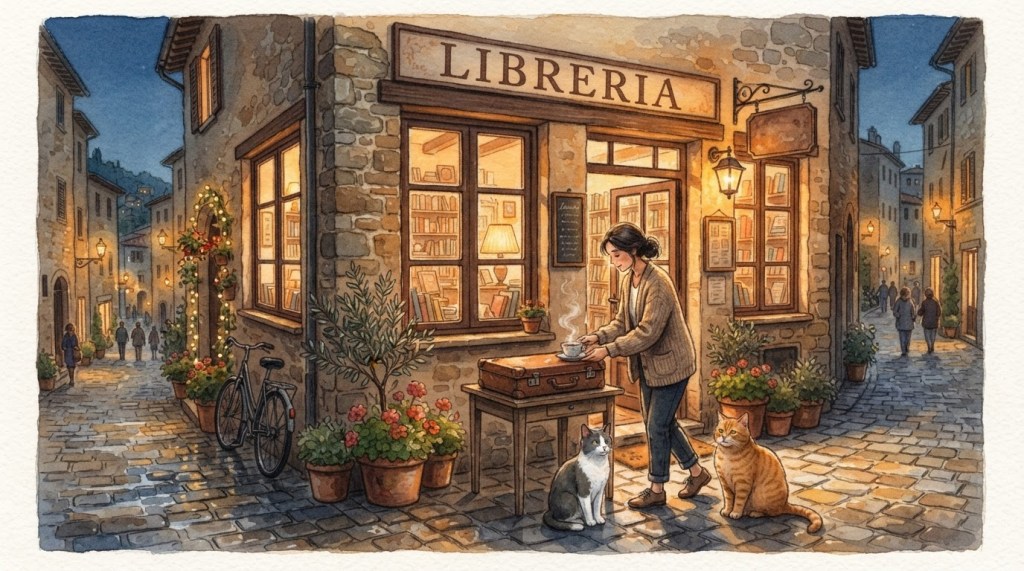
The rain had stopped an hour before dusk, but Via dell’Orologio still shone as if someone had polished every cobblestone for the evening. Moira Hopes was behind the counter of La Pagina che Fa le Fusa, rearranging a shelf of poetry that nobody had asked her to rearrange, when the doorbell gave its small brass chime and a woman stepped in out of the blue light.
She was perhaps forty-five, with a camel coat buttoned wrongly by one button and the kind of tired that has nothing to do with sleep. She did not browse. She stood just inside the door, the way people stand in a railway station, and looked at the shop as if she were checking that it was real.
Ashwaganda, who had been spread across the warm patch of floor above the radiator like a ginger rug somebody had dropped, lifted his enormous head. Toe, on the windowsill, did not move at all, but her green eyes slid to the newcomer and stayed there.
“Good evening,” said Moira. “You are very welcome, and the kettle is already on, so you cannot refuse.”
The woman laughed, a short surprised sound, as if she had forgotten she could. “I only came to buy a notebook,” she said. “I’m Solange. Solange Lipsia. I live up the hill, in the yellow house with the green shutters. Or I will, I suppose. I keep waiting for it to start being true.”
“Ah,” said Moira, and she put down the poetry. “The house of Signora Lipsia. I was so sorry, last September. She used to buy her crossword books here, and she always complained that I did not stock the hard ones.”
Solange’s face did something complicated. “She was my mother’s cousin, actually. I barely knew her. I grew up in Milan, and I only visited twice as a girl. And then in September the lawyer called, and it turned out she had left me the house. I had just lost my job, and my flat lease was ending, and it seemed like a sign. So I came.”
“And how long have you been here now?”
“Two months and four days.” She said it like a prisoner counting. “And I still haven’t unpacked. My suitcase is open on the bedroom floor, and I take out a sweater when I need one and I put the rest back. Everyone in the village is so kind. Signor Ferri brings me eggs. The baker, Adelmo, saves me the end of the loaf. And every night I walk up the hill, open that green door, and feel like a guest who has overstayed.”
Moira did not say anything wise. She simply came around the counter, took the camel coat gently by its wrongly buttoned front, fixed the button, and said, “Sit. The tea needs ten minutes, and so, I think, do you.”
A Tea for Someone Between Two Places
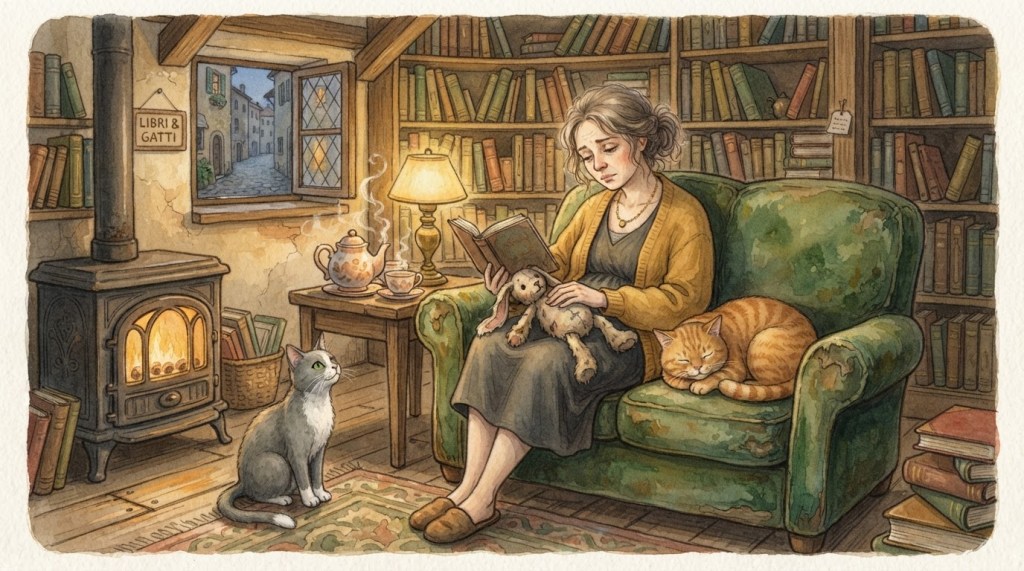
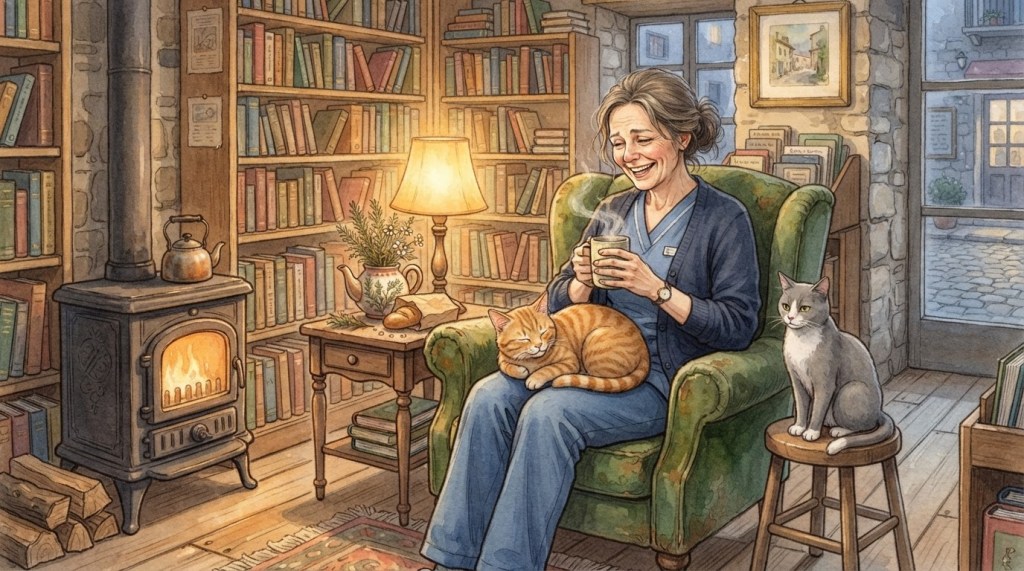
At the back of the shop, behind the shelf of travel books, there was a round table with three mismatched chairs and a crocheted cloth that Moira had inherited along with the bookshop itself. Solange sat in the chair nearest the radiator, and almost at once Ashwaganda rose, stretched his whole length like a bridge, and poured himself onto her feet.
“He does that to people who are pretending to be fine,” said Moira from the little tea corner. “He is rarely wrong. Toe, on the other hand, judges slowly. Do not take it personally.”
Moira was measuring dried leaves into a white teapot, and she narrated as she went, because she believed that tea tastes better when you know what is in it. “Lemon balm first, from the pot on my own windowsill, dried last August. It is a gentle, lemony leaf that people have brewed for centuries to settle a restless evening. Then a few threads of thyme, because thyme grows on every wall in Speranza and I think a tea for a newcomer should taste of the place. And a thin curl of orange peel, for a little brightness. A spoon of chestnut honey at the end, if you like.”
The water was poured, the lid went on, and a fragrance rose that was somehow both green and golden. Solange closed her eyes without meaning to.
“May I ask you something?” said Moira, sitting down across from her with two cups and a plate of almond biscuits. “When you say the house does not feel like home, what do you picture a home would feel like?”
Solange held the cup in both hands and thought about it for so long that the cup began to cool a little. “Like my grandmother’s kitchen,” she said at last. “In Milan, on the fourth floor. It always smelled of onions softening in butter and of the radiator dust burning in the first cold week of autumn. The tap dripped. There was a chair with a short leg that you had to sit on carefully. I knew where everything was without looking. I could have walked through it in the dark.” She smiled, then stopped smiling. “She died eleven years ago, and they sold the flat. I think I have been looking for that kitchen ever since.”
“And your house on the hill?”
“It’s lovely. That’s the problem. It’s lovely and it’s not mine. The sofa is hers. The curtains are hers. The kitchen smells of nothing, or of old wood and lavender sachets. I don’t know where the good knife is. I turned on the wrong tap this morning and the whole boiler shuddered at me.”
Toe had come down from the windowsill by now. She crossed the floor without a sound, climbed onto the third chair, and sat very upright, white paws together, watching Solange with the grave attention of a small grey judge.
“She is deciding,” whispered Moira. “Give her a minute.”
Forgive me, dear reader, while Toe makes up her mind: I have always found that the best way to wait for a cat is to read something small and kind. Many of my favourite bookshop evenings, the ones with rain on the window and a visitor who needed a cup of tea, are gathered in a little book called Tales of Speranza. Now, back to our table.
What the Kitchen Was Really Made Of
“Tell me more about the kitchen in Milan,” said Moira. “Not how it looked. How it felt, in a day.”
Solange let out a breath. “Mornings, mostly. I’d come in from school and she would already have the coffee pot on, even though I was a child and didn’t drink it. She’d give me the bread heel with butter. I’d do my homework at the table with the short-legged chair, and she would hum while she peeled things. I did that for years. Every afternoon, the same.”
“Every afternoon, the same,” Moira repeated softly. “Do you notice that you did not say what was special about the kitchen? You said what happened in it, again and again.”
Solange looked up. “I suppose I did.”
“There is a field of study called environmental psychology,” said Moira, topping up the cups, “and one of the things researchers there describe is something called place attachment: the emotional bond that people form with particular places. As far as I understand the research, it is not simply a matter of how long you have lived somewhere. It seems to grow out of repeated experience, a sense of routine and familiarity, and the meaning a place picks up from the moments that happen in it. A place becomes a home less like a house being built and more like a path being worn through a field. Nobody decides to wear the path. It is walked into being.”
“So two months isn’t enough,” said Solange.
“I would not say that either. Honestly, nobody can give you a number, and I would distrust anyone who did. People differ a great deal. What the research seems to suggest is that the clock is not the main ingredient. Repetition is. Meaning is. You have been in the yellow house for two months, but how many of those evenings did you spend actually living in it, and how many did you spend living out of a suitcase, waiting for permission to begin?”
Solange opened her mouth, closed it, and then, quite unexpectedly, began to cry. It was not dramatic. It was the quiet kind, the kind that arrives when a thing you have been carrying carefully is gently named. Ashwaganda, without being asked, shifted from her feet to her lap, all fifteen pounds of him, and began to purr, a low, deep, rumbling sound that seemed to come up through the floorboards.
“That is a twenty-five hertz purr,” said Moira, handing her a clean napkin from the biscuit plate. “Whether or not it does anything medical, I cannot promise. But I have never met a person who stayed tense under it for long.”
Solange laughed through the tears. “I’m sorry. I’m an adult. I came in for a notebook.”
“We will get you your notebook,” said Moira. “But first, another cup.”
The Smell of Onions in Butter
The second cup went down slowly. Outside, the lamplighter’s electric successor, which was a small timer box on the wall of the clock tower, clicked, and the streetlamps of Via dell’Orologio came on one by one, as they did every evening, with the faint air of a very old habit.
“You mentioned the smell,” said Moira. “Onions in butter and warm radiator dust. You described it before you described anything else.”
“It is the first thing I remember. When I think of that kitchen, it comes first, before the table or the window.”
“That is a very human thing. Researchers who study memory, among them the psychologist Rachel Herz, have found that memories triggered by smell tend to feel more emotional and more vivid than memories triggered by a word or a picture, and they often seem to take us back to earlier years in life. One explanation people offer is that the sense of smell connects quite directly to brain regions involved in emotion and memory, the amygdala and the hippocampus. I should say that scientists still debate the details, and it is not magic. But it fits what you just told me. Your grandmother’s kitchen is, in a sense, kept alive in your nose.”
Solange stared at the teacup. “And the house on the hill smells of nothing.”
“It smells of Signora Lipsia’s lavender sachets, I expect, and of the person she was. Which is not yours yet. But it could be, if you let it be. Not by erasing her, mind. By adding yourself. A home does not have to start from nothing. It can start from a shared sentence.”
Toe, who had been so patient, now stood up on her chair, stretched one white paw, and tapped it once, very deliberately, against Solange’s wrist. It was exactly the gesture of a small grey person who has finished an examination and has a result.
“She approves of you,” said Moira, with real delight. “She has done that to only three customers, and one of them was the bishop’s nephew.”
“What does it mean?”
“It means you have been admitted. Which is, I suppose, the first piece of homecoming. Someone has noticed you and decided you belong.” Moira smiled. “People forget that. We tend to think of home as a place, but a good part of it is simply being expected. Being greeted. Adelmo saves you the end of the loaf. Signor Ferri brings the eggs. You told me those as if they were problems. I would call them the first stones of the path.”
Solange sat very still. “I never thought of it that way. I thought I was being tolerated.”
“You are being befriended, which is a more tiring thing,” said Moira, “and I am quite sure that a person who does the real work of making a home is not the one who unpacks first. It is the one who allows herself to be seen at the baker’s at the same hour three days in a row.”
Small Rituals, Not Grand Gestures
“So what do I do?” asked Solange. “Tonight. Tomorrow. I don’t want a lecture, I want a first step.”
Moira laughed. “Then I will not give you a lecture. I will give you three very small things, and you may refuse any of them.”
“Go on.”
“First. Tonight, take one thing out of the suitcase and put it somewhere it does not need to be put. Not a sweater. Something you love for no practical reason. A photograph, a cup, a book you have read too many times. Put it somewhere you will see it each morning. That is all.”
“Second. Find the good knife. Everyone should know where the good knife is. It is, I think, the most underrated moment in settling in, the first time your hand goes to a drawer and finds what it wants without looking. It will take, perhaps, a week of cooking. Make something with onions and butter, if you can bear to.”
Solange’s mouth trembled into a smile. “And third?”
“Third. Choose a ritual, any ritual, and repeat it for ten days, at the same hour. Coffee on the step. A walk to the clock tower. Buying your bread from Adelmo, and learning which of his jokes are new. The worn path again. Repetition is not boring when it is chosen. It is the way a place learns your shape.”
Ashwaganda, still draped across Solange’s lap, chose that moment to roll slightly so that she had to rest her hand on his stomach. It sank into the fur. She looked down at it, and her shoulders, which had been up around her ears since the moment she came through the door, slowly came down.
“Do you know,” she said, “in two months, I have not once sat down in that house without a coat on.”
“Then perhaps that is where we begin,” said Moira. “Tomorrow, sit down in your own house with no coat on. It is a surprisingly radical act.”
The Notebook
They found the notebook together, after all. It was a plain one with a dark green cover and cream pages, from the shelf near the window, and Moira said it was the very notebook she would choose for someone starting a list of small true things.
“A list of what?”
“Of the things that have begun to feel like yours. It can start with only one line. The sound of the green door. The bakery at seven forty. The cat on the floor beside you. In a month you will read it back and discover that the path has been quietly walked.”
Solange paid, and held the notebook against her chest for a moment. At the door she turned, and Moira, who was already gathering the cups, saw that the camel coat was now correctly buttoned, though it had been Solange herself who had done it.
“Will you come back?” asked Moira.
“Thursday,” said Solange. “At the same hour. If that’s allowed.”
“It is more than allowed,” said Moira. “It is the whole idea.”
The bell gave its small brass chime. Through the window, the two cats watched her go up Via dell’Orologio under the lamps, a small figure carrying a green notebook, climbing toward a yellow house on the hill. And Moira, who had a good sense for such things, noticed that she was walking a little slower than when she had come, as a person walks when she is no longer being chased by a decision.
Halfway up, beneath the last streetlamp, Solange paused. She turned, looked back down at the lit window of the bookshop, then at the dark shape of the hill above her. Then she put her hand in her pocket, found her house key, and held it, just for a moment, like something that might be hers.
Later that night, in the yellow house, a single lamp came on in the kitchen. A pan was found. An onion was found, too, and a little butter. Down the hill, in the bookshop, Ashwaganda lifted his head from the warm patch above the radiator, sniffed the air as if he could smell it from there, and settled again with a deep contented rumble.
Moira’s Reflection
I think we often imagine that home is something we find, like a lost key behind a cushion, and that if we only searched in the right city or the right house, the feeling would be waiting. But the kind of home that lasts, as far as I can tell, is more often made than found. It is made out of ordinary repeated things: a cup in the same place, a greeting at the same hour, a smell that begins to mean something because we kept returning to it.
So if you are somewhere new, or somewhere that has not yet decided to be yours, be gentle with the waiting. You do not have to unpack everything tonight. You only have to take one thing out of the suitcase, and let the place see you do it.
What was the first small thing that made a place start to feel like home for you? I would love to hear it in the comments.
A Cup for This Story
- 1 heaped teaspoon dried lemon balm
- A few threads of fresh or dried thyme
- 1 thin curl of orange peel
- 1 teaspoon chestnut honey, if you like
- Pour over freshly boiled water, cover, and steep for about 8 to 10 minutes
Herbal teas are a comforting ritual, not medicine. If you are pregnant, taking medication or have a health condition, check with your doctor before trying a new herb.
P.S. If tonight’s question about belonging and the first small things that make a place yours stayed with you, there are ten more slow evenings like this one in Tales of Speranza.
Listen in Speranza
🎧 Moira’s bookshop also has a voice. Tales from Speranza is our free podcast of slow evening stories, read aloud for the end of the day. Listen on Spotify. (Stories read by an AI-generated voice.)
Press Play and Stay a While
If you would like a little company while the tea cools, press play on the song of the village and stay as long as you like.




Leave a Reply