Why do the good things in our lives stop feeling good, and how can we learn to notice them again?
The Man with the Umbrella
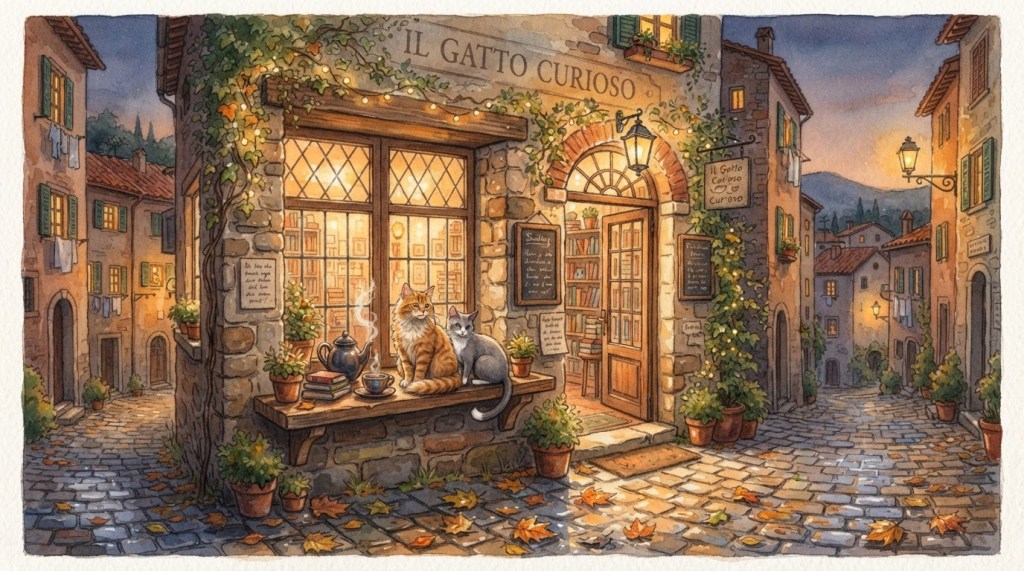
It had rained in Speranza since lunchtime, the soft, patient rain of late November that does not fall so much as settle. By five o’clock the cobblestones of Via dell’Orologio shone like the backs of sleeping fish, and the lamps had come on early, each one wearing a small halo. Inside La Pagina che Fa le Fusa, the bookshop was warm and smelled of paper, wool and the orange peel Moira Hopes had been drying on the radiator all week.
Ashwaganda, fifteen pounds of ginger tabby, lay across the armchair nearest the stove with the particular heaviness of a cat who has decided that nothing in the world requires him. His purr, a deep 25-hertz rumble, went on beneath the clicking of the radiator like a second, slower heartbeat for the room. Toe, slender and grey, with her immaculate white paws folded under her chin, sat on the windowsill with her green eyes on the street. She had been sitting there for ten minutes, perfectly still, which in Toe meant that somebody was coming.
“Who is it?” Moira asked, without looking up from the book she was shelving.
Toe did not answer, naturally. But a moment later the little brass bell above the door gave its cracked, friendly note, and a tall, narrow man stepped in out of the rain, shaking a black umbrella so carefully that not a single drop reached the books.
“Good evening,” he said. “Forgive me. I do not really know why I came in.”
“That is the usual reason,” said Moira, and smiled. “Please, leave the umbrella in the stand. The kettle is already warm.”
He was perhaps seventy, with a neat grey moustache and the upright posture of a man who has spent his life standing on platforms. He wore a good wool coat, polished shoes and a scarf that someone had clearly chosen for him with love. Everything about him said well looked after. Only his eyes were wrong. They were the eyes of a person looking at a beautiful landscape through a window that has been painted over.
“My name is Ferri,” he said. “Signor Ferri. I was the station master at Speranza for thirty-eight years. Trains, you understand. I know everything about arrivals and departures.” He gave a small dry laugh. “And I find I know nothing about what to do with myself in between.”
The Chair by the Stove
Moira led him to the second armchair, the one with the patched arm and the cushion that had long ago taken the shape of a hundred visitors. Signor Ferri lowered himself into it as if testing a bridge. Ashwaganda opened one amber eye, assessed the new arrival, and went back to sleep, which in cat language is a warm welcome.
“Tell me,” Moira said, setting out two cups. “What is the trouble? Or is it not quite a trouble?”
He took a while. Outside, a scooter hissed past through the wet. “It is not quite a trouble,” he said at last. “That is exactly the trouble. I retired three years ago. My wife, Marisa, is well. She still sings in the kitchen. My daughter Anna telephones every Sunday, and my granddaughter has just learned to read. The pension is enough. The knees are mostly obedient. I have a garden with a lemon tree, and every morning Elio at the bakery saves me the corner of the focaccia, the crispy one, because he remembers I like it.”
“It sounds like a rather lovely life,” said Moira gently.
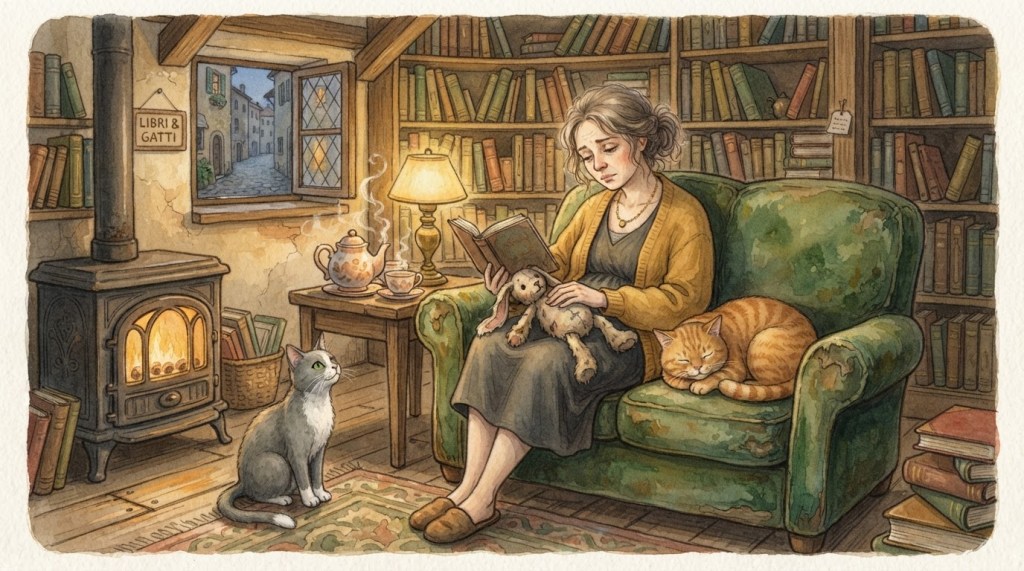
“It is. I know it is. I could write you the list.” His hands, resting on his knees, turned over slowly, palms up, as if showing her they were empty. “But when I eat the focaccia, I feel nothing. When Marisa sings, I hear it the way you hear a refrigerator. Last week Anna sent a photograph of the little one holding a book upside down and pretending to read, and I looked at it and thought, how sweet, in the voice of a man reading a train timetable. And then I was ashamed. What kind of man has everything and feels nothing? Is something wrong with me? Am I ungrateful?”
The word hung in the warm air. Toe left the windowsill, crossed the floor without a sound, and sat down directly in front of his polished shoes, looking up at him with grave green eyes.
“Ungrateful is a heavy word,” Moira said. “I would like to put it down for a while, if you will let me. Let us start with tea instead. May I choose it for you?”
Lemon Balm and Orange Peel
She went to the shelf behind the counter where the jars stood in a crooked, beloved row, each with a handwritten label, and took down three: dried lemon balm, strips of orange peel, and a few curls of cinnamon bark. She brought them to the little table between the armchairs so that he could smell them before they went into the pot.
“Lemon balm,” she said, crumbling a pinch between her fingers and holding it out. “It smells of lemon, but softly, like lemon remembered rather than lemon squeezed. The old herbalists liked it for restless evenings. I will not promise you it is medicine. But it is a very kind leaf.”
Signor Ferri bent his head and breathed in. Something crossed his face, quick as a swallow past a window.
“My mother had it in her garden,” he said, surprised. “By the water barrel. I had forgotten.”
“There. You see? It is not gone. It is only asleep.” Moira poured the hot water over the leaves and the orange peel and the cinnamon, and set a small hourglass on the table. “Three minutes. In the meantime, you may tell me about your mornings. Not the list. The mornings themselves.”
He considered this. “I wake at six, out of habit. The first train used to come through at six-twelve. I lie there and listen for it, though it has not been mine for three years. Then I make coffee. Then I walk to the bakery. Then I come home and read the newspaper. Then it is only half past nine.”
“And the lemon tree?”
“The lemon tree?” He blinked. “It is there. It is always there. It gives lemons, as lemon trees do.”
Moira said nothing. She only smiled a little, and the sand ran down through the hourglass, and Ashwaganda, in his sleep, stretched out one enormous paw and laid it, quite deliberately, on the toe of Signor Ferri’s polished shoe.
The station master looked down at the paw. It was a very large paw. It was warm, even through the leather.
“He does that,” said Moira. “He picks one person each evening and makes them an anchor. I think it is his way of saying: stay where you are, this is the good part.”
The Train You Stop Hearing
She poured the tea into two cups, pale gold with a coppery edge, and the room filled with the scent of lemon and orange and a whisper of warm bark. Signor Ferri wrapped both hands around his cup and for a moment simply held it, letting the heat soak through his palms.
“Now,” said Moira, sitting down across from him with Toe, who had by this time climbed into her lap. “I would like to tell you something, and I want you to hear it as good news. What you are describing has a name. Psychologists call it hedonic adaptation. It is one of the most reliable things we know about how minds work.”
“Hedonic,” he repeated, trying the word like an unfamiliar coin.
“From the Greek for pleasure. The idea is simple. When something new and good enters our lives, we feel it strongly. But the mind is built to notice change, not constancy. If something stays the same long enough, the feeling fades back toward a kind of baseline. Two psychologists, Philip Brickman and Donald Campbell, wrote about this in the early nineteen-seventies and compared it to a treadmill. We run toward the next good thing, and the pleasure of the last one wears off underneath our feet.”
“A treadmill,” said Signor Ferri slowly. “That is cruel.”
“It is also useful, if you think about it. Imagine if you felt the full astonishment of walking on solid ground every moment of the day. You would never get anything done.” Moira stroked Toe’s grey back. “And it goes deeper than feelings. Your senses work the same way. You know the hum of a refrigerator you only notice when it stops? Your nervous system quietly turns down the volume on anything constant. Sensory neurons often respond strongly when a stimulus begins or changes and much less when it simply carries on. Your ears, your skin, even your sense of smell all do it. You stop feeling your watch on your wrist within minutes of putting it on.”
“The six-twelve train,” said Signor Ferri, almost to himself. “People who live beside the line, they tell me they stop hearing it after a month.”
“Exactly that. You are a man who lived beside the best line in the world for thirty-eight years. And now you are living beside a good life, and the mind, being a diligent, efficient and slightly thoughtless servant, has turned the volume down on it. That is not ingratitude. It is attention doing its job a little too well.”
Something loosened in his shoulders. It was subtle, but Moira saw it, as she saw most things, over the rim of her cup.
“So I am not broken,” he said.
“You are a perfectly working human being,” said Moira. “Which, I admit, is a rather inconvenient thing to be.”
He laughed, properly this time, a short warm sound that made Ashwaganda’s ear twitch.
Forgive me for interrupting myself, dear reader, but Toe has just turned around three times in my lap and the rain is drumming on the glass, and it seems the right moment for a small confession: my favourite bookshop evenings, the ones with a pot of something fragrant and a visitor who arrives not knowing why, are gathered in a little book called Tales of Speranza. Now, back to Signor Ferri, who is just beginning to listen.
What the Cats Know
“But what do I do about it?” asked Signor Ferri. He had set down his cup and was looking, a little helplessly, at the grey cat in Moira’s lap. “One cannot simply decide to feel. I have tried. I stood in the garden yesterday and told myself, Ferri, look at this lemon tree, you are a lucky man. And the tree stood there, and I stood there, and we both felt rather foolish.”
“No, one cannot decide to feel,” Moira agreed. “Feelings are like cats. They come when they are not summoned and flee when they are chased. But attention is something we can steer, a little, the way you steer a train by switching a point and not by shouting at the engine.”
“The points,” he said, and for the first time his voice had a ring of professional interest. “Yes. That I understand.”
“Then look at Ashwaganda,” said Moira. “Not at the cat. At what he is doing.”
Signor Ferri looked. The big ginger cat lay with his paw still resting on the polished shoe, his flanks rising and falling, his whole body vibrating faintly with that deep, slow purr. There was nothing remarkable about it at all. It was simply a large animal being content.
“He has been purring for forty minutes,” Moira said quietly. “The same purr. If he were a person with a human mind, he would have adapted to it long ago. But he does not stop noticing the stove. Cats do not seem to keep a list of what they ought to be thankful for. They simply return, again and again, to the warm place. Every evening he lies in front of that stove as if it were a gift he had never been given before. I have watched him for years, and I have never once seen him bored of it.”
“Perhaps he forgets,” said Signor Ferri, “that it was there yesterday.”
“Perhaps. And perhaps that is not such a bad talent.” Moira smiled. “We cannot forget on purpose, and I would not want us to. But there is a human cousin of it. Researchers have long noticed that people who deliberately bring back a good thing, by imagining it gone or remembering how it began, tend to feel it more freshly. There is an experiment from the early two-thousands, by Robert Emmons and Michael McCullough, where students who wrote down a few things they were grateful for each week reported feeling somewhat better about their lives than those who wrote about neutral events. I should be honest with you: later studies found the effect is real but modest, and not equal for everyone. It is not a magic cure. It is a small hinge, and sometimes a small hinge is all a door needs.”
“Writing a list,” said Signor Ferri, with a trace of disappointment. “I had a list. I told you. I could write you the list.”
“Ah, but your list is a ledger, a station master’s list, accurate and complete and cold. The studies that found the most benefit were often about specific moments rather than general inventories. Not ‘I am grateful for my family’ but ‘Last Tuesday Marisa hummed while she dried the cups and I stopped to listen.’ The detail is what makes the mind sit up. A ledger bores it. A moment wakes it.”
The Corner of the Focaccia
Signor Ferri was quiet for some time. The rain softened against the glass. Toe, deciding that her lap was no longer sufficiently interesting, slipped down, padded across the rug, and jumped onto the arm of his chair, where she sat with her white paws neatly together and began, with great concentration, to wash one ear.
“May I try something?” he said.
“Please.”
He closed his eyes. His moustache moved slightly as he searched for the words. “This morning,” he said, “Elio at the bakery put the corner of the focaccia in a little square of paper. He did not say anything. He only slid it across the counter with two fingers, the way you pass a note in school. And his flour-white hand was shaking a little, because he is eighty now, and the shaking has got worse. And I took the paper and said grazie and put it in my pocket, and walked home, and ate it standing up at the kitchen window while reading the front page, and I do not remember what it tasted like.”
He opened his eyes. They were wet, and a little astonished.
“Eighty,” he said. “He gets up at three in the morning, with those hands, to bake. And for three years he has kept me the crispy corner, and I have eaten it standing up. Moira, I have not once thanked that man for the corner. Only for the bread.”
“There,” said Moira softly. “Do you feel that?”
“Yes.” He pressed two fingers to his chest, as if checking a pocket. “Yes. It is not a pleasant feeling, exactly. It is more like a window being cleaned from the inside.”
“That is what it is like. People expect gratitude to be sweet and it is often a little sharp first. It is the feeling of noticing how much was being given while you were not looking.” She refilled his cup. “And notice, too, that you did not need a new life to feel it. You only needed to look at the old one from a slightly different angle. The corner of the focaccia was always there. You simply stopped hearing the train.”
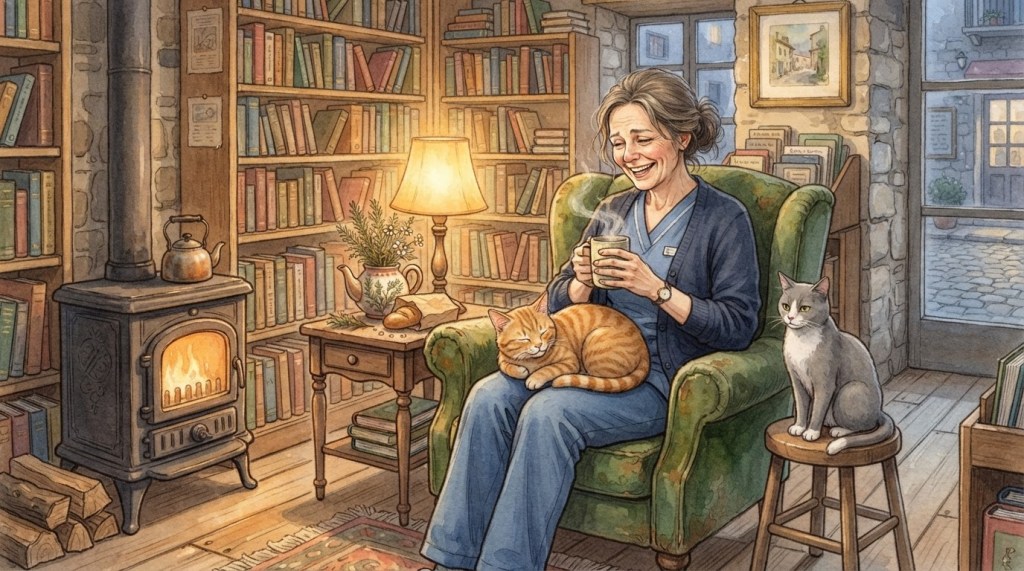
He laughed again, then wiped his eyes with a very clean, folded handkerchief, and Ashwaganda, sensing that the anchor was now well and truly set, deepened his purr by what seemed to be one full hertz.
A Small Homework, Gently Given
“I will not give you a long assignment,” said Moira, as the last light went out of the window and the street lamps took over. “You have had enough lists. But I will offer you three small things, and you may keep whichever one fits your pocket.”
“Tell me. I am a man who follows timetables.”
“The first is the slow bite. Once a day, eat or drink one thing with nothing else in your hands. No newspaper, no standing at the window. Just that. Even sensory adaptation, which turns the volume down, can be turned up a little by simply paying attention to the first moment and the last. The first sip is always louder than the tenth.”
He nodded, a man memorising a schedule.
“The second is the one specific thing. At night, before sleep, you recall one single moment from the day that was good. Not a category, a moment. Marisa humming over the cups. The shape of the lemon in the light. If you can say it aloud to her, even better, because gratitude that is spoken tends to land twice, once in the speaker and once in the listener.”
“And the third?”
“The third is the hardest, and the one I think you have already begun.” Moira lifted her cup. “Thank the person, not the bread. Tell Elio what the corner means to you. Not as a grand speech. Just, ‘I know you save it for me, and I notice.’ People who are thanked in a specific way often seem to feel it for a long time afterward. And I suspect that a very old baker with shaking hands has been waiting three years to hear it.”
Signor Ferri sat very still. Then he stood, carefully, so as not to disturb the paw that was still resting on his shoe, and found that Ashwaganda had somehow arranged it so that he could not leave without moving the cat. He looked down at the huge orange creature and the huge orange creature looked back, with perfect calm.
“He is not going to move, is he?”
“Not for an anchor who has not yet finished his tea,” said Moira.
So he sat down again, and finished the tea, slowly, with nothing else in his hands, and noticed, for the first time in a very long while, that it tasted of lemon and orange and the corner of his mother’s garden.
The Walk Home
When he finally left, the rain had thinned to a fine silver mist, and the lamps along Via dell’Orologio had that soft, enchanted look they only have after dark in November. Signor Ferri opened his black umbrella, then, after a moment’s thought, closed it again and walked a few steps with the mist on his face, to feel it.
The bakery was dark, of course. Elio would be asleep by now, ready for his three o’clock. But the shutter had a little ledge above it, and on an impulse Signor Ferri took out his small notebook, the one he had once used for train numbers, and wrote, in his careful hand: Thank you for the corner. I notice. Ferri. He tore out the page, folded it twice, and tucked it into the shutter’s handle where the baker would find it in the dark.
Then he walked home through the mist, past the fountain, past the church whose bells had been late for a century, and up the little lane to the gate where the lemon tree stood. He stopped. The tree was lit from the kitchen window, and the lemons, small, imperfect and gold, hung in the light like lamps someone had left on for him.
From inside the house, faintly, came Marisa’s voice. She was singing, something old, something about the sea, slightly off the note, as she had been for forty-six years.
He did not go in straight away. He stood by the gate, with his umbrella furled under his arm, and for a full minute he simply listened, the way he had once listened for the six-twelve, with his whole attention, as if it were the last train of the night. And it was not a refrigerator hum at all. It was a woman he loved, singing to a kitchen, on a wet Wednesday, in a village that had once been named after hope.
Back in the bookshop, Moira turned the sign to closed and put out the lamp by the window. Ashwaganda was already asleep in the warm hollow where the visitor had been. Toe sat on the sill again, her green eyes on the empty street, and Moira would have sworn, though she would never have said so aloud, that the grey cat looked quietly pleased with herself.
Moira’s Reflection
I think we are taught that gratitude is a duty, something we owe the universe like a tax, and that failing to feel it makes us a little worse than we ought to be. But the science, as far as I understand it, tells a gentler story. Our minds are built to stop noticing what is steady, and that is not a flaw of character. It is how a nervous system economises. Feeling flat about a good life does not mean the life is not good, nor that we are cold. It means that the volume has drifted down, as it does on every constant thing.
What we can do, honestly and without pretending to a magic cure, is to turn the dial back a little with small, specific, unhurried acts of attention: a slow first sip, a single remembered moment, a word of thanks said to the person rather than about the bread. The research suggests such practices help some people a modest amount, and that is quite enough to build an evening on. The corner of the focaccia was always there. The trick is only to look up.
Now I would love to hear from you: what is one small, ordinary thing in your life that you have stopped noticing, and who might be waiting to hear that you do? Tell us in the comments, and let Ashwaganda know he is not the only one with a warm place.
A Cup for This Story
Lemon Balm and Orange Peel Evening Tea
- 1 heaped tablespoon of dried lemon balm (or a small handful of fresh leaves)
- 2 strips of orange peel, preferably unwaxed
- 1 small piece of cinnamon bark
- 300 ml of freshly boiled water, steeped for 3 to 5 minutes under a lid, then strained
Drink it slowly, with nothing else in your hands. Herbal teas are a comforting ritual, not medicine; if you are pregnant, take medication or have a health condition, check with your doctor before trying a new herb.
P.S. If tonight’s question about the good things we stop noticing stayed with you, there are more slow, warm evenings like this one in Tales of Speranza.
Listen in Speranza
🎧 Moira’s bookshop also has a voice. Tales from Speranza is our free podcast of slow evening stories, read aloud for the end of the day. Listen on Spotify. (Stories read by an AI-generated voice.)
Press Play and Stay a While
Before you go, here is the song that plays when the bookshop door opens. Let it run while the tea cools.





Leave a Reply