
Why is waiting for something that matters so much harder than the thing itself?
The Clock That Was Always Right
On Via dell’Orologio, the clock above the old pharmacy had been telling the wrong time for as long as anyone in Speranza could remember. It ran eleven minutes fast on Mondays and, for reasons no one had ever explained, seven minutes slow on Fridays. The villagers had stopped minding. They simply did the arithmetic and carried on, the way you forgive a friend for always being late.
Halfway down the street, under the clock’s wandering gaze, stood a bookshop with a green door and a painted sign that read La Pagina che Fa le Fusa, The Page That Purrs. It was a Tuesday in November, the hour when the light turns the colour of weak honey, and Moira Hopes was dusting the poetry shelf with the slow, unhurried strokes of a woman who had never once been in a rush to finish dusting.
Ashwaganda lay across the radiator cover like a loaf of ginger bread that had decided to become a cat. He weighed fifteen pounds and wore every one of them with dignity. When he purred, which was often, the sound began so low that you felt it in the floorboards before you heard it, a deep, steady hum at about twenty-five hertz, somewhere between a distant train and a very large, very content bee.
Toe, by contrast, was all line and angle: a slender grey cat with four immaculate white paws, as though she had stepped carefully out of a bowl of milk and refused to track it anywhere. She sat on the windowsill with her green eyes fixed on the street, watching the road the way some people watch a kettle.
“You’ve been there since lunch,” Moira told her, without turning around. “It won’t boil faster.”
Toe did not move. But her ears rotated, just slightly, toward the door. A moment later, the bell above it gave its small bright jingle.
The Girl Who Refreshed Everything
The young woman who came in was perhaps twenty-nine, with ink-dark hair tied up in a pencil and a scarf wound twice too many times around her neck. She held her phone in her right hand the way a person holds a hot cup, carefully, but unable to put it down. She looked at the shelves. She looked at the ceiling. She looked at her phone. Then she looked at the shelves again, and Moira understood that she was not really looking at any of them.
“Good afternoon,” said Moira. “Take your time. We have plenty of it here. It’s the one thing we’re never short of.”
“That’s what I’m afraid of,” the young woman said, and then laughed at herself, a small embarrassed laugh. “Sorry. I’m Nives. I’m from the next valley, the village with the quarry. My bus back doesn’t leave for an hour and a half and I could not bear to sit at the stop. I saw the cat in the window.”
“Toe,” said Moira. “She sees everybody. She has opinions about most of them.”
Toe leapt down from the sill, crossed the floor in four silent steps, and sat precisely on the toe of Nives’s boot. Then she looked up with those green, unblinking eyes, as if to say: I know. Whatever it is, I know.
Nives crouched down, and the phone, for the first time since she had entered, went into her pocket. She stroked the grey head with two fingers. “I’m sorry,” she said again, this time to the cat. “I’m not good company today.”
“Nobody is good company when they’re waiting,” said Moira gently. “It’s one of the hardest jobs in the world, and nobody ever gives you a title for it. Sit, if you like. The kettle’s just about to be unreasonable, and I was going to make tea.”
Two Months of Silence
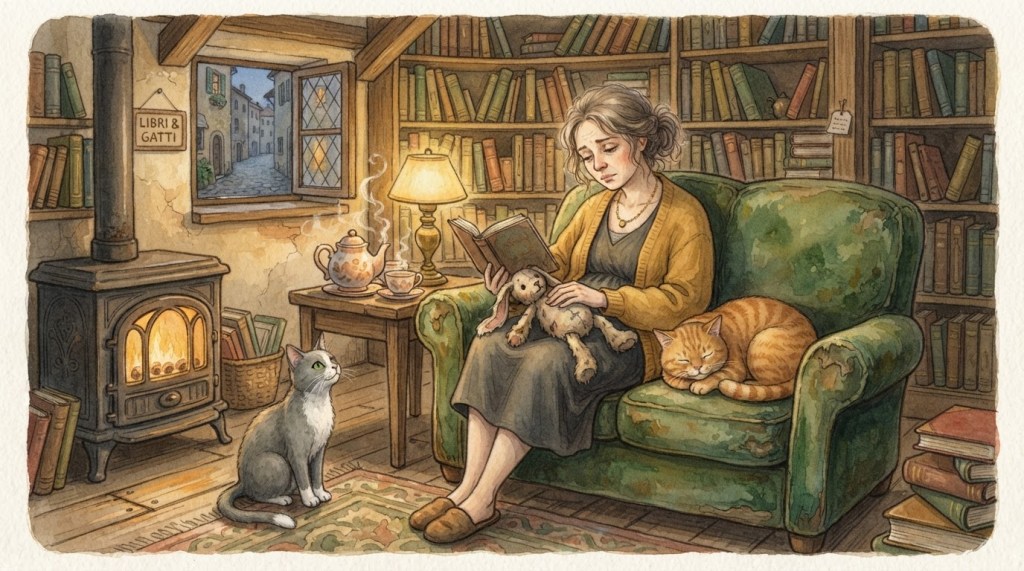
The back of the shop held a low round table, two armchairs the colour of old apricots, and a shelf of teapots that did not match one another and were all the better for it. Ashwaganda opened one eye as they passed, assessed Nives for any immediate danger or biscuits, and closed it again.
Nives sat on the edge of her chair as if it might be taken away. Moira did not ask a single question. She filled the kettle, set out two cups, and let the silence do its slow, kind work, until the girl began to speak on her own.
“I restore paintings,” Nives said. “Or I want to. I’ve been a assistant in a workshop for six years, cleaning frames, mixing varnish, holding the lamp for other people. In September I applied to the restoration school in Florence. It takes eight students a year. Eight. They said the decisions would be sent by letter, by the end of October.”
“And it is the seventeenth of November,” said Moira.
“Seventeen days late. I counted. I know that’s ridiculous. Letters get lost. The office might have changed its schedule. Somebody might be ill. I know all of it, I’ve told myself all of it, and I still check the postbox four times a day, and the email twice an hour, and the school’s website when I should be asleep. Yesterday I realised I had been standing at the gate for ten minutes in the rain, watching the road, like a dog waiting for someone who is never coming back.” She stopped. “And that’s the thing. If they said no, I think I could be sad and then get on with it. It’s the not knowing. It’s like living with a stone in my shoe that I’m not allowed to take out.”
The kettle began to sing. Ashwaganda’s purr deepened a note, as though he had been waiting for exactly this cue.
A Tea for Open Hands
Moira took down a tin with a faded label and a jar of dried petals, and lifted the lids one after the other so that the smell rose into the room: something like apples and hay and warm afternoon grass.
“This is chamomile,” she said, tipping a heaped spoonful into the pot. “The flowers, not the dust from a bag. Then a pinch of orange blossom, because it smells like a promise, which is a useful thing to have in a cup when you’re waiting for one. A strip of dried apple for roundness. And a very little lemon peel, so it doesn’t forget to be bright.”
“Does it work?” Nives asked. She sounded half hopeful, half ashamed of hoping.
“I’ll tell you the truth, because it’s the only thing worth serving with tea,” said Moira. “Chamomile has been drunk before bed for centuries, and some small studies suggest it may help people feel a little calmer or sleep a little better. But the evidence is modest, and it is not a medicine for what you are carrying. What it does for certain is give your hands something warm to hold and give your mind something to do for ten minutes that is not refreshing a screen. Sometimes that is already most of the cure.”
She set the pot down with a small wooden timer beside it, a little hourglass, and turned it over. “Ten minutes of steeping. You cannot hurry it. If you try, it tastes of nothing. If you leave it too long, it turns bitter. Chamomile has very firm opinions about patience.”
Nives watched the sand begin to fall, grain by grain. For perhaps a full minute, she said nothing at all.
What the Cats Know About Waiting
Toe, who had been seated on Nives’s boot all this time, now climbed into her lap with great ceremony, turned around twice, and settled with her white paws folded beneath her chest. Her weight was small and exact. Nives’s shoulders, which had been creeping toward her ears since the bus, began to come down by slow degrees.
“She’s very good at this,” Nives said, almost to herself.
“She’s a professional,” said Moira. “Watch her. When she waits at the window for the baker’s boy, she isn’t tense. She isn’t composing speeches in her head. She is simply there, with her whole attention on the street, and when nothing arrives, nothing is lost. Cats wait the way water waits in a glass. It’s not that they don’t care about the outcome. It’s that they haven’t added a second layer of worry on top of the first.”
“A second layer?”
“The worry about the waiting itself. Yes. That’s where we humans are quite clever, and not in a helpful way.”
At that moment Ashwaganda rose from the radiator with a long, rolling stretch, padded across the room with the unhurried gravity of a small bishop, and leaned his entire warm bulk against Nives’s shin. The purr came up through the floor and into her ankle. It was so low and so steady that she found, to her surprise, that her breathing had slowed to match it.
“That’s the twenty-five hertz,” Moira said, watching. “I won’t promise you it heals anything. Some researchers have suggested that low-frequency vibrations like a cat’s purr might have soothing effects, and many people find them calming, but the science there is still thin and I would be fibbing if I said it was settled. What I can say is that being near a large, purring animal is a very good way to remember that the body has other things to listen to besides the mind’s alarm.”
The Stone in the Shoe
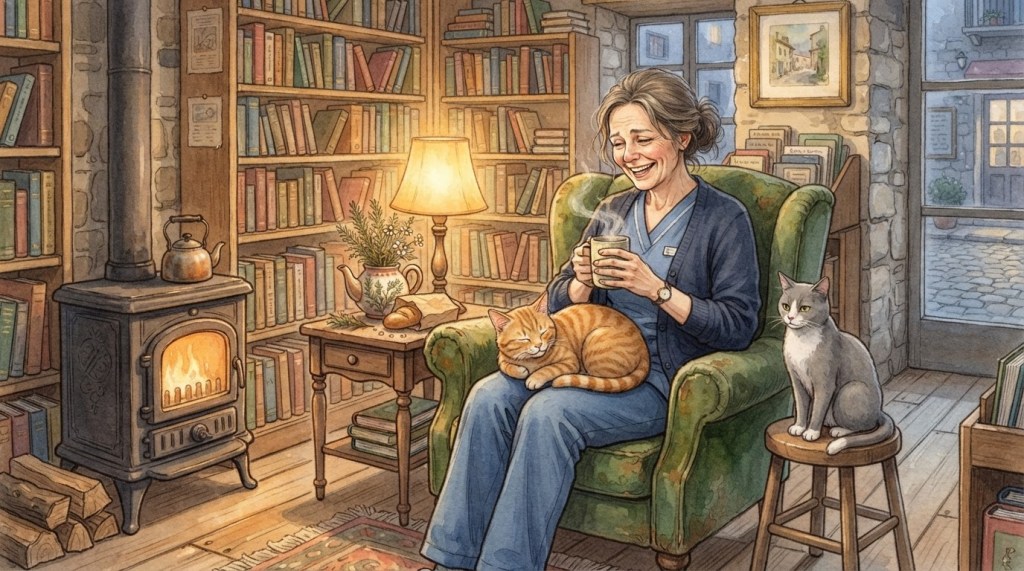
The sand ran down. Moira poured the tea, pale gold, with a steam that curled up and smelled faintly of orchards, and handed Nives a cup. She took her own and sat back.
“You said something just now that I think is exactly right,” she said. “You said that a no would be easier than not knowing. Do you know, that is something scientists have actually looked at?”
Nives lifted her eyes over the rim of the cup.
“There’s an experiment from a group at University College London, published in 2016, I believe, in the journal Nature Communications. They had volunteers play a computer game in which turning over rocks might reveal a snake, and a snake meant a mild electric shock. The researchers changed the odds: sometimes the chance of a shock was low, sometimes high, sometimes a coin-flip. And they measured how stressed the players became, using sweat on the skin and the size of the pupils.”
“Let me guess,” said Nives. “It was worst when they were sure the shock was coming.”
“That is what most of us would guess. But no. The stress was highest when the odds were about fifty-fifty, when the players had the least idea what would happen. When the shock was nearly certain, they were less stressed than when it was truly uncertain. It was a small, controlled experiment in a lab, with mild shocks, so we should not stretch it too far. But it fits what a great many people say about their lives. The mind can often prepare for a hard answer. What it struggles with is a door left neither open nor closed.”
“Like a stone in the shoe,” Nives whispered.
“Like a stone in the shoe. And the mind, bless it, does the most natural thing in the world. It tries to solve the stone. It runs scenarios. It rehearses the yes and the no. It checks the postbox, as if looking harder could move the letter forward. Psychologists sometimes call a part of this rumination, the mind turning the same question over and over like a coin in a pocket. It feels like work, and so it feels useful. But often it only wears down the coin.”
The Marshmallow, Revisited
Nives took a first sip of the tea. It tasted like warm light, soft and slightly sweet. She laughed softly, without quite knowing why.
“People always tell me patience is a virtue,” she said. “As if I could simply decide to have more of it. As if some people are born with a jar full and I got a spoonful.”
“You may have heard of the marshmallow test,” said Moira, and her eyes twinkled. “Children offered one sweet now, or two if they could wait. For years the story was that the children who waited went on to do better in life, and that patience was a kind of fixed talent you either had or hadn’t.”
“I know the one.”
“Well, later research has been much more careful. A larger study in 2018, by Tyler Watts and colleagues, found that the link was a good deal smaller than the famous story suggested, and that much of it faded once they accounted for the child’s family background and early surroundings. Other work suggests that children are quite sensible: if they have learned that grown-ups often break promises, taking the marshmallow now is not impatience. It is good judgment. So what looks like a weakness of character is often a reasonable response to a situation.”
“So I’m not bad at waiting,” said Nives slowly. “I’m waiting without any information.”
“You’re waiting in a fog, with the one thing you want most standing on the other side of it. Anyone would flinch. The useful news is that patience seems to be less like a jar you were born with and more like a muscle, or a habit of attention, and there are small things that help it. None of them is magic. All of them are free.”
Three Small Things
Moira reached down and scratched Ashwaganda behind one ear, and the purr rose an audible shade. “I’m not a doctor, and I’m not going to hand you a program,” she said. “But here is what I have seen help people, and what some of the research quietly supports.”
“First, give the checking a schedule. If you look at the postbox four times a day out of anxiety, you are feeding the anxiety every time. Some people find it easier to choose one or two times, say after breakfast and at six, and let the rest of the day belong to something else. The mind relaxes a little when it knows there will be a time to look.”
“Second, find out what you can find out. Often we wait in silence because we are afraid to ask. A short, polite message to the school’s office, ‘I wanted to check that my application was received and when decisions are expected,’ costs nothing and can turn a fifty-fifty fog into something with edges. Not every question can be answered, but you would be surprised how often the answer was only waiting to be asked for.”
“And third, keep your hands busy with the thing you love, whichever way the letter falls. Not as a distraction exactly, but as a way of remembering who you are while you wait. You are not only a person who is waiting for a letter. You are a person who knows how to take a century of grime off a painted face and let the colour come back.”
Nives looked down at her hands, at the faint stains of varnish ground permanently into the creases of her fingers. For a long moment she did not speak. Toe stretched, reached up one white paw, and touched her chin, very lightly, as if checking she was still there.
The Eleven-Minute Clock
They stayed like that for a while, the three of them, and then four, because Ashwaganda decided his place was in the middle of the room, in the exact spot where everyone would have to step around him. A pale blue dusk came down outside. The streetlamp on Via dell’Orologio flickered on with its usual slight stutter. Above the pharmacy, the wandering clock announced a time that was, depending on who you asked, either quarter past five or a little after five on a Tuesday.
“Your clock is wrong,” Nives said, glancing at the window.
“It is,” Moira agreed. “Eleven minutes fast on Mondays, seven minutes slow on Fridays. Today it’s only a little off, because it likes Tuesdays. The village stopped fixing it years ago. Old Signor Bellandi, who used to be the postman, said that a clock which is always exactly right makes people anxious about being late, but a clock that is always a little wrong makes them look up and notice the day.”
Nives smiled, and this time it reached her eyes. “I think I’ve been living inside a clock that’s exactly right. Every minute accounted for. Every minute seventeen days late.”
“There’s one more small thing about time,” said Moira, “and it’s the last I’ll trouble you with. Psychologists who study how we experience time often find that a minute we spend watching the clock feels far longer than a minute we spend absorbed in something. Waiting stretches when attention is fixed on the waiting. It does not mean you can switch it off. But it does mean the hours you spend at the gate in the rain are probably the longest hours of your whole month, and the ones with the least in them.”
“So you’re saying I should go and clean a painting.”
“I’m saying a cup of tea is ten minutes, a painting is an afternoon, and a letter, when it comes, will arrive in its own good time whether you are standing at the gate or not. I find the afternoons are kinder to spend somewhere other than the gate.”
The Bus Back to the Quarry
When the hourglass had run through three times and the teapot was empty, Nives stood up slowly, as though returning to her body after a long swim. Toe slid from her lap and landed on all four white paws with a soft, satisfied thump.
“I think,” said Nives, “I’m going to write to the school tonight. Just a short note, to ask when the decisions are expected. And then I’m going to go to the workshop tomorrow and finish that Madonna we’ve had on the easel for a month. And I’ll check the postbox once, in the evening, like a sensible person.”
“Once is a very sensible number,” Moira said.
Nives bought a small book from the poetry shelf that Moira had been dusting, a thin volume with a faded blue cover, and a tin of the chamomile and orange blossom, wrapped in brown paper and tied with string. At the green door she paused. Ashwaganda had followed her as far as the threshold and now sat in the draught, enormous and ginger, regarding her with the calm of a creature who has never once looked at a clock.
“Thank you,” she said, to all three of them. Then, with a hint of mischief: “If the letter says yes, I’ll come back and tell you. And if it says no, I’ll come back and tell you that too.”
“We’ll have the kettle on either way,” said Moira.
The bell jingled. Nives walked down Via dell’Orologio under the wandering clock, past the pharmacy and the baker’s lit window, her scarf unwound by one full turn and her phone, for the first time in weeks, forgotten at the bottom of her bag. Behind her, in the window of the bookshop, a grey cat with white paws watched her all the way to the corner, and then went back to watching the road, patient as water in a glass.
Moira’s Reflection
Waiting is hard not because we are weak but because we are built to want answers. A mind that cannot yet know whether to prepare for rain or sun will keep scanning the sky, and that scanning, however natural, can cost more than the weather ever would. The kindest thing we can do for ourselves is not to scold the scanning but to give it a rhythm: a time to look, a thing to ask, and something of our own to be getting on with.
Patience, I think, is not the absence of wanting. It is wanting with open hands. You can hold a hope and still drink your tea, still mend your frame, still notice that the light on the lane is lovely. The letter will come when it comes. In the meantime, you are still entirely yourself, and that is no small thing to be.
What are you waiting for right now, and what small thing could you do today with your hands open instead of clenched? Tell us in the comments. Moira and the cats are listening.
A Cup for This Story
- 1 heaped teaspoon dried chamomile flowers
- 1 pinch dried orange blossom
- 1 small strip of dried apple
- 1 thin strip of lemon peel
- 250 ml freshly boiled water, steeped for 10 minutes, covered
Herbal teas are not medicine; if you are pregnant, allergic to plants in the daisy family, or unwell, check with your doctor first.
Listen in Speranza
🎧 Moira’s bookshop also has a voice. Tales from Speranza is our free podcast of slow evening stories, read aloud for the end of the day. Listen on Spotify. (Stories read by an AI-generated voice.)
Press Play and Stay a While
If you have a few quiet minutes before the kettle boils, here is the song of Speranza. Press play, let your shoulders drop, and stay a while.





Leave a Reply