
How do you begin again when the first beginning did not work out?
The Clock Above the Door
On Via dell’Orologio, the Street of the Clock, there had not been a working clock for eleven years. The old brass one still hung above the shuttered shop at number nine, with its two thin hands pointing stubbornly at ten past ten, and the people of Speranza had long since stopped looking up at it. They told the time by church bells, by their phones, or by the smell of Signora Fabbri’s bread, which came out of her oven at a quarter to seven every morning without fail.
Moira Hopes looked at it every evening, though. She looked at it when she turned the sign on the door of La Pagina che Fa le Fusa from OPEN to CLOSED, and she looked at it again when she carried the watering can out to the geraniums. It was not that she expected it to move. It was only that a stopped clock seemed to her like a sentence someone had begun and never finished, and Moira had always been a person who wanted to know how sentences ended.
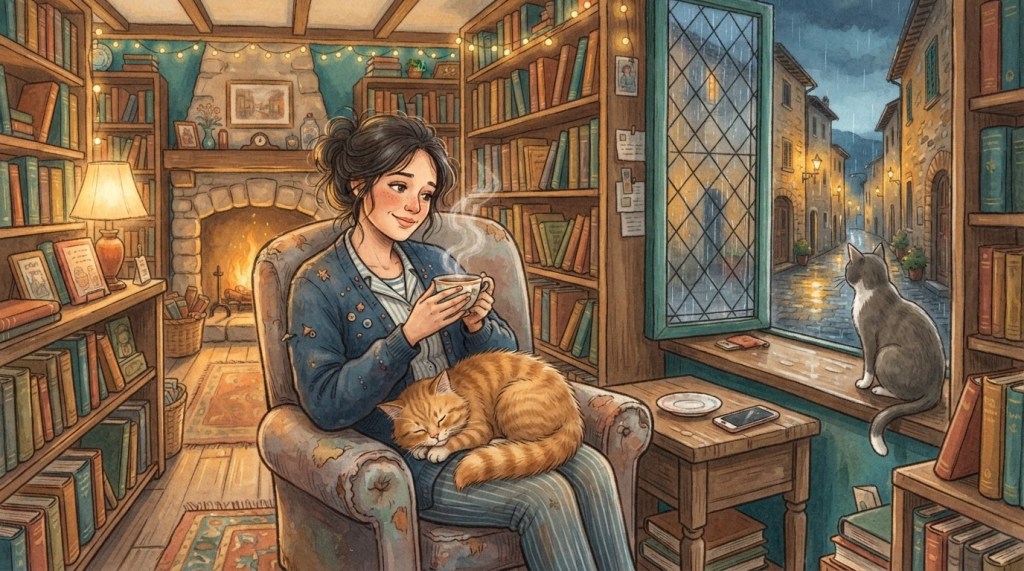
That Friday in mid-November, the light had gone the color of weak honey, and the mountains behind the village were turning from green to blue to grey. Inside the shop it was warm. A kettle muttered on the little stove at the back. Ashwaganda, the fifteen-pound ginger tabby, lay across the warmest square of floor like a dropped cushion, and his purr, deep as a cellar door, rolled gently under everything. Toe, the slender grey cat with the four immaculate white paws and the green eyes, sat on the windowsill with her tail curled around her feet, watching the street as though she were being paid to.
“Someone is coming,” Moira said to nobody in particular.
Toe’s ears turned a quarter inch toward the glass. Ashwaganda did not move at all, but his purr deepened by a shade, which was how he said yes, I noticed too.
A Visitor with Her Hands Full
The bell above the door gave its small, bright jingle, and a woman came in sideways, because her arms were occupied. She was perhaps thirty-five, with dark hair pulled back in a hurry and a grey wool coat that had been good once. In her arms, wrapped in a faded blue dishcloth like a sleeping baby, she carried something heavy and round.
“Buonasera,” she said. “I am sorry, I am not sure I am in the right place. The man at the tabaccheria said you were the person to ask about things that have stopped.”
“That is a generous description of me,” said Moira, smiling. “Come in, come in. Put your bundle down anywhere you like. The table by the window is free, and the chair has a cushion.”
The woman set the bundle on the table and unwrapped it with great care. Inside was a mantel clock made of dark wood and brass, no taller than a loaf of bread, with a white enamel face and a small chip near the number seven. Its hands stood at ten past ten.
Moira did not say anything for a moment. Then she said, softly, “Ah.”
“You know it?”
“I know its big brother. It hangs above number nine.” Moira held out her hand. “I am Moira. You must be Anselmo Valli’s granddaughter.”
The woman’s face did something complicated. “Greta,” she said. “How did you know?”
“You have his forehead. And his way of holding a clock as though it might wake up. I only met him a few times, years ago, when I first came to Speranza, but he fixed my kitchen clock once and would not take a single euro for it. He said a clock that runs late is only a clock that has opinions.”
Greta laughed, and the laugh broke in the middle into something wetter. She pressed the back of her wrist against her mouth, embarrassed, and sat down quickly in the chair with the cushion.
Toe leapt down from the windowsill without a sound and crossed the floor in four neat strokes. She sat beside the chair, looked up at Greta with her wide green eyes, and waited. She did not climb into a lap. She simply sat there, close enough to be company and far enough to be polite.
What Greta Had Brought Home
Moira said nothing about the tears. She put the kettle on to the boil again, took down three jars from the shelf, and let the silence do its work. It is a thing she understood well: that there are moments when the kindest sentence is no sentence at all, just the clink of a spoon and the smell of something green being crushed between two fingers.
It was Greta who spoke first.
“I came back to Speranza on Tuesday,” she said. “I left when I was nineteen. I was sure I was never coming back. I went to Milan, and I worked in kitchens, and then I worked in better kitchens, and eight years ago I opened my own place. A small restaurant, twenty-two seats. I put everything into it. My savings, my friends’ savings, my aunt’s savings.” She stopped. “In September I closed it. It was not a dramatic ending. There was no fire, no scandal. The numbers simply never worked, month after month, and one morning I understood they never would.”
“I am sorry,” said Moira. “That is a great deal to carry.”
“The worst of it is not even the money. It is that I am thirty-six, and I do not know what I am for anymore. Everyone says, ‘You can start again!’ As if it were a door that was just standing there open. But I did not start once. I started with everything I had, and it did not work. So why would the second time be any different? Why would I even have the strength to try? When I imagine starting again, I do not feel hope. I feel tired. I feel like someone being asked to climb the same mountain she just fell off.”
The kettle began to sing. Moira poured the water slowly over the leaves, and the steam carried up the smell of rosemary, bright and resinous, and under it the lemony softness of lemon balm.
“And the clock?” she asked gently.
Greta looked at it. “My grandfather’s workshop has been closed since he died. My mother never could bring herself to sell it, and never could bring herself to open it. On Tuesday, when I arrived, she handed me the key and said, ‘Do what you like.’ I went in yesterday. It is exactly as he left it. Tools on the bench, little drawers of springs, a magnifying lens on a bracket. And this clock, on the shelf by the window. It was the last one he was working on.” She touched the chipped enamel. “I wound it, I think. I tried. It just sits at ten past ten. I think I carried it here because I did not know where else to bring something that has stopped. Because that is what I feel like. A clock that stopped at ten past ten.”
Moira set a cup in front of her. It was an old, thick-walled cup, the color of cream, with a hairline crack that had been mended with a thread of gold paint. “Drink this first,” she said. “Then we will talk about clocks.”
The Tea, and a Purr Like a Cellar
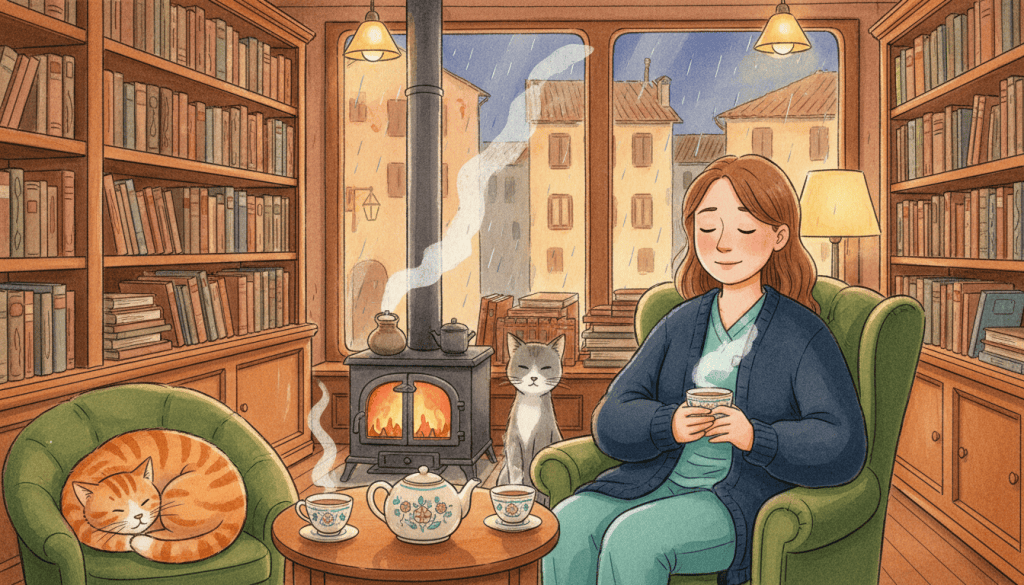
Greta wrapped both hands around the cup. The tea was pale gold, with a few tiny curls of orange peel drifting near the bottom. She breathed it in, and something in her shoulders, which had been up around her ears for what felt like months, came down by a centimeter.
“Rosemary,” she said. “I know that one. My grandmother grew it by the back door.”
“Rosemary, lemon balm, a little sweet fennel and a curl of orange peel,” said Moira. “Rosemary is the herb people have associated with remembrance since ancient times. Ophelia says it in Hamlet: ‘rosemary, that’s for remembrance.’ Lemon balm is the gentle one. It has a long folk reputation for calming, and a few small studies suggest it may ease mild feelings of stress, though I would not promise you more than a pleasant cup. The fennel is there for sweetness, and the orange peel is there because a person who is starting something deserves a little brightness.”
Greta sipped. The tea was warm and herbal and faintly sweet, and it tasted, absurdly, like her grandmother’s back step in July.
Behind her there was a soft thump and the click of claws on floorboards. Ashwaganda had gotten up, which was a rare event, rather like a hill deciding to take a walk. He crossed the shop with great dignity, stopped beside Greta’s chair, and then without any ceremony lowered his entire fifteen pounds across her feet.
“Oh,” said Greta. “Oh, he is very warm.”
“He has chosen you,” said Moira. “I would take it as a compliment. Notice that he is purring. His purr is very low, about twenty-five hertz, which is almost at the bottom of what the human ear can hear. You may find you feel it in your ankles more than you hear it.”
Greta did feel it: a slow, rolling hum that came up through her shoes and into her shins, steady as a boat engine heard through water. “Does it do anything?” she asked. “I have heard that cats’ purring is healing. Is that true?”
“I would be careful with that one,” said Moira. “There is a popular claim that purring frequencies between about twenty-five and one hundred hertz can help heal bones. It is an interesting idea, and some researchers have proposed it, but the evidence in cats and in people is not strong enough for me to promise it. What I can say honestly is that many people find the sound calming, and calm is real, even if it is not a medicine. Sometimes that is all a person needs from a cat. Someone warm, and a sound that says: nothing is being demanded of you right now.”
Greta put her head back against the chair. For a minute, neither woman said anything. The kettle ticked as it cooled. Outside, a scooter went past, and the streetlamp on Via dell’Orologio flickered on.
Why the Second Time Feels Heavier
“May I tell you something I find rather hopeful?” said Moira at last. She had taken the chair across the little table, and her own cup steamed between her hands. “I am not a psychologist. I am a bookseller who reads too much. But I have read a few things that might be useful, and I will tell you which parts are firmly established and which are only suggestive.”
“Please,” said Greta.
“You said it feels like climbing the same mountain you just fell off. That is a very human feeling, and it has a real basis. When something we have invested everything in goes wrong, we tend to take the failure as information about us, not about the circumstances. A twenty-two-seat restaurant in a hard market, with rents rising and customers cutting back, can fail for a hundred reasons that have nothing to do with how well you cook. But the mind loves a simple story, and the simplest story is ‘I am not enough.’ It is almost never the true one.”
Greta looked at the tea. “I did make mistakes. Plenty.”
“Of course you did. Everyone does. Mistakes and being unequal to a task are two different things. But let me tell you the two ideas I wanted to share, because they are about the mountain.”
She set down her cup.
“The first is about when people find it easier to begin. In 2014, three researchers, Hengchen Dai, Katherine Milkman and Jason Riis, published a study on what they called the fresh start effect. They looked at things like Google searches for the word ‘diet,’ gym attendance and the creation of goals on a commitment app, and they found that people seemed more likely to start such efforts right after what they called temporal landmarks: the beginning of a week, a month, a new year, a birthday, even the first day after a holiday. The idea is that these dates act like page breaks. They make the past feel like a slightly separate chapter, which makes it easier to say, ‘That was the old me, and this is a new page.’ It is a pattern in the data, not a law of nature, and it does not work for everyone, but it has been replicated in various forms. And it suggests something I find rather kind: you do not have to feel ready. You can simply pick a page break.”
“A page break,” Greta repeated.
“The second idea is older, and I think it speaks to your fear that the second time will be the same as the first. In the 1880s, a German psychologist named Hermann Ebbinghaus spent years memorizing lists of nonsense syllables and then testing himself. He noticed something he called savings. When he returned to a list he had forgotten, relearning it took less time than learning it had the first time, even though he could not recall it. Something had stayed behind. Later research on memory and skill has found the same general pattern: what we have learned once is rarely erased completely, and coming back to it tends to go faster than starting from nothing.”
Greta was quiet. Then she said, slowly, “So starting over is not starting from zero.”
“I would put it more carefully. I cannot promise you what a second beginning will look like in your life, and the ebbinghaus finding is about memorizing, not about restaurants. But the principle that learning leaves traces seems to hold broadly. Eight years of kitchens did not vanish when you locked that door in September. You still know how to taste a sauce and tell what it needs. You still know what it feels like when twenty-two people are hungry at eight o’clock. You know what a month of bad numbers looks like. That is not nothing. It is a good deal, actually. It is just not the thing you were hoping to carry home.”
Greta pressed her lips together. A tear ran down beside her nose, but this time she let it.
Toe and the Stopped Clock
It was at this point that Toe, who had been sitting quite still beside the chair for the whole conversation, did something unexpected. She stood, stretched her slender grey back into a small arch, and walked lightly onto the table. She stepped between the teacups with great care, her white paws making no sound at all, and sat down directly in front of the mantel clock.
She looked at it. Then she looked at Greta. Then, very deliberately, she raised one immaculate white paw and touched the little brass key that stuck out of the clock’s back.
“She is telling you something,” said Moira, amused.
“I wound it already,” Greta said. “Twice.”
“Did you wind it all the way? Or did you stop when it felt tight?”
Greta opened her mouth, then closed it again. “I stopped when it felt tight. I was afraid of breaking the spring.”
Toe tapped the key again, a small, patient, three-beat pat. Greta, half laughing, half crying, picked up the clock and turned it over. The key was stiff. She gave it a turn. And another. She felt the faint, springy resistance of the mainspring taking up its strength, and she went on turning, slowly, until the resistance became firm but not frightening, the way a good hand is firm.
Then she set the clock upright and, for the first time, did what her grandfather must have done a thousand times. She touched the pendulum with one finger and gave it the smallest push to the left.
Tick.
Tick.
Tick.
It was slightly uneven at first, like a person finding their breath after crying, and then the rhythm settled. The second hand, which had not moved in eleven years, began to sweep around the little dial. The whole shop seemed to lean in and listen. Even Ashwaganda lifted his big round head from Greta’s feet, blinked once, and put it down again, satisfied.
“It was never broken,” Greta whispered. “It was just wound too gently. It was only that nobody had been brave enough to wind it all the way.”
Moira said nothing. She had learned long ago that some sentences are better left standing on their own, like a lamp left on in a window.
The Smallest Next Step
They sat and listened to the clock for a while. The tea in Greta’s cup had gone from hot to warm, which Moira always said was the temperature at which a cup of tea is most honest.
“There is one more thing I wanted to mention,” said Moira, “and it is practical, so you may stop me if you would rather not hear it tonight. A psychologist named Peter Gollwitzer has studied what he calls implementation intentions, which are very small plans in the form ‘if this happens, then I will do that.’ For example: ‘When I unlock the workshop tomorrow morning, I will open the window and dust one shelf.’ Across many studies, plans of that shape have been found to help people follow through on intentions, with a moderate effect, though not a miracle. They seem to help because they take a big, frightening thing, like starting over, and replace it with a small thing you can actually do at a specific time and place.”
“One shelf,” said Greta.
“One shelf. You do not have to decide tonight whether to reopen the workshop, or become a clockmaker, or open another restaurant, or become something no one has thought of yet. You do not have to know what you are for. You only have to decide what to do at nine o’clock tomorrow. People who begin again rarely begin with a plan. They begin with a shelf.”
Greta laughed softly, wiping her cheek with the heel of her hand. “That is almost insultingly small.”
“It is meant to be. A mountain is only frightening when you look at the top. Your grandfather would have known that. He fixed clocks one wheel at a time.”
Greta looked at the little brass clock, ticking steadily on the table between the teacups, with the grey cat sitting beside it like a small, furry guard. “He used to say that every clock is really a very patient argument with time,” she said slowly. “He said you never win, you just keep it company.”
“That sounds like a good description of most of life,” said Moira.
Ten Past Ten
When Greta stood to leave, the street outside had gone fully dark and the lamps made small orange pools on the cobbles. She had wrapped the clock again in its blue dishcloth, but this time she held it against her chest, where she could feel it ticking against her coat, a tiny, determined heartbeat.
Ashwaganda saw her to the door at his own speed, which was slow. At the threshold he rubbed once against her ankle, leaving a faint trace of ginger fur on the grey wool, and Greta found she did not want to brush it off.
“Thank you,” she said to Moira. “I came in with a clock that had stopped, and I think I am leaving with one that has not. I do not know what I will do. But I think I know what I will do at nine o’clock tomorrow.”
“That is a very good beginning,” said Moira. “Come back and tell the cats how the shelf goes.”
The bell jingled. Greta stepped out into the cool air of Via dell’Orologio, and the cold smelled of woodsmoke and wet stone. She walked the few steps to number nine and stopped under the old brass clock, still pointing stubbornly at ten past ten.
She looked up at it for a long moment. Then she looked down at the small, ticking bundle in her arms. And she smiled, a small, tired, surprised smile, as though she were meeting an old friend she had been avoiding.
Back inside the bookshop, Moira turned the sign to CLOSED and watered the last of the geraniums. When she glanced out of the window, she saw a light come on in the shuttered shop at number nine, a single yellow window glowing in the dark. Toe, sitting on the sill, watched it too, with her green eyes half closed.
Ashwaganda, who had returned to his square of warm floor, purred once, deeply, the way a very old building settles for the night.
Moira’s Reflection
We tend to imagine that starting over means returning to zero: an empty page, an untouched shelf, a self with no history. But that is rarely how it works. What we learned in the first attempt, the skills, the instincts, even the hard lessons about what does not work, comes with us. The research on fresh starts and on relearning is far from the whole story of a human life, and I would never claim it settles anything. But it points in a quiet direction: a new beginning is usually built on something, and a good page break can help us believe that.
And the smallest step is allowed to be small. You do not have to be ready, or certain, or brave all at once. You only have to wind the key a little further than you did last time, and see whether the clock wants to run.
What is one small thing you could do tomorrow morning, a single shelf, to begin again at something you set down? Tell us in the comments. Moira and the cats would love to hear.
A Cup for This Story
Greta’s “Page Break” tea, for one big cup:
- 1 small sprig of fresh rosemary (or 1/2 teaspoon dried)
- 1 heaped teaspoon dried lemon balm leaves
- 1/4 teaspoon sweet fennel seeds, lightly crushed
- 1 curl of fresh orange peel, no white pith
- Pour over freshly boiled water, cover, and steep for 7 minutes. Strain, add a little honey if you like, and drink while warm.
Herbal teas are a gentle ritual, not a medicine. If you are pregnant, taking medication or have a health condition, check with a doctor or pharmacist before trying a new herb.
Press Play and Stay a While
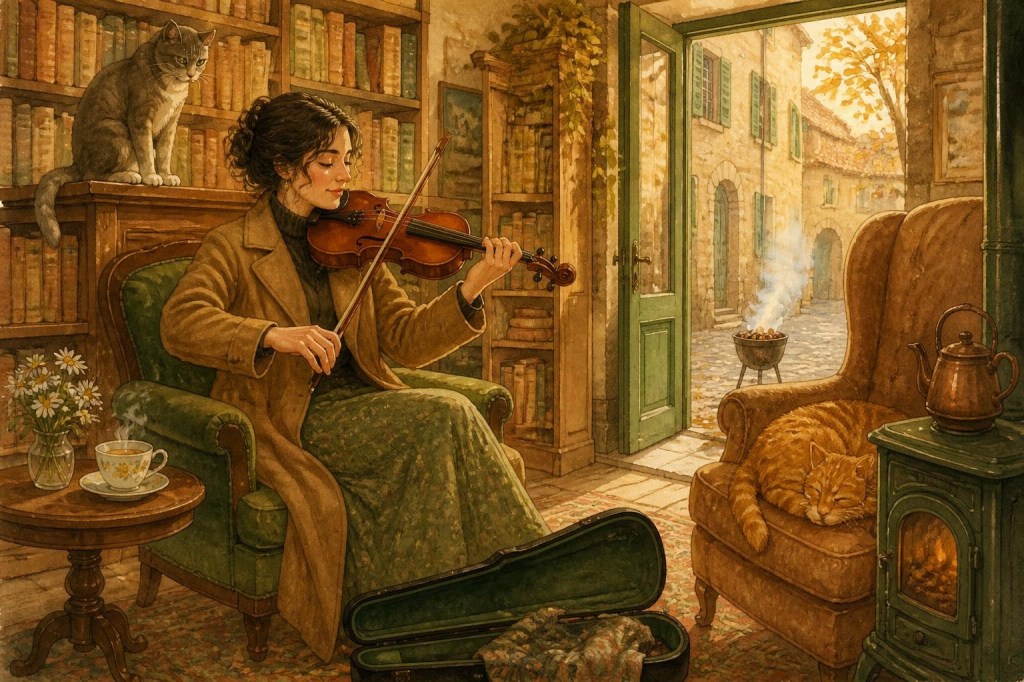
If you would like a little company while your tea cools, here is the song of Speranza. Press play, put your feet up, and stay a while.




Leave a Reply