Calm for Carers · Story 5. For everyone who spends their days holding other people together.
The Umbrella Left at the Door
It rained in Speranza that Thursday the way it only rains in November, steadily and without any hurry, as if the sky had decided to spend the whole evening thinking something through. The gutters of Via dell’Orologio sang. The slow clock on the square, which is always four minutes behind, struck six, and four minutes later struck six again, as if it wanted to be sure.
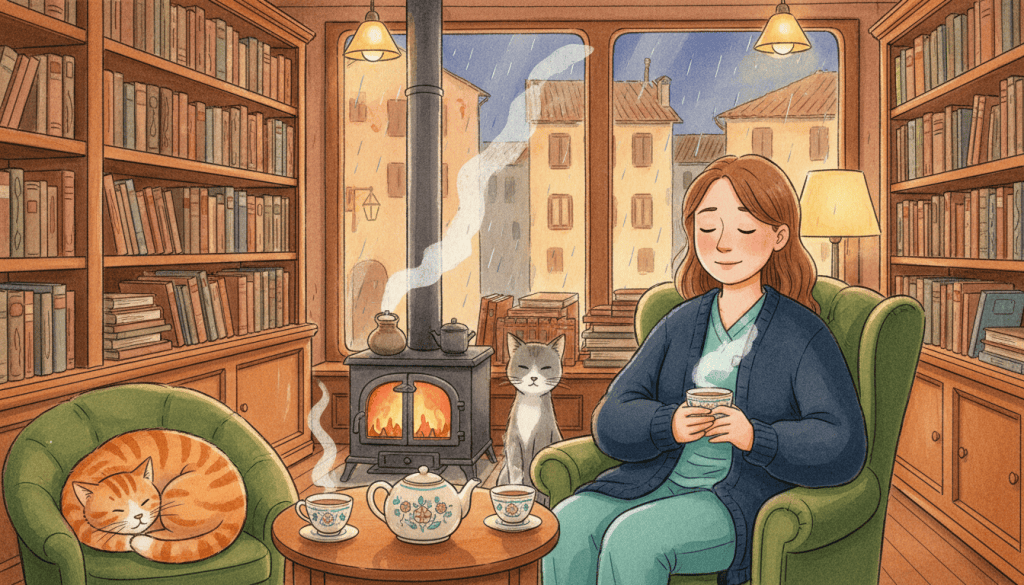
In the bookshop called La Pagina che Fa le Fusa, Moira Hopes was dusting the poetry shelf with a feather duster that Toe regarded as a personal enemy. The grey cat, slender and elegant, with four immaculate white paws that he guarded the way other creatures guard treasure, was sitting on the third stair, tail curled around his feet, glaring at the feathers. Ashwaganda, fifteen pounds of ginger tabby, was asleep on the green armchair with his chin on the armrest and his paws tucked under him, purring so deeply that the teaspoons in the saucers on the counter gave a faint, polite rattle.
The bell above the door gave its soft, lingering note.
A young woman stood on the mat, dripping. She was in her thirties, perhaps, with a dark plait coming loose over one shoulder and a navy raincoat buttoned wrongly by one button. She had propped a black umbrella against the doorframe outside, and she stood looking at it through the glass as if she were not sure she was allowed to come in without it.
“We are closed,” said Moira kindly, “in the sense that the sign says so. But the kettle is on, and the sign has never been very good at telling the truth.”
The woman gave a small, startled laugh. “I only wanted to get out of the rain,” she said. “I’ll buy a book. Any book. I’m sorry. I don’t even know why I came in.”
“People rarely do,” said Moira. “It’s one of the best reasons.”
She took the wet coat and hung it by the stove. Underneath, the woman wore a lanyard still clipped to her cardigan, and Moira, who has an eye for such things, saw the small hospital crest and the word Infermiera printed beneath a name: Teresa. Teresa saw her looking and quickly turned the card to face her chest, the way you might turn a photograph face down.
“Sit,” said Moira. “Not there. That chair is occupied.” She nodded at Ashwaganda, who opened one amber eye, assessed the newcomer, and closed it again. “There. The wooden one by the stove. It has the best view of the rain.”
What Teresa Could Not Say
For a while Teresa said nothing. She watched the water run down the window in long, crooked lines. Toe abandoned the feather duster, crossed the floor without a sound, and sat down a precise two feet from her boots, not touching, only present, like a very polite guard.
“I work on a medical ward,” she said at last. “At the hospital in the valley. Eight years now. I love it. I want to say that first, because what I’m going to say next sounds as if I don’t.”
“You don’t have to say anything,” said Moira, setting out the cups. “But if you do, I am a very good listener, and the cats are better. They never interrupt.”
Teresa pressed her thumbs together. “There is a patient on my ward,” she began, and then stopped and corrected herself. “There was. An old man. Signor Antonio. He had been with us for five weeks. He was ninety-one. He used to ask me every morning what the weather was doing, and I would tell him, and he would say, ah, a day for the garden, even in January. He had a garden, you see. Tomatoes. He talked about his tomatoes the way some men talk about their children.”
The stove ticked. Rain tapped at the glass.
“I won’t tell you the details,” Teresa went on, carefully, as people do when they have spent years protecting other people’s privacy. “They aren’t mine to tell. But the plan for his care changed over those weeks, and I did not agree with it. Not in a loud way. Not in a way I could point to and say, that is wrong, that is a mistake. The doctors had their reasons. His family were frightened and asked for everything to be done. Each decision on its own was understandable. And yet every morning I went into his room and I felt, in my body, in my stomach, that what we were doing was no longer what he would have wanted. And I had no way to change it. It was not my decision. I was the one who was there, and it was not my decision.”
She laughed, a short breath through her nose that was not really a laugh. “I did my job perfectly. Every task. Every chart. Not one error. And I came home every night feeling like I had done something terrible.”
“And now?” said Moira gently.
“He died on Tuesday. Peacefully, in the end, that is what everyone said. And the ward just carried on. A new patient was in his bed by Wednesday afternoon. Everyone said well, it was his time, and went back to work, and I smiled and nodded and today I walked out of the hospital and I could not get on the bus. I just kept walking until it rained.” She looked at her hands. “I keep thinking: what is wrong with me? Nobody else seems to be carrying this. I did nothing wrong. So why do I feel guilty?”
A Tea for a Heavy Conscience
Moira did not answer at once. She went to the shelf behind the counter, the one that holds more jars than a chemist’s, and took down three. The first was lemon verbena, long narrow leaves that smell of citrus and sunshine and of grandmothers’ gardens in July. The second was a handful of dried rose petals, pink and papery and fragrant, which a woman in the village grows behind her church and dries on mesh trays in her attic. The third was a few thin rings of dried apple, because, as Moira said, “a cup of tea is only half a tea without something to nibble on the side.”
“Lemon verbena for brightness,” she said, crumbling the leaves into the pot. “Rose for tenderness. Apple because it’s friendly. I should tell you before I pour,” she added, “that I am a bookseller, not a clinician. This tea is a warm cup to hold while your thoughts settle. It does not fix anything. But I’ve found that people say the truest things when their hands are busy with something warm.”
The kettle shrieked. The steam rose, fragrant and lemony, with the faintest sweetness of roses behind it. Teresa took the cup in both hands, and Ashwaganda, who had been pretending to sleep, got up with a long stretch, walked the length of the armchair, stepped onto her lap as if by right, turned around three times, and settled with a sigh that seemed to come from the soles of his paws.
Teresa froze. Then something in her shoulders came undone, one small notch at a time. She put a hand on the warm orange back and felt the purr travelling up through her wrist.
“He doesn’t usually do that for strangers,” said Moira. “He must have decided you are not one.”
There Is a Name for It
“Can I tell you something I read?” said Moira, taking the footstool. “I’ll tell you now that I’m no expert, only a woman who reads a lot in a quiet shop. So please treat it as one person’s understanding, not as an explanation of you.”
Teresa nodded.
“There is a phrase that nursing researchers use. Moral distress. It was introduced in the 1980s by a philosopher named Andrew Jameton, who was writing about nursing ethics. As I understand it, he described moral distress as what happens when you know the right thing to do, or at least believe you do, but you are constrained from doing it. By the hierarchy of the ward, or the rules, or the lack of time, or the wishes of others. You are not confused about what is right. You are blocked from acting on it.”
Teresa had stopped stroking the cat. “That is exactly it,” she said, in a small voice. “It isn’t that I didn’t know what to do. It’s that I knew, and I couldn’t.”
“And it is not the same thing as making a mistake,” said Moira. “That seems to be important. A person who makes an error might feel guilty because they did something wrong. A person with moral distress might feel guilty even though they did nothing wrong at all, because the wrongness they feel lives in the situation, and they are standing in the middle of it. Researchers who study this, and there are many by now, have written that it is quite common among nurses and other healthcare workers. I’m told that some studies link it with exhaustion, with thinking about leaving the profession, and with a sense of having lost something of oneself at work. I can’t give you numbers I haven’t checked, and I wouldn’t want to. But I can tell you it has a name, and that the name was invented because so many carers described the same feeling.”
“Nobody on my ward has ever said that word,” said Teresa.
“Perhaps because nobody wants to be the first,” said Moira. “That is how silence works. Everyone thinks they are the only one.”
Toe, who had been listening with the grave attention of a cat attending a lecture, hopped lightly onto the arm of the wooden chair and placed one white paw, very precisely, on Teresa’s sleeve. Then he sat, closed his green eyes, and appeared to consider the matter settled.
Bread, and the Weight That Stays
The bell above the door rang again, and Baldo the baker came in on a gust of cold air, his apron under his coat and a paper bag held out in front of him like an offering. He looked at the stranger with the cat in her lap, and at the tea, and at the rain, and understood the whole thing in the quick way people in small villages do.
“The end of the day’s bread,” he said. “Too soft to sell, too good to throw away.” He set the bag on the counter and he was already turning back to the door. Baldo believes that kindness should be quick and conversation can come later, ideally the day after.
Moira tore a round loaf in two and handed half to Teresa, who ate without noticing she was hungry until she had finished it. “I forgot lunch,” she said, wiping her fingers. “Again.”
“The body keeps its own accounts,” said Moira. “Even when we forget to.”
Teresa picked at a crumb. “It’s strange,” she said. “He’s gone and it’s over. But I still feel as if I’m carrying something around the ward. Like a tray with a glass that I’m afraid to drop.”
“I think there is a word for that too,” said Moira. “Moral residue. A researcher named Webster, and I believe another named Baylis, wrote about it around the turn of the century, if I remember rightly. The idea, as I understand it, is that a hard situation can leave something behind, even after it has ended. A kind of weight that stays after the event has passed. And, if I have it right, that weight can build if the same kind of situation keeps happening and nothing is ever said or changed. Again, I’m only a bookseller, and I may have some of the details wrong. But I remember thinking: what a precise thing to give a name to. The tray, and the glass.”
“That is exactly what it feels like,” said Teresa. Her eyes had filled, and she did not hide it. “I thought it meant I was weak. That I wasn’t cut out for this.”
“Weak people do not feel the weight of a stranger’s garden,” said Moira. “You noticed Signor Antonio’s tomatoes. That is not weakness. That is the thing that makes you a good nurse. The same quality that makes this hurt is the one that makes you worth trusting at a bedside at three in the morning. They are one quality, and it cuts both ways.”
What Might Help, and Who Can Help
For a while they sat and listened to the rain. The slow clock in the square struck seven, and then, four minutes later, struck seven again. Teresa laughed through the last of her tears. “Is it always like that?”
“Since before I arrived,” said Moira. “Nobody has ever fixed it. We decided it was a feature. It gives everyone a second chance to be on time.”
Teresa wiped her cheeks with the back of her hand. “What do people actually do about it?” she asked. “Moral distress. Is there anything?”
Moira thought about it. “I know a few things that nursing organisations have suggested over the years. I remember a framework from the American Association of Critical-Care Nurses, from the early two-thousands, called the Four A’s. Ask, Affirm, Assess, Act. As I recall, the idea is to start by asking yourself whether what you’re feeling might be moral distress. Then affirm that your distress is real and your values matter. Then assess where it comes from and how serious it is. And only then decide whether and how to act. I like that the first steps are about noticing and not about fixing. You can’t act wisely on something you haven’t named.”
“We were never taught that,” said Teresa.
“Many people were not. And I should say that I am passing on the idea, not vouching for how well it works. The research on what reduces moral distress is, I am told, still young and uneven, and no single approach seems to suit everyone. What I can say is that talking to colleagues, having a safe place to raise ethical concerns, and having someone in the workplace who listens, are things that people in the field keep coming back to. They aren’t miracles. They are doors.”
She reached for a pencil and the back of an old receipt, because Moira believes that anything important should be written down before the tea goes cold. “So here is a short list. Take it or leave it. Nothing on it is medical advice, and I wrote none of it with any authority.”
- Give it its proper name. Telling yourself “this is moral distress, not weakness” can take away a layer of shame. A feeling with a name is easier to talk about.
- Tell one trusted colleague. Not a speech. Just: “That situation sat badly with me. Did it with you?” You may find you are not alone on the ward.
- Ask where concerns can be raised. Many hospitals have an ethics committee, a clinical ethics service, or a manager or senior colleague who listens. Find out who it is before you need them.
- Write down what you value. A few lines about what you believe good care looks like. It reminds you what the hurt is protecting.
- Make a small ritual of closing the day. Hang the lanyard on the same hook, wash your hands slowly, stand for one minute at the door. Tell your body the shift is over.
- Know when to ask for more. If the weight lasts for weeks, if you cannot sleep, or you dread going in, please speak to your doctor or to your workplace support or occupational health service. That is not failure. It is looking after the person who looks after everyone else.
Teresa read the list twice, slowly, the way she probably read a medication chart, and then folded the receipt and put it in her cardigan pocket behind the hospital lanyard.
The Garden
“There’s something else,” said Teresa, after a while. The cat on her lap had gone fully boneless, a warm orange sack of purring. “I never got to say goodbye to him properly. I was on a different shift. And I never told him that I’d have liked to see the tomatoes.”
Moira did not rush to comfort her. She let the sentence stand in the room for a moment, because some sentences need space around them.
“Do you know,” she said at last, “where his garden is?”
Teresa looked up. “On the road to Montefiore. He told me once. The house with the blue gate.”
“Perhaps in the spring,” said Moira, “when the seedlings go in, you might walk past. Not to do anything. Only to look at a garden that a man loved and say, in your own head, I saw you, and I’m sorry that I could not do more. People who study grief do not all agree about how it should be done. But I have noticed that small, private farewells tend to help more than none at all.”
Teresa’s eyes were wet again, but her face had changed. It was softer, less braced. Like a fist slowly learning to be a hand.
“I think I’d like that,” she said.
Ashwaganda shifted, lifted his enormous head, and gave her wrist a slow, wet lick, with the air of a cat who considers that discussion closed.
The Umbrella Again
When the rain eased to a drizzle, Teresa got up at last, and Ashwaganda, outraged, poured himself off her lap onto the rug with all the dignity of a ginger sack of flour. She put on her coat, noticed the wrong button, and fixed it. At the door she turned.
“I came in for a book,” she said. “I never bought one.”
Moira went to the poetry shelf, ran a finger along the spines, and took down a slim volume with a faded blue cover. “I won’t read you anything from it,” she said. “Poems are for private moments. But take it for the bus. If it doesn’t help, bring it back and tell me why, and we’ll find a better one.”
Teresa tucked it into her bag and picked up her umbrella from the doorstep, where it had been standing patiently the whole time like a small black dog. “May I come back?” she asked.
“The kettle,” said Moira, “is never off. Bring a colleague next time, if you like. I suspect there are others on that ward who have been looking for a chair.”
Teresa smiled, and it was not a polite smile, but a real one that reached her eyes. Then she stepped out into the wet lamplight of Via dell’Orologio, and the bell gave its long, soft note behind her.
Two Weeks Later
It was a Saturday, and the sun had come out after a week of grey. Moira was unpacking a box of cookery books when the bell rang and two women came in, shaking the last of the cold from their coats. One of them was Teresa, the plait neat this time and the coat buttoned correctly. The other was older, with a grey bob and tired, intelligent eyes, and a lanyard of her own.
“This is Marta,” said Teresa. “She’s the senior nurse on the night shift. I said something to her, after, in the corridor. Only a few words. I said, that case with Signor Antonio, it sat badly with me.” She took a breath. “And she put down her coffee and said, me too. I thought it was only me.“
“We’ve been talking,” said Marta, a little shyly. “On our breaks. There are five of us now. We asked the ward manager whether we might have half an hour, once a month, to talk about the difficult cases. She said yes. She said she had been wondering how to ask.”
Moira said nothing for a moment. She looked at Ashwaganda, who had positioned himself in the sunny patch on the rug and was visibly deciding which of the two women deserved his lap, and at Toe, already on the arm of Marta’s chair with a white paw raised in greeting.
“Then I had better,” she said, “put the big pot on.”
Teresa grinned. “And in the spring,” she added, “I’m going to walk to Montefiore. Marta says she’ll come with me. Apparently she, too, once looked after a man with tomatoes.”
Outside, the slow clock struck eleven, and then, four minutes later, struck it again. Nobody in the bookshop minded in the least.
Moira’s Reflection
It is easy to imagine that the hardest part of caring is the tiredness: the long shifts, the heavy lifting, the broken sleep. But many carers will tell you that the heaviest thing is sometimes quieter. It is knowing what a person needs, or believing you do, and not being the one who gets to decide. Nurses, doctors, care assistants, social workers, and family members who sit by a hospital bed while others make the choices, all know the particular ache of that position. It does not make you weak. It makes you someone whose values are awake.
I am only a bookseller, and I have tried to say honestly what I know and what I do not. What I do believe, having watched the people who come through my door, is that a feeling goes on growing in silence, and starts to shrink the moment someone says, “me too.” If you carry something from your work, find one person. A colleague, a friend, a counsellor, a support service. You do not have to carry the tray alone.
Have you ever carried a decision or a situation that you did not agree with but could not change? What helped you set it down, even a little? Tell us in the comments. Someone reading tonight may be looking for exactly your sentence.
A Cup for This Story
- 1 heaped teaspoon dried lemon verbena leaves
- 1 teaspoon dried culinary rose petals
- 2 thin rings of dried apple, for sweetness and company
- 250 ml water just off the boil, steeped covered for 5 minutes, then strained
Herbal teas are a comforting ritual, not medicine. If you are pregnant, breastfeeding, taking medication or have a health condition, check with your doctor or pharmacist first. If a worry from work stays with you for weeks, please talk to your doctor or to your workplace support service.





Leave a Reply