Calm for Carers · Story 4. For everyone who spends their days holding other people together.
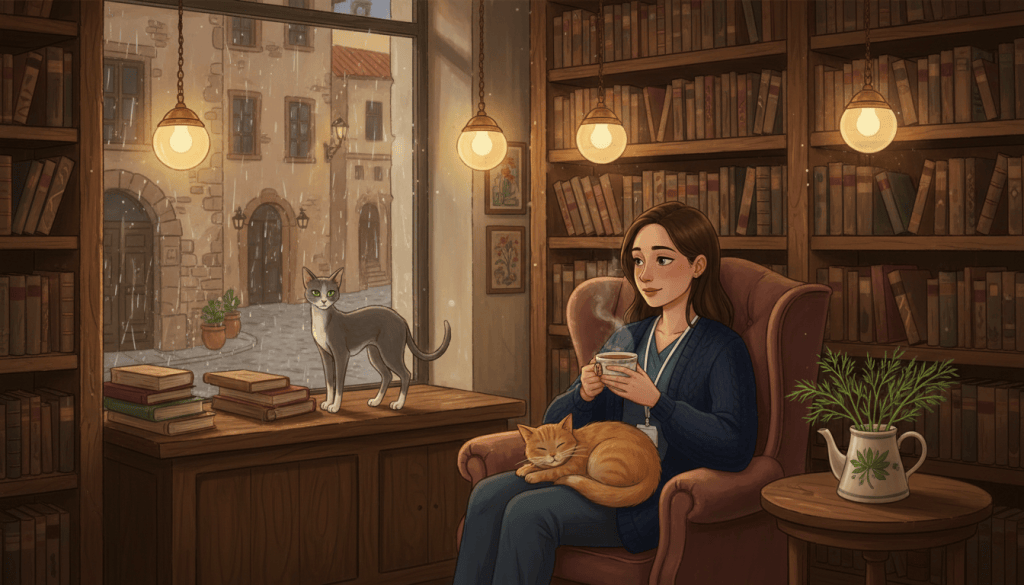
It had been raining on Speranza since lunchtime, the soft persistent kind of rain that makes the cobblestones of Via dell’Orologio shine like the backs of fish. By half past six the lamps were lit, the shutters of the bakery across the road were down, and the only window still glowing on the whole street belonged to La Pagina che Fa le Fusa.
Inside, Moira Hopes was doing what she always did at that hour: pretending to tidy the poetry shelf while actually rereading a favourite page. Ashwaganda, the fifteen-pound ginger tabby, lay across the warm patch of floor above the radiator like a loaf of bread somebody had forgotten to slice. Toe, slender and grey, with four immaculate white paws and eyes the green of new leaves, sat on the counter beside the till, washing one paw with great seriousness, as though it were due at a meeting.
The bell above the door gave its small, apologetic jingle. Toe stopped washing. Ashwaganda opened one eye.
A young woman stood on the mat, dripping. She wore a navy cardigan over a pale blue tunic, and a hospital lanyard still hung round her neck with a photograph of a much more cheerful version of herself. Her hair had mostly escaped its clip. She held a crumpled paper bag from the bakery in one hand, and in the other her phone, which she kept glancing at as if it might bite.
“I’m sorry,” she said. “I’m not here to buy anything. I just saw the light, and the cat in the window, and my legs sort of turned in. Is that all right?”
“It is the best reason anyone has ever come into this shop,” said Moira. “Please close the door before the damp gets in the biographies. There is an armchair by the stove. The blue one.”
The young woman sat. Before she had properly settled, Ashwaganda rose with the slow dignity of a ship leaving harbour, crossed the floor, gathered himself with a grunt, and climbed into her lap. He was so heavy that she let out a small laugh, the first of the evening, and then, quite suddenly, her eyes filled.
“Oh, no,” she said, wiping her face with the heel of her hand. “I am so sorry. I don’t do this. I’m fine. I’m a nurse, I’m supposed to be the one who is fine.”
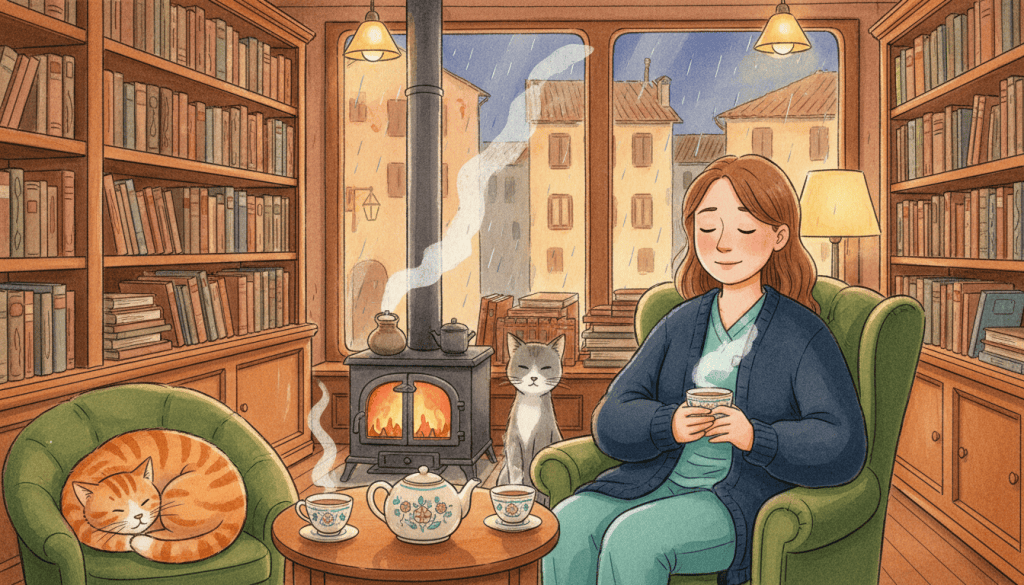
Moira said nothing for a moment. She simply went to the little kitchen behind the counter, and the sound of the kettle began, and with it a smell drifted out that was sweet and green and faintly of liquorice. When she came back, she carried a tray with a fat blue teapot, two mismatched cups, and a plate holding the last two biscotti of the day.
“Nobody in this shop has to be fine,” she said. “That is the one house rule. My name is Moira.”
“Chiara,” said the young woman. “Chiara Bellandi. I qualified in June. I started on the medical ward at the hospital in the valley in July.” She took a breath. “It is November, and I think I have made a terrible mistake.”
What Chiara Could Not Say Out Loud
The tea steeped. Toe came down from the counter, walked once around the armchair, and settled on the arm with her white paws tucked neatly under her. Chiara, without seeming to notice, began to stroke the soft grey back.
“I studied for three years,” she said. “I passed everything. My tutors said I was a natural. I had a speech ready for my interview about vocation and compassion. And then on the second day, a patient asked me a question about his medication and I did not know the answer, and I stood in the corridor with my heart going like a drum, and I realised that all those lectures had somehow not prepared me for what it is actually like. The call bells. The phones. Three people asking for three things in the same second. The families, who are frightened, so they are cross, and the crossness lands on whoever is standing there.”
“And that is you,” said Moira gently. “Standing there.”
“That is me. Today a doctor sighed at me because I had rung to ask him about something for the second time. A colleague who has been on the ward twelve years did my dressing round in half the time I take, and she was kind about it, which was worse. And tonight, on my way home, I was in the car park and I could not remember whether I had signed the controlled drugs book. I went back. I had. I had, of course I had. But I stood there with my hand on the cabinet and I thought: I am not safe. I am not good enough. Everyone can see it, and they are all being polite.”
She stopped. The rain tapped on the window. Ashwaganda’s purr, which had begun as a faint vibration, now deepened into the low, even rumble of a small engine idling somewhere warm.
“Thank you for telling me,” said Moira. “That cannot have been easy to say out loud, even to a bookseller.”
She poured the tea. It came out pale gold with a faint green tint, and the steam carried that sweet, aniseed smell, with something cool and bright underneath.
“Fennel seeds, a little peppermint, and a few curls of dried orange peel,” Moira said. “In Italy, grandmothers have been giving fennel to anyone with a restless stomach since before there was an Italy. Nerves live in the stomach, as you know better than I do. I make no claims for it beyond this: it is warm, it smells like a kind kitchen, and it asks you to sit still for the length of one cup. Sometimes that is the whole medicine, and it isn’t medicine at all.”
Chiara wrapped both hands around the cup and breathed in the steam. Her shoulders, Moira noticed, came down by about an inch.
A Bookseller Who Reads Too Much
“Can I tell you something I read?” said Moira. “I should say first that I am a bookseller, not a clinician. I have no business telling a nurse anything about nursing. But I read a great deal, mostly in the quiet hours between customers, and I have a habit of collecting the sentences that make me feel less alone.”
“Please,” said Chiara.
“There is a Canadian nursing researcher called Judy Duchscher. Some years ago she studied newly qualified nurses and described something she called transition shock. It builds on an older idea from the 1970s, the American nurse-researcher Marlene Kramer’s ‘reality shock’, which was the jolt of discovering that the world of work is not the world of the classroom. Duchscher’s point, as I understand it, is that the move from student to registered nurse is not just a change of job title. It is a change of role, of responsibility, of relationships and even of how you see yourself, and all of it lands at once. She suggested that many new nurses go through a recognisable stretch of disorientation, something like doubting their own competence, feeling physically exhausted, and wondering whether they chose the wrong career. And she described it as unfolding across roughly the first year, not the first week.”
Chiara put her cup down on the arm of the chair, very carefully, as though it might spill something else.
“That has a name?”
“It has a name, and a literature, and as far as I can tell, a great many people who have recognised themselves in it. I would not tell you it explains everything about your own situation. Only you and the people who know you well can say that, and if the feelings stay heavy, a doctor or your occupational health service is the right place to take them. But the research suggests something I find comforting: that what you describe, the fear, the second-guessing, the car park, is not evidence that you are a bad nurse. It may be evidence that you are a new one.”
Chiara laughed, a wet, surprised laugh. “A new one. I keep thinking of it as a diagnosis.”
“It might be more like weather,” said Moira. “You would not blame yourself for being rained on. Though you might reasonably ask for a better coat.”
Toe, who had been listening with her ears slightly forward, stood up on the arm of the chair, walked across Chiara’s wrist, and sat down again on the other side, where she could keep an eye on the biscotti.
The Corridor, the Clock and the Cabinet
For a while they simply sat. Chiara ate a biscotto and dunked the second one into her tea in the Tuscan manner, which made Moira approve of her at once. The rain eased and then thickened again. Somewhere far off, the clock tower on Via dell’Orologio, which had not told the right time in forty years and which the village loved precisely for that, struck seven, or perhaps a quarter past.
“May I ask you what your days are actually like?” said Moira. “Not the version for the interview. The real one.”
Chiara thought. “I get in twenty minutes early so nobody sees me panicking. I write everything on a piece of paper folded in my pocket, every task, every time, because I am afraid I will forget. I eat standing up. I do not take breaks, because the others do not seem to, and I do not want to look weak. When I get home I lie on my bed in my uniform and replay every conversation, every mistake, every look. I check my phone to see if the ward has called. They have never called. I check anyway.”
“And when something goes well?”
“That’s the strange thing,” said Chiara slowly. “I don’t think I notice. Last Tuesday there was an old gentleman, Signor Ferrante, who was frightened because it was his first night in hospital, and I sat with him for five minutes and told him about the view from my grandmother’s farm. He held my hand and said I had a voice like a lullaby. And I walked away and thought: I should have used those five minutes to chase the blood results.”
Moira did not smile, though it took some effort. “May I offer a very small thing? It is not mine. It comes from the psychologists, and I will tell you honestly how far I trust it.”
“Please.”
“In 2005, Martin Seligman and some colleagues published a study of a number of simple exercises, and one of them was called three good things. For a week, participants wrote down, each evening, three things that had gone well that day and why they thought each had happened. In that study, the people who did it reported feeling happier and less low, and some of that seemed to last for months afterwards. Later researchers who tried to repeat the exercise found smaller or more mixed effects, so I would not promise you a miracle. But it costs nothing, it takes five minutes, and it is aimed at exactly the habit you just described: the mind that files every error in ink and every kindness in pencil.”
Chiara looked down at Ashwaganda, who had begun, in his sleep, to knead her cardigan with enormous, slow paws. “So tonight I would write: Signor Ferrante held my hand.”
“And then the ‘why’,” said Moira. “That is the part people skip. Why did it happen?”
Chiara was quiet. Then she said, almost to herself: “Because I stopped. Because I noticed he was frightened, and I stopped. Because that is the thing I am actually good at.”
“There,” said Moira softly. “Now put that in the folded piece of paper in your pocket.”
What the Cats Know About Beginning
It was Toe who changed the subject, in the way that cats do, by deciding that the conversation had become too heavy and a distraction was needed. She leapt from the arm of the chair onto the nearest shelf, which held a row of cookery books, nudged a slim volume with one white paw until it tipped, and watched with polite interest as it fell onto the rug.
“Toe!” said Moira, without much conviction.
Chiara picked up the book. It was a battered paperback on bread-making. She laughed. “Did she choose that on purpose?”
“Toe chooses everything on purpose. It is just that her purposes are rarely ours.” Moira smiled. “But you know, there is something in it. When Toe first came to the shop, as a kitten, she could not manage the stairs to the upper gallery. She would sit at the bottom and cry. Ashwaganda, who is not famous for his patience, simply sat down beside her and waited. Not pushing, not showing her how. Just there, large and warm, until one day she went up one step. The next week, two. Nobody ever told her she was slow.”
Chiara stroked the ginger head in her lap. “On my ward, there is one nurse who is like that. Nonna Carla, we call her, though she is only fifty. She never says ‘you should know this by now’. She says, ‘Show me what you have done and I will tell you what I would do.’ She does not make me feel stupid.”
“Then you already have one Ashwaganda,” said Moira. “That matters more than you might think. I would not presume to say what the research says about mentoring, but I will tell you what I have seen in forty years behind this counter: nobody learns anything well while they are frightened. They learn how to hide.”
Chiara was silent for a long time. Then she said, in a smaller voice: “I have been hiding. I have not asked Carla anything for three weeks, because I did not want her to see how much I do not know.”
“And what do you imagine she would say?”
“Probably,” said Chiara, and now she was half laughing, half crying again, “‘Finally.’”
Five Small Things for a First Year
Moira went to the counter, found a scrap of paper and a pencil, and wrote for a minute. She handed it over. “These are not clinical advice and not rules. They are only the sort of small, kind things I would say to anyone starting something hard, and they are things you might talk over with a mentor or a ward manager, who know your real situation far better than I do.”
- Find your Carla. Choose one colleague you trust and ask them one real question a week. Asking is not a confession of weakness; on most wards it is how safe practice is built.
- Write three good things. Each evening, jot down three things that went well and why. It takes five minutes and trains the eye to notice what the anxious mind skips.
- Take the break. Sit down for ten minutes, with a drink and a window if you can. Tired people make more mistakes, and a ward is safer with rested nurses on it.
- Keep a “questions” page. Instead of carrying every uncertainty in your head, write it down and bring the list to a supervisor, a preceptor or a debrief. A worry on paper weighs less than a worry in the chest.
- Tell someone if it stays heavy. If low mood, dread or sleeplessness persist for weeks, speak to your doctor or your occupational health or employee support service. Needing help is not failing at nursing.
Chiara read the list twice. She folded the paper into quarters and put it into the pocket of her cardigan, next to the other folded paper, the one with all the tasks. “Number five,” she said. “I have been waking at three every morning for a month. I told myself it was the shifts.”
“It may well be the shifts,” said Moira. “Or it may be more than the shifts. I cannot tell, and neither can a teapot. But your doctor can help you find out, and so can the people at the hospital whose job is exactly that. I would be very glad if you went.”
“I will,” said Chiara. And then, more quietly, as if she were surprised to hear it: “I think I actually will.”
The Walk Home
The teapot ran dry a little before eight. The rain had faded to a mist that haloed the street lamps, and the cobblestones outside glistened like a path laid out for someone who needed one. Chiara stood at last, lifting Ashwaganda from her lap with an effort and a great deal of apology, and he poured himself onto the rug with the dignity of a king who has been asked to abdicate but is not yet sure he will.
She bought a book after all. Toe, it turned out, had been sitting beside it for the last ten minutes: a small illustrated edition of a poem collection, its spine worn soft. Moira did not tell her which poem the cat had been guarding. She only wrapped it in brown paper, tied it with string, and said, “Read one page a night. Not for the poem. For the five minutes.”
At the door, Chiara paused with her hand on the latch. “Moira. Is it silly that I came into a bookshop to cry in front of two cats and a stranger?”
“I think it is one of the more sensible things anyone has done on Via dell’Orologio this year,” said Moira. “Come back on Friday if you like. Tell me about Carla. And bring the piece of paper with the three good things.”
The bell jingled. The door closed. Through the window, Moira watched the young woman walk out into the mist, a little straighter than she had come in, one hand in her cardigan pocket where two folded papers lay side by side: the list of everything she was afraid of forgetting, and the list of everything she was learning to remember.
Behind her, Ashwaganda resumed his place above the radiator with a groan of deep satisfaction. Toe sat on the counter and washed one white paw, and then, having reviewed the evening, the other.
On the stove, the blue teapot ticked as it cooled. Outside, the clock tower, which had not told the right time in forty years, struck eight, or perhaps half past, and for once nobody minded.
Moira’s Reflection
I have never worn a uniform in a hospital, so I will not pretend to know what Chiara’s first year feels like. But I have started things, a bookshop among them, and I remember the sensation of standing in the middle of a life I had chosen and thinking, with total conviction, that everyone else could see I did not belong. What I have learned since is that this feeling is very common among beginners, and that it says very little about whether a person is good at what they do. If anything, the people who worry about being safe are often the ones paying the closest attention.
I am a bookseller, not a clinician, and nothing in this story is medical advice. The research Chiara and I talked about, Judy Duchscher’s work on transition shock and the 2005 study of the three good things exercise by Seligman and colleagues, is worth reading for yourself, with the caveat that later studies of simple exercises like this have found more modest effects than the first ones. If your own distress lasts, please speak to your doctor or your workplace’s support service. That is what they are there for.
So here is my question for you: who was your “Carla”, the colleague, teacher or stranger who made you feel safe to not know something? And if you are a seasoned carer, what is one thing you wish somebody had told you in your first year? Leave a comment below. Somewhere, a nervous new nurse is reading, and your sentence may be the one she folds into her pocket.
A Cup for This Story
Moira’s Fennel, Peppermint and Orange Peel Tea. Lightly crush one teaspoon of fennel seeds in a mortar or with the back of a spoon. Place them in a teapot with one teaspoon of dried peppermint leaves and two or three curls of dried orange peel. Pour over a large cup and a half of freshly boiled water, cover, and steep for seven to ten minutes. Strain, and drink slowly, ideally in a comfortable chair, with a cat if one is available.
Herbal teas are not medicine. If you are pregnant, taking medication or living with a medical condition, please check with your doctor or pharmacist before trying a new herbal tea.





Leave a Reply