Can I forgive someone who never said sorry?
The Woman with the Tuning Fork
The first thing Moira Hopes noticed about the woman in the doorway was the sound she brought with her. It was not a footstep or a word. It was a tiny, clear note, ringing somewhere inside her coat, as if a bell had been wrapped in wool and carried through the rain.
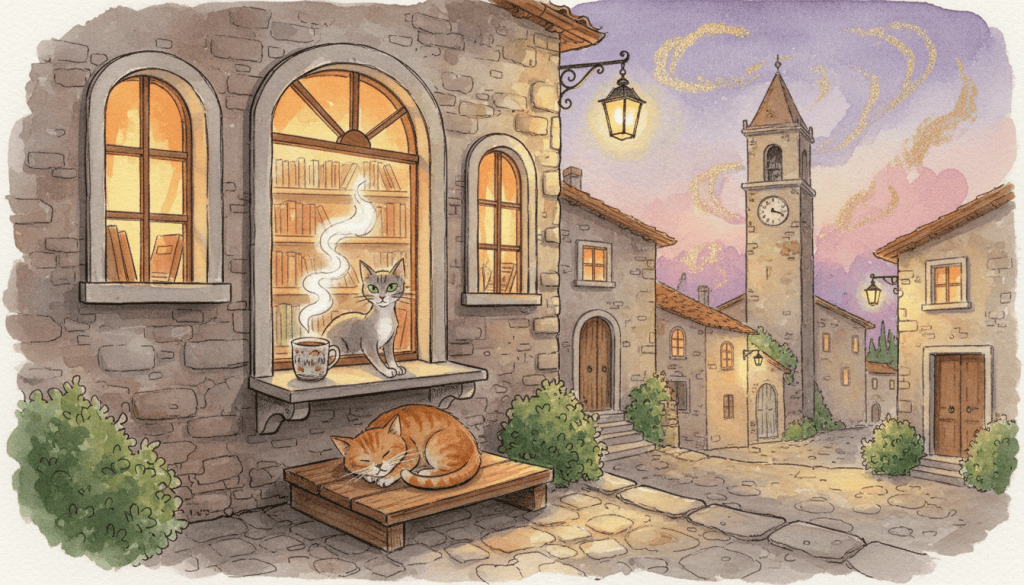
It was late on a Sunday afternoon in November, the hour when the light over Speranza turns the colour of weak honey and the clock on Via dell’Orologio, which has been four minutes slow since before anyone’s grandmother was born, gets ready to strike five. The bookshop called La Pagina che Fa le Fusa was nearly empty. The stove ticked. A kettle muttered on its ring. On the third stair of the little staircase to the poetry loft, Ashwaganda, fifteen pounds of ginger tabby, lay stretched out like a sleeping comma, his purr rolling through the floorboards at its usual deep twenty-five hertz.
“Come in, come in,” said Moira. “You’re letting the weather get at my cookery section.”
The woman stepped inside and shook the rain from her hair. She looked to be in her late fifties, with strong, careful hands, a wool coat the colour of river stones, and the slightly stooped shoulders of someone who spends her days bent over machinery. In her right hand she held a small steel fork with two prongs. She tapped it against her knee without seeming to know she was doing it, and the clear note sang out again, then faded.
“Forgive me,” she said. “Habit. It is an A. Four hundred and forty vibrations a second. I cannot walk into a room without checking whether it is in tune.”
“And is it?” asked Moira.
The woman listened, head tilted, to the stove and the rain and the rumble from the stairs. “Your cat is flat,” she said at last, and for the first time she almost smiled. “But a warm sort of flat. I like it.”
“That is Ashwaganda. He has never apologised for it.”
Something flickered across the woman’s face at that last word, quick as a bird past a window. Moira saw it. She had been keeping a bookshop for a long time, and she knew that people rarely come in for a book. They come in for the quiet, and the quiet is where the real reason tends to surface.
“My name is Livia,” the woman said. “I tune pianos. I have come from Fiorenzuola on the early bus, and I am afraid I do not know what I am doing here.”
“That,” said Moira, “is the best reason there is. Sit down. I’ll put the kettle on properly.”
The Chair by the Stove
There is an armchair beside the stove in La Pagina che Fa le Fusa that no customer has ever bought, because it is not for sale. It is deep, green and slightly sunken in the middle, and it has the remarkable property of making people tell the truth. Livia sank into it as if she had been walking toward it for years.
Moira did not ask questions. She moved about her little tea shelf, which holds more jars than a chemist’s, and listened to the silence the way a good tuner listens to a string. Toe, the slender grey cat with the immaculate white paws and green eyes, appeared from behind the shelf of travel guides, crossed the floor without a sound, and sat down exactly one metre from Livia’s shoes. He looked at her with the grave attention of a cat who is deciding something.
“He is assessing you,” said Moira. “Don’t take it personally. He assesses everyone, and he is usually right.”
Livia held out one hand, palm down, the way you do with a cat you do not want to alarm. Toe sniffed her fingers, considered the evidence, and stepped up onto her lap as though the matter had been settled in committee. His white paws kneaded once, twice, on the grey wool.
“I have a brother,” Livia said, and the words came out as if she had been holding them in her mouth for a long time. “Renzo. He is two years younger than I am. Eleven years ago our father died, and he left us a small piece of land on the hill above Fiorenzuola, with eleven rows of old vines on it. Not much. Barely enough for a few dozen bottles. But our father planted every one of those vines himself, and I thought, we both thought, that we would keep them.”
She stroked the cat. “Renzo sold the land. He did it in a single week, while I was away tuning the organ in a church near Parma. He did not tell me. I came home and there was a man with a surveyor’s tripod standing among my father’s vines. Renzo had signed the papers. He had spent the money on a business that failed within the year. And he has never said sorry. Not once. Eleven years. Not at Christmas, not when our mother died, not when I stood beside him at her grave and he looked at the ground.”
The kettle began to sing. Moira let it.
“Last Tuesday I was tuning a piano for a family in Castell’Arquato,” Livia went on, more quietly. “A child’s upright, nothing grand. And the mother said, as people do, ‘Do you have any brothers or sisters?’ And I opened my mouth, and I said, ‘No.’ Just like that. I heard myself say it. I have not stopped hearing it since.”
“And so you took the early bus,” said Moira gently.
“I took the early bus. I wanted to ask somebody who does not know either of us.” She looked up, and her eyes were bright but dry, the eyes of a person who has done her crying a long time ago and is tired of it. “Can a person forgive someone who has never said sorry? Is it even allowed? Because it feels as if forgiving him would mean telling him it didn’t matter. And it did. It mattered to me every day for eleven years.”
A Tea Chosen with Care
Moira did not answer at once. She had learned long ago that the first answer is usually the cheapest one. Instead she took down three jars from the shelf and set them on the counter, one after another, like a small congregation.
“I am going to make you something,” she said. “It isn’t a cure. Tea never cures anything, and anyone who tells you otherwise is selling something. But it gives your hands a job to do while your heart does its work, and that is more useful than it sounds.”
Into the old brown teapot went a spoonful of dried chamomile, small and golden as buttons. Then a pinch of dried rose petals, the colour of faded silk, from a garden behind the church. Then a few seeds of fennel, crushed lightly with the back of a spoon so that the sweet, green, liquorice smell rose up and filled the shop.
“Chamomile is for the shoulders,” said Moira, pouring the water. “People who carry old hurts carry them high, up near the ears. Rose is for the heart, although I will admit that is tradition more than pharmacology. And fennel is for the part of us that has been swallowing something indigestible for a very long time.”
Livia laughed, a short, surprised laugh. “That is a great deal to ask of a few flowers.”
“They only have to be warm and fragrant,” Moira said. “The rest is up to you.”
She set the pot on the little table with two cups and a saucer of almond biscuits. The tea steeped for five minutes, which is as long as Moira believes anyone should be asked to wait for anything good. In that time the rain thinned against the windows, the clock outside gave a dry, apologetic cough, and Ashwaganda, who had been asleep on the stair, rose with a groan, walked down the steps one at a time like an elderly bishop, and arranged himself across Livia’s feet.
Livia went very still. “Oh,” she said. “He is humming. I can feel it in my ankles.”
“Twenty-five hertz,” said Moira. “Give or take. Which, to a piano tuner, is something below the lowest note on your instrument. Almost a feeling rather than a sound.”
“The bottom of the bottom,” Livia murmured. She closed her eyes. For a while nobody said anything at all, and the silence in the shop was the kind that feels like a blanket being drawn up.
What Forgiveness Is Not
Moira poured the tea. It came out pale gold, with a petal or two turning slowly in the cup. She handed one to Livia, who held it in both hands and breathed the steam.
“Let me tell you what I know,” said Moira, sitting down on the footstool. “And I will tell you where my knowledge runs out, because that is part of being honest. I am a bookseller, not a psychologist. But I have read a good deal over the years, because people keep bringing me this question, and it deserves better than a greeting-card answer.”
“Please,” said Livia.
“The first thing is that researchers who study forgiveness, and there are a good many of them, are fairly careful about what the word means. They do not mean saying it was fine. They do not mean forgetting, and they do not mean reconciling, or going back to how things were. Forgiveness in the psychological sense is usually described as a change inside the person who was wronged: a gradual lessening of the resentment, the bitterness and the wish for the other person to suffer. One researcher, Everett Worthington, has spent decades on this and describes it as quite different from reconciliation. You can forgive someone and still decide never to see them again. Reconciliation takes two people. Forgiveness, in this sense, can be done by one.”
Livia looked down at the tea. “By one,” she repeated.
“That is the part that surprises people. We tend to assume that forgiveness is a transaction: he apologises, I accept, we are square. But if that were the only way, then your peace would be held hostage by someone else’s pride for the rest of your life. And your brother, forgive me, has shown for eleven years that he is not going to pay that debt on any schedule you would recognise.”
“No,” said Livia, very quietly. “He will not.”
“There is a second distinction I find useful. Some psychologists separate what they call decisional forgiveness from emotional forgiveness. Decisional forgiveness is a decision: I will not take revenge, I will not treat this person as an enemy, I will not tell the story in a way designed to wound. You can make that decision on a Tuesday afternoon, quite deliberately. Emotional forgiveness is something else. It is the actual melting of the feeling, and that, I am afraid, is not a switch. It comes slowly, in bursts, sometimes backwards. It is more like thawing a pond than turning a tap.”
Livia took a long breath. “So I can decide, and then wait for the feeling to catch up.”
“That is one way of putting it. I should say that the research on all this is still developing and that people differ greatly. But the idea that the decision can come first is a comfort to many.”
The Weight in the Coat
Toe, who had been dozing in Livia’s lap, opened one green eye, looked at the teapot, and closed it again. The rain had nearly stopped. Outside, somebody was dragging a bin across the cobbles, and the sound came through the glass thin and cheerful.
“There is one more thing,” said Moira, “and I mention it carefully, because I do not want you to hear it as a lecture. When we hold on to a grievance, the mind tends to rehearse it. We replay the scene. We rewrite our answers. We imagine what we should have said at the graveside. Psychologists call that kind of looping over a hurt rumination, and studies have linked it with raised stress and with lower mood. Some research also suggests that people who forgive, or who work on letting go of resentment, tend to report less stress and better wellbeing, though it is hard to prove exactly which causes which, and nobody should promise you a miracle.”
“The old pianos I tune are like that,” Livia said slowly. “A string that is held too tight for too long loses its voice. It does not break. It simply goes dull. You cannot get the note back by pulling harder.”
“I think that may be better psychology than anything I have said,” said Moira.
Livia laughed, and this time the laugh went all the way through her, and the tuning fork slid from her lap and rang once on the floorboards, a clear, bright A. Ashwaganda lifted his great head, regarded the fork with the dignity of a creature who has seen much worse, and put it down again.
“I think,” Livia said, wiping her eyes, “that I have been telling myself that I cannot forgive him because he has not earned it. But what if forgiving him is not about what he has earned? What if it is simply that I am tired of carrying him?”
Moira said nothing. She did not need to. The cats said it for her: Ashwaganda in his low, even hum, Toe with a small blink of green that cats reserve for people they have decided to trust.
A Letter That Is Not for Sending
They drank the second cup more slowly. The tea had deepened to the colour of old amber, and the rose had begun to open in the heat. Moira went to the counter, found a sheet of cream paper and a pencil, and set them on the table.
“Here is something some therapists suggest, and you may do as you please with it,” she said. “Write him a letter. Say everything: the vines, the man with the tripod, the grave. Say it exactly as angrily as it deserves. And then do not send it. The act of putting an old hurt into plain words, rather than letting it circle in the head, is something researchers have studied under the name expressive writing, and many people find it loosens things. Whether you send it, burn it, or fold it into a book is entirely your choice.”
“And if I want to send a different letter?” Livia asked. “A short one? Only to say that I am here, if he wants to talk?”
“Then that is a second decision, and a separate one,” said Moira. “Forgiving does not oblige you to open the door. But it does let you decide, freely, whether to leave it unlocked. Both are yours.”
Livia picked up the pencil. She turned it over twice, as she might turn a tuning hammer. Then she began to write, bent over the little table with Toe’s grey tail draped over her wrist, and Ashwaganda, still pinning her feet, rumbling steadily at the lowest edge of hearing. She wrote for a long time. Moira did not read over her shoulder. She went quietly to the poetry loft to rearrange the Montale and give the room its privacy, and the clock outside, being four minutes slow, struck five when it was already seven past.
The Note That Was Not Flat
When Moira came back down, Livia had folded the pages in three. Her face looked different. Not lighter, exactly, since the weight had not vanished, but it had been set down on a table instead of carried in a coat, and her shoulders had come down from her ears.
“I am not going to say I have forgiven him,” she said. “That would be a lie, and I tell no lies to a woman who makes tea like this. But I have decided to stop waiting for him to say it. I have decided that what I say next is up to me.” She tapped the pages. “I think this one I will keep. And tomorrow I will write him a short one. Three lines. Nothing else.”
“That sounds like a good beginning,” said Moira. “Thawing begins at the edges.”
Livia stood, gently deposited Toe on the green chair, and eased her feet from under Ashwaganda, who rolled over in protest and offered her his belly as compensation. She knelt, scratched the ginger fur, and listened one last time to his purr with her head tilted.
“I will tell you something odd,” she said. “A flat note, held steadily enough, makes the other notes around it sound sweeter. We call it a wolf interval, when two notes clash badly. The cure is never to hit one of them harder. You adjust the whole instrument, a little here and a little there, until everything finds room.” She smiled. “Perhaps a family is like that.”
At the door she took out her tuning fork, struck it against her knee, and held it up. The clear A rang through the shop, past the Montale and the cookery section and the old clock-tower guide, and for a second Ashwaganda’s purr and the fork’s high note seemed to be braiding together.
“Do you know,” said Livia, “it is in tune.”
“What is?”
“The room. I couldn’t tell when I came in. But it is.”
She went out into the wet blue evening. Moira watched her walk toward the bus stop under the slow clock, a small figure in a river-stone coat, and noticed that she was no longer carrying the fork in her fist but loosely in her open hand, as one carries something one no longer has to defend.
Behind her, on the green chair, Toe washed one white paw with great concentration. On the floor, Ashwaganda resumed his sleep, flat and warm and unapologetic.
Moira’s Reflection
That night, when the shutters were closed and the cats were fed, Moira washed the two cups and thought about how often we confuse forgiveness with surrender. We imagine that to forgive is to say the wrong did not happen, or that it did not hurt, or that the other person gets to walk away clean. But what Livia found, and what the research seems gently to support, is that forgiveness is mostly something we do for the room inside ourselves. It is the decision to stop paying rent on an old injury.
It does not need an apology, although an apology can be a lovely thing. It does not need a reunion. It needs only a person, a quiet hour, and a little willingness to set the heavy thing on the table and see what the hands can do without it. The feeling follows in its own time, like a pond thawing from the edges inward. Nobody can hurry it, and nobody needs to.
Is there an old hurt you have been waiting for someone else to mend? What might change if you decided that the next line of the story was yours to write? Tell us in the comments.
A Cup for This Story
Moira’s Rose and Chamomile Tea for an Unfinished Letter:
- 1 heaped teaspoon of dried chamomile flowers
- 1 pinch of dried, food-grade rose petals
- A few fennel seeds, lightly crushed
- 250 ml of freshly boiled water, poured just off the boil
- Steep covered for 5 minutes, strain, and sip slowly, with a cat if available
Herbal teas are a comforting ritual, not medicine; if you are pregnant, allergic to plants in the daisy family, or taking medication, check with a health professional first.
Press Play and Stay a While
If you are not quite ready to leave the bookshop, here is the song of Speranza to keep you company while your tea cools.





Leave a Reply