How do we learn to wait well for the things that cannot be hurried?
The Man with the Sapling
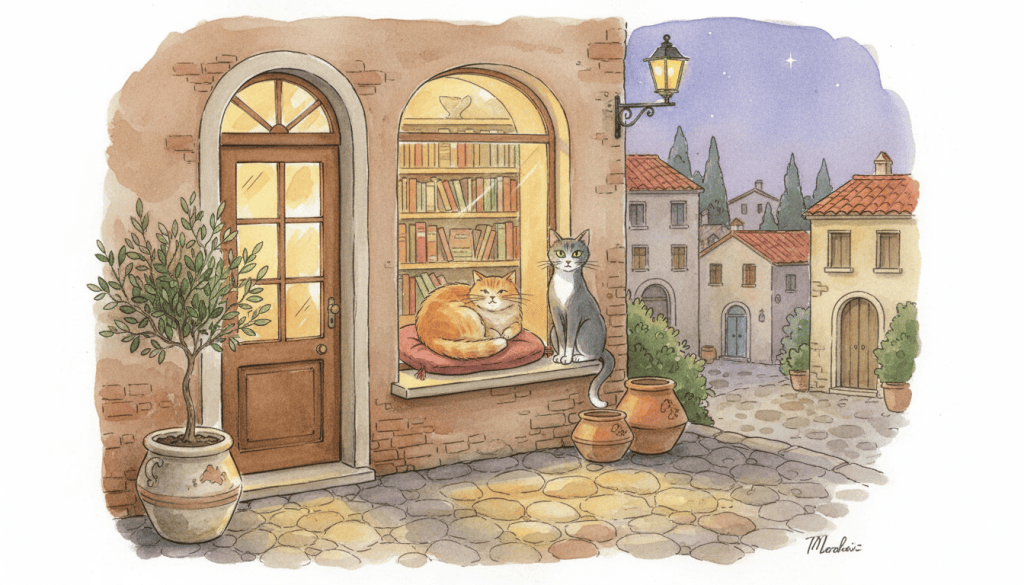
On the first Saturday of November, the rain in Speranza fell in the unhurried way it always did, as though it had nowhere better to be. It tapped on the awnings along Via dell’Orologio, it ran in thin silver rivers between the cobblestones, and it made the windows of La Pagina che Fa le Fusa glow like lanterns against the early dusk.
Inside the bookshop, Moira Hopes was shelving a stack of secondhand cookbooks and humming something that was almost a tune. The shop smelled of paper, wool, and the faint sweetness of the linden blossom she had left steeping on the little stove at the back. Ashwaganda, the fifteen-pound ginger tabby, lay stretched across the warm radiator like a loaf of bread that had been left to rise. Toe, the slender grey cat with the immaculate white paws and the green, watchful eyes, sat on the windowsill with her tail wrapped neatly around her feet, watching the street as if it were a play she had seen before but still enjoyed.
At ten minutes to six, Toe’s ears turned toward the door.
A moment later the bell above it gave its small, bright jingle, and a man came in backwards, shouldering the door open because both his arms were full. He was perhaps thirty-eight, tall and a little stooped, with rain in his dark hair and mud on the knees of his trousers. In his arms he held a terracotta pot, and in the pot stood a thin, silvery-green sapling no taller than a child’s forearm, its leaves narrow and pointed, a little battered by the weather.
“Buonasera,” he said, and then, looking down at the puddle forming around his boots, “Sorry. I am dripping on your floor. I did not know where else to go.”
“Floors dry,” said Moira, setting down her cookbooks. “It is one of their best qualities. Come in, come in. Put your tree somewhere warm. Is that what I think it is?”
“An olive,” the man said. “Or it is trying to be one.”
He set the pot carefully on the end of the counter, the way one sets down a sleeping baby. Ashwaganda lifted his enormous head from the radiator, regarded the newcomer for a long, unreadable moment, and then dropped back down with a sigh that rattled the cookbooks. Toe leapt from the windowsill without a sound and trotted over to sniff the little tree, her whiskers trembling.
“That is Toe,” said Moira. “She is the inspector. The large gentleman on the radiator is Ashwaganda, who inspects nothing and approves of everything. I am Moira. And you are?”
“Davide. Davide Ferraro.” He pushed a hand through his wet hair. “I used to live in Milan. I worked in logistics, which is a polite word for spending your whole life making sure other people’s things arrive on time.”
“And now?”
“Now I own forty-one olive trees on a terraced hillside above the village, and a farmhouse with a leaking roof, and a great deal of regret.” He tried to smile, and almost managed it. “My father planted most of those trees. When he died, four years ago, I thought: I will go back. I will learn. I will keep them alive. I replanted the ones that had died. I pruned. I read every book I could find. And do you know how many kilos of olives I picked this autumn?”
Moira shook her head.
“Nineteen,” said Davide. “Nineteen kilos. From forty-one trees. The man at the mill laughed, and he was kind about it, which was worse. He pressed them for me anyway, and I got a bottle and a half of oil.” He gestured at the sapling. “This is the last of the young ones I replanted. I dug it up this afternoon. I was going to throw it on the fire. I stood there with it in my hands, in the rain, and I could not do it. So I put it in a pot, and I walked down into the village, and I found myself outside a bookshop with a cat in the window.”
“Toe,” said Moira. “She is very good at finding people.”
The Tea for Someone Who Is Tired of Waiting
“Sit,” said Moira, pulling out the chair beside the little round table near the stove. “Take off that wet jacket. I am going to make you a cup of something, and you are going to drink it, and then if you still want to burn your tree, I will hand you the matches myself.”
Davide laughed, properly this time, a short surprised sound. He sat.
Moira moved around the back of the shop with the easy economy of someone who has made the same gesture a thousand times. She took down three glass jars from the shelf above the stove and set them in a row.
“Linden blossom,” she said, lifting the first lid and letting him smell it. It was soft and honeyed, like summer afternoons. “In Italy we call it tiglio, and for generations it has been the tea that people’s grandmothers made when someone could not settle. It is gentle, and it tastes like patience feels, if patience had a flavour. Then chamomile, because it is warm and a little apple-sweet, and because it has been a companion to restless evenings for a very long time. And last, a few curls of dried orange peel, for brightness. A tired person needs a little brightness, even if it is only a cup’s worth.”
She warmed the pot, measured the blossoms with a small wooden spoon, and poured the water just off the boil. The steam rose in a pale, fragrant ribbon.
“Now comes the hard part,” she said. “Four minutes. No more, no less. And you may not look at the clock.”
“Why not?”
“You will see.”
Davide folded his hands on the table. For the first minute he sat politely. In the second, he began to shift in his chair. By the third, his eyes had crept up to the old brass wall clock above the poetry shelf, and he was watching its second hand as if it owed him money.
“It has been four minutes,” he said, with great confidence.
“It has been two and a half,” said Moira, without turning around.
“That is impossible.”
“It is entirely possible, and in a moment I will explain why. But first, look who has come to keep you company.”
Davide glanced down. Toe had leapt silently onto the table and sat beside the pot of olive, her green eyes fixed on him with a calm that was almost rude in its steadiness. She was not watching the clock. She was not waiting for anything at all, as far as he could tell. She was simply there, entirely, in the way that cats are entirely wherever they happen to be.
Then, from across the shop, came a sound like a distant engine idling in a warm garage, deep and slow and impossibly low. Ashwaganda had risen from the radiator, stretched until his whole spine seemed to ripple, and padded across the floorboards with the unhurried gravity of a small ginger bishop. He climbed into the empty chair beside Davide with a heavy thump, turned around twice, and settled against Davide’s arm.
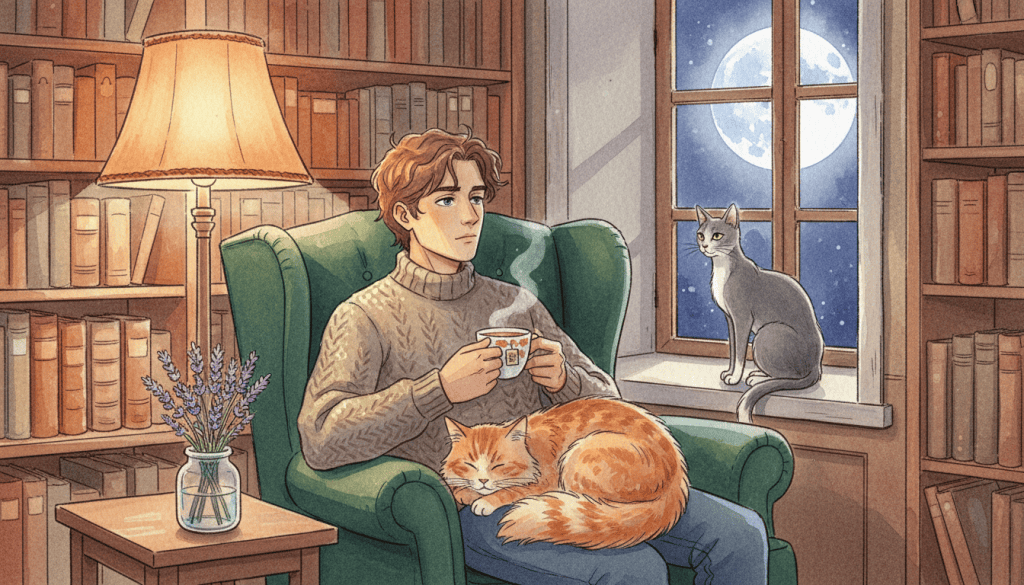
The purr began a few seconds later, a deep rumbling vibration at roughly twenty-five hertz, which Moira liked to say was the speed of the slowest, kindest part of the universe. Davide felt it through his sleeve, through his ribs, into the knotted place behind his breastbone that had been tight for four years.
“Oh,” he said quietly.
“Yes,” said Moira. “That is usually the reaction.”
She poured the tea into a thick blue cup and set it before him. He wrapped both hands around it and breathed in the steam. Linden, chamomile, a bright thread of orange. For a while, nobody said anything at all, and the silence did not feel empty. It felt like a room with the lamps turned low.
Why a Watched Pot Takes So Long
“You asked me before why you could not look at the clock,” said Moira, sitting down across from him with her own cup. “Let me tell you what I know, and I will tell you honestly where my knowledge runs out.”
“Please.”
“There is a fairly well-supported idea in psychology that our sense of time is not a clock. It is more like a rubber band. When we pay close attention to the passing of time, when we watch the pot, count the minutes, check the kettle, the interval tends to feel longer. When our attention is absorbed by something else, a conversation, a task, a good book, time seems to slip past faster. Researchers have studied this for decades, and the details are debated, but the broad pattern shows up again and again. The more of your mind you spend on waiting, the longer the waiting seems to take.”
Davide looked at the cup in his hands, and then, slowly, at the brass clock. “I have been counting the days since I planted those trees,” he said. “Literally. I have a notebook.”
“I thought you might.” Moira smiled, not unkindly. “Four years of watching the pot.”
“But the trees have not grown. That is not a feeling, Moira. That is the numbers. Nineteen kilos.”
“Yes. And that is where I want to say something about olives, and I am only a bookseller, so check it with someone who farms them.” She leaned forward. “As I understand it, an olive tree does not hurry. Young trees may give a few fruits in their early years, but they usually need a good stretch of time before they carry anything like a full harvest. A bit longer for the slower varieties. And a healthy olive tree can go on bearing for decades, even for centuries. There are trees in the Mediterranean said to be many hundreds of years old, still dropping fruit in November. Nineteen kilos in the early years may not be a failure. It may simply be what the early years look like.”
Davide was very still. “The man at the mill said something like that. I did not hear him. I only heard the laughing.”
“The laughing was not at you, I suspect. But it is hard to hear anything else when you are ashamed.”
He drew in a long breath, and Ashwaganda, as if he had been waiting for exactly this, increased the volume of his purr by a barely perceptible notch.
“There is a second thing,” Moira said, “and it is about a famous experiment, which is often told wrongly. Have you heard of the marshmallow test?”
“The children and the sweets? Wait fifteen minutes and you get two instead of one?”
“That is the one. In the nineteen-sixties and seventies, Walter Mischel and his colleagues at Stanford offered young children a treat, and told them that if they could wait until the researcher returned, they would get a second. Some children ate the marshmallow at once. Some waited. And early follow-up studies suggested that the children who waited longer did somewhat better in later life. The story spread, and it became a kind of parable: patience is a talent, you have it or you don’t, and it decides your fate.”
“That sounds rather cruel,” said Davide. “If you do not have it.”
“It does, and I am glad to say the story has been complicated since. In twenty-eighteen, a research team led by Tyler Watts replicated the study with a much larger and more varied group of children. They found that the link between early waiting and later outcomes was considerably smaller than the first studies suggested, and that much of it faded once they took into account things like the children’s family background and early abilities. So the honest summary is that patience probably matters, but it is nowhere near the whole story, and it is certainly not a fixed verdict on a child’s character.”
“And what about the children who did wait?” asked Davide. “How did they do it?”
“That is my favourite part. Mischel’s own observations suggested that the children who waited longest were not the ones who stared at the marshmallow with iron will. They were the ones who looked away. They sang to themselves, covered their eyes, turned their chairs around, invented games with their own hands. They did not resist temptation so much as rearrange their attention.”
“Like the clock,” said Davide slowly.
“Like the clock. And there is a third piece, which I think matters most for you.” Moira turned her cup in her hands. “In twenty-thirteen, a group led by Celeste Kidd at the University of Rochester ran a clever variation. Before the waiting began, some children were given a small broken promise by the researcher, who said he would bring better art supplies and then came back empty-handed. Other children met a researcher who kept his word. Then all of them were offered the marshmallow. The children who had just been let down waited, on average, only about three minutes. The children who had learned that promises were kept waited around twelve. Same marshmallow. Different experience of whether waiting was safe.”
Davide stared at her. “So it is not only about willpower.”
“It seems to be partly about trust. We find it easier to wait when we believe that the thing we are waiting for is actually coming. I would guess, though I cannot prove it, that a great many of us who say we are impatient are really people who have been disappointed before.”
The rain tapped at the window. In the quiet that followed, Toe stepped delicately across the table, sat down beside the little olive in its terracotta pot, and gave it one slow, solemn blink, as though she were granting it a licence.
The Notebook of Days
Davide was silent for a long time. When he finally spoke, his voice was low.
“My father used to say that a man who plants an olive tree is telling the world he expects to be remembered.” He gave a short, unhappy laugh. “He never saw most of his own harvests. He planted them for his father, who planted them for his. And I could not wait four years.”
“Is that what you think of yourself?” Moira asked gently. “That you could not wait?”
“I think that I came back from Milan to do something slow and honest, and I treated it like a shipment. Delivery date, quantity, tracking number. I made a spreadsheet of the harvest I expected. When it did not arrive, I decided the whole thing was a mistake.”
“You are describing a man who is very good at his job.”
“I am describing a man who is no good at this.” He lifted the cup, drank, and then looked down at the notebook he had pulled from his jacket pocket, a battered black thing with an elastic band round it. “May I show you something?”
“Of course.”
He opened it. The pages were filled with tiny, tidy handwriting, row after row of dates and numbers. Rainfall. Pruning. Leaf counts. A column headed Problems that was longer than the others. Near the back, though, in a different pen, there was a single line he had not shown anybody.
“What does this say?” Moira asked, leaning closer.
“It says, the third tree on the second terrace has new growth. Silver at the tips. I wrote it in April.” He cleared his throat. “I forgot it. I forgot I had written it. I was too busy counting what was missing to notice what was there.”
Moira said nothing. She simply let the quiet stand, the way she did when a sentence was not finished arriving.
“There was another,” he said, turning the pages. “In June. Swifts nesting under the barn roof for the first time. And September. Father’s old pruning knife found in the wall. Still sharp.” He put the notebook down and pressed the heels of his hands against his eyes. “I think I have been so angry at the trees for being slow that I stopped seeing them.”
On his arm, Ashwaganda shifted, stretched out one enormous paw, and rested it lightly on Davide’s wrist, the way one might put a hand on a friend’s shoulder. The purr continued, deep as the cellar of the world.
“There is an old way of thinking about this, in the Mediterranean,” said Moira, after a while. “Not science, just something farmers say. You do not make an olive tree grow. You make it possible for the tree to grow, and then you keep it company. The tree does the rest, in its own time.”
“Keep it company,” Davide repeated.
“That is all most of us can do, with most slow things. Gardens. Children. Grief. Books that take years to write.” She smiled. “It does not feel like much. It feels like doing nothing. But it is, I think, a great deal.”
What the Cats Knew
It was nearly seven when the tea in Davide’s cup had gone from hot to merely warm, and the knot in his chest, he noticed, had gone from a fist to something more like a loose coil of rope.
“May I ask you something?” he said. “Silly question.”
“Those are my favourite.”
“How do the cats do it? Waiting. I have been watching Toe for an hour and she has not looked at the clock once.”
Moira laughed. “Toe,” she said, “I think you should answer this.”
The grey cat, who had been sitting beside the olive pot with the total composure of a sphinx, turned her head and regarded him for a moment. Then she did something extraordinary, which was nothing at all. She simply sat and breathed and looked out of the window, where the last of the evening was draining from the sky in long bands of violet and rose. Her green eyes held the lamplight. Her white paws were folded neatly in front of her. She was not waiting for dinner, or for the rain to stop, or for the man to finish his tea. She was in the shop, in the evening, in the moment, and nothing else was required of her.
“They are not waiting,” Davide said, wonderingly. “They are just here.”
“I have always thought so,” said Moira. “A cat on a windowsill is not passing time. She is inhabiting it.”
“I cannot do that.”
“Not yet. But look.” Moira nodded toward the counter. “You carried that little tree through the rain, a long way, because you could not bring yourself to burn it. Some part of you is already doing it. Some part of you is already keeping it company.”
Davide looked at the sapling in its pot, battered and silvery and absurdly small, standing in the glow of the lamp like a candle somebody had forgotten to blow out. A single new leaf, pale as new silver, was just unfurling at the very tip of its highest branch.
“That was not there this morning,” he said.
“Or perhaps it was, and you were not looking.”
He laughed again, quietly, and wiped his eyes with the back of his hand, and nobody in the shop pretended not to notice, which was its own kind of kindness.
Ashwaganda, judging that his work was done, eased himself down from the chair with a grunt, walked slowly to the radiator, and fell asleep as though he had never woken.
Leaving Without Hurrying
At half past seven, Davide stood at the door with his jacket on, the pot tucked under one arm and a paper bag in the other hand. In the bag were a small tin of Moira’s linden-and-chamomile blend and a thick used paperback on Mediterranean orchards, which she had insisted on selling him for two euros, “because books are also slow things, and need good homes.”
“I came in here to ask you how to plant something that grows faster,” he said. “Saffron, perhaps. Or lavender. I thought you might have a book.”
“And do you still want it?”
He considered this honestly, which Moira found she liked about him. “No,” he said. “I think I wanted a way to stop feeling like I was failing. I did not need a faster crop. I needed to stop standing in front of the crop with a stopwatch.”
“A great many people do,” said Moira. “It is a very modern ailment. We have so many ways of measuring that we forget some things cannot be hurried by looking at them.”
“What will I do instead?”
“What do you think?”
Davide looked down at the pot, and then out at the street, where the rain had thinned to a soft grey mist and the lamps along Via dell’Orologio were coming on one by one.
“I think I will replant this one tomorrow, on the second terrace, beside the tree with the silver tips,” he said slowly. “And I think I will leave the notebook at home for a week. Or I will keep it, but I will add a new column.”
“What will the column be called?”
“Things that are here.“
Moira smiled. “That,” she said, “is a very good column.”
Toe trotted to the door and rubbed once against his ankle, a brief, businesslike gesture, like a signature on a form. Then she returned to her windowsill, and the bell above the door gave its small, bright jingle, and Davide Ferraro walked out into the evening carrying a very small tree and a great deal less weight than he had arrived with.
Moira watched him go, down the wet stones, past the fountain, up toward the terraced hills where forty-one olive trees waited in the dark, patient as ever, not hurrying, not counting, not worried at all.
Moira’s Reflection
Patience, I have come to believe, is rarely a talent we are born with or without. It is more often a relationship: with time, with trust, and with the thing we are waiting for. When we believe the good thing is truly coming, waiting becomes a kind of quiet work. When we have been disappointed too many times, waiting feels like standing in the rain with an empty cup. Neither feeling is a character flaw. Both are human, and both can change.
What I learned from Davide, and from a grey cat who does not own a watch, is that we can be patient with slow things by keeping them company, and by turning our attention, even for a moment, from what is missing toward what is already here. A silver leaf at the tip of a branch. A swift under the barn roof. A warm cup of tea. The harvest may be years away. The tree is already growing.
What is something in your own life that you have been watching like a pot on the stove, and what small, quiet thing might be growing there while you were counting? Tell us in the comments. Moira and the cats would love to hear.
A Cup for This Story
- Linden blossom (tiglio): 1 heaped teaspoon of dried flowers
- Chamomile: 1 teaspoon of dried flowers
- Dried orange peel: 2 or 3 small curls
- Water: about 250 ml (one large cup), just off the boil
- Steep: covered, for 4 minutes, without looking at the clock if you can manage it. Sweeten with a little honey if you like.
A note: herbal teas are a gentle ritual, not medicine, and they are not a substitute for professional care. If you are pregnant, take medication, or have allergies (especially to plants in the daisy family, which includes chamomile), please check with your doctor first.
Press Play and Stay a While
If you would like a little company for the rest of your evening, here is the song of Speranza. Let it play softly while your tea cools, and stay as long as you like.






Leave a Reply