Welcome to the Sanctuary of the Present Moment
As the winter wind howls through the valley and the nights grow increasingly longer, the village of Speranza closes its doors to the cold. But when the physical world goes quiet, the human mind often grows incredibly loud.
Without the distractions of the busy day, our brains have a tendency to wander into uncomfortable places. Sometimes, the mind projects us into the shadows, trapping us in a state of lingering anxiety and imaginary threats. Other times, it pulls us backward, locking us in the bittersweet loop of a nostalgic past we are desperate to recreate. Whether you are running from fear or chasing a ghost, the exhaustion is exactly the same.
Inside La Pagina che Fa le Fusa, Moira Hopes knows that the cure for both a racing heart and a grieving memory is identical: the profound, anchoring warmth of the present moment. With the help of a deliberately brewed cup of herbal tea, the quiet companionship of a grey cat named Toe, and the deep, 25-hertz purr of a fifteen-pound ginger tabby named Ashwaganda, even the most restless minds can finally power down.
Below are two distinct stories from the archives of Speranza. The first tells the tale of a local restorer haunted by the psychological hangover of a terrifying book, while the second follows an elderly watchmaker desperately chasing a five-minute memory in the snow. Both men walked through the heavy oak doors of the bookshop looking for an escape from their own thoughts.
Both of them left having finally found their way home.
Pour yourself a warm cup of tea, settle into a comfortable chair, and step out of the cold. The fire is already lit.
The Architecture of Survival: An In-Depth Analysis of the Well of St. Patrick in Orvieto
Perched atop a dramatic plateau of volcanic tuff, the Umbrian city of Orvieto has long functioned as a natural fortress. Throughout history, its sheer, vertical cliffs provided an unparalleled defensive advantage, rendering the city virtually impregnable to standard medieval and Renaissance siege tactics. However, this geological elevation presented a severe logistical vulnerability: a profound disconnect from the water table in the valley below. In times of peace, rainwater cisterns and external aqueducts sufficed. In times of war, the lack of an internal, secure water supply threatened to turn the impregnable fortress into a deadly trap.
This critical vulnerability was addressed between 1527 and 1537 through the commission of the Pozzo della Rocca, known today as the Well of St. Patrick (Pozzo di San Patrizio). Designed by the eminent Florentine architect Antonio da Sangallo the Younger, the well is a triumph of Renaissance hydraulic engineering, a structural marvel of double-helix geometry, and a monument to the era’s belief in the power of human industry to conquer the limitations of nature.
The Geopolitical Catalyst: The Sack of Rome and the Flight of Pope Clement VII
To understand the scale and urgency of the Well of St. Patrick, one must first examine the geopolitical crisis that necessitated its creation. In May 1527, the Italian peninsula was violently reshaped by the Sack of Rome. Mutinous troops of the Holy Roman Emperor Charles V—comprising Spanish soldiers, Italian mercenaries, and German Landsknechts—breached the walls of Rome, subjecting the city to months of unprecedented looting, destruction, and slaughter.
Pope Clement VII (born Giulio di Giuliano de’ Medici) barely escaped with his life, fleeing through the Passetto di Borgo to seek refuge within the heavily fortified walls of Castel Sant’Angelo. After enduring a grueling six-month siege, the Pope managed to escape Rome disguised as a humble merchant. Seeking a secure stronghold where he could safely reestablish the papal court and protect himself from the volatile whims of imperial forces, Clement VII traveled north to the naturally fortified city of Orvieto.
Upon his arrival, Clement VII immediately recognized the strategic value of Orvieto’s elevated position. The city’s Albornoz Fortress, situated at the eastern edge of the tuff plateau, was an ideal papal redoubt. However, the Pope, having just survived a catastrophic siege that relied heavily on starving the defenders and cutting off their resources, astutely identified Orvieto’s fatal flaw. Should Charles V’s troops follow him to Umbria and lay siege to Orvieto, the city’s rain-fed cisterns would quickly run dry, forcing a surrender regardless of the strength of the city’s walls.
To ensure the city could withstand an indefinite siege, Clement VII required a secure, internal, and inexhaustible water supply. He tasked Antonio da Sangallo the Younger—who had recently joined the Pope in Orvieto—with an unprecedented engineering challenge: sink a shaft through the solid volcanic rock of the plateau down to the valley’s aquifer, and design a system capable of extracting massive quantities of water efficiently enough to sustain a besieged city and its garrison.
Antonio da Sangallo the Younger and the Engineering Mandate
Antonio da Sangallo the Younger was uniquely qualified for this formidable task. Born into a celebrated dynasty of Renaissance architects and engineers, Antonio had trained under his uncles, Giuliano and Antonio the Elder, and had worked closely with Donato Bramante and Raphael on the construction of St. Peter’s Basilica in Rome. Sangallo was renowned not just for his aesthetic sensibilities, but for his profound mastery of military architecture, structural engineering, and fortifications.
When presented with the mandate in Orvieto, Sangallo faced a multifaceted engineering problem. He had to dig a well deep enough to reach the water table—eventually calculated at a staggering 54 meters (approximately 177 feet) below the surface of the plateau. However, creating a deep hole was only the first part of the challenge. The true difficulty lay in the logistics of extraction.
In a standard medieval well, water is drawn up in buckets via a pulley system. While sufficient for a single household, a pulley system would be woefully inadequate for a heavily garrisoned fortress under siege. To extract the sheer volume of water required to sustain a population and its livestock, Sangallo knew he had to utilize pack animals—specifically, mules and donkeys.
This introduced a severe bottleneck. If a ramp or staircase was built down to the water level, the narrow confines of a deep well shaft would create an impassable traffic jam. Mules descending empty would collide with mules ascending laden with heavy water barrels. Reversing a stubborn pack animal on a narrow, dark, and damp staircase suspended dozens of meters underground was a logistical impossibility that would bring the water extraction process to a halt.
Sangallo’s solution to this problem stands as one of the most elegant and revolutionary architectural designs of the 16th century: the double-helix ramp.
The Architectural Mastery of the Double Helix
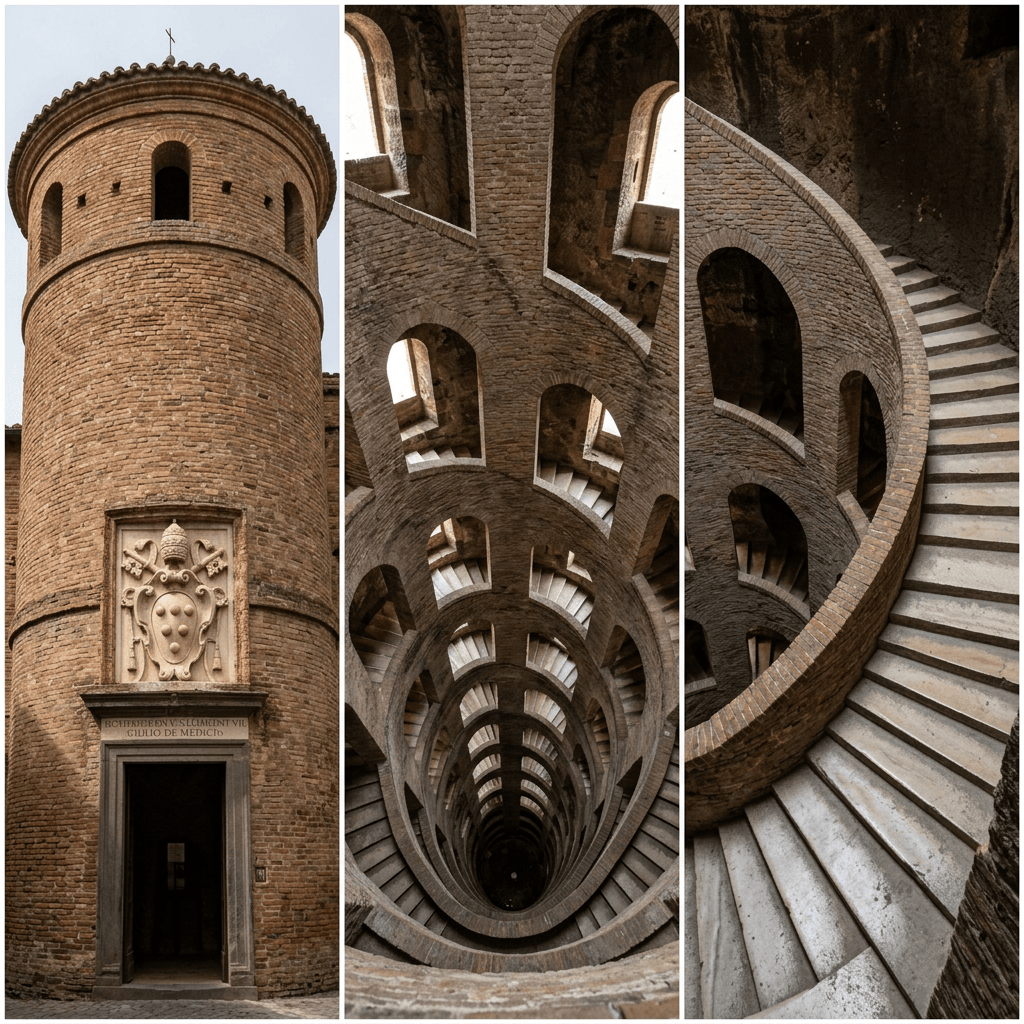
To ensure an uninterrupted, continuous flow of traffic, Sangallo designed two completely autonomous, one-way helical ramps that wrap around the central well shaft without ever intersecting. This structure mirrors the geometry of a DNA molecule—a biological blueprint entirely unknown at the time, yet perfectly adapted by Sangallo to solve a problem of continuous circulation.
The mechanics of the Well of St. Patrick are a marvel of spatial reasoning. The structure is accessed at the surface by two distinct doorways situated on opposite sides of the well’s cylindrical exterior.
- The Descent: A mule handler enters the first door and leads the unburdened animal down the first helical ramp.
- The Base: At the bottom of the 54-meter shaft, a bridge crosses the subterranean spring. Here, the handlers fill their barrels and secure them to the mules.
- The Ascent: The handler then leads the burdened mule across the bridge and directly onto the second, entirely separate helical ramp.
- The Exit: The mule ascends to the surface and exits through the second doorway, never having crossed paths with the animals currently descending.
This autonomous, one-way traffic system entirely eliminated the risk of bottlenecks, collisions, or the need for animals to turn around in confined spaces. It allowed for a continuous, high-volume conveyor belt of water extraction, utilizing the maximum efficiency of beast of burden logistics.
Structural Dimensions and Logistics
The sheer scale of the excavation and construction is staggering, especially considering the 16th-century tools available. The well reaches a depth of 54 meters and boasts a diameter of 13 meters. The two helical ramps comprise a total of 248 steps.
Sangallo’s attention to the specific needs of the pack animals is evident in the design of the steps themselves. They are extraordinarily wide and intentionally shallow. Rather than traditional stairs, they function more like a gently sloping ramp interspersed with low ridges (cordonatas) made of brick. This specific ergonomic design allowed the hooves of the mules to find secure purchase on the damp, sloping surface, preventing slips and injuries while accommodating the heavy, shifting weight of the water barrels strapped to their backs.
The 72 Windows: Lighting the Abyss
Descending 54 meters into solid rock creates an environment devoid of natural light, which would have terrified the pack animals and made navigation perilous. To resolve this, Sangallo designed a central, hollow cylindrical shaft that serves as a massive light well.
Cut into the interior walls of the double-helix ramps are 72 large, arched windows that open directly into this central void. As sunlight enters from the massive oculus at the top of the well, it penetrates the central shaft and filters through these 72 arched openings, illuminating the ramps below.
The windows serve a dual purpose. Aesthetically, they create a breathtaking, dramatic interplay of light and shadow, transforming a utilitarian water extraction facility into an awe-inspiring architectural space. Logistically, they provided just enough ambient light to keep the mules calm and the handlers oriented as they navigated the deep descent into the earth. The windows also facilitated vital ventilation, preventing the buildup of dangerous subterranean gases and ensuring the air remained breathable for the laborers and animals working in the depths.
Geological Challenges and the Transition of Materials
The construction of the well, which took exactly a decade to complete (1527–1537), was a grueling battle against the geological realities of the Orvieto plateau.
The upper sections of the well were carved directly through the volcanic tuff. Tuff is relatively easy to excavate but possesses high structural integrity when left intact, allowing Sangallo’s miners to carve the ramps and arched windows directly out of the living rock with minimal need for reinforcing masonry.
However, as the excavation deepened toward the valley floor, the geological composition shifted dramatically. The miners hit a deep stratum of argillaceous clay—a loose, unstable, and water-logged material that threatened to collapse the entire structure. The transition from solid rock to shifting clay posed a severe threat to the lives of the workers and the viability of the project.
To secure the lower sections of the well, Sangallo had to pivot from excavation to structural masonry. He reinforced the lower depths with immense, curved walls of kiln-fired brick. These brick reinforcements were painstakingly laid to hold back the immense pressure of the surrounding clay and earth, ensuring the structural integrity of the well shaft and the lower portions of the ramps. The transition from the rugged, exposed volcanic tuff in the upper levels to the smooth, precise brickwork in the lower levels serves as a physical record of the geological battle fought by Renaissance engineers.
At the very bottom of the well, Sangallo constructed a small, elegant bridge crossing the natural spring that feeds the basin. Even at this subterranean depth, functioning in near darkness, the architectural finishing is precise and deliberate, reflecting the Renaissance ideal that utility and beauty must remain inextricably linked.
Quod Natura Munimento Inviderat Industria Adiecit
When Clement VII died in 1534, the well was incomplete. The project was subsequently championed by his successor, Pope Paul III (Alessandro Farnese), under whose reign the well was finally finished in 1537.
To commemorate the completion of this monumental task, a Latin inscription was carved into the exterior cylindrical structure at the surface, flanked by the papal coat of arms of the Farnese family. The inscription reads:
“Quod natura munimento inviderat industria adiecit.” (What nature begrudged for defense, human industry added.)
This single sentence perfectly encapsulates the humanist philosophy of the Renaissance. It acknowledges the inherent limitations and vulnerabilities of the natural world—in this case, Orvieto’s lack of a water source. However, rather than accepting this natural limitation as an absolute decree, the inscription celebrates the triumph of industria—human ingenuity, engineering, labor, and intellect—in overcoming nature’s deficits. The well is not merely a survival mechanism; it is a monument to the Renaissance belief that mankind possesses the intellectual capacity to master and reshape the natural environment.
The Mythological Shift: From Pozzo della Rocca to the Well of St. Patrick
For the first few centuries of its existence, the structure was pragmatically known as the Pozzo della Rocca (the Well of the Fortress), reflecting its proximity to the Albornoz Fortress and its primary military function. However, during the 18th century, the well underwent a fascinating cultural and mythological rebranding, acquiring the name it holds today: Il Pozzo di San Patrizio (The Well of St. Patrick).
This renaming was driven by local friars who drew a compelling, allegorical connection between the physical architecture of Sangallo’s deep, dark descent and a famous medieval Irish legend. According to Catholic lore, Saint Patrick retired to an island in Lough Derg, Ireland, where Christ revealed to him a deep, terrifying cave or pit. This pit was said to be the entrance to Purgatory. Saint Patrick used the pit to convince the doubting Irish pagans of the realities of the afterlife; those who were brave enough to descend into the terrifying depths of the cave, endure its psychological torments, and return to the surface would be cleansed of their sins and granted a glimpse of Paradise.
The friars of Orvieto saw a profound parallel in Sangallo’s well. The deep, spiraling descent into the cold, damp, and dimly lit bowels of the earth physically mimicked the mythological descent into the underworld. The arduous journey down into the darkness, followed by the purifying element of water at the bottom, and the subsequent grueling ascent back into the brilliant sunlight of the surface, mirrored the spiritual journey of purification and redemption outlined in the legend of St. Patrick’s Purgatory.
This allegorical renaming transformed the well from a purely military utility into a site of psychological and spiritual intrigue. Today, the phrase “Pozzo di San Patrizio” is still used in Italian idioms to describe a bottomless pit, an endless task, or a seemingly infinite drain on resources, cementing the structure’s place in the cultural lexicon.
The Well’s Enduring Legacy and Modern Experience
Today, the Well of St. Patrick is no longer required to sustain a besieged city, but it remains one of Orvieto’s most vital cultural and historical landmarks. It stands as a testament to Antonio da Sangallo the Younger’s brilliance, showcasing an engineering concept that predates the modern understanding of the double helix by centuries. The design principles utilized here heavily influenced later architectural works, most notably the famed double-helix staircase at the Château de Chambord in France, which is widely attributed to the influence of Leonardo da Vinci but shares the exact spatial DNA of Sangallo’s utilitarian masterpiece.
For the modern visitor, the descent into the Pozzo di San Patrizio offers a visceral, immersive experience of Renaissance engineering. As one steps through the entrance and begins the downward journey, the temperature plummets, the air grows damp, and the ambient noise of the modern city fades, replaced by the echoing drip of subterranean water and the shifting interplay of light passing through the 72 arched windows.
Looking across the vast central shaft, a visitor descending the first ramp can clearly see people ascending the second ramp on the opposite side of the void—close enough to speak to, yet structurally separated by a gulf of air and stone, perfectly preserving Sangallo’s brilliant system of isolated traffic. Reaching the bottom, standing on the small brick bridge just inches above the crystal-clear spring water, one can look straight up the 54-meter shaft toward the distant oculus of sky—a view that emphasizes the sheer audacity of digging such a structure by hand in the early 16th century.
The Well of St. Patrick is a rare monument where form and function were executed with absolute, uncompromising perfection. It was born from the terror of the Sack of Rome and the desperate need for survival, yet it was executed with the grace, geometric precision, and aesthetic dignity that defined the High Renaissance. It remains a definitive proof of the inscription that guards its entrance: when nature denies a necessity, human ingenuity has the power to build it from the stone up.










Leave a Reply