
What’s a song that changed your life?
View all responses
If there is one piece of music capable of changing a life, it is Arvo Pärt’s Spiegel im Spiegel—a quiet, unhurried dialogue between a piano and a violin that teaches the racing heart to stop running and simply rest inside the silence between the notes.
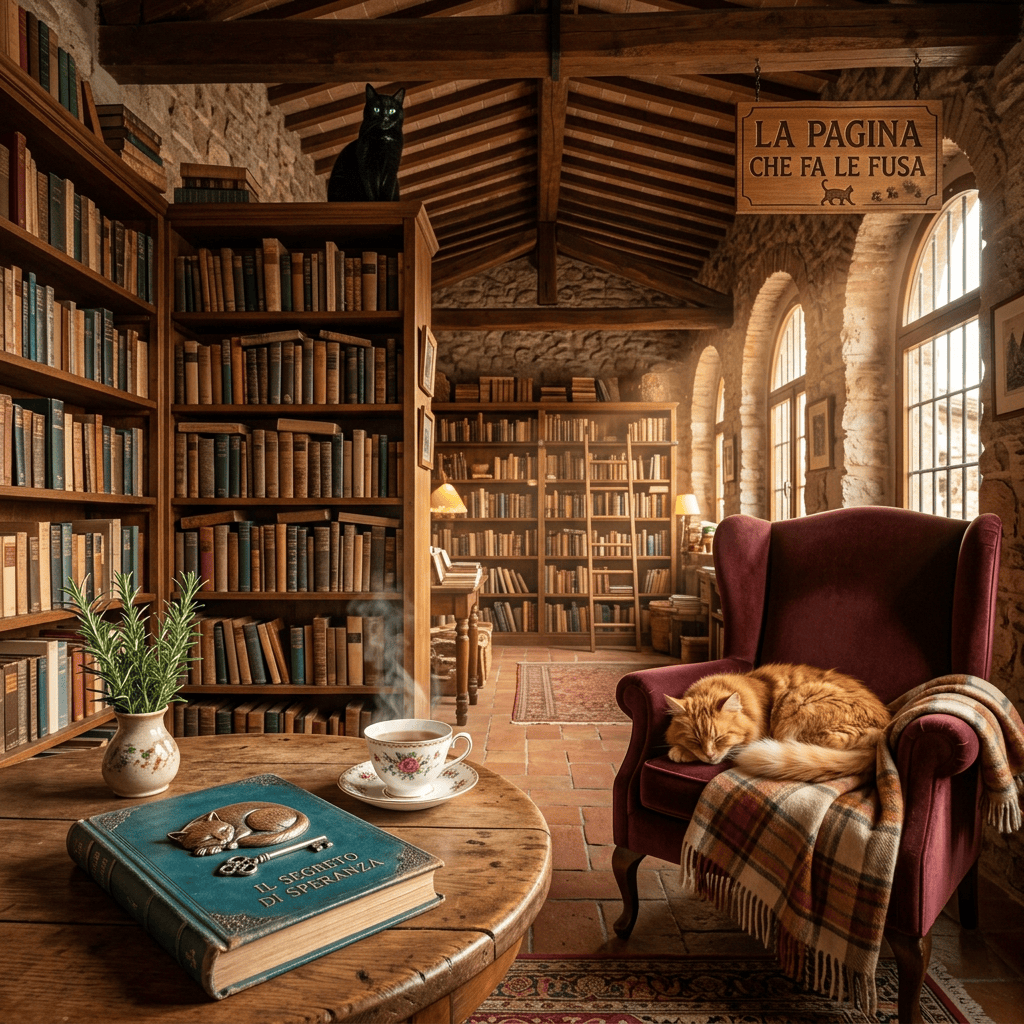
And it was that very question that blew into La Pagina che Fa le Fusa on a damp, foggy Tuesday afternoon in November.
Outside, the small hill village of Speranza was wrapped in gray wool. The autumn leaves stuck like copper coins to the wet cobblestones, and the streetlamps had just flickered to life. Inside the shop, the air was warm and smelled of dried elderflower, roasted barley, and the clean, comforting aroma of well-loved paper. A small cedar log sizzled in the hearth.
On the wide velvet cushion beside the stove, Ashwaganda lay stretched in full royal ease. His ginger tail gave a single, slow flick of greeting as the brass bell above the door chimed, but his golden eyes remained heavy with sleep, his chest rising and falling to a low, rhythmic purr that rumbled against the floorboards like a friendly cello. Across the room, perched on the top rung of a wooden library ladder, Toe sat upright with his ears pricked forward, studying the newcomer with intense curiosity.
The man who entered was tall and carried an umbrella that had seen better decades. His name was Giuliano, a retired piano tuner from the valley who had spent fifty years listening to strings, hammers, and pitches until his ears knew every vibration in Northern Italy. Yet today, his shoulders were slumped, his eyes carried the dull exhaustion of someone who had forgotten how to sleep, and beneath his arm he clutched a flat, square cardboard sleeve with frayed edges.
“Good afternoon, Moira,” Giuliano murmured, his voice as quiet as falling dust. “I don’t need a book today. I think… I think I just needed to stand somewhere where things aren’t moving so fast.”
Moira smiled, stepping out from behind the counter with a linen towel over her arm. “Then you have come to the right place, Giuliano. Take off your damp coat and sit by the fire. You look like a man who has been carrying a heavy thought uphill.”
Giuliano sank into the deep wingback chair near the hearth. He carefully set the worn cardboard sleeve on his knees, his hands trembling slightly.
Moira went straight to the apothecary shelf. She chose dried linden blossom to ease tension in the chest, crushed lemon verbena to lift the spirit, and a few dried chamomile heads steeped in fresh well water. She brought the steaming clay mug over and set it on the little table beside him, accompanied by a small pot of chestnut honey.
“Tell me what you have there,” Moira said softly, sitting on the wooden stool opposite him.
Giuliano ran his rough, calloused fingers over the sleeve. “It’s a recording from forty years ago. A simple nocturne played by my late wife on our wedding anniversary. For four decades, whenever the world felt cruel or too loud, I put this record on the turntable. It changed my life the first time I heard it—it was the song that convinced me to stay in music, the song that taught me what kindness sounded like. It gave me back my breath.”
He paused, staring into the steam rising from his cup.
“Last night,” he whispered, “I put it on again. And I felt… nothing. Just dead vinyl and scratching needles. My ears heard the notes, but my chest stayed completely numb. I thought to myself: if the song that changed your life stops speaking to you, what is left?”
Before Moira could answer, Toe decided that the inspection could no longer wait.
The white-pawed cat hopped down from the ladder with feather-light grace. He padded across the rug, jumped onto the arm of Giuliano’s chair, and lowered his nose to the cardboard sleeve. He didn’t sniff the surface; instead, he tapped the bottom corner of the sleeve repeatedly with one sharp white claw, then looked up at Giuliano with wide, unblinking green eyes.
At the same moment, Ashwaganda stirred. The big ginger cat rose, stretched his front legs forward into an elegant bow, and walked over to Giuliano’s feet. Without asking for permission, Ashwaganda rested his heavy chin directly on Giuliano’s leather boot and let out a deep, rolling purr that vibrated right through the sole of the man’s shoe.
“Toe seems to think the sleeve has a secret,” Moira said, watching the cat’s paw. “And Ashwaganda says your heart is beating in triple time when it ought to be in four.”
Giuliano blinked, looking down at Toe’s insistent white paw. He picked up the cardboard jacket and turned it over.
Because the cardboard had grown dry and brittle over four decades, the bottom fold had split open. Stuffed inside the dark, forgotten gap between the paper lining and the cardboard back was a folded yellowed slip of paper. Giuliano pulled it out with trembling fingers.
It was written in the neat, looping fountain-pen script of his wife, dated the very evening she had given him the record:
“Giuliano, if you are listening to this when the house is too quiet: remember that the music is not inside this piece of plastic. The music was the afternoon we spent walking by the river before we recorded it. Don’t look for me in the speaker. Look for me when you open the window.”
Giuliano stared at the slip of paper. A slow, shuddering breath escaped his chest, and for the first time in months, the hard knot in his brow relaxed. Two tears ran down into the lines of his smile.
“She always knew,” Giuliano said, laughing softly through his tears. “She always told me I spent so much time tuning the piano that I forgot to listen to the room.”
Ashwaganda gave a satisfied grunt and rubbed his side against Giuliano’s trouser leg, while Toe nestled into the crook of the man’s elbow, tucking his white paws neatly under his chest.
Moira handed him the warm cup of linden tea. “A song doesn’t change our life because the notes are magical, Giuliano. It changes our life because, for three minutes, it makes us brave enough to sit still and feel who we are. When the song goes quiet, it isn’t broken. It’s just waiting for you to bring the warmth back to the room yourself.”
They sat together in comfortable silence for a long time. The only sounds in La Pagina che Fa le Fusa were the faint patter of rain against the glass, the slow crackle of the hearth fire, and the deep, steady purr of two cats keeping watch over a restored heart.
Moira’s Reflection:
A beloved song does not hold our memories hostage inside its melody; it is only a doorway. When the music seems to lose its voice, do not force the notes—step through the door, open the window, and let life fill the quiet spaces again.






Leave a Reply