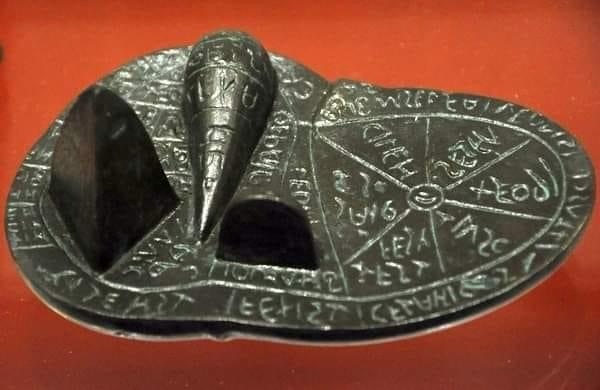
The Liver of Piacenza is an Etruscan artifact found in a field near Gossolengo, in the province of Piacenza, Italy, in1877. It is now kept in the Municipal Museum of Piacenza, in the Palazzo Farnese.
It is a life-sized bronze model of a sheep’s liver covered in Etruscan inscriptions, measuring 126 × 76 × 60 mm (5 × 3 × 2.4 inches) and dated to the late 2nd century BC, i.e. a time the Etruscans were already under Roman rule.
The liver is subdivided into sections for the purposes of performing haruspicy (hepatoscopy); the sections are inscribed with names of individual Etruscan deities.
The Piacenza liver is a striking conceptual parallel to clay models of sheep’s livers known from the Ancient Near East, reinforcing the evidence of a connection (be it by migration or merely by cultural contact) between the Etruscans and the Anatolian cultural sphere.
The outer rim of the Piacenza liver is divided into 16 sections; as the Etruscans divided the heavens into 16 astrological houses, it has been suggested that the liver is supposed to represent a model of the cosmos, and its parts should be identified as constellations or astrological signs. Each of the areas then corresponds to its relevant god. It was likely used as a kind of celestial map and key to interpreting events that happened in each of the zones — a sort of “how-to” for would-be soothsayers.







Leave a Reply