Can I forgive someone who never said sorry?
The Bell Over the Door
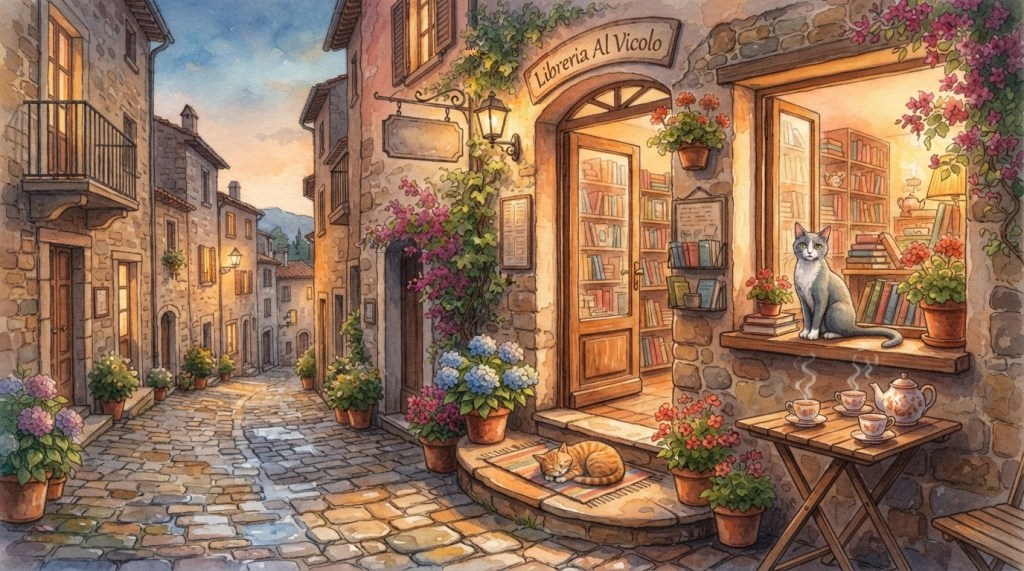
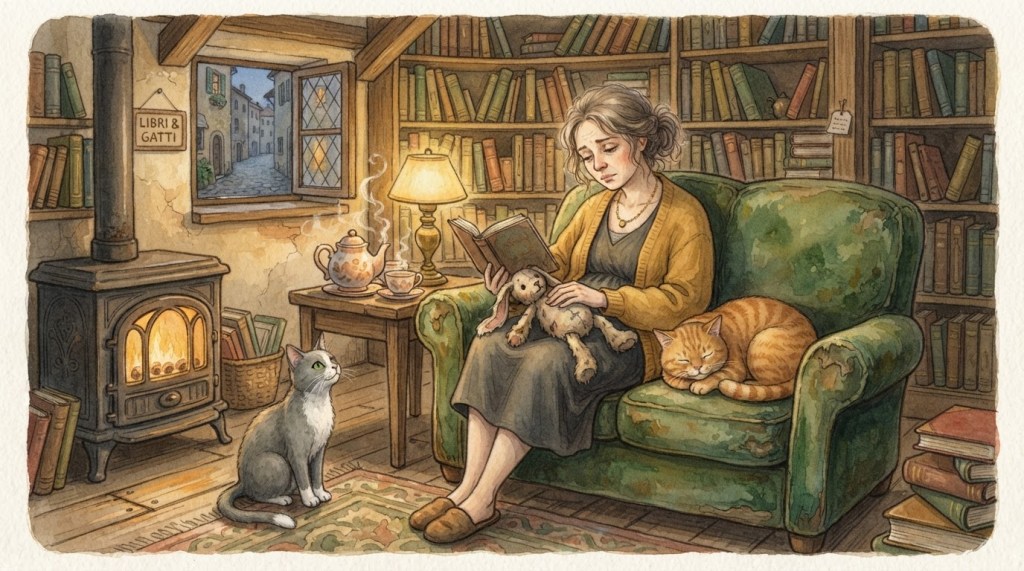
It had rained in Speranza since noon, the thin, patient rain of late November that does not fall so much as hang in the air, and by six o’clock the lamps along Via dell’Orologio wore little halos. Inside La Pagina che Fa le Fusa, the stove ticked, the kettle muttered, and Moira Hopes was standing on the library ladder with a book about mushrooms in one hand and a book about astronomy in the other, wondering how the two had ever come to share a shelf.
Below her, Ashwaganda lay across the warmest rug like a ginger loaf left to prove. He was fifteen pounds of sleeping cat, and his purr, even in sleep, was a low, steady engine that Moira had once measured against a tuning app on her phone: twenty-five hertz, give or take. Toe sat on the windowsill above the radiator, slender and grey, her four white paws tucked under her as neatly as folded napkins, her green eyes following a raindrop down the glass.
The bell over the door gave its small, cracked chime.
The man who came in was perhaps sixty, broad in the shoulders, with a wet felt hat and the careful manner of someone who is used to being useful and not used to asking for anything. He wiped his shoes twice on the mat, which Moira always took as a sign of good character, and then stood there holding his hat in both hands as if it might wander off.
“Good evening,” Moira said, climbing down. “You have found the driest place in Speranza. Please, come closer to the stove.”
“I only came in to look at the books,” he said. “I am Saverio Calvani. I fix roofs. I was on my way home, and I saw the light.”
“People often see the light when they are on their way home and not quite ready to arrive,” said Moira, and she said it so kindly that he laughed, a short surprised laugh, and sat down in the green armchair without being asked twice. Toe left her windowsill, crossed the floor in four silent steps, and settled beside his boots as though she had been waiting for him all week.
A Tea Chosen for Him
Moira did not ask what was wrong. In eleven years of keeping the bookshop she had learned that a question asked too early makes a person close like a clam, whereas a cup of something warm, handed over without comment, usually opens a door all by itself.
She looked at his hands, which were scarred and square and had gripped his hat so hard that the knuckles were pale, and she looked at his shoulders, which sat a little higher than shoulders should. Then she went to the shelf of jars behind the counter and took down three: dried linden flowers, the pale gold ones that smell of June afternoons; a handful of rose petals, deep pink and papery; and a few thin ribbons of dried apple.
“Linden,” she said, over her shoulder, “because in Italy it has been the tea for frayed nerves since before my grandmother was born. Rose, because it smells like somebody being gentle with you. And apple, because everything is better with a little sweetness that does not come from sugar.”
“Is it medicine?” he asked, a little suspicious.
“It is a warm cup and ten quiet minutes,” said Moira. “I would not call that medicine. I would call it good manners towards yourself.”
She poured the water over the flowers and let the steam rise. The room filled with a scent like honey and warm hay, and Ashwaganda, without opening his eyes, rolled onto his back and exposed a belly the colour of marmalade, which in cat language means all is well; proceed.
Saverio held the cup in both hands, the way he had held the hat. For a long while he said nothing, and neither did Moira. The rain tapped. The stove ticked. At last he looked into the amber tea and said, to the tea rather than to her:
“My brother Ettore and I have not spoken in eleven years.”
The Letter He Did Not Send
It was an old story, he said, and an ugly one, and the ugliest part was how small it had started. Their mother Marisa had died, and there was a house in the hills with a walnut tree, and a workshop full of tools that had been their father’s. Ettore, the younger one, had lived nearer and had managed the paperwork. When it was all signed, Saverio discovered that the workshop, and everything in it, had been sold to a man from the coast. Ettore had said it was the only sensible thing to do. He had said it in a voice, Saverio remembered, as if he were explaining the weather.
“My father’s planes,” Saverio said. “His chisels. The little brass level with his initials. I would have bought them myself, if anyone had asked me. Nobody asked me.” His thumb moved along the rim of the cup. “I said things at the funeral lunch that I should not have said. He said things back. And then he went home, and I went home, and the years began to pile up like snow on a roof that nobody climbs.”
“And he never apologised,” said Moira quietly.
“Never. Not once. Not a card at Christmas, not a word when my wife was ill. Last month I met his daughter in the square at Ravello, and she told me, so lightly, as if it were nothing, that her father has a bad heart now. That he does not go out much.” Saverio’s voice had thinned. “I have written him a letter four times this week. I have it in my pocket. It is a perfectly good letter. And every time I get to the postbox, my hand will not do it. Because it feels as if I would be saying that what he did was all right. And it was not all right.”
Toe, at his feet, lifted her chin and looked at him with great seriousness. Then she put one white paw very lightly on the toe of his boot, and left it there.
“It was not all right,” Moira agreed. “I will say that plainly, because I think you have been waiting for someone to say it. A person can be wronged, and badly, and still be a good man. And a person can do a careless, unkind thing and still be loved. Both of these are true at once, which is exactly why it is so tiring to carry.”
Saverio blinked hard and looked towards the ceiling, where a few paper stars hung from the beams. “Eleven years,” he said. “And I can still remember what he said at that lunch word for word. Is that normal?”
“Perfectly,” said Moira. “And that, I think, is where I can be of some use. Let me tell you what I have read about it. Will you let me? It involves a heartbeat.”
“A heartbeat,” he repeated, and almost smiled. “Go on.”
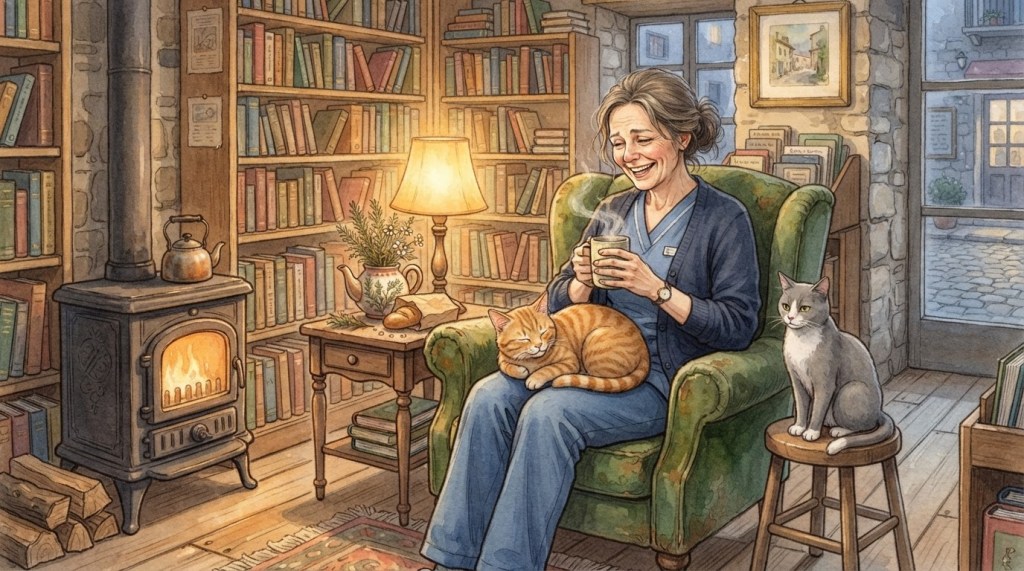
She had settled onto the footstool opposite him, and at that very moment Ashwaganda, who had been asleep for two hours, woke up, stretched until his claws showed, and walked across the rug with the unhurried dignity of a bishop. He climbed into Moira’s lap, all fifteen pounds of him, turned around twice, and sank down with a sigh like a small accordion.
Moira looked at the new weight on her knees and laughed softly.
And here, if you will forgive me, is where Moira leans out of the story for a moment to speak to you.
Ashwaganda has just claimed my lap, and the rain has settled in for the night, so I will tell you a small secret while the tea cools: the slow evenings I love best from this bookshop have been gathered into a little book, Tales of Speranza. It is there on the shelf whenever you would like some company. Now, back to Saverio and his letter.
What Happens in the Body
“Some years ago,” Moira began, one hand moving along Ashwaganda’s broad back, “a psychologist named Charlotte Witvliet and her colleagues did a small, careful experiment. They asked volunteers to think about someone who had hurt them, and they measured the body while the volunteers did it: heart rate, blood pressure, the tiny tension of the facial muscles, the sweat on the skin.”
“And?” said Saverio.
“When people dwelt on the grudge, rehearsing the injury, nursing the anger, their bodies reacted as if under a mild threat. The heart sped up, the pressure rose, the muscles tightened. When the same people were asked to imagine empathising with the offender, or to imagine forgiving, the reaction was calmer. It was a small study, mind you, and a laboratory is not a kitchen table at midnight. I would not call it a miracle cure for anything. But it fits what many people tell us about how a long grudge feels.”
“It feels like a roof I am holding up with my shoulders,” said Saverio slowly. “Every day. I did not know I was holding it.”
“Many people do not. There is a word for the mental part of it: rumination. It is when the mind replays the same scene again and again, the way a gramophone needle catches in one groove. The research on rumination is fairly consistent that it keeps distress alive instead of resolving it. The mind believes it is solving a problem. In truth it is only walking in a circle, wearing a path in the grass.”
Saverio turned his cup slowly. “So I should forgive him, and the heartbeat will calm down. That is the lesson.”
“No,” said Moira, firmly enough that Toe’s ears flicked. “That is exactly the lesson I do not want you to take. Because there is a second piece, and it matters more.”
Two Kinds of Forgiveness
“There is a researcher named Everett Worthington who has spent much of his career studying forgiveness,” she went on. “He separates it into two things that are easy to confuse. The first he calls decisional forgiveness. That is a decision, made with your head: I will not take revenge, I will not treat this person as an enemy, I will let the debt go. You can make that decision on a Tuesday afternoon, and it may even be a quiet, practical sort of choice.”
“And the second?”
“Emotional forgiveness. That is when the feelings themselves change: the bitterness softens, a little warmth or at least neutrality comes back. And that one cannot be ordered. It comes in its own time, like a tide. You may decide on Tuesday and still wake on Wednesday with a clenched jaw. That does not mean the decision failed. It means the tide has not yet come in.”
Saverio was quiet. Rain slid down the window. Ashwaganda’s purr rose a little, steady and low, and the whole room seemed to hum with it.
“There is one more thing,” said Moira, “and it is the answer to your question about the postbox. Forgiveness is not the same as saying the wrong was acceptable. It is not forgetting. It is not even reconciliation, which needs two people. Worthington and others are quite clear that you can forgive someone without restoring the relationship, and that you can forgive someone who has never apologised, and who may never. The apology belongs to them. The forgiveness belongs to you. They are two separate gifts, and one does not need the other in order to exist.”
“Then what is it for?” Saverio asked, and it was not a challenge but a real question. “If it does not make him sorry, and it does not make it right?”
“It is for the one who is holding the roof,” said Moira.
He put the cup down very gently on the little table. His hands, she noticed, were no longer white at the knuckles.
The Cats Have an Opinion
“May I tell you what Worthington suggests to help it along?” Moira said. “He has a little method, a five-step one, which he calls REACH. I will give it to you in plain words, and you may keep whichever step is useful and leave the rest on the shelf.”
She counted on her fingers, carefully, so as not to disturb the cat. “Recall the hurt honestly, without making it bigger or smaller. Empathise, meaning try to imagine what the other person might have felt or feared, which is not the same as excusing them. Altruistic gift, which is remembering a time you yourself were forgiven when you did not deserve it, and offering that kindness back. Commit, in some small way, perhaps by writing it down, so the decision does not evaporate overnight. And Hold on, because the old feelings will return on bad days, and that is not failure; it is just weather.”
“Empathise,” said Saverio, with something that was almost a grimace. “That is the hard one. What was he afraid of? He was the one who stayed. He did the paperwork. He sat in the hospital. I was out on roofs in three provinces, always busy.” His voice faltered. “Maybe he sold the workshop because he could not bear to walk past it every day. Maybe he thought that if he asked me, I would say no, and he would have to carry the whole house alone. Maybe he was not being cold at all. Maybe that voice of his, explaining the weather, was a man holding himself together.”
He stopped, shocked at himself.
“You do not have to be certain,” said Moira gently. “That is the part people forget. Empathy is not mind-reading. It is only leaving a door slightly ajar for a kinder explanation than the one your anger prefers. You may never know which story is true. But you are allowed to stop insisting on the worst one.”
At that moment Toe, who had said nothing all evening, stood up from his boots, stretched in a long grey curve, and jumped lightly into his lap. She turned once, pressed her white paws one after the other into his thigh as though kneading a very small loaf, and lay down with her chin resting on his wrist. Her purr was thin and silvery, so different from Ashwaganda’s rumble that the two together sounded like a cello and a flute.
Saverio sat perfectly still, afraid to breathe.
“She does not do that for everyone,” Moira whispered.
“What does it mean?”
“I believe it means she has decided you are safe to sit on,” said Moira. “Which is its own kind of forgiveness, if you think about it. Cats forgive in a very practical way. They do not wait for an apology. They simply decide whether the room is warm enough to stay in.”
He laughed, and this time the laugh went all the way down, and something loosened in his chest that had been tight for a very long time. He wiped his eyes with the back of his scarred hand, embarrassed, and Moira pretended to be busy with the teapot until he had finished.
What the Letter Said
When he spoke again, it was nearly dark outside, and the rain had thinned to a whisper. “May I show you the letter?” he asked. “I do not think it is right anymore.”
He took it from his coat, carefully, so as not to dislodge the cat. It was a single sheet, folded in three. Moira did not take it; she only nodded. He read the opening aloud, in a voice that was trying to be steady: “Ettore, I think it is time that you explained yourself.”
He stopped, and shook his head. “It is a summons,” he said. “It is a letter that wants to win. No wonder my hand will not post it. Part of me knows he would read it and not answer, and then I would have eleven more years of silence, with proof.”
“What would you like a letter to do?” Moira asked.
Saverio was quiet for a long time. Toe’s purr rose and fell. “I would like him to know that I heard about his heart,” he said finally. “I would like him to know that the walnut tree is still there. And that I do not need the chisels back.” He swallowed. “I do not think I need him to say sorry. I think I would just like him to know that the door is not locked.”
“That sounds like a different letter,” said Moira, and she took a clean sheet of cream paper from the drawer under the counter, and a pencil, and set them on the table beside the empty cup. “Nothing says you must send it tonight. Nothing says it must be long. Three lines is a great deal, when it is the right three.”
He wrote slowly, with the cat still on his lap and the pencil looking tiny in his big hand. Moira did not read over his shoulder. She watched the rain instead, and listened to the two purrs rising and falling, a cello and a flute, in the lamplit shop, and she thought, as she often did, that forgiveness sounds very much like that: not a trumpet, not a grand speech, but a small steady sound made by someone who has decided to stay in the room.
Walking Home
When he stood to leave, Toe slid from his lap with an air of mild reproach and returned to her windowsill. Ashwaganda, who had slept through the entire proceedings from the comfort of Moira’s knees, opened one amber eye and closed it again, which was as much of a farewell as he gave to anyone.
Saverio put on his damp hat, then took it off again, and held it as he had at the beginning, but differently now, like a man holding a hat and not like a man holding on. “I am going to post it in the morning,” he said. “Not tonight. Tonight I am going to sleep, if the roof lets me.”
“The roof will manage without you for one night,” said Moira.
He bought a book before he went, a small one on carpentry joints, which Moira suspected he did not need and would read cover to cover. At the door he turned. “And if he does not answer?”
“Then you will still have done the part that belongs to you,” said Moira. “That is the whole of it, Saverio. The sending is yours. The answer is his. Whatever he does with it, you will walk home lighter than you walked in.”
The bell chimed its small cracked chime. Outside, the rain had stopped, and the cobbles shone under the lamps like a river laid flat. Saverio walked down Via dell’Orologio with his hat on his head and his shoulders, Moira noticed from the window, a good two inches lower than when he had arrived.
Moira’s Reflection
I think we are taught to believe that forgiveness is a gift we hand to the person who hurt us, and that they must earn it with an apology, as one earns a ticket with a coin. But the longer I keep this shop, the more I suspect it is closer to opening a window in a room that has been shut for too long. The other person may never feel the draught. You will.
It does not erase what happened, and it does not ask you to pretend. It only asks whether you would like to put down one of the heavy things you have been carrying, and whether you might, in your own time, allow a kinder explanation than the worst one. The tide comes in when it comes in. All we can do is leave the door unlocked.
Is there someone you have been waiting to hear from, who may never say the words? What would the unlocked door look like for you? Tell me in the comments, and I will read every one by the stove, with a cat on my lap.
A Cup for This Story
- 1 tablespoon dried linden flowers
- 1 teaspoon dried rose petals (food grade)
- 3 or 4 thin ribbons of dried apple
- 250 ml of just-boiled water, steeped for 8 minutes, covered
- A teaspoon of honey, if you like. Drink slowly, preferably with a cat nearby.
Herbal teas are a comfort, not a medicine; if you are pregnant, on medication or unwell, please check with your doctor before trying a new herb.
P.S. If tonight’s question about forgiving without an apology stayed with you, there are ten more slow evenings like this one waiting in Tales of Speranza.
Listen in Speranza
🎧 Moira’s bookshop also has a voice. Tales from Speranza is our free podcast of slow evening stories, read aloud for the end of the day. Listen on Spotify.
Press Play and Stay a While
Before you go, here is the little song that plays when the bell rings in Speranza. Let it play softly while the tea cools.




Leave a Reply