Why does resting feel like something we have to earn?
The Baker Who Came Before the Bell
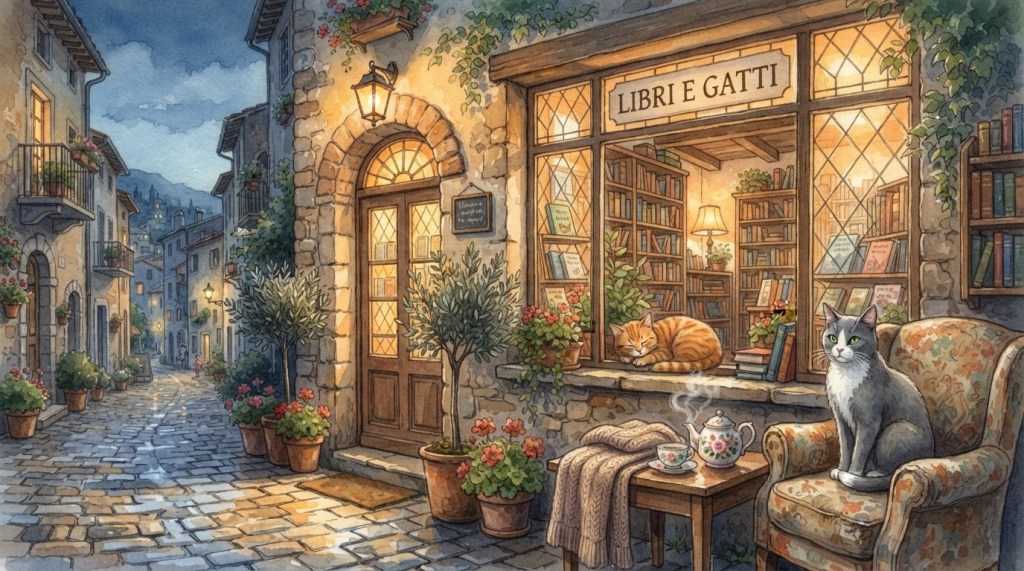
The first frost of the season had arrived in Speranza overnight, and Via dell’Orologio wore it like a thin white shawl. By half past four in the afternoon the light had already turned the colour of weak honey, and Moira Hopes was standing at the window of La Pagina che Fa le Fusa with a cup of tea going cold in her hands, watching the cobblestones glitter.
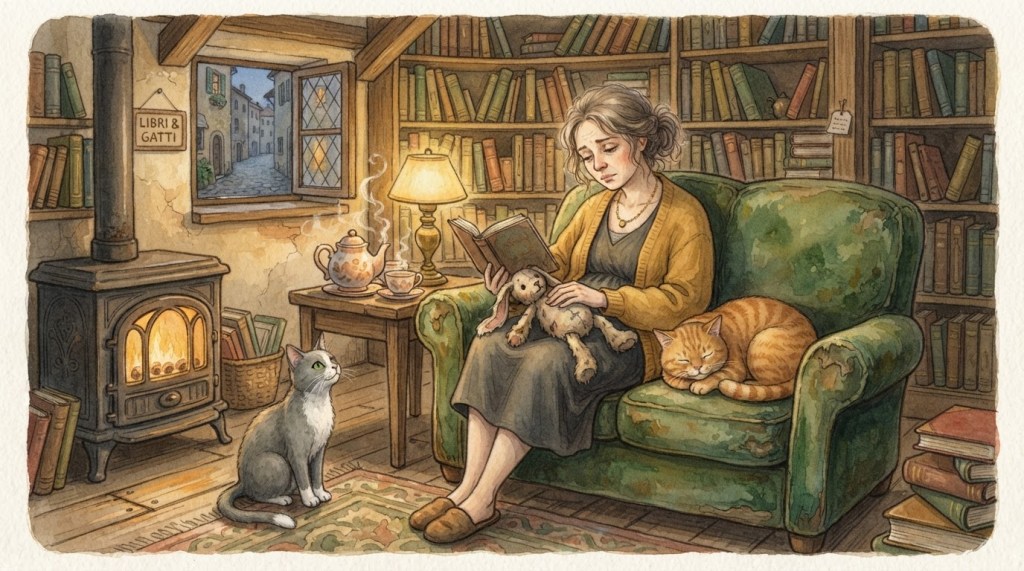
Behind her, the bookshop breathed its usual evening breath: the tick of the radiator, the whisper of paper settling on shelves, and, from the green armchair by the stove, the low, steady engine of Ashwaganda. The fifteen-pound ginger tabby was asleep in the way only a cat can manage, completely and without apology, with one paw hanging over the armrest like a man who has dropped his newspaper. His purr rolled on at its usual deep pitch, somewhere around twenty-five hertz, more felt than heard, a hum you notice in your ribs before you notice it in your ears.
Toe, the slender grey cat with the immaculate white paws, sat on the counter beside the till, upright and alert, green eyes fixed on the door. Toe was always the first to know about visitors. Moira had stopped asking how.
“Someone is coming,” Moira said, to no one in particular.
Toe blinked once, slowly. A moment later the little brass bell above the door gave a nervous, half-hearted jingle, as though the person pushing the door had not quite decided whether to come in.
The man in the doorway was broad-shouldered and floury to the elbows. There was a dusting of white in his eyebrows, and a smear of it across his cheek that he clearly did not know about. He was holding his cap in both hands, turning it round and round by the brim.
“Signora Hopes,” he said. “Forgive me. I should be at the oven. I am always at the oven. But Lucia said, if I did not come here today, she would hide my apron.”
“Then you had better come in,” said Moira, smiling, “before she carries out the threat. You are Ettore Calvani, from the bakery on the piazza. I have eaten your rosemary bread for eleven years and never once seen you outside it.”
He laughed, but it was a short, tired laugh, and it did not reach his eyes. “That is exactly the problem, Signora.”
A Chair Is Not a Confession
Moira cleared a pile of postcards from the second armchair, the one with the patched arm, and Ettore lowered himself into it the way a man sits when he suspects the chair might ask him to leave. He perched on the very edge. His boots, she noticed, were still dusted with flour, and his knee was bouncing.
“Tea first,” she said. “Questions afterwards. Sit back, Ettore. The chair will not mind.”
“I cannot sit back,” he said. “If I sit back, I start counting. The dough for tomorrow, the delivery to the school, the invoice from the miller I have not answered. Today is Thursday, and on Thursdays the bakery is open until seven. I should be there. I left Giulio in charge and my stomach has been in knots since I crossed the piazza.”
“And what happens at the bakery on a Thursday that Giulio cannot manage?”
Ettore opened his mouth, and closed it again. “Nothing,” he admitted. “Giulio is good. He has been with me three years. He would do everything correctly, probably better, because he does not get distracted by worrying.”
“Then what are you afraid of?”
He looked down at his cap. For a while there was only the radiator and Ashwaganda’s purr.
“Last month,” Ettore said at last, “my doctor told me my blood pressure is too high. He said I must slow down. Sleep more. Take one whole day each week with no work. I said yes, yes, of course. And I went home and lay in bed on Sunday morning, and I could not do it. After one hour I felt sick with guilt. As if I had stolen something. As if my father, who started that bakery in 1961 and never took a Sunday off in his life, were standing at the foot of the bed with his arms folded.”
He turned the cap again. “So I got up and made bread. Lucia was not pleased. Today she sent me here. She said, ‘Go and ask the woman with the cats how a person learns to rest.’ So. Here I am. How does a person learn to rest, Signora? It sounds so stupid when I say it aloud.”
“It does not sound stupid at all,” said Moira gently. “It sounds like one of the most common questions in the world. Wait here.”
The Tea for a Hardworking Man
Moira went through to the little back room where the kettle lived, among jars of dried leaves and flowers labelled in her careful handwriting. She did not hurry. She knew that the brewing was part of the answer: the slow warming of the pot, the counting of the spoonfuls, the minutes during which nothing could be done but wait.
She chose lemon balm first, because its bright, green, faintly citrus scent has been used in European kitchens and monastery gardens for centuries as a gentle evening herb. Then dried linden blossom, honeyed and soft, a flower beloved in Italian homes at the end of the day. A few curls of dried orange peel for warmth. Last of all, a pinch of chamomile, because every tea for a worried person ought to hold a little chamomile, if only for the old, familiar smell of it.
She carried the tray back. On the way, Toe jumped down from the counter and trotted ahead of her, tail high, to the patched armchair, where she turned two neat circles on Ettore’s lap, sat down on his floury apron, and began to wash one white paw with great concentration.
“Oh,” said Ettore, frozen. “Oh, I do not— I am covered in flour.”
“She does not mind. Cats are not much impressed by flour.” Moira set the tray down and poured. The steam rose in a thin gold ribbon. “Hold the cup with both hands. Do not drink yet. Just hold it, and tell me what you can smell.”
Ettore closed his eyes and breathed in. “Lemon. Something like… a summer garden after rain. And honey.”
“That is the linden. Good. Now notice that for the last ten seconds, you were not counting anything.”
His eyes opened. He looked, for a moment, like a boy caught out. “That is true,” he said slowly. “I forgot to count.”
What the Brain Does When You Are Doing Nothing
Moira settled into her own chair. Ashwaganda, without waking, shifted his great ginger weight and let out a sigh that made the whole armchair tremble.
“Let me tell you something about your own head, Ettore,” she said. “When people picture resting, they imagine the brain switching off, like a shop closing for the afternoon. It does not work that way. In the late 1990s and early 2000s, a neurologist called Marcus Raichle and his colleagues noticed something odd in brain scans. When volunteers were told to do nothing in particular, just lie still and let their minds drift, certain regions of the brain did not go quiet. They lit up. And they lit up in a coordinated way, as though a different orchestra had begun to play once the main performance was over.”
“A different orchestra,” Ettore repeated.
“Researchers now call it the default mode network. It seems to be involved in things like remembering, imagining the future, thinking about other people, and making sense of our own lives. We do not yet understand everything it does, and scientists still argue about the details. But the broad picture is well supported: the brain at rest is not idle. It is busy with a different kind of work, the sort that cannot happen while you are focused on the next task. Even in the quietest moments, the brain uses a good share of the body’s energy. It never really stops. So when you say ‘I am doing nothing,’ your head is, quite literally, doing something else.”
Ettore frowned, thinking. “So resting is not stealing from the work.”
“It may be closer to a different part of the work. I would not promise more than that, because the science of rest is young. But many people find that the answer to a knotty problem arrives in the shower, or on a walk, or just as they are drifting off to sleep. That is probably not a coincidence.”
She sipped her tea. “And there is a second thing, which concerns your knees.”
He glanced down. His knee, she saw, had finally stopped bouncing. “My knees?”
“The bouncing. You have been in this shop for fifteen minutes and you have named, aloud, five unfinished jobs. There is a famous idea in psychology called the Zeigarnik effect, named after Bluma Zeigarnik, who in the 1920s noticed that waiters seemed to remember unfinished orders better than completed ones. The popular version says that unfinished tasks nag at the mind. The strict laboratory evidence for the original effect is more mixed than people think. But there is a nice later study, from 2011, by two researchers named Baumeister and Masicampo. They found that when people made a specific plan for an unfinished goal, the nagging thoughts about it eased, even though the goal was not yet done. The mind, it seems, does not always need the task finished. Sometimes it only needs to be told: I know about this, and here is when I will deal with it.”
“A plan, instead of the work itself,” said Ettore.
“Exactly. So tell me, if you could write down all five jobs and next to each one a time when it will be done, would the knots in your stomach loosen at all?”
He considered it with the seriousness of a man weighing flour. “A little,” he said. “Yes. A little.”
Forgive me for a small aside, dear reader, while the tea cools and Toe settles herself more firmly on our baker’s apron. The evenings I treasure most in this shop, the ones where a worried person comes in from the cold and leaves a little lighter, are gathered together in a quiet book, Tales of Speranza. Now, back to our baker.
The Guilt That Comes With the Apron
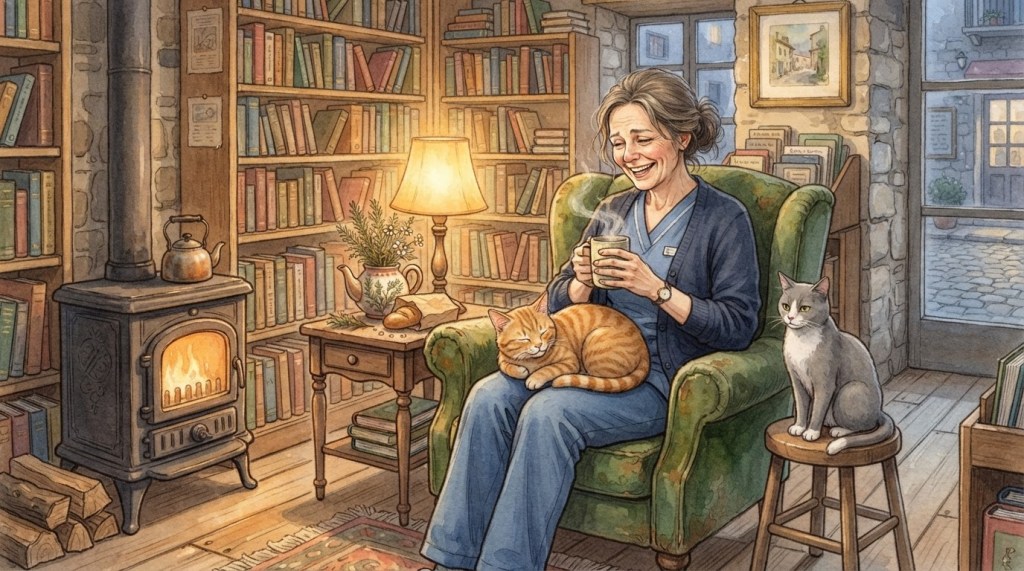
Ettore drank at last. The tea was warm and faintly sweet, and as he swallowed, his shoulders came down by what looked like about an inch. He stared into the cup as if it had said something surprising.
“But the plan will not fix the other thing,” he said. “The guilt. My father.”
“No,” Moira agreed. “That one is older than any plan. Tell me about him.”
Ettore was quiet. Toe, perhaps sensing something, stopped washing her paw and rested her chin on his wrist.
“He was a very good man,” Ettore said. “He was up at three every morning, from the day he opened until the day his hands would no longer hold the peel. He never said, ‘Work is good,’ or any speech like that. He simply never stopped. And when I was a boy, I understood that this was what love looked like. The bread in the morning. The shutter up before dawn. If you loved people, you got up for them. So when I lie in bed on a Sunday, some part of me hears that I am being lazy, that I am letting the family down. It is not a thought. It is a feeling in the body, like cold water.”
Moira let the silence be. Across the room, the stove ticked. Ashwaganda’s purr deepened a little, as if he too were listening.
“I do not think your father was wrong about love,” she said finally. “Showing up for people is a beautiful thing. But I wonder whether he got one small piece of the arithmetic wrong. Perhaps he believed that rest was the opposite of care, when it may be one of its ingredients.”
“Rest as an ingredient,” said Ettore.
“You, of all people, know about ingredients. What happens to dough if you do not let it rest?”
He let out a soft, surprised laugh. “It fights you. It springs back. The gluten is too tight. You can knead it all night and it will not stretch. You must leave it alone for half an hour, and then it becomes obedient.”
“Is the resting dough wasting time?”
“No,” he said. “It is… doing its work in the dark. The flour drinks the water. The gluten relaxes. Things happen in the resting that I could never make happen with my hands.”
“I would not push the comparison too far,” said Moira, with a twinkle. “A baker is not a loaf. But you have just explained, in your own language, what the sleep researchers say in theirs. We know that sleep helps the brain consolidate memories and learning, though the exact mechanisms are still being worked out. And it is well established that chronic short sleep is linked with higher blood pressure and other strains on the heart. Your doctor was not being fussy. He was telling you that your body keeps its own kind of books, and rest is one of the columns.”
Ettore set his cup down very carefully. “I have been treating rest like a debt,” he said slowly. “Something I owe, and cannot pay, and so I feel bad. But you are telling me it is not a debt. It is…”
“A part of the recipe,” Moira finished.
The Cat Who Never Apologised
It was Ashwaganda who ended the silence. With a groan that began somewhere near his belly, the big ginger cat unfolded himself from the green armchair, dropped to the floor with a soft thump, and padded across the rug, taking his time, in no apparent hurry about anything. He stopped at Ettore’s boots, sniffed the flour with great dignity, then climbed up onto the arm of the patched chair and lowered himself, loaf-shaped, against the baker’s shoulder.
The purr came with him, deep and slow, and Ettore went very still. Moira watched his face change. It was not that he relaxed all at once. It was more that he seemed to stop bracing, like a man who has been carrying a heavy sack for so long he has forgotten it is not part of his body.
“He is warm,” Ettore whispered, as if he might frighten the cat away with a normal voice.
“He is also fifteen pounds,” said Moira. “Which means you are now officially trapped. You cannot possibly get up. It would be unkind.”
“Giulio will be wondering.”
“Giulio will be fine. And if he is not, you will hear about it tomorrow, and you will both survive. Now, look at Ashwaganda. Have you ever, in all the years you have known cats, seen one apologise for lying down?”
Ettore looked at the heavy ginger head resting on his shoulder, the half-closed amber eyes, the whiskers twitching slightly in some private dream. “No,” he said, and smiled properly for the first time. “Never.”
“Cats sleep a great deal. Twelve to sixteen hours a day is typical for a house cat, though it varies. And nobody has ever called a cat lazy and meant it, because we understand, somewhere, that the sleeping is part of the hunting. The rest is part of the readiness. Ashwaganda is not avoiding his life. He is saving himself for it.”
Toe, still in his lap, gave a small, approving chirp, as though the matter had been settled.
A Different Kind of Thursday
They sat for a long while. The window went from honey to blue. In the street the lamps came on one by one along Via dell’Orologio, each with a faint, soft halo of cold air around it, and somewhere across the piazza a church clock counted five.
“I will tell you what I do,” said Moira at last, “and then you may keep what is useful and throw away the rest. I do not take my rest as a reward. I take it as part of the day, like opening the shutters. At four I stop and make tea, whatever is happening. Not because I have finished anything, but because I have decided that four o’clock is the hour I become ordinary again. The shop does not collapse. In eleven years, it has never collapsed.”
“And if the work is not finished?”
“Then I write it on a card, with the time I will do it, and I leave the card on the counter where the cats can supervise. It sounds silly, and it works better than it should. Do you think you could try something like that? Not a whole day off, not at first. A small piece. Twenty minutes in the afternoon, with a cup in your hands and nothing to prove.”
Ettore thought. “Twenty minutes, I could do. In the little gap after the lunch rush, when the ovens are cooling. I could sit on the flour sacks with a cup of this.” He glanced at the teapot. “And write the five jobs on a card. It would not feel like stealing, if it is on a card.”
“If it helps, think of it as the bread resting,” said Moira. “Only this time the bread is you.”
He laughed, a real laugh this time, deep and round, and Ashwaganda’s ear twitched at the sound.
“And on Sundays,” Ettore said, more quietly. “My father.”
“Perhaps you could think of it this way,” she said. “He gave you a bakery and a way of showing love. You can keep both. You might simply add one line to the family recipe: that a baker who rests is a baker who lasts. If you want to honour him, the best thing may be to still be here, with steady blood and clear eyes, at the oven, in twenty years.”
Ettore’s eyes were bright. He did not answer. He only nodded, once, and stroked the heavy ginger head against his shoulder with a floury hand that left a pale print on the fur. Ashwaganda did not mind in the slightest.
Leaving by the Front Door
When at last he stood, he did so slowly, handing Ashwaganda back to the armchair like a man returning something precious. Toe hopped down and trotted to the door ahead of him, tail high, to see him off.
“How much do I owe you for the tea?” Ettore asked, reaching for his wallet.
“Nothing,” said Moira. “Come back on Sunday and tell me how the twenty minutes went. And bring a loaf, if you must bring something. I will not say no to your rosemary bread.”
He laughed again, put on his cap, and pushed open the door. The cold came in sweet and clean, smelling of frost and woodsmoke. Outside, the piazza lamps shone on the cobblestones, and across the way, through the bakery’s lit window, Moira could see a young man in an apron laying out loaves with great care, perfectly capable, perfectly calm.
“Look at that,” said Ettore softly. “The sky has not fallen.”
“It rarely does,” said Moira. “Goodnight, Ettore.”
“Goodnight, Signora. Goodnight, cats.”
The bell jingled behind him, a brighter sound than before. Through the window, she watched him cross the piazza at an easy walk, not his usual brisk, hunted stride, but the slower gait of a man who has just realised he is allowed to arrive.
Ashwaganda had already gone back to sleep. Toe leapt up onto the counter, turned her green eyes on Moira, and blinked, slowly, in the way that means well done, or perhaps just I told you so.
Moira’s Reflection
We tend to treat rest as something to be earned, as though a day off were a prize for the people who have finished everything. But the list is never finished, and so rest never comes. What the baker discovered, with a little tea and a lot of cat, is that rest was never a reward. It was always an ingredient, something the whole recipe needs, the way dough needs its quiet hour before it will do anything good.
The guilt is real, and it usually comes from somewhere loving: a parent who worked too hard, a world that counts worth in hours. We do not have to fight it. We can thank it for its devotion and then, gently, sit down anyway. A cat has never once apologised for lying in the sun, and the cat is still, as far as anyone can tell, perfectly good at being a cat.
What about you? When did you last rest without feeling you had to justify it? And what would your twenty minutes look like? Tell us in the comments. Moira and the cats would love to hear.
A Cup for This Story
- 1 teaspoon dried lemon balm
- 1 teaspoon dried linden blossom
- A pinch of dried chamomile
- 2 or 3 curls of dried orange peel
- 250 ml of just-boiled water, steeped covered for 7 to 8 minutes, then strained. Drink slowly, with both hands round the cup.
Herbal teas are a comforting ritual, not medicine. If you have a health concern such as high blood pressure, please talk with your doctor, and check with them before using herbs if you are pregnant or take medication.
P.S. If tonight’s question about rest and guilt stayed with you, there are more slow, kind evenings like this one waiting in Tales of Speranza.
Listen in Speranza
🎧 Moira’s bookshop also has a voice. Tales from Speranza is our free podcast of slow evening stories, read aloud for the end of the day. Listen on Spotify. (Stories read by an AI-generated voice.)
Press Play and Stay a While
If you are not quite ready to leave the bookshop, put the kettle back on and let this little song keep you company for a few minutes.





Leave a Reply