
Calm for Carers · Story 6. For everyone who spends their days holding other people together.
The bell above the door of La Pagina che Fa le Fusa rang twice, which in Speranza usually means someone has pushed the door with one hand while the other is busy with a phone. It was a quarter past six on a Thursday evening in November, the hour when the lamps along Via dell’Orologio come on one by one and the baker across the road starts pulling down his shutter with a long, tired rattle.
Moira Hopes looked up from the ledger she was pretending to balance. The woman in the doorway wore a navy cardigan with a hospital badge still clipped to the pocket, and she was reading something on her screen with the frown of a person who has read the same message four times. Her thumb hovered. Then, with visible effort, she turned the phone face down against her hip and stepped inside.
“Sorry,” she said, before she had even closed the door. “Sorry, I’m not sure if you’re open. I can come back. It’s nothing. I only wanted to look at the books for a minute.”
“We are open until someone needs a cup of tea,” said Moira. “Which is a flexible kind of hour. Come in. Mind the grey one’s tail.”
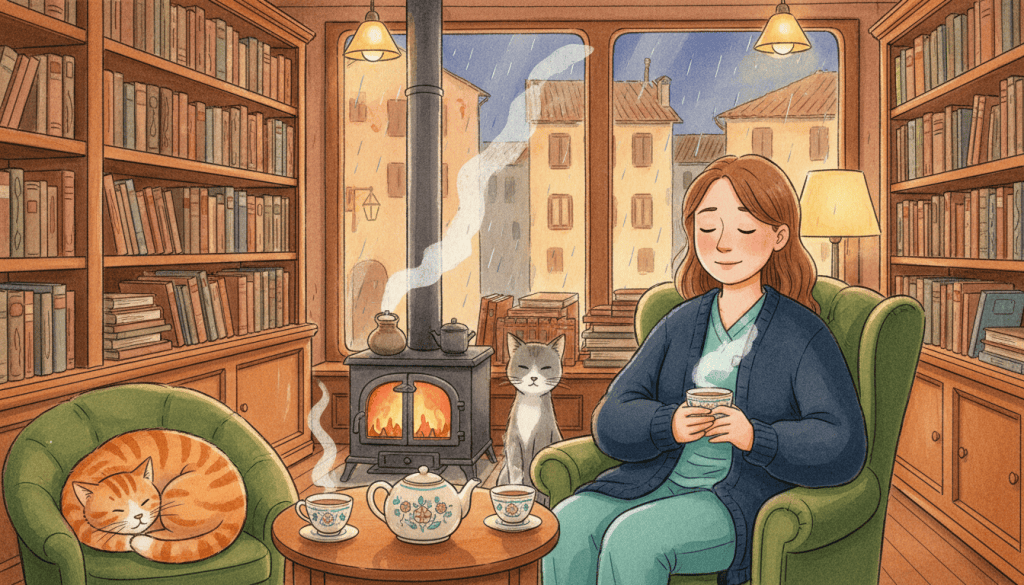
Toe, the slender grey cat with the immaculate white paws, was arranged on the radiator shelf like a small sculpture of herself, green eyes half closed. She did not move her tail. She never moved her tail for anyone, and it was a standing joke in the shop that visitors apologised to it. The woman apologised to it. Moira smiled into her ledger.
On the faded armchair by the stove, the other cat was occupying roughly two-thirds of the cushion. Ashwaganda, fifteen pounds of ginger tabby and every ounce of it composed, opened one amber eye, assessed the newcomer, and began to purr. It was a deep purr, a purr you felt in the floorboards, the sound of a very large engine idling in a very warm garage.
A Nurse Who Always Said Yes
“I’m Elena,” the woman said, still standing, as if sitting required permission. “I work on the medical ward up at the hospital in the valley. Eleven years now. I don’t usually come into shops after work. I usually go home and, you know. Start the second shift.”
“Children?” asked Moira.
“Two. And a father-in-law who lives with us, and a ward that is always short, and a group chat for the nurses on my floor that never, ever stops.” She laughed, and it was a thin, brittle laugh. “I just came out of the car park and I saw your window and the cat in it, and I thought, I would like to sit somewhere where nobody can ask me for anything. Which is ridiculous. You have a shop. I’m sure you want me to buy something.”
“I want you to sit down,” said Moira. “The buying can wait. If a book wants you, it will make itself known. They are shameless about it.”
Elena sat. The armchair across from Ashwaganda’s was the one nobody ever chose first, because it faced the window and the window faced the street, and people who are being brave prefer to face the wall. She sat on the very edge of it. Ashwaganda extended one heavy paw across the gap between the chairs and laid it on the arm of hers, claws sheathed, as if to say: this is a reservation.
Moira put the kettle on the stove and let the silence do some of the work. She had learned over the years that most people who walk into a bookshop at that hour do not need to be asked a question. They need to be given a chair and a little time to find out how heavy their own bag is.
“It’s the phone,” Elena said at last, and the words came out in a rush. “That message. It’s from our coordinator. There’s a gap on Saturday night, someone’s child is ill, and could I possibly cover. And I already did the last two Saturdays. And I already told my husband I would be at his mother’s birthday lunch on Sunday, and if I do a night I will be a ghost at that lunch, and I know that, and I know I should say no. I have known I should say no since the car park. And I have typed no three times and deleted it three times.”
“What happens when you imagine sending it?”
Elena thought about it. “My stomach drops,” she said. “Not because anyone would shout. Nobody would shout. It’s that I can see the gap on the rota. I can see the empty bed number and the junior nurse who’ll be alone with eighteen patients. And I think, that’s my fault. If I say no, that’s on me.”
“Ah,” said Moira, in the tone of someone recognising an old acquaintance. “The gap that belongs to you.”
Orange Peel and Cinnamon on the Counter
The kettle began to mutter. Moira went to the shelves behind the counter where the jars stood in neat, mismatched rows: dried petals, slivers of root, leaves rolled by someone’s patient hands. She took down rooibos, a few curls of dried orange peel, and a stick of cinnamon, and she brought them to the small table by the stove.
“This is a tea for saying no,” she said. “Don’t let the name fool you. There is nothing magical in it. Rooibos is a gentle red tea from South Africa that has no caffeine, so it won’t keep you awake when you finally get to bed. Orange peel is cheerful. Cinnamon is warming. Mostly, though, it is a tea that takes seven minutes to steep, and you cannot hurry it. That is the whole of my medicine, I’m afraid. Seven minutes in which nobody can ask you for anything.”
“You said medicine.”
“I was joking. I am a bookseller, not a clinician. I know a little about tea and a little about books and a good deal about people who sit in that chair. Whatever else I say tonight, please hold it lightly. If you ever feel that this is more than tiredness, your own doctor and your workplace’s occupational health service are the right people to talk to. I only offer tea and a place to sit.”
Elena nodded. Ashwaganda’s purr deepened, as if he had been waiting for exactly that disclaimer before proceeding.
Moira poured hot water over the leaves and set a small sand timer on the table. The sand began to fall, and the scent of orange and cinnamon rose slowly into the shop, mixing with the smell of old paper and wood smoke.
The Story of the Rota
“May I tell you something about myself?” Moira asked.
“Please.”
“Before I had this shop, I ran a pharmacy counter. Not here. Another town, another life. I was very good at it and I was very good at saying yes. Yes, I’ll stay late. Yes, I’ll cover the holiday. Yes, of course I can take that call at dinner. People praised me for it, and the praise was a kind of warmth, and I got used to being warm that way. Then one winter I noticed that I could not remember the last time I had read a book for pleasure. I had a whole shelf of them at home, unopened, like a row of patient dogs.”
“What did you do?”
“I did the least dramatic thing possible. I started leaving at the time I was meant to leave. That’s all. It felt like stealing. The first week, I was sure the pharmacy would collapse without me.” Moira’s eyes crinkled. “It did not. Some things were slower. Someone else learned to do the thing only I used to do. And do you know, a colleague told me months later that she had been wanting to learn it for years, but I never left a gap big enough for anyone else to step into.”
Elena was quiet for a moment. “A gap big enough for someone else,” she said slowly.
“I am not telling you what to do about Saturday,” Moira said. “I do not know your ward, or your coordinator, or what is truly at stake. There may be real reasons to say yes. There may be Saturdays when yes is the right and loving answer. I only want you to have a free choice. A yes that you cannot refuse is not much of a yes.”
Toe, who had been pretending to sleep, opened her green eyes and regarded Elena with great seriousness. Then she stepped down from the shelf in three precise movements, crossed the floor on her immaculate white paws, and sat directly on the phone, which Elena had put on the little table. The screen glowed through a blanket of grey fur.
Elena burst out laughing, a real laugh this time, low and surprised. “She’s sitting on my phone.”
“She does that,” said Moira. “She regards it as a rival. In fairness, she may be right.”
What the Researchers Say About Switching Off
The sand ran out. Moira lifted the strainer and poured the tea, a deep amber red, into two thick cups. She pushed one across to Elena, who wrapped both hands around it as though it were a small animal.
“There is one piece of research I find comforting,” said Moira, “and I will tell you what it says and what it does not say. Occupational psychologists have a name for the thing you are trying to do on Saturday night, or rather the thing you are trying to be allowed to do. They call it psychological detachment from work. It means mentally switching off from work in your time away from it. Not just being absent from the building, but being absent in your head.”
“I’ve never managed that,” Elena admitted. “I’m at my mother-in-law’s table and I’m thinking about potassium results.”
“You are in good company. Two German researchers, Jan Wendsche and Antje Lohmann-Haislah, gathered the studies on this together a few years ago. Their meta-analysis combined the results of eighty-six publications, covering well over thirty-eight thousand employees. Broadly, they found that people who reported being better able to detach from work in their free time tended to report less exhaustion, less fatigue, better sleep, and more satisfaction with life.”
“So it works.”
“I would be careful there,” said Moira gently. “That is exactly the sort of thing I mean about holding it lightly. Most of those studies asked people to describe their own experience at one point in time. That kind of research can show that two things go together. It cannot prove that one causes the other. It may be that people who are less exhausted find it easier to switch off. The researchers themselves were honest about that limitation. What I take from it is smaller, and I find it more useful. Rest is not laziness. Researchers have studied it as a serious subject, and the pattern they see is consistent with something your body has probably been trying to tell you.”
Elena looked into her cup. “And what about the other direction? The after-hours part.”
“The same review found that doing work-related things after hours, such as answering messages and checking in, was linked with being less able to detach. The connection was a moderate one, not a dramatic one. But it fits what most of us already feel. The phone that lives in your pocket is a thread that stays tied to the ward, even when your feet are in a valley and your body is at a lunch.”
Elena turned over the phone beneath Toe, very carefully, so as not to disturb the cat. The screen was dark. She looked at it for a long time.
A Short Practical List for Carers
“You said you are not sure how to start,” Moira said. “I am not a clinician, so these are only the things I have seen work for people who sit in that chair. Take whichever one fits and leave the rest.”
- Write the no before you send it. Type it, read it, and decide whether it is kind and clear. A good no is short: “I can’t cover Saturday, but I hope you find someone.” You do not owe a long explanation.
- Name the real choice. Ask yourself what you are saying yes to and what you are saying no to. A yes to the extra shift may be a no to Sunday lunch, to sleep, or to being a person with a body and a family.
- Create a small border between work and home. Silence the group chat outside agreed hours, or move work messages to a single app that you check at set times.
- Leave a gap for others. If you always fill the hole in the rota, nobody else learns that the hole exists. Gently let a team lead or manager see it.
- Tell one person. Say aloud to a trusted colleague, friend or relative: “I am finding it hard to say no.” Said aloud, it often loses a little of its power.
- Ask for help if it persists. If exhaustion, dread or low mood stay with you for weeks, talk to your doctor or your workplace’s occupational health or support service. Needing help is not a failure of character.
Elena counted the points on her fingers as Moira spoke, a habit of someone who had written a great many handover notes. When Moira finished, Elena said, “That last one. I always think I’ll wait until it’s bad enough to count.”
“There is no entrance exam,” said Moira. “You are allowed to come in while the door is still easy to open.”
The Sixth Cup
They drank. The orange peel had made the rooibos taste like a sunlit afternoon in a different season, and the cinnamon sat quietly at the back of each sip like a hand on the shoulder. Ashwaganda had finally stopped guarding his reservation and rolled heavily onto his side, one paw stretched toward Elena’s knee. Toe, still on the phone, had begun to knead it slowly, as though trying to turn it into something soft.
“I keep thinking that if I say no, they will think less of me,” Elena said at last. “That I am not a team player.”
“May I say something that will sound like a fortune cookie?”
“Please.”
“The people who truly respect you are the ones who will still respect you after the first no.” Moira lifted her cup. “And the people who do not respect you after the first no were, I am sorry to say, not respecting you before it. They were respecting your availability. That is a different thing, and it is a poor thing to be loved for.”
Elena set her cup down. Her hands, Moira noticed, were no longer shaking, and her shoulders had come away from her ears by perhaps an inch.
“I will tell you what I think,” said Elena slowly. “I think I will reply to my coordinator. I’ll say I can’t do Saturday night, but I can do the early shift next Tuesday if it helps. That’s a real offer. I mean it. It just doesn’t take everything.”
“That sounds like a person with a boundary and a heart at the same time,” said Moira. “Which is the only kind worth being.”
“And I’ll go to the lunch on Sunday and eat too much and let someone else worry about potassium.”
“Excellent. Also eat the little almond biscuits. They are always at the end of the table. Nobody ever takes them.”
Elena laughed again. She stood, and this time she did not apologise to the tail. She lifted Toe off the phone, very gently, and the grey cat allowed it with an air of great forbearance. Elena typed for a minute, her thumbs steady. Then she held the screen toward Moira, who politely looked away, and pressed send.
“There,” she said. Her voice was small and astonished. “It’s gone. Nothing happened. The roof is still on.”
“The roof usually is,” said Moira.
Leaving, and Not Leaving
At the door, Elena turned. The street outside had gone fully dark, with rain beginning in fine silver threads under the lamps. She looked at the shelves, the cats, the stove, and the little table with its two empty cups.
“I didn’t buy anything,” she said.
“Come back and buy a book when you have time to read it,” said Moira. “That is the most flattering thing a person can do to a bookseller. And take a few of these.” She pressed a small paper bag of rooibos and orange peel into Elena’s hand. “Steep for seven minutes. Do not check your phone while it brews.”
“What if I check it?”
“Then you check it, and you drink the tea anyway, and tomorrow you try again. Boundaries are not a verdict. They are a practice, like any other. You will be clumsy at first. So are most things that are worth doing.”
The bell rang once behind Elena, softly. Through the window Moira watched her cross the street, pause at the corner under the clock, take her phone out of her pocket, look at it, and then, deliberately, put it back.
Ashwaganda lifted his large head and watched her go. Then he settled it back down on his paws, his purr rolling on as steadily as a tide. Toe returned to her radiator shelf and resumed being a sculpture.
“Well,” said Moira to the cats, collecting the cups. “That was a good one.”
Neither cat disagreed. In Speranza, that counts as applause.
Moira’s Reflection
Many of the carers who find their way to a quiet shop like mine are not short of kindness. They are short of permission. The nurse who covers every shift, the daughter who answers every call, the doctor who stays for one more patient, the volunteer who always says “of course.” Their generosity is real, and it is also, sometimes, a way of paying a debt that nobody actually asked them to pay.
I am a bookseller and not a clinician, so I will not tell you what is right for your ward, your family or your life. I will only say that saying no, kindly and clearly, can be one of the most caring things you do, for the people you love and for yourself. A rested carer has more to give than a depleted one, and a team that learns to see its gaps can, over time, learn to fill them together.
And if saying no feels impossible, or if tiredness and dread have settled in for weeks, please speak to your doctor or to your workplace’s support or occupational health service. That is not a weakness. It is the same advice you would give to anyone you were caring for.
So tell me: what is one small yes you have been giving that you would like to take back, or one small no you wish you had the courage to say? You are very welcome to share it in the comments, or simply to read other people’s and feel a little less alone.
A Cup for This Story
Elena’s “Saying No” Tea: a gentle, caffeine-free evening cup that takes its time.
- 1 heaped teaspoon of loose rooibos
- A few curls of dried orange peel, about half a teaspoon
- A small piece of cinnamon stick, or a pinch of ground cinnamon
- One cup of just-boiled water; steep for seven minutes with the lid on, then strain
Make it slowly, sit down, and leave the phone in another room for the whole seven minutes. A little honey is lovely, if you like.
Herbal teas are not medicine. If you are pregnant, taking medication or living with a medical condition, please check with your doctor or pharmacist before trying a new herbal tea.
Sources and further reading: Wendsche, J. and Lohmann-Haislah, A. (2017), “A Meta-Analysis on Antecedents and Outcomes of Detachment from Work,” Frontiers in Psychology, 7, 2072.





Leave a Reply