How many beautiful things have we never done, only because we were afraid of getting one small part of them wrong?
Saint Martin’s Little Summer
Every year, around the eleventh of November, Speranza is given a present it has done nothing to deserve. The fog lifts, the wind drops, and for three or four days the sun comes back as if it had forgotten something. The old people call it l’estate di San Martino, Saint Martin’s little summer. Windows open again. Someone always sets up a brazier in the piazza to roast chestnuts, and the smell of smoke and sweet burnt shells drifts all the way up Via dell’Orologio, where it slips under the door of La Pagina che Fa le Fusa and settles among the books.
On the afternoon of the twelfth, the door of the bookshop was propped open with a dictionary. Moira Hopes was dusting the poetry shelf with a feather duster that had seen better decades, and humming something she could not quite remember the name of.
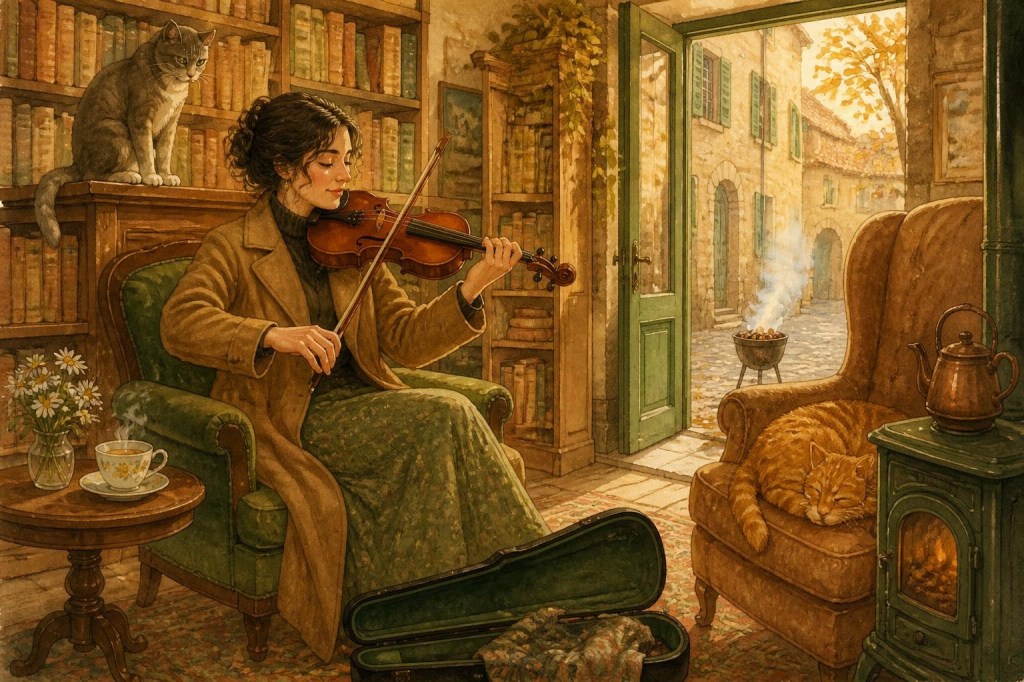
A young woman stopped on the threshold. She was perhaps thirty-five, in a long camel coat, with dark hair pinned up in a hurry, and she held a black violin case against her chest the way some people hold a child, or a shield. She did not come in. She looked at the window display, then at the street, then at the window display again.
“You can come in,” said Moira, without turning round. “The dictionary is only holding the door. It doesn’t bite.”
The woman laughed, a small startled laugh, and stepped inside.
On the counter, Toe, the slender grey cat with white paws and green eyes, sat up very straight and watched the violin case with deep professional interest. In the big armchair by the stove, Ashwaganda, the enormous ginger tabby, lifted his head, considered the newcomer for a long moment, and then began, slowly, to purr, a sound so deep it seemed to come up through the floorboards.
The Woman with the Violin Case
“I’m looking for sheet music,” the woman said. “Or no. I’m looking for an excuse. I don’t know which.”
“Those are on different shelves,” said Moira, “but I can help with both. I’m Moira.”
“Matilde. Matilde Ferraris. I teach violin at the music school, above the pharmacy.” She hesitated. “Don Lino has asked me to play at the concert for Saint Cecilia. On the twenty-second. A solo. In the church.”
“How lovely,” said Moira.
“It isn’t,” said Matilde. “I mean, it is. But I played last year, too. And in the middle of the second movement, my bow slipped, and the E string made a sound like a gate that needs oil. In front of the whole village. I stopped. I froze, completely, for I don’t know how long. Then I started again, and I finished, and everybody clapped, but I didn’t hear any of it. I went home and I didn’t take the violin out of its case for three weeks.” She looked down at the case. “I have to give Don Lino an answer by Saturday. I was going to tell him no. I was on my way to tell him, actually. And then I smelled the chestnuts and walked the other way.”
Moira put down the feather duster.
“Matilde,” she said, “do you have twenty minutes?”
“I have a student at five.”
“Then you have forty. Sit down. Put the violin somewhere Toe can’t sit on it, which is nowhere, so keep it on your knees. I’ll make tea.”
Chamomile, Lemon Verbena and a Pinch of Lavender
In the little kitchen behind the counter, Moira took down three jars. Chamomile first, the small dried flowers like a handful of tiny suns, smelling faintly of apples and hay. Then lemon verbena, long pale leaves that she crushed lightly between her fingers so that the whole kitchen briefly smelled like a lemon grove after rain. And last, a very small pinch of lavender, no more than a few buds, because lavender is like a loud guest at a dinner party: delightful, in moderation.
“Why those?” Matilde called from the armchair, where she was sitting very upright with the violin case across her knees.
“Chamomile because it is the oldest friend of nervous evenings in half the kitchens of Europe,” Moira called back. “Lemon verbena because it’s cheerful, and I think a brave tea should be a little bit cheerful. And lavender because it smells like linen drying in the sun, and nobody has ever felt worse after smelling linen drying in the sun. I make no medical promises. It’s a warm cup and a quiet chair, and those do most of the work.”
She came back with two cups and set one beside Matilde. The steam rose pale gold in the light from the open door.
Matilde wrapped her fingers around it. Moira noticed that her fingertips, on the left hand, were hard and flattened from years of pressing strings. A musician’s hand. A hand that had practised for decades, and still did not trust itself.
What the Village Remembers
“May I ask you something odd?” said Moira, sitting down opposite.
“Everything about today is odd.”
“I was at that concert last year. In the third row, next to Signora Amalia, who brought biscuits in her handbag and rustled them through the Ave Maria.” Moira smiled. “Do you know what I remember about your playing?”
Matilde went pale. “The squeak.”
“I remember the slow part,” said Moira. “The part where everything went quiet and the candles were the only things moving. I remember that Signora Amalia stopped rustling. That, believe me, is a miracle you should put on your CV. I honestly do not remember a squeak. I’m sure it happened, because you say it did. But I didn’t keep it.”
“You’re being kind.”
“I’m often kind,” Moira agreed. “But I’m also old enough to be honest. And I think there’s a reason why you remember the squeak and I remember the candles. Some psychologists have studied it, in fact.”
The Spotlight That Isn’t There
“Around the year two thousand,” Moira began, settling back with her cup, “a psychologist at Cornell University called Thomas Gilovich, with two colleagues, ran a wonderfully silly experiment. They asked university students to put on a T-shirt with a large picture of a singer on it, a singer who, at the time, students would have found deeply embarrassing to be seen wearing. Then each student walked into a room full of other students, stayed a moment, and left.”
Matilde was listening now, despite herself.
“Afterwards, the researchers asked the wearers how many people in the room they thought had noticed the shirt. I’m telling you from memory, so don’t hold me to the decimals, but the wearers guessed about half. Then they asked the people in the room. In fact only around a quarter had noticed. Roughly half as many as the wearers feared.”
“Half as many,” Matilde repeated.
“They called it the spotlight effect,” said Moira. “The feeling that a bright light follows us everywhere, showing every flaw, when really most people are busy standing in their own little light, worrying about their own T-shirts. Later studies found something similar with mistakes and awkward moments: we tend to think others judge us more harshly, and remember our stumbles for longer, than they actually do. It doesn’t mean nobody ever notices anything. It means our own estimate is usually turned up too loud.”
Matilde turned the cup in her hands. “But I’m a musician. The whole point is that people listen.”
“They do listen,” said Moira. “That’s my point. They listen to the music. You were listening to the mistakes.”
Toe Makes a Mistake
It was at precisely this moment that Toe decided to take part in the conversation.
She had been sitting on the top of the nearest bookcase, looking down at the violin case with the concentrated longing of a cat who has seen a box she is not allowed into. Now she gathered herself, wiggled her hindquarters once, twice, and leapt for the arm of Matilde’s chair.
She missed.
Not by much. Her front paws reached the arm, her back paws found only air, and for one long, undignified second she hung there, scrabbling, before sliding gracefully, if a slide can be graceful, onto the rug. On her way down, her tail swept a small paperback from the side table. It landed open on the floor with a flat slap.
Toe sat up at once. She looked around the room with an expression of supreme calm, as if she had meant to arrive on the rug all along. Then she began, very thoroughly, to wash one white paw.
Matilde burst out laughing. It was a real laugh, the kind that comes from the stomach and takes the shoulders with it, and it went on for some time.
“Do you love her any less?” Moira asked, when Matilde had wiped her eyes.
“Less? I think I love her more.”
“There’s a study about that, too,” said Moira, “though I’d hold this one more loosely. In the nineteen-sixties a psychologist named Elliot Aronson played people recordings of a quiz contestant. In some versions, the contestant was brilliant and then, at the end, clumsily spilled a cup of coffee over himself. The listeners tended to like the brilliant person who spilled the coffee more than the brilliant person who didn’t. They called it the pratfall effect. Later research has found it’s not so simple: it seems to depend on who is watching and on whether the person was clearly competent to begin with. But I’ve always found it a comforting idea. A small slip, from someone who obviously cares and obviously knows what they are doing, can make them more human, not less.”
Toe finished her paw, strolled over, and climbed, this time successfully, onto Matilde’s lap, settling half on her coat and half on the violin case with an air of having been expected.
From the armchair by the stove, Ashwaganda’s purr deepened, as if he were seconding the motion.
Eight Bars in a Bookshop
For a while, nobody spoke. The chestnut smoke drifted in through the open door. Somewhere down the hill, a child was shouting for someone named Pippo. Matilde drank her tea to the bottom and sat looking at the empty cup.
“Will you play something?” said Moira. “Here. Now. Just for the cats.”
“Oh, no. I haven’t warmed up. The violin hasn’t warmed up. It will sound terrible.”
“Probably,” said Moira cheerfully. “That’s rather the idea.”
Matilde looked at her for a long moment. Then she lifted Toe, gently, onto the arm of the chair, and opened the case. The violin inside was a deep red-brown, the colour of chestnuts. She tightened the bow, tucked the instrument under her chin, and, without any preparation at all, began to play.
It was the slow movement. Moira knew it at once, from the candles and the silence of the year before. The notes came out a little cold, a little stiff, like someone walking on a frosty morning. On the eighth bar, the bow caught the string at a wrong angle and a thin, scratchy sound cut across the melody.
Matilde’s whole body flinched. Her bow stopped in the air.
In the armchair, Ashwaganda did not stop purring. Toe did not even open her eyes. Outside, the child went on shouting for Pippo. The world, Moira observed silently, had not ended.
“Keep going,” she said softly. “Nobody here is counting.”
Matilde took a breath. And then, slowly, she brought the bow down again and went on. The ninth bar. The tenth. Somewhere around the sixteenth, the violin warmed, and her shoulders came down from her ears, and the sound opened like a window. The melody climbed and turned and came home, filling the little shop from the floorboards to the dusty top shelf, where the old atlases live.
When she finished, there was a silence of the good kind. Then two people who had stopped on the pavement outside began, a little shyly, to clap.
Matilde turned bright red. She also, Moira noticed, smiled.
A Note for Don Lino
“Which part will you remember?” Moira asked, as Matilde put the violin back in its case. “The scratch on the eighth bar, or the people on the pavement?”
Matilde thought about it honestly. “Both,” she said. “But I think the pavement will be louder.”
“That,” said Moira, “is all anyone can ask.”
Before she left, Matilde bought a slim book of letters written by musicians to their students, which Moira had pulled from the shelf without a word, and a postcard of Speranza’s church tower against a blue sky. At the counter, she borrowed Moira’s pen and wrote on the back of the postcard, in quick looping handwriting: Dear Don Lino, yes. I may squeak. Please keep the candles. M.
“I’ll deliver it on my way to the lesson,” she said.
At the door, she stopped, and looked back at the grey cat, who was now sitting on top of the bookcase again, eyeing the same jump with the same longing.
“Is she going to try again?”
“Oh, certainly,” said Moira. “She always does. That’s the thing about cats. They fall off things constantly, and it never once occurs to them to stop climbing.”
Matilde laughed, tucked the violin case under her arm, not against her chest this time, and stepped out into Saint Martin’s little summer. Moira watched her walk down Via dell’Orologio, past the brazier, where she stopped to buy a paper cone of chestnuts, and on towards the church.
Behind her, there was a soft thump. Moira did not need to turn round to know that Toe had tried the jump again, and that this time, against all odds, she had made it.
Moira’s Reflection
We are, all of us, the only audience that never leaves the concert. We sit in the front row of our own lives and listen for the wrong notes with a terrible, loyal attention, and we assume that everyone else is listening just as hard. Most of the time, they aren’t. They are listening to the music, or thinking about dinner, or rustling biscuits in their handbags.
The research I told Matilde about is not a promise that nobody will ever notice a mistake. Sometimes they will. But it gently suggests that we overestimate how bright the spotlight is, and underestimate how kindly people tend to see someone who is trying. Fear of making mistakes protects us from very little. Mostly it keeps the violin in its case.
So here is my question for you, and the comments are open, with the kettle on: what is your violin, the thing you’ve stopped doing because of one wrong note, and what would happen if you played eight bars of it this week, just for the cats?
A Cup for This Story
Matilde’s brave tea, for one generous cup:
- 1 heaped teaspoon of dried chamomile flowers
- 1 teaspoon of dried lemon verbena, lightly crushed between your fingers
- A very small pinch of dried culinary lavender (4 or 5 buds are plenty)
- Freshly boiled water, poured over and covered for 5 to 7 minutes
- A little honey if you like, and something you’ve been afraid to try, waiting for you afterwards
Herbal teas are a comforting ritual, not medicine, and they cannot treat or cure any condition; if you have health concerns, are allergic to plants in the daisy family, are pregnant, or take medication, please check with a doctor or pharmacist first.
Press Play and Stay a While
If you have a few quiet minutes and a warm cup beside you, let this song keep you company, wrong notes and all.




Leave a Reply