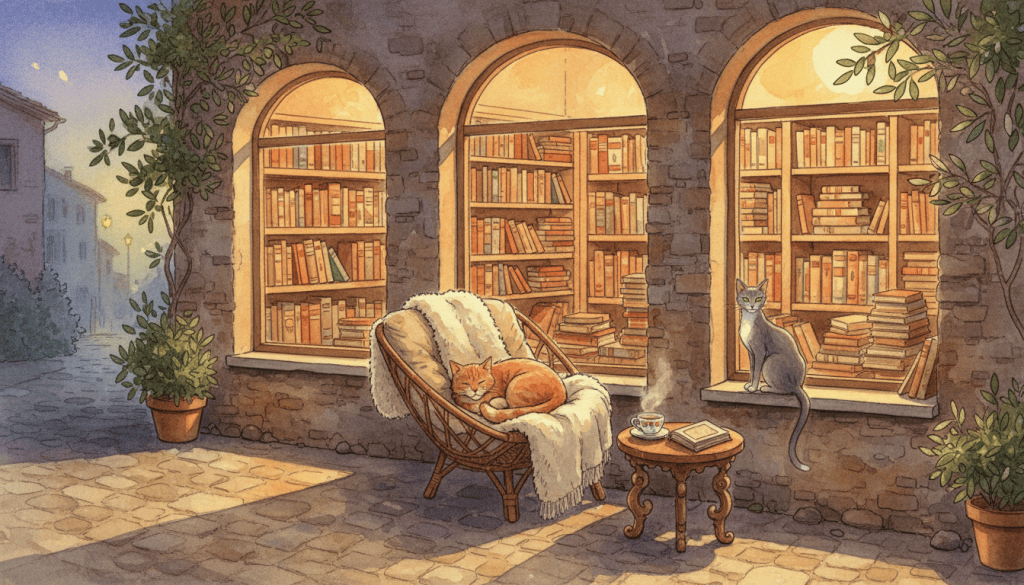
When did we learn that resting has to be earned, and what would it feel like to rest without guilt?
The Man Who Arrived Running
On the twelfth of November, the olive harvest in Speranza was in its third week, and the whole village smelled of crushed leaves and green oil. The hills along the road were draped with nets. Ladders leaned in the trees like tired giants. Everyone who owned so much as four olive trees had been up since dawn, and everyone was a little bit short of temper.
At a quarter to five, when the light on Via dell’Orologio had turned the colour of weak honey, the bell above the door of La Pagina che Fa le Fusa jangled in a hurry. A man came in sideways, the way people do when they are carrying too many things in their heads. He was perhaps forty, broad in the shoulders, with olive leaves still caught in the collar of his work jacket and a phone in each hand. One of them was buzzing. He looked at it, frowned, and put it face down on the nearest shelf, on top of a book of Calabrian fairy tales.
“I’m sorry,” he said, to no one in particular. “I only need a minute. I need a book. A present. For my sister. Something she’d like. She likes… books.”
Behind the counter, Moira Hopes put down her pencil. She had been writing the week’s orders in a ledger with a spine as soft as an old glove, and she had a long habit of noticing the people who came in sideways.
“That narrows it down wonderfully,” she said, and smiled. “Come in properly, if you can bear it. Close the door, or the draught will take every bookmark in the shop to the piazza.”
He closed the door. Then he stood in the middle of the shop with his shoulders up near his ears, looking at the shelves as if they were a to-do list.
On the windowsill, Toe, the slender grey cat with immaculate white paws and green eyes, opened one eye and examined him the way a customs officer examines a suitcase. In the big armchair by the stove, Ashwaganda, fifteen pounds of ginger tabby, did not open an eye at all. He merely adjusted his weight, and from somewhere deep in his chest came a sound so low that it was felt more than heard: a long, slow purr at about twenty-five hertz, the sort of sound that makes teacups hum on their saucers.
The man’s right shoulder dropped by perhaps a centimetre. He did not notice. Moira did.
A Present for Somebody Else
“Who is your sister?” Moira asked, coming round the counter.
“Agnese. She’s in Bologna. Her birthday is on Saturday, and I haven’t bought anything, and I haven’t called, and I haven’t…” He stopped. He looked at the phone on the shelf. It buzzed again, rattling against the fairy tales. “I’m sorry. It’s the mill. I own the oil mill, the frantoio, out on the Strada del Poggio. It’s the season. Forty-one families bring me their olives, and every one of them wants to be first, and the press broke on Monday, and the mechanic is coming tomorrow, maybe, and I haven’t been to bed before two o’clock since the second of November.”
“And your name?”
“Corrado. Corrado Bellini.”
“Moira Hopes. And this is Toe, who is judging you, and that is Ashwaganda, who has already forgiven you.” She said it kindly. “Corrado, I’ll find you something for Agnese. That part is easy. First, will you sit down for ten minutes?”
“I can’t. There’s a truck coming at six, and…”
“The truck will come at six whether you are standing up or sitting down,” said Moira. “I promise I’ll have you out of here in time. And I’ll make you a tea that you can drink while you tell me about her. Nobody ever chose a good book for a sister while standing on one foot.”
There was a long pause, in which Corrado looked at the door, at the two phones, at the green-and-gold glow of the stove. Then, as if his legs had made the decision without consulting him, he sat down on the low stool beside the armchair.
Moira went to the little kitchen behind the counter. Through the open doorway, he could hear the click of a kettle, the chime of a jar being unscrewed, the rustle of dried leaves.
Linden, Lemon Balm and a Strip of Orange
She took her time. Moira always did, and it was not by accident. She believed that the minutes spent making a cup of tea were part of the tea, the way a porch is part of a house. She chose from the shelf of glass jars with her fingers rather than her eyes: a spoonful of linden blossom, pale and papery, which smelled of honey and summer afternoons. A spoonful of lemon balm, crumbled gently between her palms to wake it up. A thin strip of orange peel, from an orange she had brought home from the market on Sunday, curled into the cup like a small golden ribbon.
“Why linden?” Corrado called, craning his neck. He could not help it; his curiosity, it turned out, was the part of him that had not been put away.
“Because in Italy we have drunk it for generations, mostly in the evening, and because it tastes like being told to sit down,” Moira answered. “Lemon balm for its lemony brightness, because a calm tea should not taste sleepy. And orange for the sake of cheerfulness. I’m not claiming any of it is a cure for anything. It’s a good cup of something warm, and the warmth is doing half the work.”
She carried the cup in, steam curling from it, and set it on the small table beside him. He wrapped both hands around it, and she saw his knuckles, cracked and stained green-brown from the olives.
“Drink it slowly,” she said. “It’s hot.”
“I don’t do slowly,” Corrado said, but he took a sip, and then a second. For a moment he said nothing. Toe had left the windowsill and was now walking along the back of the sofa with her white paws placed one in front of the other, as if testing each cushion for honesty.
“It’s very good,” he said at last, in a small voice, like someone admitting something.
What Rest Is Not
“Tell me about the mill,” said Moira, sitting down across from him with her own cup.
He told her. It came out in a rush, as things do when they have been held back for weeks. The mill had been his father’s, and his grandfather’s before that. His father had worked every harvest until the year he died, and had once pressed oil with a fever of thirty-nine degrees because “the olives don’t wait.” Corrado had been twenty-nine when he took it over, and he had never, not once, let a harvest day go to waste. He had been proud of that. He still was.
“But?” said Moira.
“But on Sunday,” Corrado said slowly, “the press broke, and for the first time in twelve years there was nothing I could do. The mechanic was in Perugia. The families went home. And I had four hours with nothing to do, and I sat on the steps of the mill, and I felt… sick. Actually sick. Like I was doing something wrong. As if somebody was going to come and catch me.” He laughed, without humour. “I’m forty-one years old. I own the building. Who was going to catch me?”
“Your father, perhaps,” said Moira, gently.
Corrado was quiet.
“I think rest has a bad reputation,” she went on, “because we confuse three different things. There’s laziness, which is simply not doing what you promised to do. There’s collapse, which is stopping because you’ve run out of everything. And there’s rest, which is stopping on purpose, so that you can continue. They look alike from the outside, and many of us were raised to treat them as the same sin. But only the last one is a skill.”
“A skill?”
“A skill,” Moira said. “And like all skills it feels clumsy at first.”
In the armchair, Ashwaganda stretched one enormous paw until it touched Corrado’s boot, and left it there, as heavy and as warm as a hot-water bottle. Corrado looked down at it and, for the first time since he had entered the shop, he did not reach for a phone.
The Cats’ Contribution
The next ten minutes were not very clever. Moira did not give advice. She asked about Agnese, and Corrado told her that his sister was three years younger, that she had left Speranza at eighteen to study architecture, that she called every Sunday and that he had missed her calls for four Sundays running. He said that the last time they had really talked, she had said: “You know, you could come to Bologna for a weekend, Corrado. The mill would survive.” And he had answered: “It wouldn’t,” and then felt the line go quiet.
“Would it?” Moira asked. “Survive?”
He opened his mouth to say no. Then he closed it. The truth was, it had survived his father’s funeral, when he had closed it for exactly two days. It had survived Monday’s broken press. It had been standing for a hundred and ten years.
“Probably,” he said, with difficulty, “it would survive a weekend.”
Toe chose that moment to climb into his lap. She did not ask. She stepped on his knee with one white paw, then the other, turned in a precise circle, and lay down with her chin on his wrist, so that her green eyes looked straight up at him. Corrado went completely still, the way a man goes still when a bird lands on his hand.
“She doesn’t do that with everyone,” said Moira.
“What do I do?”
“Nothing,” said Moira. “That’s the whole point. You do nothing, and you let her purr, and you notice that the world doesn’t end.”
Under Toe’s small, quick motor, and the great slow thunder from the armchair, the two rhythms overlapped like two bells at different distances. Corrado’s breathing, which had been quick and high in his chest, began, without any decision on his part, to lengthen. He did not know it was happening. He only knew that the tightness behind his eyes was loosening a little, like a knot in a wet rope.
What the Researchers Found When They Asked People About Rest
After a while, Corrado said, “Is it normal? To feel guilty when you stop? Or is it only me, and my father’s ghost?”
“It’s very common,” said Moira. “I can tell you about a study, if you like. It’s one I’ve always loved.”
“Please.”
“A few years ago, a group of researchers, led by a psychologist named Claudia Hammond and based at Durham University, ran something they called the Rest Test. It was a big online survey, with something like eighteen thousand people from around a hundred and thirty countries. They asked people which activities they found most restful, and how much rest they felt they got.” She turned her cup in her hands. “I’m telling you the numbers from memory, so please don’t quote me to a scientist. But two things stayed with me. The first was that the most popular answer was simply reading. The second was that many of the top answers were things that look like very little: being in nature, being alone, listening to music, and, near the top, just doing nothing in particular.”
“Reading,” Corrado said, and glanced, almost shyly, at the shelves.
“I did not plan that,” said Moira, with a twinkle. “The other thing they found, and this one comforts me, is that the people who rested most, and said they felt most rested, were not the ones who did the most extreme things. They were people who had found a few small things that worked for them and did them regularly. It was not about a holiday once a year. It was about a cup of tea on a Tuesday.”
“And the guilt?”
“The survey was not really about guilt,” Moira admitted. “But I can tell you what I understand from the wider research, with the caution I’d give to anything in psychology: many people carry a belief that their worth depends on being useful, and that belief is often learned very early, from the adults around us. It isn’t proof of anything except that we are good at learning. And what we have learned, we can, slowly, learn a different way.”
Corrado was looking at the stove. “My father used to say a man who sits is a man who’s waiting to die.”
“He may have said it with love,” said Moira. “People often say the hardest things with love. But I don’t think he was right.”
The Brain That Does Not Stop
“There is one more thing,” she went on, “and I think you will like it, because you’re a practical man, and it’s practical.”
“Go on.”
“When you sit on the steps of the mill with nothing to do, and your mind drifts, it isn’t switching off. Scientists who study the brain, in the early two-thousands, noticed that a particular set of regions becomes more active, not less, when we are not concentrating on a task. They called it the default mode network. It seems to be involved in things like remembering, imagining the future, and thinking about other people. Nobody fully understands all it does, and the science is still being argued about. But there is a nice experiment, from a team led by a researcher named Benjamin Baird, from about 2012, where people were given a creativity task, the sort where you must think of unusual uses for an ordinary object, like a brick. Then some of them were given a break with a very undemanding task, one that lets the mind wander, and some were given a hard task, and some just rested. Afterward, those with the easy, mind-wandering break did better when they came back to a problem they had already seen. It’s a small study, and I wouldn’t build a cathedral on it, but it points in a friendly direction.”
“So thinking about nothing,” said Corrado, “is working.”
“Possibly working in a way you cannot see. That is the honest version. Your mind may be sorting out your olives while you sit on the steps. But only if you let it.”
He laughed, properly this time, a short, surprised laugh, and Toe, on his lap, flicked one ear in disapproval at the movement and settled again.
“I don’t think I’ve sat down for ten minutes in front of another living creature since my father’s funeral,” he said.
“Then it’s about time,” said Moira. “How is the tea?”
He looked into the cup. It was half empty, and he had not noticed himself drinking it. “Better than I expected,” he said.
The Book for Agnese
At ten past five, he stood up, very carefully, so as not to disturb the grey cat, who had to be lifted by Moira and transferred, with a small complaint, to the sofa. Corrado picked up his phones. He looked at them for a long moment. There were fourteen messages from the mill, three missed calls from a number he did not recognise, and one message, sent an hour ago, which said: “Sunday? Don’t forget. A.”
“The book,” said Moira, and went to the shelf by the window.
She chose slowly, and he watched her do it, as if he were watching a craftsperson at work. She drew out a slim hardback with a pale green cover and put it into his hands. “It’s a collection of short stories about siblings. Not sentimental ones. Funny ones, sharp ones, and one that will make you cry on the train. I suspect Agnese will like it, because it is a book about people who love each other badly and then well.”
“And me? Do I need a book?”
“You need a weekend,” said Moira. “But I can recommend a book to read on the way to Bologna.”
Corrado looked at the book. Then at the phone. He did what Moira had not asked him to do: he put the phone to his ear, and pressed a number, and waited, standing in the middle of the shop with the sound of the cats’ purring behind him.
“Agnese?” he said. “No, nothing’s wrong. Nothing. I… I wanted to say happy birthday early. No, I’m not busy. I mean, I am. But I’m not busy right now.” A pause. “Is the sofa free this weekend? Because I might… yes. Yes, I know. I know. I’ll ask Tonino to run the mill for two days. He’s been wanting to anyway. No, I’m serious.”
Moira busied herself with the ledger, and pretended not to listen, which is a thing that booksellers are very good at.
When he hung up, he stood looking at the phone as if it had done something unexpected. “She cried,” he said. “I think. Or she was laughing. It’s hard to tell.”
“With sisters it often is,” said Moira.
The Door and the Draught
He paid for the book, and for a second, smaller, paperback, a gentle novel about a man who inherits a mill, which Moira had slipped into the bag without comment, and which he accepted without asking why. At the door, he paused with his hand on the latch.
“Moira. What do I tell them, the families? When I say that I’m taking two days?”
“The truth,” said Moira. “That the mill will be closed on Saturday and Sunday, that the press will be mended by then, and that the olives, believe it or not, will still be olives on Monday. Forty-one families will survive it. They may even be grateful. A tired miller, after all, makes poorer oil than a rested one.”
“Is that true?”
“I have no idea,” Moira said cheerfully. “But I do know it’s true of booksellers.”
He laughed again. At his feet, Ashwaganda, who had somehow left the armchair, wound once, twice, around his boots, leaving a faint trail of ginger fur on the dark cloth, like a blessing. Corrado crouched, and with one cracked, green-stained hand, he stroked the great warm back, once, from head to tail.
“Thank you,” he said, to both of them, and to the room. He went out, and the bell rang softly, and the draught took exactly one bookmark to the floor.
Through the window, Moira watched him walk down Via dell’Orologio. At first he walked fast, as he had come in. Then, near the fountain, he slowed. He stopped. He stood for a moment, looking up at the hills where the nets lay silver in the last light, and just stood there, with the green book in his hand, doing nothing in particular.
“Well,” said Moira softly. “That’s a start.”
From the sofa, Toe stretched out one white paw, and yawned.
Moira’s Reflection
I have often thought that we are taught everything about work and nothing about rest. We learn to tell time by the hours we have been useful, and we measure a day by what it produced. Then one afternoon the press breaks, or the illness comes, or the children grow up, and we find ourselves on a step with nothing to do, and the silence feels like an accusation. I don’t think it is. I think it is an invitation we have simply never learned to read.
Rest, I have come to believe, is not the opposite of caring, whether for a mill, a family, or a bookshop. It is what makes caring last. The research I told Corrado about is small and incomplete, as most good research is, and it does not promise miracles. But it gently suggests what the cats have always known: that stillness is not emptiness, and that a few quiet minutes, taken on purpose, may be doing more work than we can see.
So here is my question for you, and the comments below are open, as always, with a pot of tea waiting: what is the smallest thing that truly rests you, and when did you last give yourself permission to do it?
A Cup for This Story
Corrado’s evening tea, for one generous cup:
- 1 heaped teaspoon of dried linden blossom
- 1 teaspoon of dried lemon balm, crumbled between your palms
- 1 thin strip of fresh orange peel (no white pith)
- Freshly boiled water, poured over and covered for 7 to 8 minutes
- A little honey, if you like, and a chair you do not intend to leave for ten minutes
Herbal teas are a comforting ritual, not medicine, and they cannot treat or cure any condition; if you have health concerns, or you are pregnant, or take medication, please check with a doctor or pharmacist first.
Press Play and Stay a While
If you have ten quiet minutes, and a warm cup beside you, let this song keep you company while you do nothing in particular.




Leave a Reply