Why can’t I switch off at night?
A Knock After Closing Time
The knock came at twenty past ten, which in Speranza is very late indeed. The clock on Via dell’Orologio, four minutes slow as always, had already struck the hour with the tired dignity of an old man clearing his throat, and the shutters of La Pagina che Fa le Fusa were halfway down.
Moira Hopes lifted them again. On the step stood a young man in a thin jacket, with a laptop bag over one shoulder and the particular brightness in the eyes of someone who has been staring at a screen since breakfast.
“I’m so sorry,” he said. “I saw the light. I’m staying at the guesthouse above the bakery, and I can’t sleep, and I can’t work, and I thought if I walked long enough my head would get tired before my feet. It hasn’t.”
“Then your feet had better come in,” said Moira. “The kettle is still warm.”
His name was Tomas. He translated technical manuals from German into Italian and Italian into English, he said, mostly for companies that made pumps. He had a deadline on Friday, three hundred pages about valves, and every night for a month he had lain in bed with sentences marching across the ceiling.
“It’s not even worry, exactly,” he said, sinking into the green armchair by the stove. “It’s more like my brain is a radio that nobody switched off. Valve, pressure, deadline, did I reply to that email, did I lock the door, what did I mean by that thing I said in 2019.”
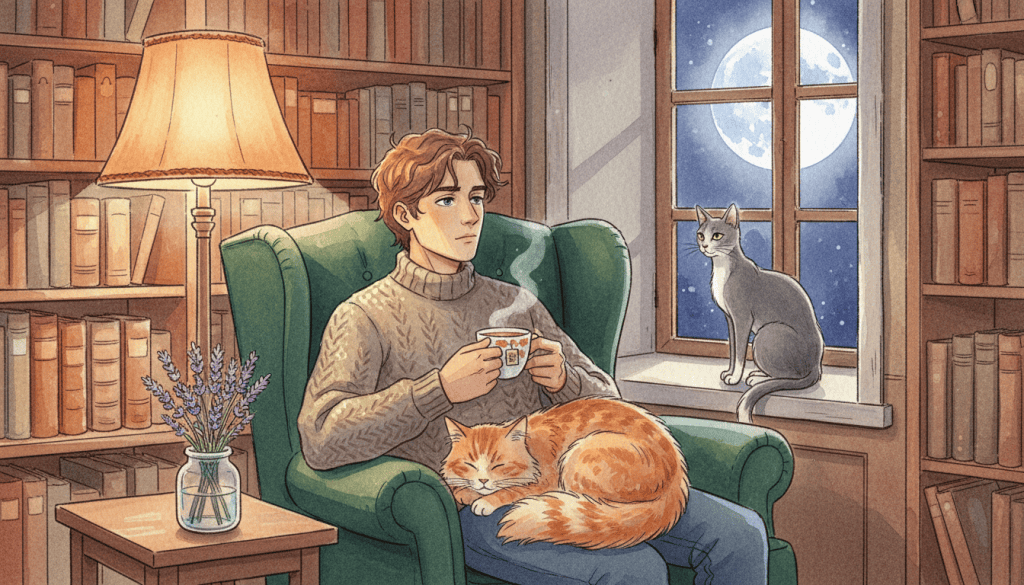
On the third stair, Ashwaganda opened one amber eye. Fifteen pounds of ginger tabby considered the visitor, judged him to be a person in need of weighting down, and descended the staircase one deliberate step at a time.
The Radio That Nobody Switched Off
Moira took down two jars. One held lavender, grey-blue and dry as paper. The other held lemon balm, which smells, when you rub it between your fingers, like a lemon that has decided to be kind.
“I won’t pretend this is a sleeping draught,” she said, spooning them into the brown teapot. “It’s a cup of something warm and fragrant at an hour when your body would like to be told the day is over. That’s all. But sometimes that’s quite a lot.”
Ashwaganda arrived at the armchair, made no request for permission, and poured himself onto Tomas’s lap like a sack of warm flour. The purr started at once, low and even, somewhere beneath hearing.
“Oh,” said Tomas. “He’s heavy.”
“He’s very good at it,” said Moira. “Plenty of people find that a little weight is calming. He has made a career of it.”
From the windowsill, Toe the grey cat watched with his green eyes half closed, his white paws folded neatly beneath him, as if supervising a procedure he had seen many times before.
What Moira Has Learned About Busy Minds
While the tea steeped, Moira sat on the footstool and spoke quietly, the way you talk near a sleeping child.
“I’m a bookseller, not a doctor,” she said, “and if you can’t sleep for weeks on end, the right person to see is your doctor. But people bring me this question often, so I’ve read a bit. Here’s what I’ve gathered.
“The mind doesn’t like loose threads. When you go to bed with a dozen unfinished things, it keeps picking them up to check they’re still there. Some people find it helps to give the threads somewhere else to live. A notebook by the bed. Before you turn out the light, you write down tomorrow’s three most important jobs and anything that’s nagging at you. It sounds too simple. But the list holds the threads, so your head doesn’t have to.”
Tomas laughed softly. “A to-do list for my ceiling.”
“Exactly. The second thing is light. You’ve been looking at a bright screen all day, and very likely in bed too. Sleep researchers generally suggest dimming the lights and putting the screens away for a while before bed, so the evening actually feels like evening. Lamps, not ceiling lights. Paper, not pixels.”
“And the third?”
“The third is the one people dislike,” said Moira, smiling. “If you’ve been lying awake a long time, getting frustrated, it’s often suggested you get up, go somewhere quiet and dim, and do something boring until you feel drowsy. The bed should be for sleeping, not for arguing with yourself.”
“So walking to a bookshop at ten at night was correct,” said Tomas.
“Entirely correct,” said Moira. “Though I’d recommend somewhere closer next time.”
The Lavender Hour
She poured the tea. It was pale green-gold and smelled of summer hillsides and lemon peel. Tomas held the cup in both hands and breathed it before he drank.
“In my grandmother’s house,” Moira said, “the last hour before bed had a name. She called it the lavender hour. No work, no news, no arguments. Just a lamp, something to sip, and something slow to do with your hands: darning, a crossword, a few pages of a book you already know the ending of. She said the day needs a doorway, not a cliff.”
“A doorway, not a cliff,” Tomas repeated. “My days end like a cliff. I close the laptop and fall straight into bed, still running.”
Moira went to the shelf of old paperbacks, chose one with a soft, cracked spine, and put it in his hand. It was a collection of short stories about a village by the sea, nothing in it louder than a fishing boat.
“Not for translating,” she said. “For reading badly, half asleep. It’s very boring in the best way.”
Tomas opened it and read a paragraph aloud, slowly. Then another. His voice dropped as he went. Ashwaganda’s purr seemed to drop with it. Somewhere around the third page, Toe left the windowsill, crossed the floor without a sound, and lay down on Tomas’s feet, completing the arrangement.
The clock outside struck eleven at four minutes past. Tomas did not hear it. His head had tipped against the wing of the armchair, the book open on the cat, the cup cooling on the table.
The Note on the Napkin
Moira let him doze for twenty minutes. Then she touched his shoulder and he woke, embarrassed and astonished.
“I haven’t done that in a month,” he said.
“Then go and do it again in a proper bed,” said Moira. “Before you lie down, write your three jobs for tomorrow. Lamp, not ceiling light. Leave the laptop in the bag. And keep the book.”
At the door he took a paper napkin from the counter and wrote on it, there and then: 1. Chapter 12, valves. 2. Email Klaus. 3. Buy lavender. He folded it into his pocket like a ticket.
“The radio is quieter,” he said, tapping his temple.
“It doesn’t have to be off,” said Moira. “Just turned down enough to hear the rain.”
He walked back up the street toward the bakery, his steps slower than when he came. Ashwaganda returned to the third stair. Toe washed one white paw. And Moira lowered the shutters, finally, on a shop that smelled of lavender.
Moira’s Reflection
We treat the end of the day as a switch, and then wonder why we’re still humming in the dark. But minds are more like kettles than lamps: they need a little while to cool. A list to hold the loose threads, a dimmer light, a slow thing for the hands and a warm cup are not magic. They’re simply a doorway, built on purpose, between the day and the night.
What does the last hour of your day look like? Do you have your own lavender hour? Tell us in the comments.
A Cup for This Story
Moira’s Lavender Hour Tea:
- 1 teaspoon of dried lemon balm
- A small pinch of dried, food-grade lavender (a little goes a long way)
- A thin strip of lemon peel
- 250 ml of water just off the boil
- Steep covered for 5 minutes, strain, and drink by lamplight
Herbal teas are a comforting ritual, not medicine. If you are pregnant, taking medication or have ongoing trouble sleeping, please talk to a health professional.
Press Play and Stay a While
If you’re not quite ready to leave the bookshop, here is the song of Speranza to keep you company while your tea cools.




Leave a Reply