How do you define success in life?
View all responses
There is a particular kind of tired that has nothing to do with sleep. It arrives on the evening of the day you finally get what you worked for. The congratulations have stopped, the room has gone quiet, and you discover that the feeling you were promised did not come with the package. You were told, for years, that there would be a summit, and that standing on it would feel like something. Instead you are simply standing somewhere, slightly out of breath, looking at the next mountain.
It is a very modern kind of loneliness, and it is far more common than anyone admits at dinner parties. In the village of Speranza, where the hills fold over each other like blankets and the rain in November arrives politely and stays for days, it has a simple cure. The cure is a pot of tea, a very large cat, and a conversation with someone who is not trying to sell you anything.
This is the story of the evening a woman walked into La Pagina che Fa le Fusa carrying everything she had ever wanted, and left it, for a little while, on the floor.
The Last Bus Out of the Rain
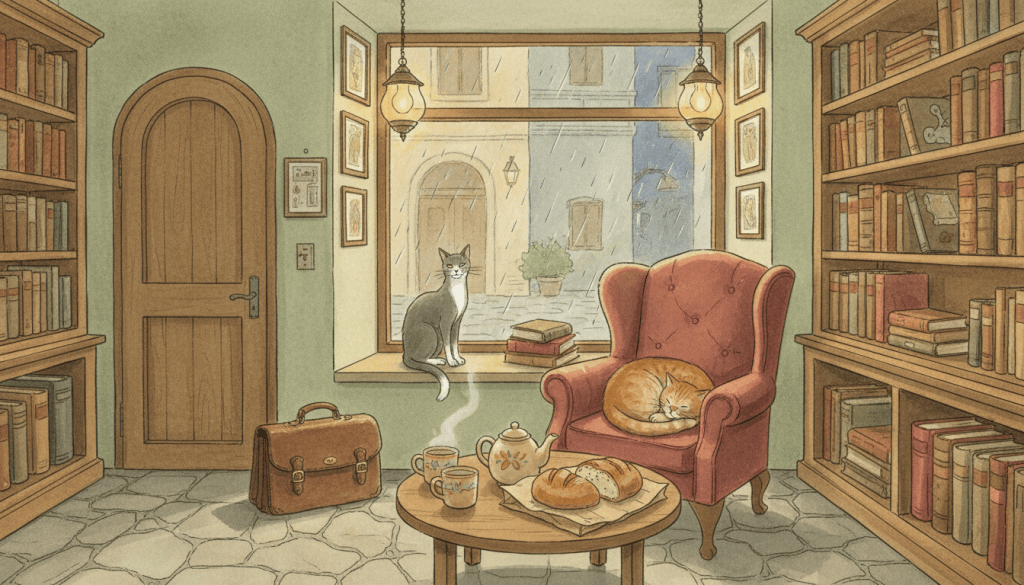
By five o’clock the light over Via dell’Orologio had turned the color of weak tea, and the cobblestones shone like the backs of fish. Inside the bookshop, Moira Hopes was doing what she did at the end of most afternoons: moving slowly from lamp to lamp, switching them on one at a time so that the shop seemed to wake up gently rather than all at once.
Ashwaganda, the fifteen-pound ginger cat, was asleep in the velvet armchair by the cast-iron stove with his chin resting on the armrest and his back paws stretched out behind him like a dropped scarf. Toe, the slender grey cat with the immaculate white paws, sat on the windowsill with his tail curled around his feet, conducting his nightly inspection of the street. Anything that moved on the cobblestones was noted, assessed and, if found harmless, forgiven.
The brass bell above the door gave its soft, lingering note. A woman stepped in backward, shouldering the heavy door open because both of her hands were full. In one she held a leather briefcase that cost more than the shop’s entire stock of poetry. In the other she held a bottle of prosecco wrapped in tissue paper and tied with a silver ribbon, the kind of gift that arrives with a card signed by forty people.
She was perhaps forty, wearing a charcoal coat so perfectly tailored that the rain seemed to have slid off it out of respect. Her hair was pinned up with the precision of someone who had not allowed a single strand to misbehave since the previous decade. Her name was Livia Marchetti, and that morning, in a glass-walled office in Bologna, she had been made a partner in one of the most respected law firms in northern Italy.
“I’m so sorry,” Livia said, in the quick, clipped voice of a person who apologizes before she has done anything wrong. “I don’t want to buy anything. The last bus to the station was cancelled. There’s been a landslide on the line, and the man at the stop said the next one might not come until nine. I only need somewhere dry to sit. I can pay for the privilege. I can buy a book. I can buy ten books.”
“You do not need to buy anything to be dry,” Moira said, smiling. “Put your things down. Take off your coat. It is far too elegant for a room that smells of cedar smoke and old paper, and it will thank you for a rest.”
Livia hesitated, which was unusual for her. Hesitation, in her profession, was a form of weakness. But something in the shop’s stillness, in the amber pools of lamplight and the faint rhythmic rumble coming from the armchair, loosened her grip. She set the briefcase against the wall, placed the prosecco carefully on the floor beside it as if it might wake someone, and allowed Moira to take her coat.
A Pot of Lemon Balm and Ginger
Moira did not ask what the woman did for a living. In her experience, it was always the first question people asked each other and almost never the interesting one. Instead she disappeared into the little kitchenette behind the poetry shelves and began to choose.
For a person whose shoulders sat two inches higher than nature intended, she wanted something that would soften without sedating. She chose dried lemon balm, a leaf that herbalists have trusted for centuries to calm a racing mind, and that modern researchers have studied for its gentle effect on mood and restlessness. She added a few flowers of chamomile, and then, because the evening was cold and the woman’s hands had been trembling slightly around the bottle, a single thin coin of fresh ginger for warmth. The kettle rattled to a boil. The steam smelled of summer lemons and sunlit gardens.
When Moira returned with the tray, Livia had not sat down in the armchair offered to her. She was standing in the middle of the room, scanning the spines with the rapid, evaluating gaze of a person who read contracts for a living, and who could not quite switch the habit off.
“That chair is taken, I’m afraid,” Moira said, nodding toward the stove. “But there is a second one beside it, and the occupant of the first is a very generous neighbor.”
Livia sat. The cushion exhaled. Within half a minute, Ashwaganda opened one golden eye, studied her with the lofty patience of a judge reviewing an appeal, and then heaved himself across the gap between the chairs with a soft, grunting brrrp. He climbed onto her lap, turned around exactly twice, and settled his enormous warm weight across her knees like a living hot-water bottle.
“Oh,” said Livia. “I wasn’t expecting that.”
“Nobody ever is,” said Moira. “He has excellent instincts. Please do not feel obliged to move him. It would be considered very rude.”
The purr started low, a deep and steady twenty-five-hertz hum that traveled up through Livia’s thighs and into the hollow of her chest. She looked down at her own hands, which did not know what to do with a cat, and slowly lowered them onto his warm, dense fur. For the first time since six that morning, her shoulders came down from around her ears.
The Spreadsheet She Made at Twenty-Two
She drank the tea in small, careful sips. Outside, the rain thickened. Toe left the windowsill, crossed the room with his unhurried, geometrical walk, and sat directly in front of the briefcase by the door, studying the bottle of prosecco as though it were an unfamiliar bird.
“I should be happy,” Livia said suddenly, to nobody in particular. “That’s the ridiculous thing. I should be so happy. I made partner today. I’ve wanted it since I was twenty-two. I made a spreadsheet, you know, in my first year at university. Columns for every milestone: top of my class, first internship, first job at a major firm, first major case, partnership by forty-one. I color-coded it. Every time I hit a target, I turned the cell green.”
“And today the last cell turned green,” said Moira, sitting down across from her with her own cup.
“At ten past eleven this morning. They popped the champagne, and everyone made speeches. The senior partner said I was an example to the younger lawyers. And I stood there smiling, and what I actually thought, all through the speeches, was: what is next? Not in an excited way. In an empty way. As if I had been running up a staircase for nineteen years and had just discovered that the landing had no door.”
She laughed, but it came out thin. Ashwaganda pressed his forehead into her wrist, as if to say that the laugh was not required here.
“I called my mother on the way to the bus stop,” Livia went on. “She cried with happiness. She told me she’d tell everyone at church. And I felt nothing, Moira. I felt like an actress who had forgotten her line. What is wrong with me? I got everything I asked for.”
“Nothing is wrong with you,” Moira said gently. “Something is rather right with you, actually. You are noticing. Most people spend their entire lives climbing the staircase and never stop to ask about the door.”
The Science of the Disappearing Summit
Moira set her cup down on the low table. Toe, who had abandoned the prosecco, hopped up beside it and sat with his paws together, listening, as he always did when she was about to explain something.
“There is a name for what you are feeling,” she said. “Psychologists call it hedonic adaptation. It is the habit of the human mind to return to its baseline level of contentment, no matter how wonderful or terrible the thing that happened to us. In a famous study from the nineteen-seventies, researchers compared lottery winners with people who had suffered serious accidents. The winners did not turn out to be dramatically happier than everyone else once the excitement faded. Later research has argued about the details, as good research should, but the central idea has held up well. We are astonishingly good at getting used to things. We get used to the salary, the title, the corner office, and the applause. Within weeks, sometimes within hours, the new thing becomes the ordinary thing.”
“So it was all pointless,” said Livia bitterly.
“Not pointless. Misdirected. There is a second idea, which the psychologist Tal Ben-Shahar has called the arrival fallacy: the belief that when we arrive at some particular destination, we will be happy ever after. It is a very comfortable lie, because it lets us postpone living until later. The mind says, I will rest when I make partner, and then I will be kind when the pressure eases, and then I will call my sister when this case is over. The destination keeps moving, because the part of you that was never satisfied at the beginning does not become satisfied at the end.”
Livia was very still. Her hand had stopped moving on the cat’s fur, and Ashwaganda, who took such things personally, nudged it with his head until she began again.
“I haven’t spoken to my sister in two years,” Livia said quietly. “Not properly. We exchange messages at Christmas. She lives in Lecce now. She’s a teacher. She has two children I’ve only met twice. I always meant to go down. There was always a deadline.”
“Yes,” said Moira, with no triumph in her voice at all. “There always is.”
The Baker Who Came for His Glasses
It was at that moment that the bell above the door rang again, and a gust of wet, yeasty, wonderful air blew into the shop.
The man who came in was short and round and about seventy, with forearms like fence posts, white flour still ghosted into the creases of his knuckles, and a green knitted hat pulled down over his ears. He carried a paper bag under one arm, and from the bag rose the smell of bread so fresh that Livia’s stomach, which had accepted nothing but coffee since dawn, announced itself loudly in the quiet.
“Baldo,” said Moira, standing. “You are early. And wet.”
“I left my reading glasses on your counter yesterday,” said the baker, in the unhurried voice of a man who had never in his life been late for the oven. “I can’t read the new order forms without them, and Sofia refuses to tell me anything I want to hear. And I brought you this, because the first batch came out so well that it would be criminal to keep it to myself.”
He set the bag on the low table, and the room filled with the scent of warm crust and wheat. Toe stood up on all four white paws, his nose twitching with scholarly interest. Baldo’s eyes traveled to the stranger in the armchair, to the pinned hair and the pearl earrings, to the enormous ginger cat spread across her lap like a conquering general, and he smiled the particular smile of a man who has seen a great many travelers hide in this shop.
“Baldo Rinaldi,” he said, offering a floury hand. “I make the bread in the square.”
“Livia,” she said, and shook it, and was a little startled to find that the hand was as warm as the loaf.
Moira tore the bread in half. The crust crackled. Steam unrolled into the lamplight, and for a moment no one spoke, because nobody has ever found anything useful to say while holding a piece of bread that fresh. Livia bit into hers and closed her eyes. It tasted of salt and wheat and the slow patience of something that had been allowed to rise in its own time.
“Livia was just asking,” Moira said innocently, “what it means to be successful.”
“I was not,” said Livia, startled. “I was telling you about a spreadsheet.”
“Same question,” said Moira, “wearing a different coat.”
Baldo chuckled and lowered himself onto a wooden stool with the care of a man whose knees had stood at a counter for fifty years. He took the cup Moira handed him and held it with both hands.
“Success,” he said, in the tone of someone turning over a familiar stone. “My son-in-law asks me this all the time. He is an accountant in Milan and he has a plan for me. A second bakery, a third, a franchise, a brand. He showed me a presentation with arrows. ‘Papà,’ he says, ‘you could be a chain.’ And I tell him: Alberto, I have never wanted to be a chain. I have wanted to be a baker.”
“But isn’t that exactly what you’d call ambition?” Livia asked, and heard her own voice come out sharper than she intended. “Growing. Building something larger than yourself?”
“Maybe for you,” said Baldo, without offense. “For me, I tell you what a good day is. At a quarter to five in the morning, in the dark, the first people come through the square. The man who drives the milk truck. The nurses coming off the night shift at the clinic. The girl who opens the pharmacy. And the bread is warm. It is exactly warm, not too much, not too little. And I put it into their hands, and they smell it, and for one second, before the day begins, their faces change. That is my success. It happens every morning. I have had it eleven thousand times, maybe more.”
He took a sip of lemon balm tea, wrinkled his nose at the ginger with great politeness, and drank it anyway.
“I have never been rich,” he added. “I have never been famous. Nobody will give a speech about me. But when my wife was ill, the whole village took turns cooking for us for four months, and there was not a single day when someone did not knock on the door with a pot. A man who is loved like that has not failed. I know a little about failing, signorina. I think I have been very successful indeed.”
What the Longest Study in the World Found
Livia said nothing for a long moment. She chewed the last of her bread. Rain tapped on the window glass, a sound so regular that it seemed to be counting something.
“May I add something?” Moira asked, and when both of them nodded, she went on. “There is a research project in Boston, begun in nineteen thirty-eight, that has followed the same group of people for more than eighty years. It began with young men, and it later expanded to include their wives, and then their children. It is called the Harvard Study of Adult Development, and it is probably the longest scientific investigation of human lives ever undertaken. The researchers measured everything: health, careers, incomes, marriages, habits, and in the end, happiness.”
“And what did they find?” Livia asked. “That money doesn’t buy happiness? I could have told them that.”
“Quite the opposite, in fact. Money helps, and so does a good job, and nobody in the study pretended otherwise. But the single strongest predictor of who would be healthy and content at eighty was not their salary, their fame, or even their cholesterol. It was the quality of their close relationships at fifty. People who had warm connections, someone they could call at three in the morning, someone who knew their real name and not only their title, lived longer, stayed sharper, and reported being happier. The directors of the study have put it plainly: good relationships keep us happier and healthier. It is not a romantic idea. It is a data set.”
Toe, who had been listening with great seriousness, stood, stretched with exquisite slowness, and stepped across the table to settle himself against Baldo’s knee. The baker scratched him between the ears without looking down, the way a person strokes something he has loved for a very long time.
“So the people who were most successful by the old definition,” said Livia slowly, “and the people who were most successful by yours, Baldo…”
“May turn out to be the same people,” Moira finished, “if they were lucky enough to know who they were doing it for.”
Turning the Cell Green
For a while, no one spoke. The stove ticked as it cooled. Ashwaganda’s purr had slowed to the long, deep rhythm of a heart that was in no hurry whatsoever, and Livia noticed, with faint surprise, that her own breathing had slowed to match it.
She reached down to the floor beside her chair, where her phone lay face-down. She turned it over. It glowed with forty-three unread messages, congratulations stacked on congratulations, and none of them from anyone she would have called at three in the morning. She scrolled until she found a name she had not tapped in months.
“It’s nearly six,” she said. “She’ll be putting the children to bed.”
“Bedtime is a wonderful time to be telephoned by an aunt,” said Moira.
“What would I even say?”
“That you were thinking about her,” said Baldo, from the stool. “That is a whole conversation. You can leave the rest for later.”
Livia looked at the cat on her lap, at the baker in his green hat, at the tall, calm bookseller waiting without any trace of expectation, and then she pressed the name. The phone rang four times. Moira and Baldo, with the perfect tact of people who have spent their lives in small places, rose and carried the tray into the kitchenette, where they became extremely interested in the washing-up.
From the armchair came a murmur. A pause. A small, startled laugh that cracked in the middle. Then a long silence, and then a voice that was no longer the voice of a partner at a firm, but the voice of a younger sister saying, I’m sorry, I know, I’m sorry, tell me about the children. Tell me everything.
Toe, who had been watching from the windowsill, closed his green eyes in what could only be described as approval.
The call lasted forty minutes. When Livia put the phone down, her mascara had given up its position entirely, and her hair had slipped from its pins, and she looked a good ten years younger and considerably less tidy. She had agreed to take the first available train to Lecce the following Friday. She had promised to bring a pasta machine, because her nephew wanted to learn to make tagliatelle. She had not once mentioned the word partner.
“I think,” she said, a little shakily, to the room at large, “I’ve been keeping the wrong spreadsheet.”
“Then start a new one,” said Moira, returning with a fresh pot. “There is no rule about the number of columns.”
“What would be in it?”
“Whatever you would be proud to have turned green on an ordinary Tuesday, with no one watching,” said the baker, who had been trying very hard not to listen and had heard every word. “I would put: warm bread, and a call to my daughter, and a walk in the hills with my wife’s old scarf around my neck. I would put: the bread was warm. Again.”
Livia laughed, properly this time, a real laugh that shook the cat. Ashwaganda gave a theatrical sigh and rearranged himself without opening his eyes.
The Nine O’Clock Bus
The nine o’clock bus did arrive, eventually, groaning up the hill through the rain with its headlights smeared into long gold stripes. By then, Livia had eaten two more slices of bread, listened to Baldo explain, in loving detail, why the secret of good sourdough is mostly patience, and discovered that Toe had quietly curled up on top of her briefcase and gone to sleep, as though he, too, had decided that it was not the most important thing in the room.
She stood at the door, buttoning her tailored coat, which looked a little different now, a little more like clothing and a little less like armor. Moira handed her a small paper packet tied with kitchen string.
“Lemon balm and chamomile,” she said. “Add the ginger if you like, but only if you are cold. And take this.”
It was the prosecco. Livia had left it on the floor, forgotten. She looked at it for a moment, then pushed it gently back across the counter.
“Keep it,” she said. “Open it with whoever comes in on the first night of snow. Tell them it’s from someone who finally understood the question.”
“And what is the answer?” Baldo called after her, from the stool, grinning.
Livia paused in the doorway, with the rain blowing silver into the lamplight and the bus waiting at the bottom of the hill. “I think,” she said, “it’s whatever you would still be glad of if nobody ever found out.”
The bell chimed its long, lingering note. The door closed. In the armchair by the stove, Ashwaganda, who had moved back to his own cushion the moment she stood, rolled onto his side and began, once more, to purr.
Moira’s Reflection
We are handed definitions of success long before we are old enough to question them: a grade, a title, a number in a bank account, a house with the right kind of window. These are not wicked goals, and there is nothing shameful about wanting them. The trouble begins when we mistake the scoreboard for the game. Research on hedonic adaptation tells us that every achievement is quickly absorbed into the ordinary, and that the thrill of arrival fades faster than we expect. What does not fade so quickly is the feeling of being known, of belonging to a person, a place, a routine of small kindnesses.
So perhaps the question is not what will I achieve? but who will be glad that I did, and who will I be glad to share it with? Success, defined that way, is not a summit at all. It is a table with enough chairs, a loaf of bread that is still warm, and a phone call you were brave enough to make. You do not have to abandon your ambitions to live this way. You only have to stop postponing the people.
Your turn: how do you define success in life? Tell us in the comments. And if there is someone you have been meaning to call, consider this your gentle, purring reminder.
A Cup for This Story
- 1 heaped teaspoon dried lemon balm
- 1 teaspoon dried chamomile flowers
- 1 thin coin of fresh ginger (optional, for cold evenings)
- 250 ml of just-boiled water, steeped for 7 minutes under a lid
Herbal teas are a gentle comfort, not a medicine. If you are pregnant, taking medication, or have a health condition, check with your doctor before adding new herbs to your routine.
Press Play and Stay a While
Close your eyes, let the rain do its work, and listen to tonight’s song from Speranza.





Leave a Reply