
What’s a book or movie that genuinely scared you?
View all responses
There is a specific kind of darkness that descends upon the village of Speranza in the depths of November. It is not the soft, violet dusk of midsummer, nor the crisp, starry black of a freezing January. It is a heavy, suffocating darkness, born from low-hanging rainclouds that swallow the peaks of the surrounding valleys and press down upon the slate roofs of the stone houses. On these nights, the wind does not howl; it whispers. It rattles the loose windowpanes with the persistence of a restless spirit and sends wet, decaying sycamore leaves scraping across the cobblestones like the dry scuttle of unseen claws.
On nights like these, the human imagination becomes a fragile, highly volatile instrument. The shadows stretch a little too far. The creak of a floorboard sounds less like settling wood and more like a deliberate footstep. The mind, starved for the easy visual confirmation of daylight, begins to invent its own narratives to fill the gloom.
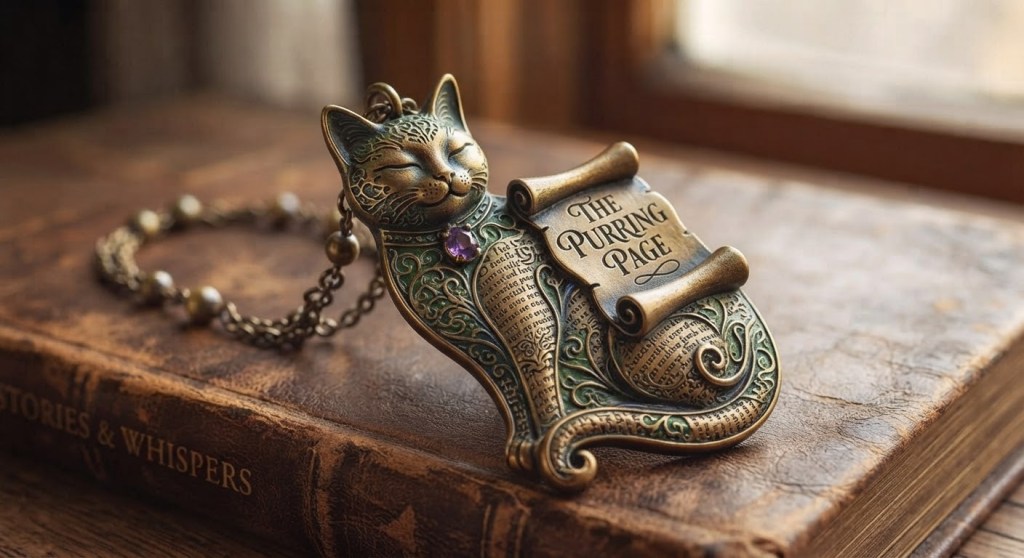
This is precisely why La Pagina che Fa le Fusa—Moira Hopes’ tea shop and independent bookstore—keeps its lamps burning brightly until the final stroke of midnight.
From the street, the shop’s large bay windows radiate a rich, golden, amber light that cuts through the miserable drizzle. To step inside is to cross a physical and psychological boundary. The scent of the shop is an immediate grounding mechanism: a thick, comforting tapestry of roasting coffee beans, dried lavender, ancient paper, melting beeswax, and the deep, resinous smoke of the cedar logs burning in the massive cast-iron stove.
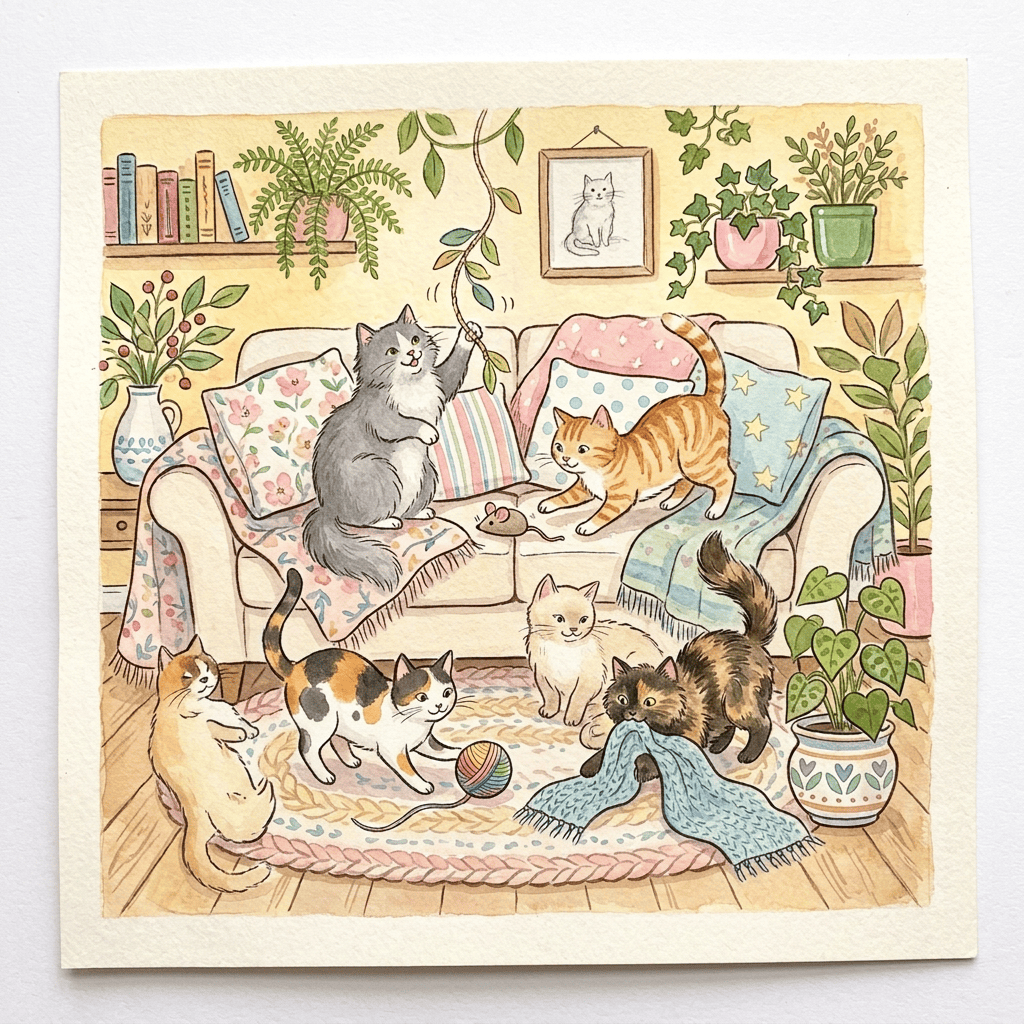
On this particular Tuesday evening, the shop was an oasis of profound quiet. Ashwaganda, the shop’s massive fifteen-pound ginger tabby, was currently demonstrating his absolute mastery over the concept of gravity. He lay draped across the back of a worn velvet armchair, his limbs hanging loosely over the sides like a molten copper blanket, his chest vibrating with a rumbling, twenty-five-hertz purr that resonated into the floorboards. Toe, the slender grey cat with the immaculate white paws, was engaged in his own quiet evening ritual: meticulously grooming his left shoulder while perched atop a stack of encyclopedias detailing the history of European hedgerows.
Behind the heavy oak counter, Moira Hopes was quietly polishing a set of antique brass scales when the brass bell above the door chimed with a sudden, sharp urgency.
The heavy door was pushed open to reveal Julian, the village’s antique barometer restorer. Julian was normally a man of meticulous logic and unflappable calm. He was a man who understood pressure, mechanics, and the predictable laws of physics. Tonight, however, Julian looked as though he had been dragged backwards through a hedge. His heavy wool coat was buttoned unevenly, his usually neat silver hair was sticking up in erratic tufts, and beneath his eyes lay deep, bruised shadows that spoke of a profound lack of sleep.
He shut the door quickly behind him, leaning his weight against the heavy wood as if trying to physically barricade the stormy night outside. He let out a long, ragged exhale.
“Julian,” Moira said, setting down her polishing cloth. Her voice was low, melodic, and entirely devoid of judgment. “You look as though you’ve been chased by the Hound of the Baskervilles. Come away from the door. The draught is terrible tonight.”
Julian pushed himself off the doorframe and walked toward the counter, his boots leaving wet, muddy prints on the woven rugs. He didn’t seem to notice. He gripped the edge of the wooden counter with pale knuckles.
“Moira,” he said, his voice dropping to a conspiratorial, slightly frantic whisper. “I have made a terrible, terrible mistake.”
“Have you accidentally purchased another collection of Victorian taxidermy?” Moira asked gently, moving toward the small copper-lined kitchenette nestled behind the register.
“Worse,” Julian groaned, burying his face in his hands. “I read a book. A specific book. And now my house is trying to kill me.”
Moira paused, her hand hovering over a glass jar of dried chamomile. She turned to look at the barometer restorer. “Ah. I see. You decided to dabble in the dark arts of psychological horror during a thunderstorm.”
“It was Sunday night,” Julian confessed, looking up with wild, exhausted eyes. “The wind was howling. The fire was lit. I felt cozy. I felt secure. I thought to myself, ‘Julian, what better time to read that classic gothic novel you bought last year?’ You know the one, Moira. The Architecture of Silence by E. Elias Thorne.”
Moira winced sympathetically. The Architecture of Silence was a notorious piece of literature. It featured no ghosts, no monsters, and no gore. Instead, it was a slow, agonizingly tense psychological thriller about a man who inherits a sprawling countryside manor, only to slowly realize that the dimensions of the house are changing. Hallways grow an inch longer every night. Doors appear where there were solid walls. The geometry of the house slowly turns inward, trapping the protagonist in an ever-shifting labyrinth of his own paranoia.
“Julian,” Moira sighed, reaching for a different jar—this one filled with dried skullcap, a powerful herb known for instantly quieting a racing, overstimulated mind. “You live alone in a three-hundred-year-old stone cottage that is actively settling into the side of a hill. Why on earth would you read a book about a house that eats people?”
“Because I am a fool!” Julian lamented, throwing his hands in the air. Toe, startled by the sudden movement, stopped grooming and pinned his ears back, observing the frantic man with narrow, judgmental green eyes. “I thought it would be atmospheric! But Moira, I haven’t slept in two days. Last night, I swear the hallway between my bedroom and the kitchen was longer than it was in the afternoon. I counted my steps. It took twelve steps instead of ten. And the floorboards… they aren’t just creaking. They are breathing.”
Moira did not laugh. In the sanctuary of La Pagina che Fa le Fusa, no genuine anxiety was ever mocked, no matter how irrational it might seem in the cold light of day.
“Sit down by the stove, Julian,” Moira instructed softly, pointing to the empty armchair opposite the one currently occupied by Ashwaganda. “Take off your wet coat. I am going to make you a very specific pot of tea, and then we are going to talk about the amygdala.”
Julian obeyed with the mechanical compliance of an exhausted man. He shed his damp coat, sank into the plush upholstery of the armchair, and stared blankly into the dancing orange flames of the cedar fire.
Moira began the deliberate, slow ritual of the tea. She measured out a robust spoonful of roasted barley to provide a deep, earthy, grounding base—a flavor that tasted of dirt and roots and solid reality. To this, she added the dried skullcap to soothe his shattered nervous system, a generous pinch of lemon balm to lift the heavy dread sitting in his chest, and a dash of sweet, warming nutmeg.
As the boiling water cascaded over the herbs, releasing a thick, fragrant cloud of steam, she carried the heavy clay teapot and two thick mugs to the low oak table situated between the armchairs.
She poured the dark amber liquid, the scent of nutmeg and roasted earth instantly competing with the smell of the woodsmoke. She handed a mug to Julian, who gripped it with both hands, using the ceramic heat to warm his trembling fingers.
“The problem with reading a genuinely terrifying book, Julian, or watching a truly frightening film,” Moira began, taking her own seat and smoothing her apron over her knees, “is that the human brain is entirely too good at its job.”
Julian took a sip of the hot tea. The earthy, grounding warmth seemed to instantly drop his shoulders by a fraction of an inch. “My brain is currently telling me that my linen closet is planning to murder me.”
“Exactly,” Moira smiled gently. “You see, the oldest part of our brain—the amygdala—is responsible for our survival instincts. It is the alarm system. It controls the fight, flight, or freeze response. But the amygdala is primitive. It is very bad at distinguishing between a physical threat standing right in front of you, and an imagined threat constructed by black ink on white paper.”
Moira took a slow sip of her tea, letting the silence stretch for a moment, filled only by the crackle of the fire and the rain lashing against the glass.
“When you read The Architecture of Silence,” she continued, “your neocortex—the logical part of your brain—knew you were sitting safely in your armchair in Speranza. But the author’s prose was so evocative, so insidious, that it bypassed your logic and spoke directly to your amygdala. Your body began to produce cortisol and adrenaline. Your heart rate increased. Your pupils dilated to let in more light, searching for predators in the shadows. Your body went to war, Julian. And the problem is, when you finally closed the book and went to bed, the cortisol didn’t just vanish.”
“It lingered,” Julian murmured, staring into his teacup. “I felt like I was vibrating. Every shadow looked deliberate.”
“It is the hangover of fear,” Moira agreed. “We seek out scary stories because we enjoy the thrill of testing our boundaries from a place of safety. We like to stand in a brightly lit room and peer out the window into the dark. It makes the light feel warmer. But sometimes, a story is so good that it reaches through the window, grabs us by the collar, and pulls us out into the cold. And getting back inside takes time.”
Julian looked up at Moira. The wild exhaustion in his eyes was beginning to dull, replaced by a quiet, desperate curiosity. “Has a book ever done that to you, Moira? Have you ever read something that genuinely terrified you?”
Moira paused. She looked around her shop, at the thousands of spines lining the walls, containing millions of lives, tragedies, and triumphs.
“Yes,” Moira said quietly. “Once. It wasn’t a book about ghosts, or serial killers, or monsters hiding in the dark. Monsters are easy, Julian. You can run from a monster. You can fight a monster. The things that truly terrify me are the things you cannot fight because they live entirely within your own mind.”
She set her teacup down on the saucer with a soft clink.
“Years ago, I read a novel called The Erasing of August. It was a quiet, unassuming literary fiction book. The protagonist was a brilliant woman, a historian, who slowly begins to suffer from early-onset dementia. But the author didn’t write it from a clinical perspective. The author wrote it from a strict, claustrophobic first-person point of view. As the character’s mind deteriorated, the prose itself began to deteriorate. The vocabulary of the book shrank. The chapters became shorter. The narrative became confused, looping back on itself, forgetting characters that had been introduced fifty pages earlier.”
Moira gave a small, involuntary shiver.
“By the end of the book, the language was reduced to simple, terrifyingly basic sentences. The character was losing her reality, and because you were trapped in her perspective, you were losing it with her. I finished the book at three in the morning, and I was weeping. Not just crying, Julian, but sobbing with a profound, existential terror. I was terrified of my own mind. I was terrified that everything I am, all my memories, all the books I have read, all the people I have loved, are just fragile chemical electrical sparks that could simply… turn off.”
Julian stared at her, the terror of his shifting floorboards momentarily eclipsed by the heavy, sobering reality of Moira’s fear. “What did you do?” he asked softly.
“I did what I am going to make you do tonight,” Moira said, her smile returning, warm and anchoring. “I administered a literary palate cleanser.”
At that exact moment, Toe decided he had spent enough time observing from the encyclopedias. The slender grey cat hopped down from the shelf, landing silently on the rug. He trotted over to Julian’s chair, stopped, and sniffed the edge of Julian’s leather satchel resting on the floor.
With a swift, practiced movement of his white paw, Toe batted at the brass buckle of the satchel. It popped open. Inside, glaring accusingly under the warm shop light, was the thick, black-spined copy of The Architecture of Silence.
Toe leaned his head forward, gave the book a long, thorough sniff, and then did something highly uncharacteristic. He turned around and kicked a small pile of imaginary dirt over the book with his hind legs, exactly as a cat does in a litter box.
Julian blinked. Then, despite his exhaustion, a short, barking laugh escaped his chest. “I couldn’t agree more, Toe. It belongs in the dirt.”
The sudden sound of laughter was the signal Ashwaganda had been waiting for. The massive ginger cat stood up on the back of his armchair, stretched until his front claws dug deep into the upholstery, and executed a surprisingly graceful leap across the low table, landing squarely on Julian’s lap.
Julian let out an “oof” as fifteen pounds of solid feline weight settled onto his thighs. Ashwaganda did not curl up. He stood on Julian’s lap, placed his two massive front paws directly onto Julian’s chest, right over his heart, and pushed his wet, pink nose against Julian’s chin.
Then, he turned on the engine.
The purr was magnificent. It was not a delicate, airy sound. It was a heavy, mechanical rumble that vibrated through Julian’s ribcage. It was the frequency of healing, of absolute safety, of ancient feline contentment.
“This is step one of your recovery,” Moira noted, picking up her tea. “The exorcism of anxiety via heavy ginger cat. Do not attempt to move him. He is currently recalibrating your heart rate.”
Julian didn’t want to move him. He sank deeper into the chair, wrapping his arms around Ashwaganda’s warm, vibrating bulk. He closed his eyes. The scent of the roasted barley tea, the sound of the rain, the heat of the fire, and the rhythmic, living weight on his chest began to drown out the lingering shadows of E. Elias Thorne’s prose.
“And step two?” Julian asked, his voice already sounding thicker, sleepier.
“Step two,” Moira said, standing up from her chair and walking over to a specific shelf near the window, “is the palate cleanser. You cannot simply go home and lie in the dark, Julian. Your brain will immediately resume its frantic search for threats. You must overwrite the terrifying narrative with something profoundly safe, beautiful, and utterly mundane.”
She ran her fingers over a row of brightly colored spines before pulling down a slender volume bound in cornflower-blue cloth. She walked back and placed it on the armrest of Julian’s chair.
Julian cracked one eye open to read the gold-embossed title. “The Secret Life of English Scones: A Baker’s Year in the Cotswolds.”
“It is a memoir,” Moira explained, sitting back down. “There is absolutely no plot. There is no suspense. For two hundred pages, a lovely elderly man named Arthur describes the exact ratios of butter to flour, the changing of the seasons outside his kitchen window, and the gossip of the local postman. The biggest source of conflict in the entire book is in Chapter Four, when Arthur’s oven thermostat breaks and he slightly overbakes a batch of lemon drizzle cake.”
Julian let out a long, slow breath, a genuine smile finally touching the corners of his mouth. “It sounds like the most boring book in the world.”
“It is an absolute masterpiece of boredom,” Moira corrected him, raising her mug. “It is a literary warm bath. You will go home, Julian. You will turn on every lamp in your cottage. You will make yourself another cup of tea. And you will read about Arthur’s scones until your eyes are so heavy you cannot hold the book open. Your amygdala will realize that the only threat in your environment is a slightly burnt pastry, and it will finally power down.”
Julian stayed in the armchair for another hour. He drank three cups of the grounding skullcap and barley tea. He allowed Ashwaganda to knead his chest until the ginger cat eventually collapsed into a heavy, snoring puddle of fur on his lap. He watched Toe bat a piece of crumpled paper across the floor.
By the time Julian finally stood up to leave, the frantic, haunted energy that had followed him into the shop was entirely gone. He buttoned his wool coat, tucked The Secret Life of English Scones securely under his arm, and left the terrifying copy of The Architecture of Silence sitting on the counter.
“Keep it,” Julian said, nodding at the gothic novel. “Put it on a high shelf. Far away from me.”
“I will lock it in the back room with the books on existential philosophy,” Moira promised with a wink. “Sleep well, Julian. Remember: walls are just walls.”
“Thank you, Moira,” Julian said softly. He pulled open the heavy oak door. The Tramontana wind was still howling, and the rain was still falling in icy sheets. The night was just as dark as it had been two hours ago. But as Julian stepped out onto the wet cobblestones, his shoulders were relaxed. He no longer looked like a man being hunted by his own imagination.
Moira watched him walk away through the bay window, the golden light of the shop casting a long, protective shadow behind him. She walked over to the counter, picked up the dark, heavy book, and ran her hand over the spine.
Moira’s Reflection We have been telling each other terrifying stories since the days we sat around campfires in caves, listening to the wolves howl in the dark. We need the shadows. We need to explore fear through the safe container of ink and paper, so that we can practice being brave when real darkness falls. But a smart reader knows that you must never leave yourself trapped in the dark. You must always build a bridge back to the light. Whether it is a cup of warm tea, the purr of a heavy cat, or a book about baking scones, the greatest triumph of a terrifying story is the profound, beautiful relief of closing the cover and remembering that you are safe.
We’ve all done it. You’re sitting alone at night, the wind is howling, and you decide it’s the perfect time to read that psychological thriller or watch a horror movie. Two hours later, you are staring at the ceiling, convinced your closet door just moved. 🫣
In our latest story from the village of Speranza, a local clockmaker makes this exact mistake and stumbles into La Pagina che Fa le Fusa seeking an emergency cure for his panic.
Moira Hopes breaks down the real science of a “fear hangover”—why your brain’s amygdala traps you in survival mode long after you close the book—and prescribes the ultimate cure: a grounding herbal tea, the 25-hertz purr of a 15-pound ginger cat, and a “literary palate cleanser” about baking scones in the Cotswolds. ☕🐈
What is your go-to comfort book or movie when you need to banish the shadows? Tell us in the comments!





Leave a Reply