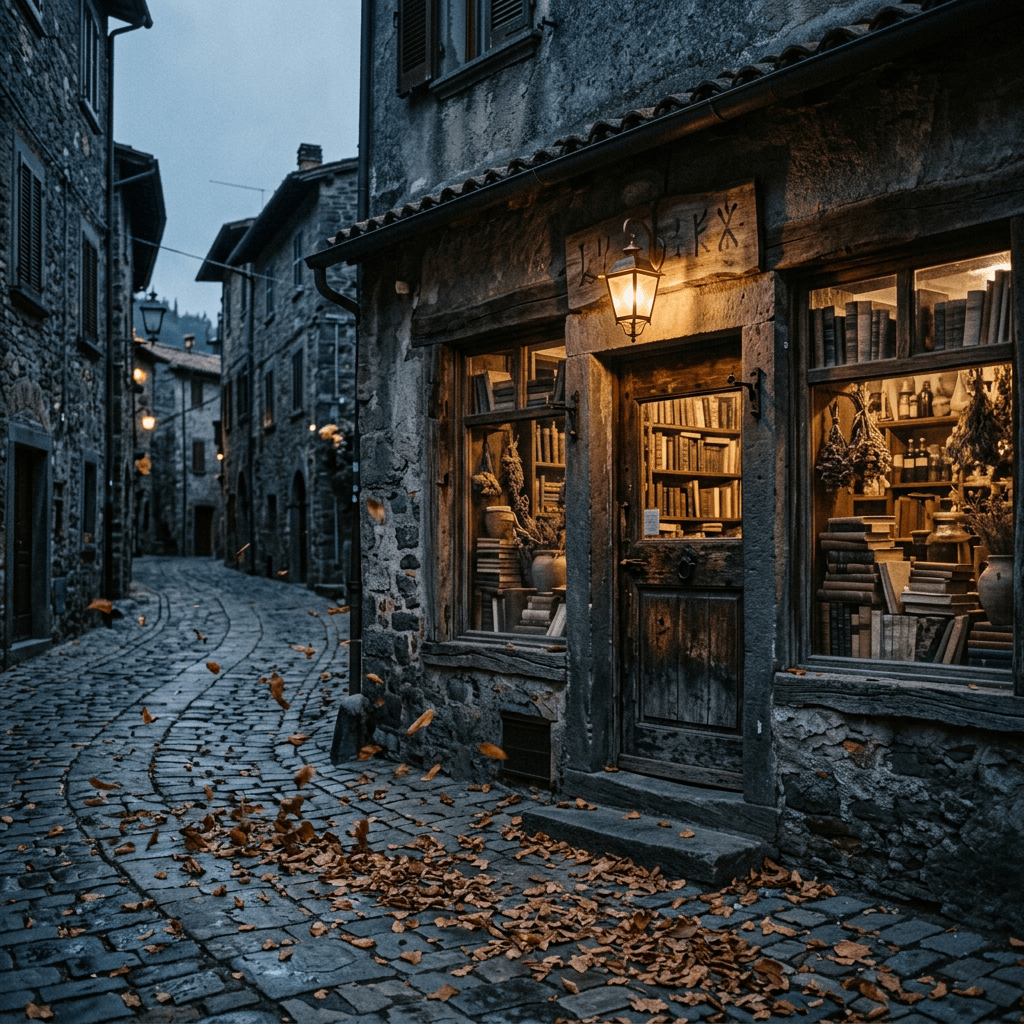
The wind known as the Tramontana does not simply blow through the village of Speranza; it arrives like an old, demanding guest. It sweeps down from the jagged northern peaks, carrying the sharp, metallic chill of altitude, the scent of crushed pine needles, and the heavy, damp promise of impending snow. By late November, the village surrenders to it completely. The locals do not fight the winter. Instead, they fold into it. They shutter their windows, pull heavy woolen blankets over their knees, and allow the village to become a quiet, silver-toned sanctuary isolated from the frantic machinery of the modern world.
The cobblestones of Via dell’Orologio, polished smooth by centuries of foot traffic and horse-drawn carts, gleam like wet obsidian under the amber glow of the wrought-iron streetlamps. The village is quiet, save for the rhythmic drumming of the rain against the slate roofs. But at the end of the street, where the road curves toward the edge of the valley, a warm, golden rectangle of light spills out onto the wet pavement.
This is La Pagina che Fa le Fusa—Moira Hopes’ tea shop and bookstore.
To step through its heavy, weather-beaten oak door is to step out of time entirely. The brass bell above the frame does not ring with a harsh, modern clatter; it chimes with a soft, resonant note that seems to hang in the air for minutes. Inside, the shop is a fortress of literature, warmth, and sensory comfort. The walls are lined floor-to-ceiling with uneven, sagging wooden shelves, packed tight with books of every size, age, and color. There is a grand, roaring fire burning steadily in a massive cast-iron stove in the center of the room, radiating a dry, cedar-scented heat that instantly thaws frozen fingers and tense shoulders.
But it is the smell of the shop that stops most people in their tracks. It is a complex, deeply comforting aroma. It smells of dried lavender, roasted black tea, beeswax, and something else—something distinctly sweet, baked, and impossibly familiar.
It is here that Moira Hopes likes to share a completely useless, yet entirely magical, scientific fact.
If you ask a chemist or a master botanist, they will tell you that the distinctive, comforting smell of an old bookstore is not a coincidence, nor is it a trick of the mind. It is a matter of chemical breakdown. Paper is made from wood pulp, and wood pulp contains a complex organic polymer called lignin. Lignin is what gives trees their structural rigidity; it is what allows a sapling to stand tall against the wind. But over time, as paper is exposed to air, light, and the slow march of decades, the lignin begins to oxidize and break down.
As it decays, lignin undergoes a chemical transformation and releases a specific volatile organic compound. That compound is vanillin—the exact same chemical responsible for the flavor and scent of vanilla beans.
It is a completely useless fact for daily survival, but to Moira, it is a profound philosophy. Every time a customer walks in, shaking the rain from their umbrella and asking why the shop smells like a warm bakery when there are no ovens, Moira smiles. She points to the thousands of aging, yellowing books lining the walls.
“They are decaying,” Moira will say gently, wiping down the polished wood of the counter with a linen cloth. “The paper is breaking down. But instead of turning bitter or rotting away, time is literally turning them into vanilla. They are sweetening as they age. It is a reminder that growing older, and breaking down, doesn’t always have to be a tragedy. Sometimes, it is just the process of becoming something softer.”
On a particularly brutal Tuesday evening, when the rain was turning to sleet and the wind was howling against the frosted glass of the shop’s windows, this useless fact proved to be exactly what a stranger needed to hear.
The shop was currently occupied by its two most important residents. By the cast-iron stove, Ashwaganda—a massive, fifteen-pound ginger tabby cat—was curled into a perfect, heavy circle. Ashwaganda was the anchor of the shop. He did not merely sleep; he meditated. His purr was a constant, low-frequency baritone rumble that hovered at exactly twenty-five hertz. Veterinary science suggests that this specific frequency promotes tissue regeneration and bone healing, but in Moira’s shop, Ashwaganda’s purr was primarily used to heal frayed nerves. The deep vibration of his chest resonated through the wooden floorboards, creating a baseline of absolute, unshakable peace.
On the other side of the room, perched precariously on a rolling library ladder, was Toe. Toe was a sleek, athletic cat with a coat the color of storm clouds and four distinct, immaculate white paws. Toe was the shop’s archivist. While Ashwaganda provided the grounding bass, Toe provided the curiosity. He possessed striking, intelligent green eyes that seemed to constantly evaluate the emotional state of anyone who entered. Toe did not sleep by the fire; he patrolled the high shelves, batting at floating dust motes, rearranging loose bookmarks, and occasionally knocking specific volumes onto the floor if he felt they were being unjustly ignored.
At precisely half-past six, the brass bell above the door chimed.
A gust of icy wind swept into the room, sending a flurry of loose receipts fluttering across the counter. A woman stepped inside, pushing the heavy oak door shut with her shoulder. She stood on the woven welcome mat, shivering violently, her breaths coming in short, ragged gasps.
Her name was Clara, though Moira did not know that yet. What Moira did know, simply by looking at the sharp, rigid line of the woman’s shoulders and the dark, bruised exhaustion under her eyes, was that this woman was running on empty. Clara wore a sharply tailored, expensive wool coat that looked entirely unsuited for the mountain weather of Speranza. She gripped a sleek leather briefcase so tightly her knuckles were white. Everything about her screamed of the city—of concrete, glass, subway trains, and the relentless, suffocating velocity of modern corporate life.
Clara was a data architect in a massive metropolis. For the past twelve years, her entire existence had been measured in milliseconds, gigabytes, and efficiency algorithms. She spent her days in sterile, windowless server rooms that smelled of ozone, compressed air, and burning plastic. She lived in a world where everything had to be optimized, upgraded, and replaced the moment it showed a sign of age. She had come to Speranza on a desperate, last-minute sabbatical, fleeing a nervous breakdown that had been quietly hunting her for a decade.
“I’m sorry,” Clara said, her voice tight and defensive, as if apologizing for her mere existence. “I know it’s late. The sign outside said you were open, but if you’re closing…”
“The sign is correct,” Moira said softly, her voice carrying the warm, unhurried cadence of a cello. “And the door is unlocked. Therefore, you are exactly where you are supposed to be, exactly when you are supposed to be here. Please, leave your coat on the rack by the door. It’s soaked through.”
Clara hesitated. In her world, you did not simply take off your armor in front of a stranger. But the dry, cedar heat of the stove, combined with the heavy, rhythmic purr radiating from the ginger cat on the floor, began to chip away at her defenses. Slowly, she unbuttoned her coat, hung it on the brass rack, and stepped deeper into the shop.
She looked around, her eyes darting nervously across the thousands of spines. “I… I don’t know what I’m looking for,” Clara admitted, wrapping her arms around herself. “I haven’t read a physical book in years. Everything I read is on a screen. Everything is backlit. Everything hurts my eyes. I just… I wanted to be somewhere that felt real. Somewhere that didn’t feel like it was moving so fast.”
Moira did not immediately walk over to the shelves. She did not recommend a bestseller, nor did she offer a catalog. Instead, Moira turned her back to the counter and walked over to the small, copper-lined kitchenette nestled in the corner of the shop.
“The first rule of La Pagina che Fa le Fusa,” Moira said, striking a long wooden match and lighting the gas burner beneath a copper kettle, “is that we do not rush the shelves. The books have been waiting for decades; they can wait another ten minutes. Are you allergic to cinnamon or cardamom?”
Clara blinked, taken aback by the sudden shift in protocol. “No. No allergies.”
“Good,” Moira said. She reached into a row of glass apothecary jars. “When the body is moving at a hundred miles an hour, you cannot ask the mind to suddenly stop. It will crash. You have to slow down the physical vessel first.”
Moira began the ritual. It was a deliberate, agonizingly slow process designed specifically to force the observer to surrender their impatience. She scooped two spoonfuls of dark, roasted Assam tea leaves into a heavy ceramic teapot. She added a pinch of dried chicory root for a grounding, earthy depth, a piece of cracked cinnamon bark for internal heat, two crushed cardamom pods for clarity, and finally, a tiny, dark sliver of dried Madagascar vanilla bean.
Clara stood by the counter, watching. At first, she shifted her weight from foot to foot, her fingers twitching toward her pocket where her smartphone sat like a heavy, demanding stone. But as the minutes ticked by, the absolute lack of urgency in the room began to work on her. The only sounds were the crackle of the cedar logs in the stove, the wind rattling the windowpanes, and the deep, oceanic purr of Ashwaganda.
“It smells… incredible in here,” Clara whispered, looking up at the towering shelves. “It smells like baking. Like my grandmother’s kitchen when I was a child. Do you sell pastries?”
Moira poured the boiling water into the teapot. A thick plume of fragrant steam rose into the air. “We do not,” Moira replied, placing a ceramic lid over the pot to let it steep. “What you are smelling is time.”
Clara frowned, confused. “Time?”
Moira picked up a small, weathered book from the counter. The cover was faded, the corners bumped and softened by years of handling. She held it out to Clara. “Smell the pages.”
Clara looked skeptical, but she took the book, opened it to the center, and brought her face to the paper. She inhaled deeply. Her eyes widened. It was the exact smell of the room—a rich, deep, unmistakably sweet aroma of vanilla, dust, and dried grass.
“That is a completely useless piece of science that I happen to love,” Moira explained, leaning against the counter as the tea steeped. “Paper is made from wood, and wood contains a polymer called lignin. It’s what makes trees strong. But as paper ages, as it is exposed to air and light, that lignin breaks down. It oxidizes. And when it does, it transforms into a compound called vanillin. It is the exact same chemical that gives vanilla beans their scent.”
Clara stared at the open book in her hands, her thumb tracing the slightly rough, yellowed edge of the page.
“In your world,” Moira continued gently, pouring the dark, amber tea into a thick clay mug, “when things get old, they are discarded. When technology breaks down, it is thrown away. It becomes obsolete, useless, and frustrating. You spend your life trying to prevent decay, trying to keep everything updated, fast, and pristine.”
Moira slid the warm mug across the wooden counter. Clara wrapped her cold hands around the heated clay, letting the warmth seep into her palms.
“But in here,” Moira said, gesturing to the thousands of books surrounding them, “decay is not a failure. It is a transformation. These books are breaking down. Their spines are cracking, their pages are yellowing, their chemical structure is literally falling apart. And yet, the result of that decay is a sweetness that you can smell the moment you walk through the door. Breaking down doesn’t always mean you are ruined. Sometimes, it just means you are finally becoming soft enough to comfort someone else.”
Clara stood frozen. The words hung in the warm, cedar-scented air. For twelve years, she had viewed her own exhaustion as a personal failure. She viewed her burnout as a systemic error that needed to be patched, optimized, and fixed. The idea that her breaking down might simply be the natural process of softening—of turning into something less rigid and more human—struck her with the force of a physical blow.
A single tear broke free, tracking hot and fast down her cold cheek. She didn’t wipe it away. She just brought the mug of tea to her lips and took a slow, trembling sip. The warmth of the cinnamon and the earthy depth of the chicory spread through her chest, untying a knot that had been pulled tight for over a decade.
Suddenly, a soft thud echoed from the back of the shop.
Clara jumped slightly, turning toward the noise. In aisle three, in the section Moira privately categorized as ‘Books for People Who Have Forgotten How to Breathe’, Toe was sitting on the floor. At his white paws lay a thick, heavy volume bound in faded green cloth. He had purposefully nudged it off the lower shelf.
Toe looked at the book, then looked down the aisle directly at Clara. He let out a short, demanding chirp.
“I believe Toe has found your prescription,” Moira said, picking up her own cup of tea. “He has an uncanny knack for matching the right paper to the right person.”
Clara walked slowly down the aisle, her boots making no sound on the thick, woven rugs. She knelt beside the gray cat. Toe did not run away; instead, he leaned forward and bumped his wet nose firmly against Clara’s knuckles, leaving a tiny, damp imprint of his unique nose-print on her skin. He purred—a higher, lighter sound than Ashwaganda’s deep bass, like a small motorboat cruising across a calm lake.
Clara picked up the book. It was an old botanical journal from the 1920s, filled with hand-drawn, watercolor illustrations of mountain flora, mosses, and root systems. It was a book about slow, silent growth. It was a book about things that took years to bloom in the dark.
She opened the cover. The spine gave a satisfying, soft crack. She brought the pages to her face and breathed in. The scent of vanillin—of old lignin giving way to time—filled her senses. It smelled like safety. It smelled like permission to rest.
Clara carried the book back to the center of the shop. She didn’t return to the counter. Instead, she walked over to the plush, worn velvet armchair positioned near the cast-iron stove. She sat down, pulling her knees up slightly, resting the open book on her lap.
Ashwaganda, who had been observing the entire interaction through half-closed, golden eyes, decided it was time to intervene. The massive ginger cat stood up, stretched his front legs until his claws dug into the rug, and gave a massive, jaw-cracking yawn. He padded slowly over to the velvet armchair. Without asking for permission, he jumped up, his heavy paws landing softly on the armrest, and stepped directly onto Clara’s lap, right over the pages of the open botanical journal.
Clara stiffened for a fraction of a second, unaccustomed to such direct, heavy affection. But Ashwaganda did not care about her boundaries. He circled twice, circled a third time, and then collapsed into a solid, warm loaf of orange fur against her stomach. His engine roared to life. The twenty-five-hertz purr vibrated through the book, through Clara’s coat, and directly into her chest.
Clara leaned her head back against the velvet chair. She closed her eyes. Outside, the Tramontana wind howled against the village of Speranza, bringing the first freezing sleet of the winter. But inside the shop, wrapped in the scent of cinnamon tea, decaying lignin, and the acoustic therapy of a fifteen-pound cat, the storm did not matter. For the first time in twelve years, Clara had nowhere to be, nothing to optimize, and absolutely no need to hurry.
From behind the wooden counter, Moira watched the tension finally drain out of the young woman’s shoulders. She watched Toe jump up onto the back of the armchair, curling his grey tail around Clara’s neck like a soft, woolen scarf.
Moira smiled, picked up her polishing cloth, and returned to wiping down the brass scales on the counter.
Moira’s Reflection
We spend so much of our lives terrified of the aging process. We view every wrinkle, every moment of exhaustion, and every breakdown as a failure of our machinery. But we are not machines. We are organic, living things, subject to the same beautiful chemistry as the trees and the paper they produce. Sometimes, the breakdown is not a destruction; it is a distillation. It is the necessary process of shedding our rigid, defensive structures so that the sweetness we have carried inside us all along can finally be released into the world. If a forgotten book can turn into vanilla, imagine what a tired human heart can turn into when it is finally given permission to rest.ow do you define success in life?
View all responses
Did you know that the comforting, sweet smell of an old bookstore is actually a matter of chemistry?
Paper is made from wood, which contains a structural polymer called lignin. Over time, as a book ages and decays, that lignin breaks down and releases vanillin—the exact same chemical found in vanilla beans!
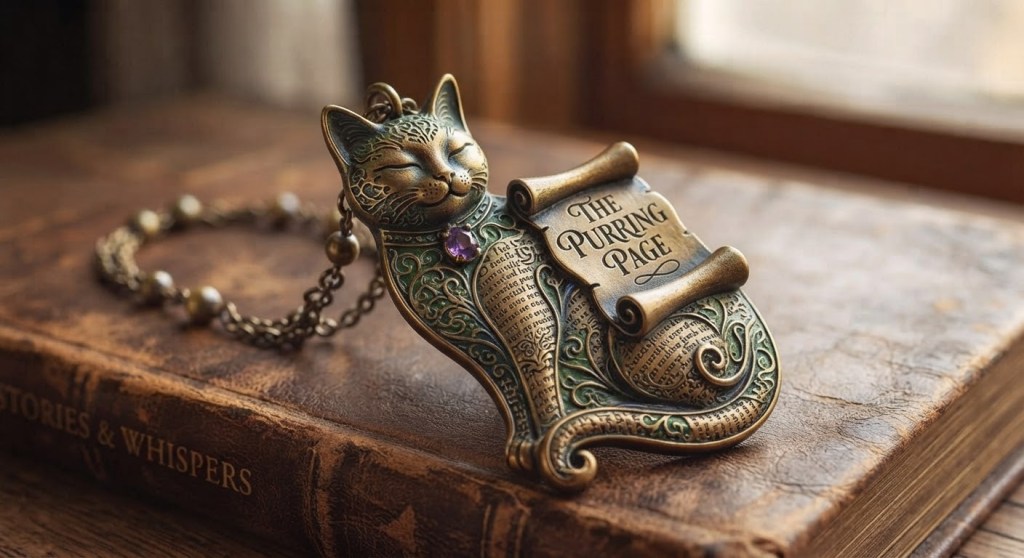
In today’s new story from The Purring Page, Moira Hopes shares this completely “useless” fact with a visitor who is suffering from severe digital burnout. It turns out that the chemistry of old paper holds a beautiful lesson for all of us: Breaking down doesn’t always mean you are ruined. Sometimes, it’s just the process of becoming something softer and sweeter.
If you are feeling exhausted, rushed, or overwhelmed by screens today, we invite you to step inside the fictional village of Speranza. Let Toe help you find the right book, and let Ashwaganda’s 15-pound purr heal your nerves by the fire.





Leave a Reply