
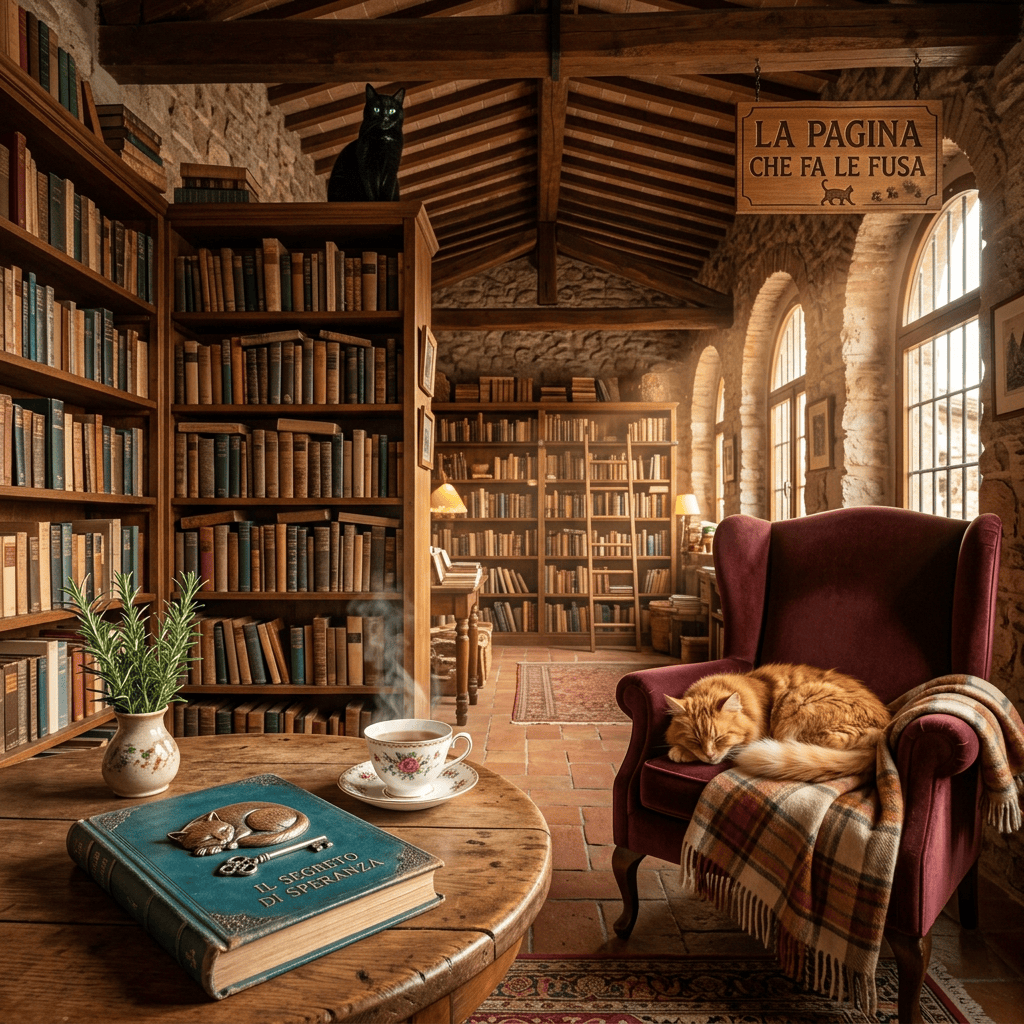
The autumn air in the hill village of Speranza smelled of woodsmoke, roasted chestnuts, and damp cobblestones. Under a stone arch covered in wild ivy, the heavy oak door of La Pagina che Fa le Fusa stood slightly open. Inside, the room was warm and quiet. Heavy wooden beams supported the high ceiling, and rough stone walls were lined from floor to top with crowded bookshelves.
Moira Hopes stood behind her wide oak counter, arranging porcelain cups next to glass jars of dried chamomile and rosemary. On the worn bordeaux velvet armchair in the corner, Ashwaganda, a large ginger cat with a thick orange coat, was curled asleep on a wool blanket. High above, resting on the edge of a mahogany shelf, Toe, a sleek black cat, watched the shop with calm green eyes.
The brass bell above the door chimed. Three women stepped in, bringing a rush of cool wind and lively chatter.
Altea entered first. She was the owner of the Cigars House, and the scent of rich, aged tobacco leaves clung to her wool coat. Next came Anna, whose hands were warm from working the steam wand at the Coffee Taverna on the village square. Finally, Marisa walked in carrying a small silver tin from Mint Choccolet, her boutique treasure house known across the region for importing rare sweets and cocoa beans from every corner of the world.
“The village is buzzing today,” Anna said, pulling up a wooden chair by the counter. “The rehearsal at Teatro Goldoni has every street crowded. The director has ordered twelve carafes of espresso for the backstage crew tonight.”
“And he rejected my finest Dominican cigars,” Altea added with a dry grin. “He called them ‘provincial.’ Carlo Vane thinks Speranza exists only to serve his vanity.”
“He came to my counter this morning,” Marisa said softly, opening her tin to reveal dark mint truffles. “He took three samples of single-origin Peruvian chocolate, criticized the sugar ratio, and walked out without paying. The man collects enemies faster than applause.”
Moira smiled gently as she poured hot chamomile tea for her three friends. “The theatre brings excitement to the hills, but Carlo Vane has a habit of making people nervous. Let us hope the play goes smoother than the rehearsals.”
Toe shifted on his high perch, his ears twitching as if listening to something far beyond the stone walls.
When the afternoon light softened into pale amber, the three shopkeepers returned to their businesses, leaving Moira alone with the quiet purr of her companions.
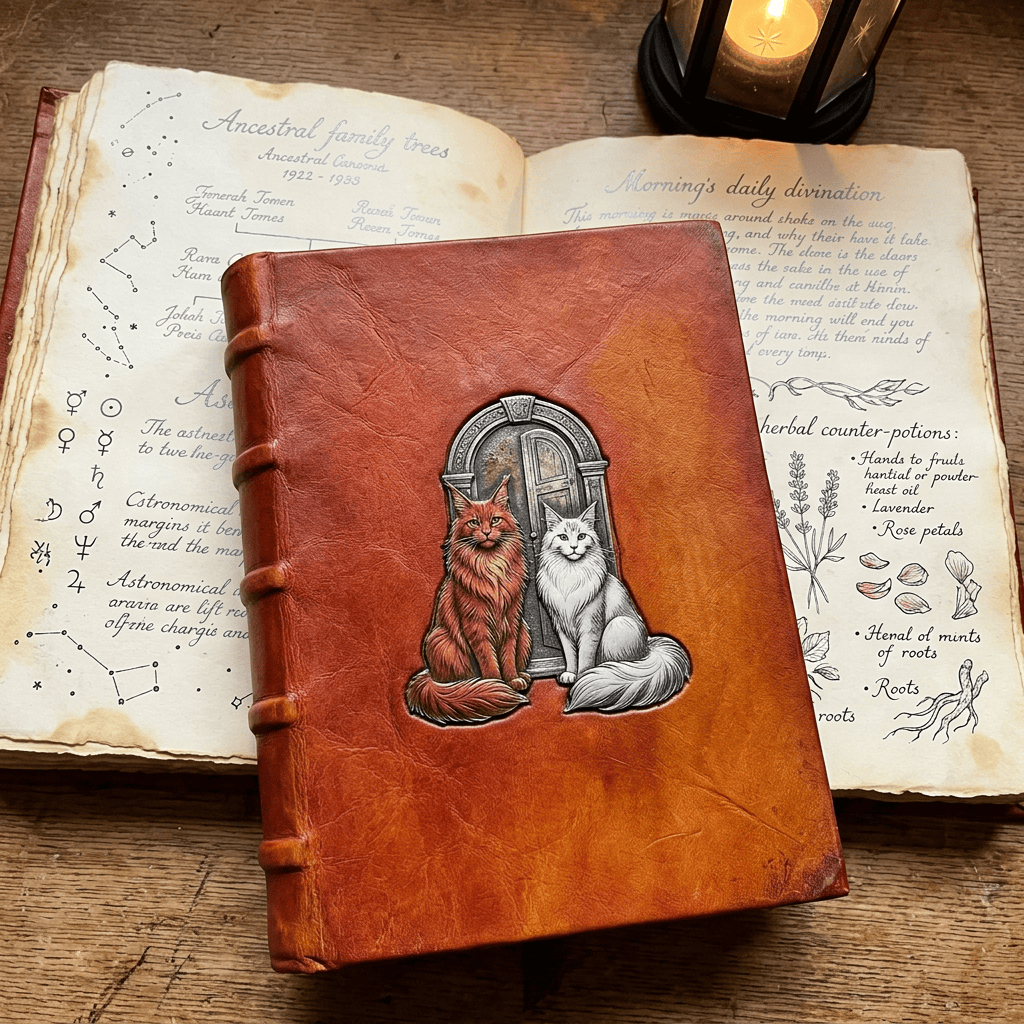
Moira reached beneath the counter and brought out her most guarded treasure: an ancient volume she had discovered months ago in the village market. The book was bound in supple, faded peacock-blue leather that showed fine cracks and faint scuffs from centuries of handling. There was no printed title on the cover, only a silver-stamped emblem—worn smooth by time—of a sleeping cat curled protectively around an ornate key.
She laid the book on the counter. The deckle-edged parchment pages crackled softly as they turned, releasing a dry fragrance of pressed herbs and ancient paper. The words inside were penned in shimmering silver ink that caught the lantern light.
Moira traced the delicate lines of script. The page open today held a short verse beneath an ink diagram of a clock and a theatre curtain:
A bitter draft in velvet shade,
Where false applause and greed are paid.
The drop that steals the actor’s breath
Hides where sweet warmth invites his death.
Ashwaganda jumped from the bordeaux chair with a soft thud, padded across the terracotta floor, and rested his chin against the edge of the book. Toe climbed down the shelves, his dark silhouette moving without a sound. He stopped by Moira’s wrist, tapping his paw gently against the silver key emblem.
“A bitter draft,” Moira murmured, looking down at the two cats. “Something dark is brewing at the theatre tonight.”
Teatro Goldoni sat on the eastern edge of the village square, an 18th-century stone playhouse with heavy red velvet curtains, gilded balconies, and narrow backstage corridors. That evening, the theatre was filled with the commotion of dress rehearsal.
Anna had set up a brass coffee station near the stage wings, serving dark roasts to the tired cast. Altea stood near the stage door, chatting with the stage manager, while Marisa arranged trays of mint-infused dark chocolate in the green room.
At the center of the stage stood Carlo Vane. He was a tall man with sleek grey hair, wearing an expensive tailored coat. He shouted directions with sharp, cutting words.
“Elena! You enter from the left on the third chime, not the fourth! You move like a sack of grain!” he barked at his lead soprano, Elena Moretti.
Elena stood stiffly under the hot stage lights, her face pale with fury. “I move according to the score, Carlo. You would know that if you understood music.”
“I understand success,” Vane sneered. “And without my name on the marquee, you would still be singing in village cafes.”
In the wings, the young prop master, Pietro, tightened the rigging ropes with trembling hands. Vane had threatened to dismiss him that very afternoon over a missing antique stage prop. Every corner of the backstage area was charged with quiet resentment.
At eight o’clock, the stage manager called a fifteen-minute intermission. The actors dispersed into the dressing rooms, and the stage crew moved props under the dim work lights.
Carlo Vane walked stiffly toward the backstage coffee cart. “Anna,” he snapped, rubbing his temples. “Give me a double espresso. Extra hot. And make sure it has proper bite this time.”
“Right away, Signor Vane,” Anna replied evenly. She pulled a rich, dark shot from the copper machine, the dark crema rising to the rim of a small white ceramic cup.
Vane took the cup, marched toward his private desk behind the heavy backdrop scenery, and sat down among piles of musical scores.
Five minutes later, a sharp, crashing sound echoed through the cavernous stage.
Anna was the first to round the velvet backdrop. Carlo Vane was slumped forward over his desk, his arm swept across the table, knocking over a brass lamp and scattering papers across the dusty floorboards. The white ceramic cup lay in pieces at his feet, surrounded by a dark, steaming puddle.
Anna gasped, stepping back into the corridor. “Moira! Altea! Come quickly!”
Moira ran into the alcove, followed closely by the stage crew. She knelt beside Vane and pressed her fingers against his neck. The skin was still hot, but there was no pulse. His pupils were fixed, and his jaw was locked tight.
Beneath the heavy smell of roasted espresso, Moira caught a faint, unmistakable scent rising from the broken cup: the bitter tang of wild laurel extract, mixed with an intense, artificial sweetness.
Within twenty minutes, the local police had sealed the theatre exits. Ispettore Salomone walked into the backstage area, his coat damp from the evening mist and his face lined with fatigue.
“A sudden collapse?” Salomone asked, looking down at the body.
“Poison,” Moira stated clearly. “Fast-acting and concentrated. It was placed directly into his coffee.”
Salomone turned his gaze toward Anna, who was sitting on a prop crate, her hands trembling. “You prepared the drink, Signorina Anna?”
“I pulled the espresso straight from the machine,” Anna said, her voice shaking. “I handed it directly to him. I swear on my life, there was nothing in that cup but pure coffee.”
“He had many enemies here tonight,” Altea intervened firmly, stepping between Anna and the officer. “He spent the last three hours insulting his lead singer, threatening his stage crew, and boasting about money he owed to investors.”
“Be that as it may,” Salomone said in a tired tone, “the cup came from the cart. Until my officers inspect every inch of this theatre, nobody leaves the building.”
Moira slipped out of the corridor and returned briefly to La Pagina che Fa le Fusa through the back alley. She needed clarity, and she needed her companions.
When Moira opened the door to her tea sanctuary, Ashwaganda and Toe were waiting by the entrance. As soon as she stepped inside, the two cats did not ask for food; they turned in unison and walked deliberately toward the side table where the peacock-blue book lay open.
Toe leaped onto the table, his sleek black tail swishing with precision. He extended a single unsheathed claw and tapped the bottom margin of the parchment page.
Moira looked closely. A new line of silver script had shimmered into view beneath the celestial diagram:
The venom waits not in the pot,
Nor in the beans the grinder bought.
Look to the sweet that hides the freeze,
Carried in pockets on the breeze.
“Not in the coffee pot itself,” Moira whispered.
Ashwaganda rubbed his cheek against Moira’s coat pocket, then turned toward the door, letting out a low, demanding meow.
“You want to go back to the theatre,” Moira said.
She picked up her doctor’s bag, placed Ashwaganda into his sturdy canvas carrier, and allowed Toe to slip out into the shadows of the alley behind her. The cats moved through the cobblestones like silent guards.
Back inside Teatro Goldoni, the police were busy searching the main dressing rooms. Moira, carrying her bag, stepped quietly into the backstage storage area behind the coffee station.
Toe slipped beneath a row of heavy costume racks, moving like a phantom among long velvet cloaks. A second later, a soft wooden rattling sound came from beneath a vintage trunk.
Moira knelt down. Toe was pawing at a small tin box that had rolled behind the baseboard. She picked it up and opened the lid.
Inside were four cubes of white refined sugar. Three of them were standard porous sugar cubes. The fourth, however, had a tiny, pinpoint puncture on its underside, sealed with a microscopic drop of hardened wax.
Ashwaganda trotted over to the prop table near the stage wings. He sniffed a discarded coat belonging to the stage crew and sneezed twice, backing away with a hiss.
Moira inspected the coat. In the deep right pocket, her fingers found an empty amber glass dropper bottle. When she held it up to the stage work lights, she smelled the exact residue: concentrated laurel glycoside, an extract capable of causing instant cardiac arrest when dissolved in boiling liquid.
The killer had not poisoned the coffee pot. The killer had slipped a prepared, poisoned sugar cube directly into Vane’s cup while he walked past the costume rack in the dim hallway.
Moira walked back onto the main stage where Salomone had assembled the suspects: Elena Moretti, the soprano; Pietro, the prop master; Signora Falcone, the wealthy sponsor; alongside Altea, Marisa, and Anna.
“Ispettore,” Moira announced, her voice calm and steady. “You can release Anna from suspicion. The coffee in her machine is pure.”
Salomone raised an eyebrow. “You have evidence, Dr. Hopes?”
“I do,” Moira said, placing the amber dropper bottle and the tin of sugar cubes on the central prop table. “The poison was delivered inside a modified sugar cube. The killer knew Carlo Vane always took one lump of sugar with his espresso. The killer dropped it into his cup as he walked through the unlit corridor behind the scenery.”
Elena Moretti scoffed. “Any one of us could have walked past him in the dark.”
“True,” Moira replied, turning her eyes slowly toward the wings. “Except the poison was mixed with a very specific solvent—a mint extract used exclusively to mask the bitter scent of laurel leaves. An extract stolen from Marisa’s storage pantry this morning.”
Marisa gasped. “Someone took a bottle of my concentrated peppermint oil during the delivery!”
“And,” Moira continued, looking directly at Pietro, the prop master, “the person who handled the dropper had their coat dusted with crushed laurel leaf residue. The same coat currently hanging by the prop table with your work gloves in the left pocket, Pietro.”
Pietro’s face lost all color. He stepped back toward the stage ropes, his hands twitching nervously. “You don’t understand! He was going to ruin me! He stole my grandfather’s antique dagger, claimed it was his own, and threatened to have me blacklisted from every theatre in northern Italy if I asked for it back!”
“Murder is not justice, young man,” Ispettore Salomone said quietly, stepping forward and placing a firm hand on Pietro’s shoulder. Two officers moved in to secure the young man.
Pietro hung his head, offering no resistance as they led him out through the heavy stage doors into the cool night air.
The tension in the theatre dissolved into a collective sigh of relief. Anna sat down on a wooden bench, leaning her head on Altea’s shoulder, while Marisa quietly closed her chocolate tin.
Later that night, the four friends sat around the low wooden table inside La Pagina che Fa le Fusa. The hearth fire crackled brightly, casting warm orange light across the stone walls and packed bookshelves.
Ashwaganda slept soundly on his bordeaux armchair, his deep purr filling the room with steady comfort. High above, Toe rested with his paws tucked beneath his chest, his golden-green eyes half-closed in quiet triumph.
Moira sat back with a hot cup of chamomile, running her hand over the soft leather cover of Days of your Dreams. In the quiet hills of Speranza, the truth had been uncovered once again—guided by sharp eyes, loyal friendship, and the silent wisdom of two very clever cats.





Leave a Reply