How do you choose between two paths when both of them are good?
The Man with Two Pockets
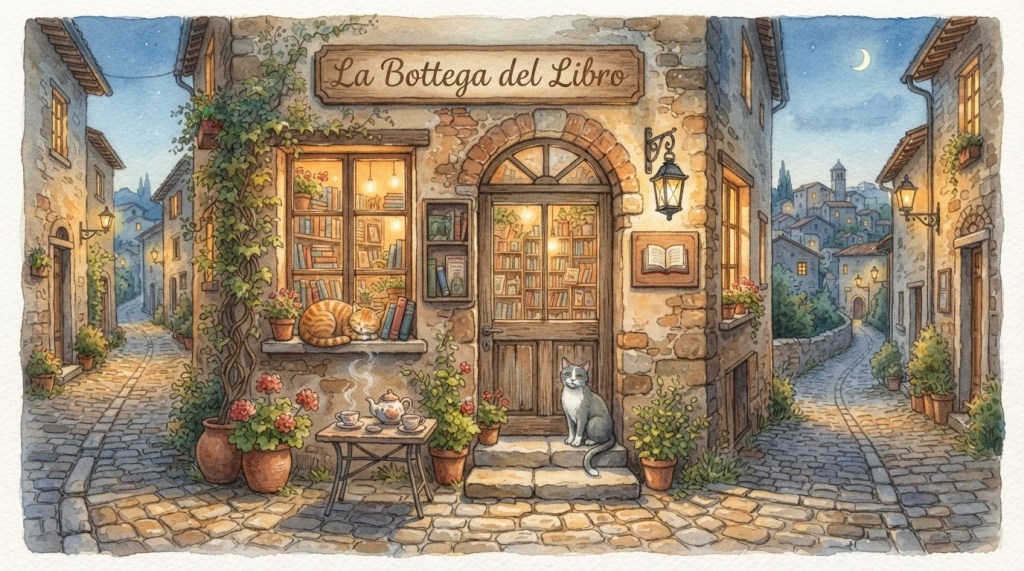
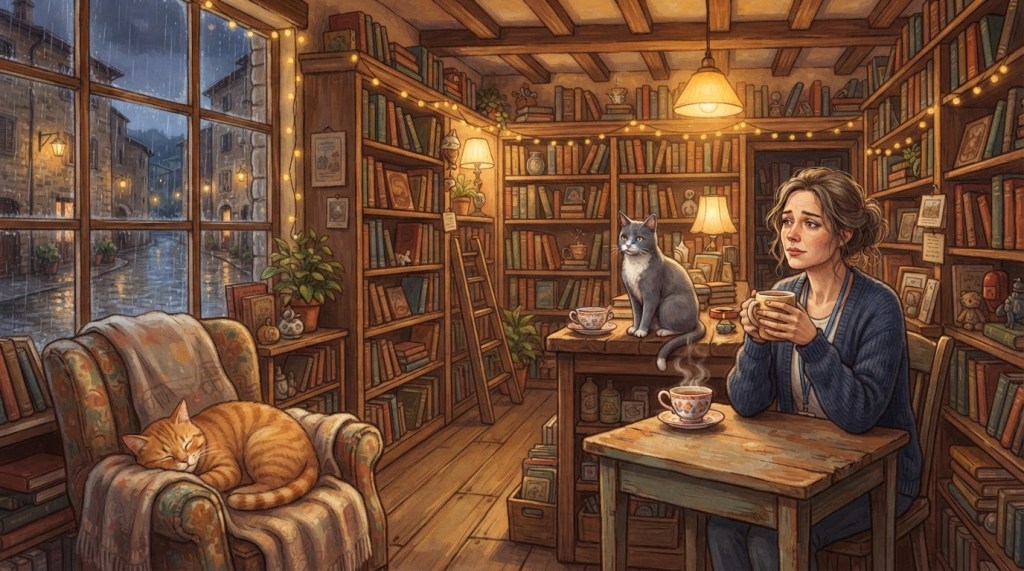
On the fifteenth of November, a little after four in the afternoon, the light in Speranza turned the colour of weak honey and stayed that way. Via dell’Orologio smelled of woodsmoke and wet stone. In the window of La Pagina che Fa le Fusa, Ashwaganda lay across three cookbooks like a ginger draught excluder, all fifteen pounds of him, his purr rolling out at a pitch so low that the glass in the door hummed along with it.
Moira Hopes was on the stepladder, shelving the last of the autumn deliveries, when the bell above the door gave its small brass cough. She looked down and saw a tall, narrow man in a navy overcoat, hat in his hands, standing very straight on the doormat as if waiting for a signal to change.
“Good afternoon,” he said. “I am sorry. I do not need a book. I mean, I would like a book, but that is not why I came in.”
“That’s the most common reason people come in,” said Moira, climbing down. “Please, sit. The green armchair is the best one. It forgives everybody.”
He sat, and then he did something odd. He put his right hand in his right coat pocket and held it there, and put his left hand in his left coat pocket and held that there too, as though he were carrying two small birds and could not decide which one to let go.
“My name is Teodoro,” he said. “I was a signalman for the railway for thirty-eight years. The little station at Ponte Alto, then the junction at Cervara. I have been retired since March.”
“Thirty-eight years of deciding which train goes where,” said Moira. “I suspect you were very good at it.”
Something flickered across his face, a mixture of pride and bewilderment. “That is exactly the problem, signora. I was very good at it. A lever goes one way or the other way. The line is open or it is closed. There is a rulebook, and the rulebook tells you. Now I have two levers and no rulebook, and I have not slept properly for nine days.”
A Ticket and a Key
Moira put the kettle on the little stove in the back corner and let him talk while it warmed. It is a habit of hers. People tell the truth more easily to someone whose hands are busy.
His daughter, Ginevra, lived in Vancouver. She had gone there fifteen years ago for a research post, married a kind man, and had two children Teodoro had met in person exactly six times. Last month she had called and said, in the careful voice of someone who has rehearsed, that there was a small flat near their house, that the children had started asking when Nonno was coming for good, and that there was no pressure at all. She had said the words no pressure three times. He had counted.
He took his right hand out of his pocket. In it was a folded airline booking, soft as cloth from handling. “A one-way flight. I can confirm it by Wednesday, or the price goes up and the flat will be offered to somebody else.”
Then he took out his left hand. In it was a brass key on a loop of green wool. “And this is the house in Speranza. Ninety-one steps from the piazza. My wife, Annunziata, planted the lemon tree by the door the year we married. She has been gone six years. The tree has not yet noticed.”
He laid the ticket on one knee and the key on the other and looked at them.
“I have made lists,” he said. “Two columns. Grandchildren, my daughter, new things, my health, in case I get ill and nobody is near. On the other side, the lemon tree, the people I know, the barber who has cut my hair since nineteen eighty-four, Annunziata’s grave, the sound of the church clock. The columns are almost the same length. Every night I add something to one, then something to the other, and in the morning I am exactly where I began. I do not want to choose wrong. If I choose wrong, there is no second chance. I am seventy-one.”
Moira did not say it will all work out, or that there is no wrong choice. She had learned long ago that those sentences slide off a worried mind like rain off a tin roof. Instead she said, “Teodoro, may I make you a tea? I would like to choose it for you, and I would like to explain why afterwards, if you’ll allow me.”
“A tea,” he said, with the faint, polite surprise of a man who has been offered a spoon for a bridge. “Yes. Thank you. Yes.”
The Tea That Moira Chose
She went down the narrow shelf of glass jars behind the counter, past the chamomile and the linden, past the rooibos she had been using all week, and stopped at three she had not touched in a while. Fennel seed, pale green and faintly sweet. A curl of dried sweet orange peel. A few sprigs of thyme from the pot on the back step.
She crushed a teaspoon of the fennel seeds in a mortar until the shop smelled of liquorice and sunshine. She added the orange peel and a small pinch of thyme to the blue teapot, poured the water over, and set a timer for six minutes.
“Fennel is an old companion of slow afternoons,” she said, over her shoulder. “People have been steeping it after meals for a very long time, and it tastes like patience. The orange is for brightness. And thyme is for remembering. The Romans, so I’m told, believed it gave courage, which is a lovely story and nothing more. I won’t pretend a cup of tea will make your decision. All it can do is give your hands something to hold while your mind sits down.”
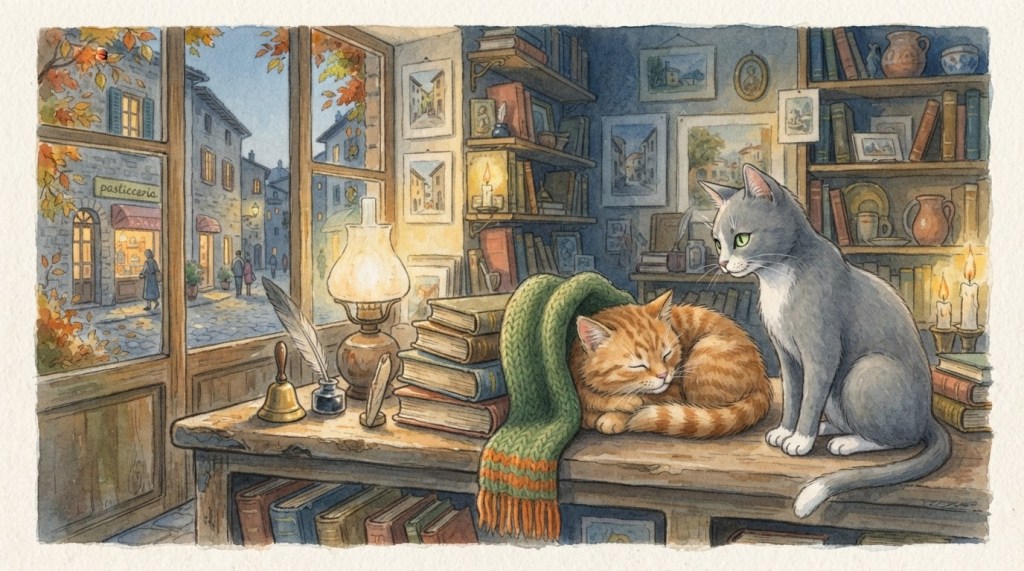
While the tea steeped, Toe came out from beneath the poetry table. She was a slender grey cat with immaculate white paws and green eyes the colour of sea glass, and she walked toward Teodoro with the unhurried precision of an inspector. She sniffed the airline booking. She sniffed the brass key. She gave the key a longer, more thoughtful sniff, and then sat down precisely halfway between his two knees, looking up at him with great seriousness.
“She does that,” said Moira, carrying over the tray. “She has opinions about doorways.”
Teodoro let out a breath that was almost a laugh. “She is standing exactly on the line between the two of them. The platform edge.”
“Perhaps she is the one person in the room who is not worried,” said Moira, and poured.
Fifteen Pounds of Ginger Weather
The tea was the colour of pale straw with a blush of orange. Teodoro held the cup in both hands, the ticket and the key still on his knees, and drank. His shoulders, which had been rising towards his ears for nine days, came down about an inch.
Then Ashwaganda woke.
He did it the way he did everything: completely, and without hurry. He stretched his front legs until his claws made two small ticking sounds on the cookbook cover, dropped from the window ledge with a thud like a dropped sack of flour, and walked across the shop with his tail up like a flag. He considered the green armchair. He considered Teodoro’s lap, which was already occupied by a ticket, a key and, now, a grey cat’s attention. Then he did what he always did when a human was carrying more than they could manage: he sat heavily on Teodoro’s feet.
“Oh,” said Teodoro. “He is warm.”
“Furnace,” said Moira. “Fifteen pounds of it. And listen, if you can.”
He listened. The purr came up through his shoes and his shins, a slow, deep rumble more felt than heard. Moira, who had read a good deal about it over the years, told him what she knew, and was careful about the edges of it. Domestic cats purr at a frequency that often sits somewhere between about twenty-five and a hundred and fifty cycles per second, and Ashwaganda’s sat near the bottom of that range, which was why you could feel him in the floor. Some researchers have wondered whether those vibrations help cats themselves heal, and some people find the sound soothing. “But I don’t know that anyone has proved that a cat’s purr fixes anything in a person,” she said. “What I do know is that nobody in the world has ever been hurried by a purring cat. It is difficult to rush while a creature is demonstrating how it is done.”
Teodoro drank his tea. Toe stayed on the line between ticket and key. Ashwaganda stayed on his shoes. The clock at the end of the street struck the half hour, and for a while nobody needed anything from anyone.
Why the Columns Never Settle
When the cup was nearly empty, Moira sat on the footstool opposite him and said, “May I tell you something about those two columns of yours? I read about it once and I have never forgotten it, because it made me feel a great deal less foolish about my own decisions.”
“Please.”
“In the nineteen-fifties, an economist and psychologist named Herbert Simon pointed out something rather humbling. Real people almost never have all the information, or all the time, needed to find the single best option. He suggested that we do something else instead. We look for an option that is good enough against the things that matter to us, and then we stop. He made up a word for it: satisficing, a blend of satisfy and suffice.”
“Satisficing,” Teodoro repeated, tasting it like the tea.
“Decades later, the psychologist Barry Schwartz and his colleagues studied people according to how they usually choose. They called one group maximizers, people who feel they must examine every option and be certain they have found the best. They called the other group satisficers. In their questionnaires, the maximizers tended to report more regret and less satisfaction with their lives, even when their choices objectively turned out well. I should be careful: that was a correlation, and it was measured by self-report, and psychologists still argue about how large and how consistent the effect is. But the pattern has been found often enough that people take it seriously.”
Teodoro looked at the two columns he had folded in his breast pocket, and then at Moira. “I am a maximizer.”
“You were a signalman,” said Moira gently. “Your job was to be certain. For thirty-eight years, being certain was a matter of safety, and it was the right habit. But it’s a habit built for levers, where one setting is correct and the other is a collision. It does not travel well into a choice between two good lives. When both columns are full of things you love, there isn’t a correct answer hiding in the arithmetic, and no amount of adding will find one. The columns stay level because they are supposed to stay level. That’s what makes it a hard choice rather than a hard sum.”
He sat very still. Under his feet, Ashwaganda’s purr gave a small rise and fall, like breath.
“There is a second thing,” Moira went on, “and it may help with the fear of choosing wrong. The psychologist Daniel Gilbert and his colleagues spent years asking people to predict how they would feel after big events, such as a lost election, a rejected application or a breakup, and then checking how they actually felt later. Over and over they found what they called the impact bias. We tend to overestimate how intense a future feeling will be, and how long it will last. We picture the new city, or the loss of the old one, as a vivid and permanent weather system. Then we get there, and ordinary life gets to work. We make a friend, we find a good bakery, we notice we are still ourselves. The mind has quiet ways of making a home out of whatever it is given. Gilbert’s term for it, I believe, was a psychological immune system.”
“So the fear is exaggerated,” said Teodoro slowly.
“The fear is real,” said Moira. “But the forecast it gives you is usually too dramatic, in both directions. Vancouver will probably be less overwhelming than you dread, and less magical than you hope. Speranza will probably be less safe than it feels from here, and less empty than it looks in the dark. I’m not saying the choice doesn’t matter. Of course it matters. I’m saying that the question ‘which one will I regret?’ may be the wrong question, because the research suggests that you are not very good at predicting regret. A better question might be ‘which one do I want to walk towards?’ You can ask that one even when you can’t see the end of the road.”
The Question Under the Question
Teodoro said nothing for a long time. He turned the brass key over in his fingers, and rubbed the green wool loop with his thumb.
“Annunziata tied this on,” he said at last. “The green wool. She said I would lose a plain key within a week. I never did.”
“It sounds like she knew you well.”
“She did.” He cleared his throat. “May I tell you what I have not told Ginevra? When I imagine the flat in Vancouver, I imagine the children running in. I imagine their faces. It is a very bright picture. But when I imagine the house here, I do not imagine myself sitting there alone, as I thought I would. I imagine myself with a ladder, picking the lemons in January. And every time I imagine it, I am carrying a bag of them down the ninety-one steps, and giving them away. To the barber, to the woman at the bakery, to Signora Beltrame next door.” He stopped. “I have not put giving away lemons in either column.”
“It sounds to me,” said Moira, very carefully, “like a column of its own.”
“Yes.” He looked at the ticket. “And yet. I think what I am afraid of is that to love one is to abandon the other. If I stay, I am the grandfather who sent postcards. If I go, I am the husband who left the tree.”
Toe, who had been sitting on the line between the ticket and the key, chose that moment to stand up and walk, with great deliberation, across the ticket and the key together, leaving small grey hairs on both. Then she stepped off Teodoro’s knees, trotted to the shelf by the till, and returned to the footstool with a small cardboard calendar that Moira kept for the cats’ vet visits, which she nudged with her nose until it fell open on the floor.
Moira laughed softly. “She is not a very subtle cat. But she has a point. You’ve been treating this as a lever with two positions, forever. Might it be a calendar, with a longer shape than that?”
Teodoro stared at the calendar, which showed the month of December and a drawing of a cat in a Santa hat. “What do you mean?”
“I mean that the choice you’ve described is ‘forever, one place or the other.’ Nobody has actually offered you that. Ginevra said no pressure three times. People who say that often mean ‘I would love you to come, and I would rather you were happy than convenient.’ Have you asked her whether the flat is only available to a man who sells his house and never looks back? Have you asked whether you might try the winter there, say, from January to March, and still keep your key?”
He opened his mouth and closed it again. “I had not asked. I assumed it was one door, closing the other.”
“It may be, in the end. Perhaps one day there’ll be a real, final choice, and you’ll make it with the same dignity you showed the railway. But you are standing at a point where it isn’t one yet. The research on decisions suggests that when we are exhausted and frightened, we tend to squeeze a long, flexible future into a single dramatic moment. Sometimes the kindest thing is to put some air back in it.”
What the Cats Knew
They sat with that for a while. Outside, the lamplighter’s automatic lamps came on one by one along Via dell’Orologio, and a pair of schoolchildren ran past the window with their scarves flying. Ashwaganda, still on Teodoro’s feet, had begun the slow, heavy blink that precedes sleep.
“I want to tell you one more thing,” said Moira, “and then I’ll leave you in peace. When I decided to open this bookshop, I made a list too. It was a very long list. And a friend, the baker’s wife, who is wiser than anyone with flour on her hands has a right to be, said to me: ‘Moira, don’t ask which choice is safe. Ask which choice you’d be sorry not to have tried.’ It sounds like a nudge towards boldness, but it wasn’t. I think she meant that some roads are worth testing gently, with a return ticket in your pocket and a good coat. I took the shop. I’ve been sorry about the roof and never about the shop.”
Teodoro looked at the ticket, and then, slowly, he did something that surprised them both. He folded it in half, then in half again, and placed it not in his right pocket but in the breast pocket, next to the two columns. He put the key back in his left pocket. Then he took the columns out, read them once more, shook his head, and folded them into a very small square.
“Can I borrow a pen, signora?”
She brought him one, and a clean sheet from the pad by the till. He wrote slowly, in the careful capitals of a man used to log books. Moira did not read it. Toe did, or at least sat beside it with her green eyes narrowed, as though verifying the spelling.
When he finished he held it up. It was not a list. It was a short message, addressed to Ginevra, that began: Dear Ginevra, I would like to come, and I would like to come in January, for the winter, and to see how it feels. Could we talk about keeping the key?
“I’ll send it tonight,” he said, “when I have found the right way to ask it on the telephone. I have not told her the winter might become longer. I do not know yet. But I think that the question is the first honest thing I have said to her in a month.”
“That sounds like a very good first honest thing,” said Moira.
The Walk Home
He bought a book, in the end, a small old edition of travel stories with a green cloth cover, and Moira wrapped it in brown paper and tied it with string, the way she did for people who she suspected would read it twice. At the door he turned his hat once in his hands, then put it on.
“The tea,” he said. “What was it, exactly? In case I wish to make it for myself.”
“Fennel seed, crushed, with a strip of sweet orange peel and a pinch of thyme. Six minutes. And a cat on your feet, if you can find one.”
“The cat will have to be arranged,” said Teodoro, and he smiled, properly, for the first time that afternoon. It was the smile of a man who had put down one of the two birds and found that his hand was still warm.
He went out into the blue evening. Moira watched him through the glass: a tall, narrow figure in a navy coat, walking not quickly, up Via dell’Orologio towards the ninety-one steps, one hand in his pocket on a brass key and a loop of green wool. At the corner by the church he paused, looked up at the clock, and nodded to it as if to an old colleague. Then he went on.
Behind her, Ashwaganda rolled over on the doormat with a groan, still warm where a man had been standing. Toe sat on the cookbook pile in the window, her white paws tucked neatly under her, watching the street, her green eyes catching the lamp.
“You two,” said Moira, “are shameless.”
Toe blinked once, slowly. Ashwaganda began to purr again, at a pitch you could feel in the floorboards. The shop settled around the three of them like a blanket, and on the shelves the books waited, each one a road that had not yet been walked.
Moira’s Reflection
Most of the choices that keep us awake are not between a good road and a bad one. They are between two roads we love, and that is exactly why they hurt: the loss is built into the gain. It helps, I think, to notice that “I must pick the one correct answer” is an instruction from a tidier world. Good enough, chosen with care and a clear sense of what matters to us, has been a respectable way to decide for a very long time, and the research on satisficing suggests it can be kinder to our peace of mind than hunting for the perfect option.
It also helps to remember that we are poor forecasters of our own feelings. The future usually turns out gentler and more ordinary than the version we rehearse at three in the morning, and we are usually more adaptable than we fear. So if you are standing between two paths tonight, you might try asking a different question: not “which one will I regret?” but “which one am I walking towards?”, and “is there a smaller, softer first step that keeps both doors a little open?”
Now it’s your turn: have you ever stood between two good paths? What helped you choose, or what do you wish someone had told you? Tell us in the comments. Moira, Ashwaganda and Toe would love to hear.
A Cup for This Story
- 1 teaspoon fennel seeds, lightly crushed in a mortar (or with the back of a spoon)
- 1 strip of dried sweet orange peel, about 2 inches long
- 1 small pinch of dried thyme (or one fresh sprig)
- 250 ml (a large cup) of freshly boiled water
- Steep covered for 6 minutes, strain, and sip slowly. A little honey is lovely, if you like.
A note: herbal teas are a comfort and a pleasure, not medicine. If you are pregnant, taking medication, or have a health condition, check with your doctor before drinking herbs regularly.
Press Play and Stay a While
If you would like a little company while the tea steeps, here is the song from Speranza. Press play, settle in, and stay as long as you like.



Leave a Reply