
Calm for Carers · Story 7. For everyone who spends their days holding other people together.
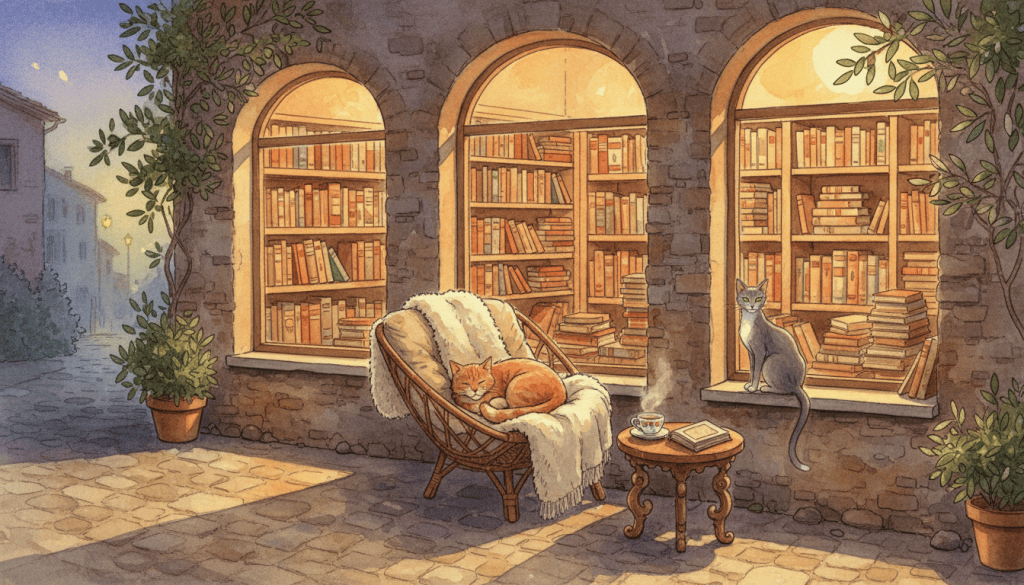
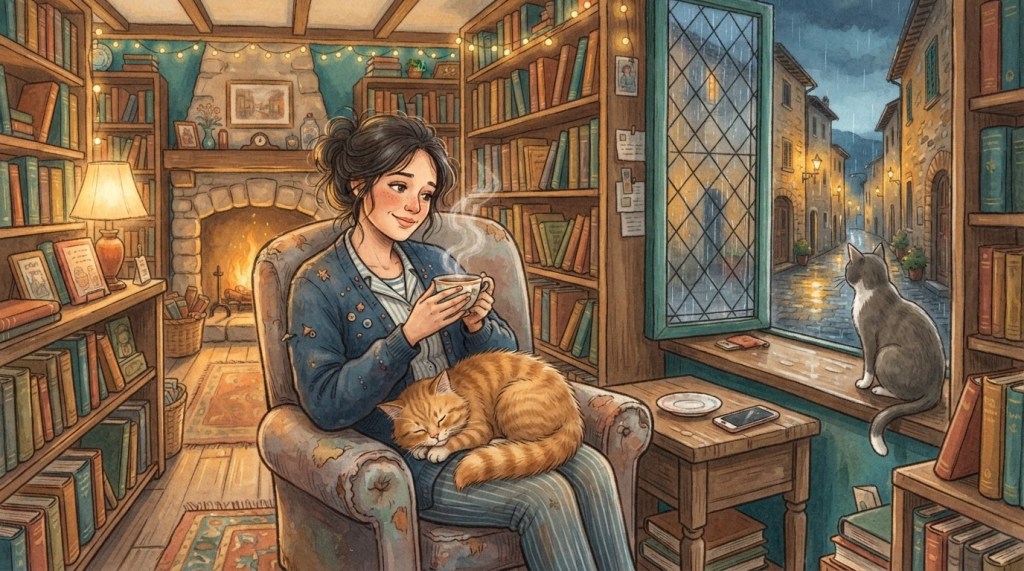
It had been raining in Speranza since the morning, the soft, patient rain that comes down the hills in November and turns the cobbles of Via dell’Orologio into little rivers of lamplight. By six o’clock the baker had pulled down his shutter, the pharmacist had switched off her green cross, and the only window still glowing on the whole street was the one belonging to La Pagina che Fa le Fusa, the bookshop of Moira Hopes.
Inside, the radiator ticked. Ashwaganda, the fifteen-pound ginger tabby, had arranged himself across the good armchair like a loaf of bread that had given up on the world, his purr rumbling so deeply that the teaspoons on the counter hummed along. Toe, the slender grey cat with the immaculate white paws and the green, watchful eyes, sat on the end of the poetry shelf, washing one paw with great ceremony and pretending not to listen to the weather.
Moira was just thinking about closing when the bell above the door gave its small brass cough, and a woman came in with her umbrella still open. She stood there on the mat, dripping, before she seemed to realise it, and then she folded the umbrella with the careful movements of someone who has spent a long time being careful.
“I’m sorry,” she said. “I only wanted to get out of the rain. I’ll just look at the books.”
“Look as long as you like,” said Moira. “The rain has no appointments tonight, and neither do I.”
The woman was perhaps forty, with dark hair pinned up in a way that had been tidy at dawn, and a navy cardigan under her raincoat. On the cardigan, half hidden by the lapel, was a small enamel badge. Moira knew the look of those badges. Nurses wore them, and so did the people who had been nurses for so long that they no longer noticed they were wearing one.
She wandered along the shelves without really reading the spines. Toe slid down from the poetry shelf, crossed the floor on silent white paws, and sat directly in front of her shoes, looking up. The woman stopped. Toe did not move. It is a thing Toe does, and nobody in Speranza has ever worked out how she chooses.
“She likes you,” said Moira, from behind the counter. “That is not a compliment she hands out easily. Would you like to sit? I was about to make tea, and I make far too much of it.”
“I should really go home,” said the woman. But she did not go. She lowered herself onto the little wooden chair by the reading table, and Toe, with the air of a creature whose work was entirely in hand, jumped into her lap and turned twice and lay down.
The Woman with the Folded Umbrella
Her name was Marta. She said it the way people say their names when they have not been asked for it in a while. She worked at the hospice up on the hill road, the low yellow building with the cypress trees, where she had been a palliative care nurse for eleven years.
Moira put the kettle on and said nothing, because she had learned long ago that silence in a bookshop is a kind of hospitality, and that people fill it when they are ready.
“It was last Tuesday,” Marta said at last, to the cat. “A gentleman called Anselmo. He was ninety-one. He had been with us for nine weeks, which is a long time for us. He did the crossword every morning, in pen, and he used to read me the clues he couldn’t get and then tell me I was no help at all. He was right. I am hopeless at crosswords.”
Ashwaganda opened one amber eye, considered the room, and closed it again. His purr changed pitch, very slightly, the way an organ changes when someone presses a lower pedal.
“He died at ten past four in the morning,” she went on. “I was there. His daughter was on her way from Bologna and didn’t make it, so I held his hand. I did everything right. Everyone said so. I called the doctor, I called the family, I washed him and straightened the sheets, and by seven I had given the handover and I was in my car. And on Wednesday I was back at work, and there was a new patient in his room by Thursday lunchtime, and nobody said a word about him. Not because they are unkind. It’s just that there were four more people in four more beds who needed me. That’s the job.”
“And now?” said Moira, gently, setting down a tray.
“And now I’m fine,” said Marta. “I’m completely fine. That’s what’s strange. I’m not crying, I’m sleeping, I’m eating. I went to the supermarket this afternoon and I stood in front of the shelf with the crossword magazines for ten minutes and I could not move. Ten minutes. A man asked if I was all right and I said yes, of course, thank you. And then I got in the car and drove here, and I don’t even know why, because I have never been in this shop in my life.”
She laughed, a short embarrassed laugh, and wiped her eye with the back of her wrist as if it were a nuisance.
“The shop likes to be found by people who need to sit down,” said Moira. “I think that is all it is. Now, I am going to make you something particular. Do you know linden blossom? Here we call it tiglio. The trees along the old road behind the church are full of it in June, and I dry the flowers in paper bags in the back room, so for half the summer the whole shop smells of honey and hay.”
The Tea of Slow Honey
Moira measured the pale, papery blossoms into a round white teapot, added a thin curl of orange peel and a single small piece of cinnamon bark, and poured the water over them just off the boil. The smell rose at once: honeyed, green, a little like warm hay and a little like a summer afternoon from a long time ago. Marta closed her eyes without meaning to.
“Linden has been drunk as a comforting evening tea in Italy and across Europe for a very long time,” said Moira. “I should say plainly that I am a bookseller, not a clinician, and I am not going to tell you that a flower can mend a heart. What I can tell you is that a warm cup that smells of summer gives your hands something to do and your shoulders a reason to drop. Sometimes the body needs permission before the mind does.”
She poured two cups, set one in front of Marta, and set the other in front of the empty chair beside her. “I always pour one extra. People tend to bring somebody with them, even when they come alone.”
Marta looked at the second cup for a long moment. Then she wrapped both hands around her own and drank, and for a minute or two there was only the rain and the radiator and Ashwaganda’s enormous slow purr.
“Can I tell you what I keep thinking?” she said. “I keep thinking that something is wrong with me. Eleven years. I have sat with so many people at the end. I should be better at this by now. I should have a kind of, I don’t know, a thicker skin. Instead I am standing in a supermarket aisle in front of a magazine because a ninety-one-year-old man called me useless at crosswords.”
“Can I tell you what I have read?” said Moira. “Only what I have read, mind. I am not an expert, and I will tell you where the edges of what I know are.”
Marta nodded.
What the Researchers Have Noticed
“There is a small, careful study,” Moira said, “published in the Journal of Nursing Scholarship in 2010. A group of researchers led by Lisa Gerow interviewed eleven registered nurses about what it was like when a patient died. Eleven is not many, and the authors would be the first to say that it cannot speak for every nurse in the world. But what the nurses told them was striking.”
“The nurses described relationships with their patients that were reciprocal, that went beyond the professional role. They said their earliest experiences of a patient dying shaped how they responded for years afterwards. Many of them leaned on spiritual beliefs and on small caring rituals. And many of them said that staying professional meant, in their words as the researchers reported them, compartmentalising. Putting the feeling in a box so that they could carry on caring for the next person.”
Marta had gone very still. Toe lifted her chin to look at her.
“The researchers gave it a name, and I think about the name often,” said Moira. “They called it a curtain of protection. The idea was that nurses draw a kind of curtain across their own grief so they can keep giving support to the patients and families who still need them. It is not a flaw. It is a skill. It is probably what let you sit in that room at four in the morning and do everything right.”
“A curtain,” said Marta.
“The trouble with a curtain is that nobody ever tells you when you are allowed to open it again,” Moira said. “Hospitals have a rota for everything, but not for that. So the curtain stays drawn, and the grief waits behind it, and then one afternoon it finds a crossword magazine in a supermarket.”
Marta put her cup down. Her hands, Moira saw, were trembling a little, not much, the way leaves tremble before the wind has properly arrived.
“There is a second thing,” Moira said, more quietly. “A grief researcher named Kenneth Doka coined a phrase many years ago: disenfranchised grief. It means grief that other people do not recognise or give permission for. When a husband dies, everyone sends flowers. But when a patient dies and you were the nurse, there is no card and no black ribbon, and sometimes not even a conversation at handover. Doka and others have suggested that healthcare workers often fall into exactly this category. You are close enough to feel it and, in the eyes of the world, too professional to be allowed to.”
“And there are some people trying to change that,” she added. “A doctor in the United States, Jonathan Bartels, introduced something he called the Pause: a short, secular moment of silence in the room after a patient has died, so that the team can acknowledge what has happened before everyone walks away to the next task. He has said himself that it is not a cure-all, and I think that is a wise thing to say. It does not take the grief away. It only says: this mattered, and we noticed. Other clinicians have written about similar silences. The idea is very simple, which is perhaps why it is so moving.”
Marta sat for a while with her hand on the grey cat’s back.
“We don’t do that,” she said. “Nobody ever suggested it. I used to light a little candle in the chapel after, when I started. I stopped. I don’t know when. It felt like I was being sentimental. There was always something to do.”
“Perhaps that is the place to begin,” said Moira. “Not to fix anything. Just to notice that you used to have a small ritual, and that it was not sentimental at all. It was your own way of opening the curtain a hand’s width, and then closing it gently.”
Anselmo’s Clues
The rain thickened against the window. Ashwaganda rolled over with a groan of enormous contentment, offering his belly to the radiator, and the purr rolled on beneath everything like a distant train that was not coming for anyone.
“Tell me about the crosswords,” said Moira.
And Marta did. She told her how Anselmo had been a surveyor, how he had measured half the hill farms of the province with a theodolite and a notebook, how he insisted on doing the crossword in pen because, he said, a man who is afraid of a mistake should not be solving anything. She told her that he had a habit of reading the clue aloud, pausing, and then saying, “Marta, a seven-letter word for patience.” And that she had said, every single morning, “I don’t know, Signor Anselmo,” and he had said, every single morning, “Exactly.”
She was crying by then, quietly, without drama, the way water leaves a full glass that has been carried too far. Moira slid the little box of paper handkerchiefs across the table, the one she keeps beside the poetry, and did not say a word. Toe stood up in Marta’s lap, put both white paws on her collarbone, and pressed her forehead briefly under Marta’s chin before settling down again.
“He died on a Tuesday and I was back on Wednesday,” Marta said. “I never said goodbye. I mean, I did, in the room. But I never said it to anyone else. I never said, ‘I lost somebody.’ You can’t, can you? Because he wasn’t mine. His daughter lost him. I just worked there.”
“You were with him at the end,” said Moira. “I think that might be the opposite of just working there.”
For a long time nobody spoke. The tea steamed gently. Somewhere in the back room the old clock that Moira has never managed to get right struck seven, though it was nearer to a quarter past six.
“Seven letters,” Marta said at last, wiping her face, and laughing a little through it. “A word for patience. I never got it.”
“Perhaps he did not want you to get it,” said Moira. “Perhaps it was the asking that mattered. Some people give us something to carry just so that we have a reason to keep them.”
What a Bookseller Can Offer
When the second pot was brewing, Moira disappeared among her shelves and came back with a small paper notebook, plain, cream-coloured, with a ribbon page marker. She put it on the table.
“I am not going to tell you what to do,” she said. “You are the nurse, and I am the woman who sells you paper. But I have been sitting with people on this chair for a good many years, and some small things have turned up often enough that I write them down. Here is the short list. Take what fits and leave the rest on the table.”
- Give the loss a name, out loud or on paper. Say “I lost someone” to one person you trust, or write one line about the patient: who they were, one detail only you would know. It does not have to be eloquent.
- Make a tiny ritual and keep it. A candle, a moment of quiet in the car park, a hand on the door frame before you leave the room. Ritual is not sentiment. It is a way of marking that something real has happened.
- Ask for a minute at handover. Even thirty seconds of “this was a hard one” among colleagues can open the curtain a little. You may find others have been waiting for someone to say it first.
- Tell one person what you are noticing. A supermarket aisle you cannot walk past, a song, a smell. Unexpected reminders are common, and saying them aloud makes them lighter to carry.
- Look after the basics for a few days. Food, water, a little fresh air, an earlier night. It is not a cure, only a way of being kind to the body that has been holding the weight.
- Use the support that exists. Your workplace may offer a debriefing, a chaplain, a psychologist or an employee assistance line. If the heaviness does not ease after a few weeks, or it gets in the way of sleep, work or home, please speak to your doctor or your occupational health service. That is not weakness. It is the same good judgement you use for your patients.
Marta read the list slowly, twice. She took the notebook and held it, and Moira saw that she was not looking at the words any more, only at the cream-coloured cover, as if it might open on its own.
“Can I ask you something?” Marta said. “Do you think it’s all right to be sad about him? Honestly? Even though I did my job, and he was old, and it was expected?”
“I think the sadness is the other half of the job,” said Moira. “You could not have sat with him for nine weeks, and read him clues you could not solve, and held his hand at ten past four in the morning, if you had not loved something about him. The grief is only that love with nowhere to go. I would not be in a hurry to get rid of it. I would just give it a place to sit.”
Ashwaganda chose that moment to rise from the armchair, with a groan and a stretch that took nearly a minute, walk across the shop with enormous dignity, and lean the whole warm weight of his side against Marta’s calf. His purr came up through the floor and through her shoes. She laughed, properly this time, and put her free hand down on his broad ginger head.
“He is the shop’s official grief counsellor,” said Moira. “He has no qualifications whatsoever, and the best bedside manner in Speranza.”
Leaving by the Open Door
It was nearly eight when the rain began to ease. Marta stood and found her umbrella and her keys and the notebook, and then, because Toe had followed her to the door and sat on the mat looking up, she crouched and let the grey cat touch her nose to her fingers once, formally, like a handshake between old colleagues.
“I think I am going to buy a crossword magazine,” she said. “Tomorrow. And leave it open on the table in the staff room, with one clue filled in. Is that silly?”
“I think it is the least silly thing I have heard all week,” said Moira. “And if you ever do find the seven-letter word, I should like to be told.”
Marta smiled. It was a different smile from the one she had come in with, less tidy, a little crooked, and entirely her own. She opened the door, and the bell gave its small brass cough, and the cool wet air of the street came in smelling of cypress and stone.
“Grazie,” she said. “For the tea. And for the second cup.”
“Come back in June,” said Moira, “and smell the linden.”
She watched through the window as Marta walked up Via dell’Orologio, the umbrella furled under her arm, not hurrying, past the baker’s dark shutter and the pharmacist’s switched-off cross. At the corner by the fountain she stopped, looked up at the clouds splitting over the hill, and stood there a moment with her hand lifted a little, as if she were holding the door of a room open for someone to leave.
Moira turned off the lamp over the counter. In the half dark Ashwaganda climbed back into the armchair, and Toe took her place on the poetry shelf, and the second cup of tea, the one nobody had touched, sat cooling on the reading table with its small ribbon of steam. Moira carried it to the window and set it on the sill, facing the street, and left it there all night.
Moira’s Reflection
I am a bookseller, not a nurse, and I will never know what it is to stand in a quiet room at four in the morning with a hand growing cold in mine. But I have watched a good many carers come through my door, and what strikes me every time is how rarely they are asked the simplest question: who did you lose this week?
The research I have shared is small and careful, and I have tried to say only what it says: that nurses often draw a curtain over their grief in order to keep caring, that this grief can go unrecognised, and that a brief, shared moment of acknowledgement may help some people. It is not a prescription. It is a reminder that if you have felt this, you are in good company, and that the feeling is not a sign you are doing your work badly. More often it is a sign that you are doing it with your whole heart.
If the weight does not lift, or if it begins to get between you and sleep, work or the people you love, please do speak to your doctor or to the support your workplace offers. Asking for help is part of caring too.
So here is my question for you, and I would love to read your answers in the comments: is there a small ritual, at work or at home, that helps you mark the moment when someone in your care has died, or has moved on, or has simply left your life? And if you have never had one, what might you like it to be?
A Cup for This Story
Moira’s Tea of Slow Honey (makes one generous pot for two cups)
- 2 heaped teaspoons of dried linden (tiglio) blossom
- 1 thin strip of orange peel, pith removed as far as you can
- 1 small piece of cinnamon bark, about the length of your thumb
- 500 ml of water, just off the boil
Put everything in a warmed teapot, pour over the water, cover, and let it steep for five to seven minutes. Strain into two cups. Add a little honey if you like. Drink the first cup slowly, with both hands, and set the second where someone you are remembering might sit.
Herbal teas are not medicine. If you are pregnant, taking any medication or living with a medical condition, please check with your doctor or pharmacist before trying a new herbal tea.




Leave a Reply