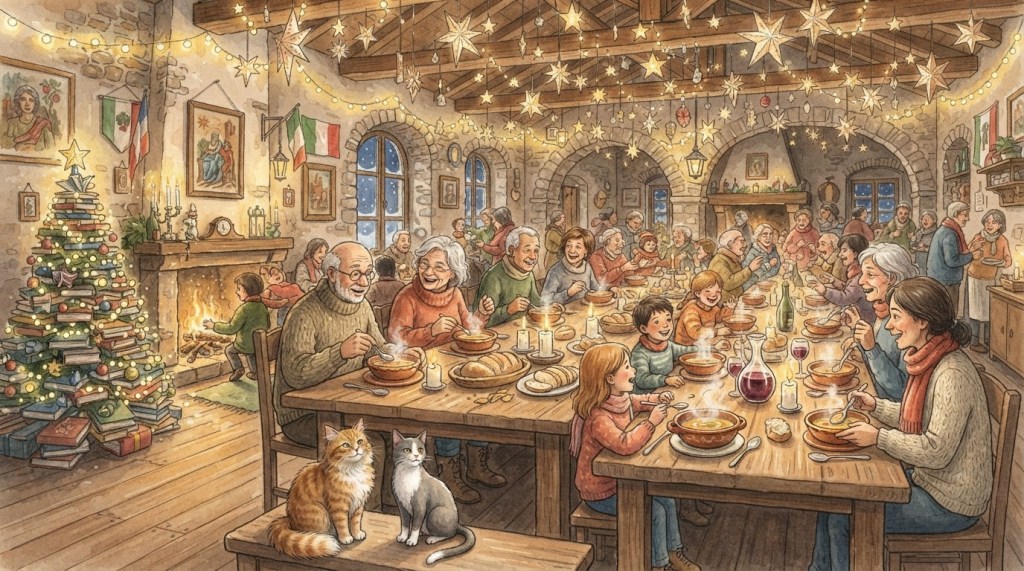
From The Inn’s Menu. “Every year, on the first truly cold Saturday of November, the whole of Speranza crowds into the town hall to decide how Christmas will look. Nobody ever agrees on anything, and somehow it is always beautiful. And every year, at the end, there is the soup from the island that isn’t there.” — Moira
The notice went up on the door of the town hall on a Monday, written in the mayor’s careful, old-fashioned hand and pinned with four drawing pins, one of which was a little gold star left over from the year before.
Citizens of Speranza. Saturday, six o’clock, the Great Hall. Christmas. Bring ideas, bring chairs, bring bowls.
By Tuesday, someone had added in pencil underneath: And bring patience. By Wednesday, someone else had added: And biscuits. By Thursday the notice had become a small collaborative document, the way notices in Speranza always do, and the last line, in a child’s round letters, read simply: And the cats.
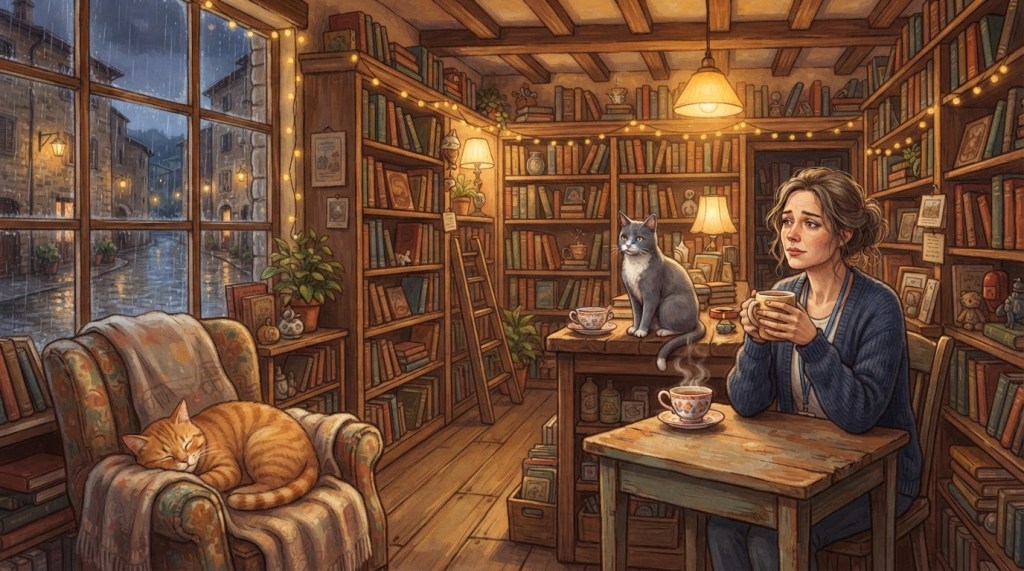
Moira Hopes read it on her way to open the bookshop and laughed out loud in the empty street. Then she went inside, where Toe was sitting on the counter with her immaculate white paws together, and Ashwaganda was lying in the window like a large ginger cushion that someone had forgotten to put away.
“You’ve been invited,” she told them. “Officially. In writing.”
Toe received this news as a duchess receives the post. Ashwaganda did not wake up at all, but his purr changed key, which Moira chose to take as acceptance.
The Island That Isn’t There
Everyone in Speranza knows about the island, and nobody can quite tell you where it is.
On clear winter mornings, if you stand at the very end of the old stone harbour wall and look out past the last buoy, you can sometimes see it: a low green hump on the water, with a lighthouse no taller than a man and a scatter of white houses like sugar cubes. On other mornings there is nothing there but sea and sky. The maps in the bookshop disagree about it. One shows it, in faded ink, with a name too small to read. Another shows only a thumbprint that might be a coffee stain. The newest map pretends it was never there at all.
The children call it l’Isola che Non C’è, the island that isn’t there. The grown-ups call it the same thing, but they lower their voices slightly when they do, out of a kind of respect.
What everybody agrees on is this: every November, on the morning of the great Christmas meeting, a small blue boat comes into the harbour of Speranza from the direction of the island. In it is Nonna Assunta, who is somewhere between eighty and a hundred and refuses to be more precise, wrapped in three cardigans and a fisherman’s coat, with a crate of the morning’s catch at her feet and an enormous, dented copper pot lashed to the bench beside her.
Nobody has ever seen her leave. She simply arrives, makes the soup, and on the following morning the blue boat is gone from its mooring, and the island, as often as not, is gone from the horizon too.
Saturday Morning at the Inn
The blue boat came in at eight o’clock on Saturday, under a sky the colour of a pigeon’s wing. By nine, Nonna Assunta was installed in the kitchen of the inn next door to the bookshop, sleeves rolled to the elbow, sorting fish on the scrubbed wooden table with the speed of a card dealer.
Moira had been her kitchen assistant for eleven years now, a position that came with no salary, no authority, and a great deal of instruction delivered in a dialect that Moira understood about two-thirds of.
“Onions,” said Nonna Assunta, without looking up. “Fine. Not like the last time. Last time you cut them like roof tiles.”
“Last time was ten years ago,” said Moira.
“I remember everything. Fine.”
So Moira chopped the onions fine, and the celery, and the garlic, and a bunch of flat-leaf parsley with the stalks kept separate, because Nonna Assunta said the stalks went into the pot and the leaves went on top and anyone who mixed them up deserved to eat their soup cold. The old woman, meanwhile, cleaned the fish: firm white fillets cut into generous pieces, a heap of mussels and clams left soaking in cold salted water, and a pile of prawns that she peeled with her thumbs, throwing the shells into a smaller pot to simmer into stock.
Ashwaganda had followed Moira through the connecting door, as he always did when there was fish in the building, and was sitting beside Nonna Assunta’s chair with his front paws together, like a large ginger altar boy. Every few minutes, without looking down and without breaking her rhythm, she dropped a small scrap of fish into his waiting mouth.
“You spoil him,” said Moira.
“He is a good listener,” said Nonna Assunta. “On the island, we feed good listeners.”
Toe watched all of this from the top of the dresser, among the plates, with an expression of tremendous moral superiority. She did not beg. She waited. When Nonna Assunta finally lifted her hand and held up a single perfect pink prawn without a word, Toe came down from the dresser in three silent steps, took it with great delicacy, and went back up again, and the dignity of the whole transaction was preserved on both sides.
Six O’Clock in the Great Hall
The Great Hall of Speranza’s town hall is not, by the standards of other town halls, very great. It has a long room with a beamed ceiling, tall windows that rattle in a north wind, a portrait of a bearded gentleman nobody can identify, and a radiator that works on alternate Thursdays. But it has one magnificent thing: a single oak table that runs almost the whole length of the room, so long that the people at one end have to shout to the people at the other, and so old that it has initials carved into its underside from children who are now grandparents.
By six o’clock the hall was full. People had brought chairs from home, as instructed, so that the seating was a cheerful mismatch of kitchen chairs, garden chairs, a piano stool, and a velvet armchair that the haberdasher had wheeled across the square on a trolley. People had brought bowls, as instructed, and stacked them at the end of the table in a leaning tower of colours. People had brought biscuits, as amended. And people had brought, despite the notice, very little patience, because everybody already had an opinion about Christmas, and most of the opinions were loud.
The mayor, Signor Benedetti, a gentle, round man with spectacles that slid down his nose whenever he became emotional, stood at the head of the table and rang a small brass bell. Nobody heard it. He rang it again. The baker, who was sitting nearest, put two fingers in his mouth and whistled like a ferry, and the hall fell silent.
“Thank you, Franco,” said the mayor. “Friends. Citizens. Cats.” He nodded to Moira, who had Toe on her lap and Ashwaganda on the chair beside her, occupying it entirely. “We are here, as every year, to decide how Speranza will dress for Christmas. I have only one rule. Every idea will be heard. And no idea will be laughed at.”
This rule lasted approximately four minutes.
The Proposals
The first proposal came from the young couple who had opened the flower shop in the spring. They stood up together, holding hands, slightly pink, and suggested that instead of the usual coloured lights along Via dell’Orologio, the village might hang only warm white ones, very small, like stars that had come down to see the shops.
There was a murmur of approval. It was a lovely idea. Then the haberdasher, from the depths of her velvet armchair, said that warm white lights were very elegant, certainly, very modern, very much like a hotel lobby, and that she personally had been born in Speranza and had looked at red, green and gold lights on Via dell’Orologio every December of her life, and she intended to go on looking at them until she was carried out of the village feet first.
The flower couple sat down, slightly pinker.
“Perhaps,” said the mayor, his spectacles beginning their descent, “we could have white lights on one side of the street and coloured on the other?”
“Then the street will look like it can’t make up its mind,” said the postman.
“It can’t,” said the baker. “Neither can we. It will be very honest.”
That was the first big laugh of the evening, and it rolled down the long table and back again, and even the haberdasher laughed, and in the end it was agreed, by a show of hands and one raised paw, that the street would indeed be honest: white on the left, coloured on the right, and the clock in the middle could decide for itself.
The second proposal came from the students at the language school, who wanted to make paper stars, hundreds of them, one for every family in the village, and hang them in the windows of the empty shop by the fountain, so that it would not look sad over Christmas. Each star would have a word written on it in a different language: hope, speranza, espoir, Hoffnung, esperanza, and as many others as the students could find. That idea was approved so quickly that the students looked almost disappointed, having prepared a speech.
The third proposal came from the baker, Franco, who stood up, cleared his throat, and announced that this year Speranza would have the largest panettone in the province, baked in his own oven, displayed in the square, and cut on Christmas Eve with a ceremonial knife.
“How large?” asked the mayor.
Franco held his arms out as wide as they would go.
“Franco,” said his wife, from three chairs down, “your oven is this big.” She held her hands about a forearm’s length apart.
“I will bake it in sections,” said Franco, with immense dignity, “and assemble it.”
The hall dissolved. The postman laughed until he had to take his glasses off. The grandfather at the end of the table laughed so hard he began to hiccup, and his small grand-daughter had to thump him on the back with both fists. Even Toe, on Moira’s lap, made a small noise that might in another animal have been a snort. Franco stood through all of it with his arms still outstretched, beaming, because Franco had been the funniest man in Speranza for forty years and knew perfectly well what he was doing.
The giant panettone was approved, in sections, on condition that Franco’s wife supervised the assembly.
A Tree Made of Books
When it came to Moira’s turn, the hall went a little quieter, because the bookshop’s proposals were traditionally the strangest and everybody wanted to hear.
“I’d like to build a tree,” she said. “In the window of La Pagina che Fa le Fusa. Out of books. Green ones at the bottom, then blue, then the old red cloth ones at the top, stacked in a spiral, with a star on top made from the pages of a dictionary that fell apart last spring.”
“How will you sell the books,” asked the haberdasher, practical as ever, “if they’re holding up a tree?”
“That’s the second part,” said Moira. “Anyone in the village can come and take a book from the tree, as long as they leave another one in its place. A book they loved. With a note inside for whoever finds it next. By Twelfth Night, the tree will be made entirely of Speranza’s favourite books, and nobody will know which ones came from where.”
There was a short silence. Then the grandfather at the end of the table, who had finally stopped hiccupping, said, “I would give my copy of The Count of Monte Cristo. I’ve read it six times. It’s time somebody else had a turn.”
“I’d give my cookery book,” said Franco’s wife. “Franco never lets me use it anyway.”
“I’d give the book I read when my son was born,” said the postman, quite quietly, and nobody laughed at that one at all.
The tree of books was approved without a vote.
It was at about this point that somebody noticed Ashwaganda was no longer on his chair. A brief search revealed him in the large cardboard box at the side of the hall where the mayor kept last year’s decorations. He had climbed in, arranged himself on a nest of tinsel, and fallen deeply asleep with a red glass bauble balanced on his stomach, rising and falling with each breath. His purr echoed faintly off the cardboard like distant thunder.
“Well,” said the mayor, pushing his spectacles back up, “I believe the box of decorations has been approved.”
Toe, not to be outdone, jumped down from Moira’s lap, walked the full length of the long oak table between the bowls with the slow, deliberate grace of a cat on a catwalk, stopped in front of the mayor, looked him in the eye, and knocked his little brass bell onto the floor. It rang, at last, loudly and clearly, and everybody applauded.
The Copper Pot
Then the doors at the back of the hall opened, and a smell came in.
It was the smell of the sea, but the sea in a good mood: tomatoes and white wine, garlic and parsley, a breath of chilli, and under all of it the deep, salty sweetness of fish that had been swimming that morning. Every head in the hall turned at once, like a field of sunflowers turning toward the light.
Nonna Assunta came in first, very small, in her three cardigans, carrying nothing at all, because carrying was beneath her. Behind her came two of the language school students, red in the face, bearing the great dented copper pot between them on a pair of wooden poles, like a sedan chair for a soup. Behind them came Moira’s friend from the inn with a basket of bread, thick slices toasted golden and rubbed with garlic, and the smell of that alone made the postman close his eyes.
The pot was set down in the middle of the long table. Nonna Assunta lifted the lid.
Steam rose in a great soft cloud toward the beams. Through it, you could see the soup: a deep red-gold broth, with mussels open like little black books, clams like pale buttons, pink prawns curled like commas, and large white pieces of fish that had held their shape just long enough. The parsley leaves lay scattered on top, bright green, exactly as instructed.
“Bowls,” said Nonna Assunta.
And the leaning tower of bowls came down, one by one, passed hand to hand along the table, every colour and every size: blue bowls and yellow bowls, a chipped white one from the baker’s kitchen, a wooden one that the flower couple had brought from their wedding, a child’s bowl with a rabbit painted in the bottom. Nonna Assunta filled each one with a ladle that had probably been her grandmother’s, and each one travelled back down the table with a slice of toasted bread tucked into the side.
Around the Great Table
For a few minutes the Great Hall of Speranza was completely quiet, which had not happened in living memory. There was only the sound of spoons, and of bread being dipped, and of mussel shells being placed carefully on the edges of saucers, and of the north wind trying the windows and deciding not to bother.
Then the talking came back, but softer. The arguments about the lights had become affectionate. The haberdasher was telling the flower couple that perhaps, just perhaps, a few white lights in her own shop window would not be the end of civilisation. Franco was sketching the sections of his giant panettone on a paper napkin for his wife, who was correcting the sketch with a pencil. The students were writing the word hope in Greek on the back of a biscuit wrapper, arguing about the accent. The grandfather had fallen into conversation with the postman about The Count of Monte Cristo and was explaining, with his spoon, the exact plan of the Château d’If.
Moira sat near the middle of the table with her bowl in her hands. Ashwaganda had woken up at the first breath of soup, emerged from the decorations box still wearing a strand of tinsel over one ear, and was now on the chair beside her, gazing at her bowl with an expression of patient, religious devotion. Toe had settled beside the copper pot itself, where it was warmest, like a small grey guardian of the hearth.
Nonna Assunta came and sat on Moira’s other side, with a bowl of her own at last.
“Good?” she asked.
“It’s the best it’s ever been,” said Moira, who said this every year, and meant it every year.
“It is the onions,” said Nonna Assunta. “This year they are fine.” Then, after a moment, more quietly: “No. It is not the onions. It is the table. Soup is only soup in a pot. At a table like this, it becomes something else.”
“What does it become?”
The old woman looked down the long oak table, at the mismatched chairs and mismatched bowls, at the baker and the haberdasher and the students and the grandfather and the little girl with tinsel in her hair, at the cats, at the steam rising toward the beams.
“An island,” she said. “One that is there.”
The Last Proposal
When the pot was empty, and the bread was gone, and Ashwaganda had been allowed, by a unanimous vote of the table, one final piece of white fish, the mayor stood up again. He did not ring the bell this time. He did not need to.
“There is one more proposal,” he said, “and it is mine. I would like us to do this again. Not only in November. I would like us, on Christmas Eve, after the panettone has been cut,” here he nodded gravely at Franco, “to bring our chairs and our bowls back to this table, and eat together. Everyone. Especially the ones who would otherwise be on their own.”
Nobody spoke for a moment. Then the haberdasher raised her hand from the depths of the velvet armchair. Then the flower couple. Then the students, the postman, the grandfather and his grand-daughter, Franco and his wife, Moira, and, finally, at the far end of the table, very slowly, a small brown hand in three cardigans.
“You will come?” said the mayor, astonished, his spectacles sliding all the way to the tip of his nose. “From the island? In December?”
“If the sea allows,” said Nonna Assunta. “And if somebody cuts the onions fine.”
Everyone looked at Moira. Moira put her hand on her heart.
The proposal was carried, as the minutes later recorded, “unanimously, with cats.”
Walking Home
It was nearly ten when Moira walked back across the square with Ashwaganda trotting at her heels, still trailing his strand of tinsel, and Toe riding on her shoulder like a small grey scarf, because Toe considered cobbles after dark to be beneath her.
The village was very still. The wind had dropped. Above Via dell’Orologio, the bare wires were already waiting for their lights, white on one side, coloured on the other, and the clock in the middle ticked on as if it had not yet been told it would have to choose.
At the end of the street, Moira stopped and looked down toward the harbour. The little blue boat was still at its mooring, rocking gently, its lantern lit. Beyond it, past the last buoy, the sea was dark, and there was no island to be seen at all.
But behind her, through the tall windows of the town hall, she could see the long oak table, and a few people who had not wanted to go home yet, still sitting around it in the lamplight, laughing at something Franco had said.
“There it is,” Moira said to the cats.
Neither cat disagreed.
From The Inn’s Menu: Nonna Assunta’s Island Fish Soup
Nonna Assunta’s island is a story, but her soup is a real, simple, Italian-style fish soup that anyone can make at home. Use whatever firm, fresh fish your fishmonger recommends; the soup is generous and forgiving. Serves 6 at a long table.
Ingredients
- 800 g firm white fish fillets (such as cod, monkfish, hake or gurnard), skinned and cut into large chunks
- 500 g mussels, scrubbed and debearded
- 300 g clams, soaked in cold salted water for 1 hour to release any sand
- 300 g raw prawns, peeled (keep the shells for the stock)
- 5 tablespoons extra virgin olive oil
- 1 onion, finely chopped (fine, as Nonna Assunta insists)
- 1 celery stick, finely chopped
- 3 garlic cloves, sliced, plus 1 whole clove for the bread
- A small bunch of flat-leaf parsley, stalks finely chopped, leaves roughly chopped and kept apart
- A pinch of dried chilli flakes, to taste
- 150 ml dry white wine
- 400 g tin chopped tomatoes or tomato passata
- 1 litre fish stock (homemade from the prawn shells, or good shop-bought)
- Salt and black pepper
- 6 thick slices of rustic bread, toasted
Method
- Quick prawn stock (optional): simmer the prawn shells in 1.2 litres of water with a piece of onion, a celery leaf and a few parsley stalks for 20 minutes, then strain. You’ll need about 1 litre.
- Check the mussels and clams: throw away any with broken shells, and any open ones that don’t close when tapped firmly.
- In a large, wide pot, warm the olive oil over a low heat. Add the onion, celery, sliced garlic, parsley stalks and chilli, and cook gently for 8 to 10 minutes, until soft and sweet but not browned.
- Turn up the heat, pour in the white wine and let it bubble for 2 minutes. Add the tomatoes and the stock, season lightly, and simmer for 15 minutes so the flavours come together.
- Add the chunks of white fish and simmer very gently for 4 minutes. Don’t stir too much, or the fish will break up; shake the pot instead.
- Add the mussels and clams, cover with a lid and cook for 3 to 4 minutes, until the shells open. Add the prawns for the last 2 minutes, until pink and just cooked through. Throw away any shells that stay closed.
- Taste and adjust the salt. Rub the toasted bread with the whole garlic clove, put a slice in each bowl or on the side, ladle the soup over, and scatter with the parsley leaves and a thread of olive oil.
Moira’s notes: fish soup is best eaten the moment it’s ready, at a table with too many people around it. If you can’t find clams, use more mussels; if you can’t find mussels, use more fish. Make sure all seafood is very fresh and cooked through. This recipe contains fish, shellfish and molluscs, so please check with your guests for allergies, and leave out the bread for a gluten-free bowl.
Moira’s Reflection
I have been to many Christmas meetings in Speranza now, and I have never once seen the village agree on anything quickly. Not the lights, not the tree, not the size of Franco’s panettone. And I have come to think that the arguing is part of the decoration. A village that cares enough to disagree about the colour of its lights is a village that is paying attention to itself.
But the part I love best is always the end, when the pot comes in and everyone stops talking. Whatever you are planning for December, I hope there is a long table in it somewhere, with mismatched chairs and mismatched bowls, and at least one chair saved for someone who might otherwise be alone.
Tell me: what would your village, or your street, or your family argue about at its Christmas meeting? And what book would you leave on the tree? The comments are open, and the kettle, as always, is on.
Not sure which story to read next? Tell us how you’re feeling tonight and Moira will pick one for you. And if you’d like more evenings in Speranza, the Tales of Speranza are waiting on the shelf.




Leave a Reply